

IN A CLASSROOM AT MARINA HIGH SCHOOL, 16-year-old Vivianah Navarro and her classmates are measuring how much liquid a dozen spoons and several graduated cylinders can hold. These measurements are not just an abstract exercise in volume. Navarro is enrolled in the Patient Care & Personal Wellness Career Technical Education class at Monterey Peninsula Unified School District, studying pharmacology – and understanding which spoons are most accurate matters for measuring dosages.
In addition to learning about different health-related fields, Navarro and her classmates – some are learning veterinary basics, others digital imaging – have volunteer opportunities that emphasize learning new skills. “We partner with Global Health Brigade virtually, and they have a clinic experience in Honduras,” teacher Vanesa Cano says. Students join via Zoom and perform patient intake interviews, alongside a Brigade physician on the ground. Cano’s class offers 14 different modules, each focused on a different career within the health care industry. Every three weeks, students move into a different module and explore at least five during the class.
High school is increasingly about more than preparing students to get a spot at university. It is a place where students can explore different industries, professions and careers paths via Career Technical Education (CTE) courses, as well as volunteer and internships opportunities. This approach is designed to provide students with different pathways to continue their education in the same field after graduation, or to provide them enough skills to land an entry-level job right after high school.
For decades, getting a college degree was the primary goal pushed in K-12 education. In the early 2000s, college education was the emphasis. Nicolas Defendis, a biology teacher and CTE instructor at Soledad High School, remembers the message delivered when he was a student: “If you don’t go to college, you’re not going to be anything. You’re not going to be able to make money,” he recalls hearing. “They really just started to put vocational training to the side.”

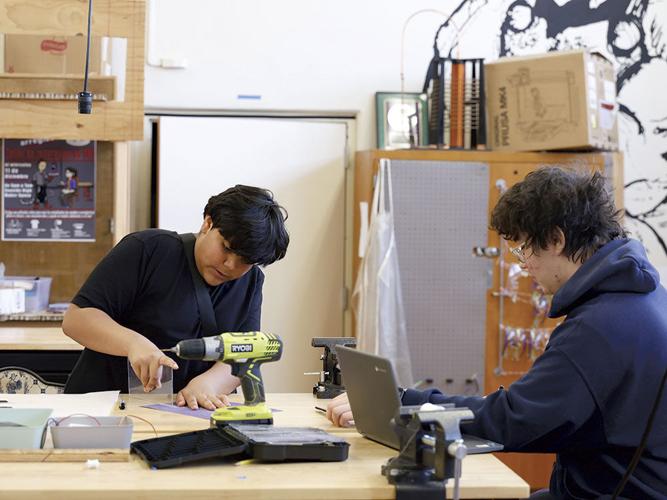
Below: Vivianah Navarro, 16, measures the capacity of different household spoons while studying pharmacology at Marina High School. Accuracy is important to make sure people get the correct dose of a prescription.
Over time, a lack of skilled trade workers, workforce changes during the pandemic, an acute shortage of workers in different industries – including health care and education – and the increasing cost of college education have helped shift the focus away from preparation for a four-year college degree, broadening to focus on readiness for associate’s degrees, certifications or directly for a career. Trade skills are making a comeback.
IN SOME WAYS, CTE REFLECTS A RETURN TO EDUCATIONAL ROOTS – it is not new. For over 100 years, the federal government has invested in technical education, since the Smith-Hughes National Vocational Education Act was signed into law on Feb. 23, 1917. Back then, the focus was on agriculture, construction and industrial education. While those fields remain relevant, they have other elements that didn’t exist before, chiefly advances in technology, like use of drones and robots in agriculture.
To help students gain hands-on experience, school districts offer CTE classes from different trades including local relevant industries like agriculture and hospitality; on-demand careers including health care, education and child care, as well as STEM fields such as robotics, engineering and software development.
CTE courses are a way high school students can gain some hands-on experience and glimpses of what being a nurse, an auto mechanic or a teacher is all about in the real world. In the past, the path to postsecondary education didn’t offer the same kind of intentional education structures as it does today. Students could choose elective classes, but those didn’t necessarily transfer into gaining enough skills for entry-level jobs, nor could students carefully plan their postsecondary education to slide smoothly into a college or university track with the right prerequisites for a particular professional path.
If Seaside High School students, for example, are interested in STEM fields, they can enroll in a robotics or programming class in high school; after that, students can look at the different routes available locally at colleges and universities that fit their goals. They could transfer to CSU Monterey Bay to pursue a bachelor’s of science in mechatronics engineering, or enroll in the manufacturing technology program at Hartnell College.
MPUSD offers 30 courses in eight different disciplines across its four high schools, including in health, robotics and culinary fields.
Through CTE, students can obtain various certifications. For example, students enrolled in health care pathways can obtain CPR and Stop the Bleed certifications; culinary students can work toward a ServSafe food handler certification.
This school year, Soledad High School offers 12 different CTE pathways. About a third of the student population completes a career pathway and about 340 students took at least one CTE class last school year. The district also offers an elective career exploration class for seventh – and eighth-graders.
Tony Sanchez, CTE director for Monterey Peninsula Unified School District, says CTE has changed a lot over the past decade. Previously, there was little interaction with industry leaders; now, administrators and instructors meet regularly with local business and industry experts to keep their programs up to date. “CTE is very much centered on a focus of how we’re going to move not just college kids, but students with skills to connect them to viable careers,” Sanchez says.
Defendis notes there is now a new value being applied to technical education, with the hope of giving students, even those who are going to college, a broad spectrum of education and exposure to different skills. “You live for a long time. Why not spend 10 years being a welder, and then transition from being a welder to being a teacher? That’s the kind of perspective that helps the kids a lot,” Defendis says.
For the past seven years, the state has worked to rebuild the reputation of vocational education and produce skilled workers in industries that face workforce shortage – future carpenters, electricians, drivers, health care professionals and educators.
OVER THE PAST DECADE, California has pushed to promote trade schools to increase its skilled workforce in high-demand jobs. According to the state Employment Development Department, the top five middle-skill occupations in the coastal region (which includes Monterey County) are nursing assistants, medical assistants, teacher assistants, heavy and tractor-trailer truck drivers, and licensed practical and licensed vocational nurses. Their annual incomes range from $31,000 to $55,000 (the median income for one person in Monterey County is $74,150).

CTE Robotics students at Seaside High School work collaboratively to build a robot from square one.
The highest-paying trade jobs nationwide are in the health care industry. Ultrasonographers and respiratory therapists can expect to earn $90,000 or higher; both trainings are offered at two-year institutions of higher learning.
California has invested millions in improving and diversifying CTE programs across the state, focusing on in-demand trade skills. CTE classes are treated similar to arts or foreign languages, in that one year of CTE can be a requirement for students to graduate high school.
Trades are growing in popularity. During the spring of 2022, two-year colleges saw increased enrollment in programs such as construction (over 19 percent, or 11,140 students), mechanics (11.5 percent, or 9,950 students) and culinary (12.7 percent, 6,170 students), according to the National Student Clearinghouse Research Center.
Last fall, associate and certificate programs grew by 2.2 and 9.8 percent, respectively, faster than bachelor’s programs which grew by less than 1 percent.
In recent years, California has launched two new programs to provide and promote career pathways for in-demand trades and professions that require different levels of education, ranging from adult school programs to four-year education.
Those include the Golden State Pathways Program – which focuses on high-paid jobs in industries that are projected to grow exponentially such as health care, renewable energy and robotics – an initiative the California Department of Education has invested $470 million into.
There is also the K-16 Education Collaboratives, also aiming to create collaborations with school districts, colleges, universities and regional employers. The goals are to make it easier for students to transition to post-high school education and make it easier to transfer after finishing high school. The program also focuses on school districts with higher concentrations of low-income students.
Several local school districts are part of K-16 Education Collaborative, including MPUSD (Marina and Seaside high schools), Salinas Union High School (El Sausal Middle School and Alisal High School) and Soledad Unified. “The K-16 Collaborative encourages our districts/schools to look for ways to blend these funds to create career pathways sustainably, in order to help students quickly reach their educational goals and transition into high-wage jobs,” says Roberto Núñez, director for student success at Monterey County Office of Education.
“It’s really pushing us to collaborate on levels that we haven’t before – with our community college partners and with CSUMB – to align the work that we’re doing, where we can look at the curriculum,” Sanchez says. “How can we link this to a college program?”
Regional pathways are also a guide, where students can stop or continue until they reach their destination. It can be a straight line, or they can take breaks in between and return as needed.
For example, if a student enrolls in a health care pathway, they have different options that can be stackable like climbing a ladder. A student from Soledad enrolled in the Patient Care Pathway has three postsecondary options: enrolling at the Salinas Adult School for Certified Nursing Assistant certification, enrolling in Hartnell for a two-year Registered Nurse program, or pursuing a bachelor’s of science at CSUMB.
Students enrolled in a K-16 pathway are also required to take up to 12 units of college credit, which gives them a leg up to enroll in a two – or four-year college.
“Our primary focus is to have students receive the greatest mobility, like the highest-paying job possible in the shortest amount of time,” says Ashley Selck, the K-16 Collaborative coordinator for the Northern Central Coast region. This means pushing for students to earn a living wage, which in this area would be at least $31/hour.
Rob Appel is director of Mission Trails Regional Occupational Program, a Salinas Union High School District campus that is dedicated to CTE programs, where nearly 6,000 students were enrolled last year, studying 13 different industry sectors. Appel highlights the importance of collaborating with colleges so they can transition smoothly from CTE to college programs. “They can get additional training and they need those certifications that would allow them to jump into those positions that are going to pay them at a higher wage,” he says.
There is state support for the these efforts. In 2023, the Central Coast region received a three-year, $18.1 million grant through California’s Community Economic Resilience Fund, CERF, to expand or build new education-to-career pathways and address equity gaps.
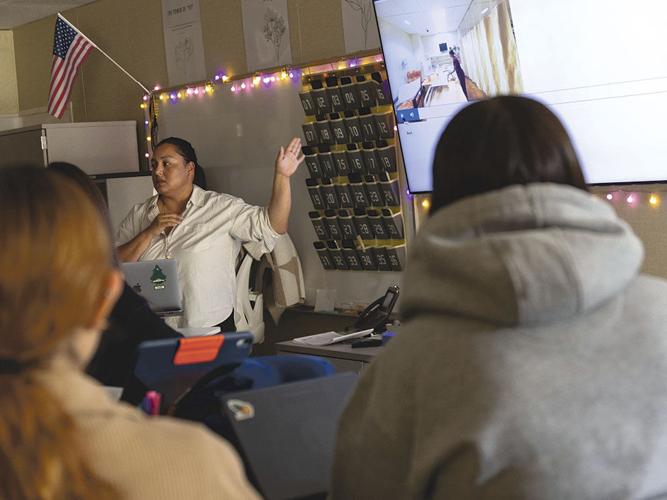
ON A MONDAY MORNING, students at Soledad High School are attentively watching a video with their instructor, Lyndsey Alvarez, and spotting what the nurse assistant on screen did wrong – there’s a problem with moving the patient’s head, and not closing the curtains to respect the patient’s privacy before starting other tasks.

Lyndsey Alvarez guides students to spot right and wrong ways to attend to patients as they watch a video, part of the Patient Care Pathway at Soledad High.
This is part of the patient care pathway. Soledad Unified started a patient care pathway two years ago, where high school students learn about patient care from theory to practice. During the first year, they learn medical terminology. In the second year, students do more hands-on training, including checking vital signs and patient comfort levels by practicing with mannequins (or watching this video of a nursing assistant in action).
“A patient care tech is a little bit like a nursing assistant, so they get a lot of the hands-on opportunities to explore their bedside skills and communication skills,” Alvarez says.
Some programs at Soledad and in other districts offer even more training, with hands-on opportunities and internships with local business partners.
“If I show you a video or I talk to you about it, that’s one thing, but if I put you in on the factory floor and you’re interfacing with people who are doing the data entry, or whatever the profession is, then it sparks a deeper sense of, ‘This could be something I want to do,’” Sanchez says.
Soledad Unified has an in-house internship program for students in the education pathway’s second year. Before going to class, SUSD interns spend an hour at a nearby elementary school. Giselle Lucio Elizalde is a Soledad High School senior, and an intern at Rose Ferrero Elementary. Every morning before going to school she works from 8-9am with third-graders and special ed students, helping them with their assignments. Lucio Elizalde enrolled in the education courses because she was looking for a job; her goal is to become a traveling nurse.
Student interns work five hours a week, earning minimum wage, while also developing teaching skills. The education field is highly promoted among students due to a local and nationwide teacher shortage, but Defendis knows many students may choose to take their careers in a different direction. He says exposing students to different paths provides a bigger picture of what they can accomplish. For example, trusting a 4.0 GPA student to repair a car – or encouraging a 2.5 student to pursue a college degree. “They could be a teacher or a lawyer. I think that perspective is good, and it doesn’t happen unless they’re exposed to both,” Defendis says.
Even if graduates choose a different field, like a teaching student going into nursing, Defendis says it’s still a benefit: They are learning real-life skills in a professional setting, applicable for just about anything. And they will have insight into how public education works, something that can help them when they become parents and enroll their own children in school, or when voting for school district bond measures. Besides giving them work experience, it is hopefully making them better citizens.
ONE ADVANTAGE OF CTE is that students also can get involved in a project they may not be able to afford on their own, especially if they are from low-income families. One of those subjects is robotics. This year Seaside High School students are working on a drone that will measure the ocean current as part of the Naval Postgraduate School’s design challenge, where students create solutions to tackle climate change challenges.
These projects are expensive – registration for the international FIRST Robotics competition is $6,000 and building a 150-pound robot can cost up to $3,000. “If we don’t offer something like this to all high school students, then you’ll have an inequality issue, right? So only students who can afford to do this get into the STEM fields,” says Michelle Chen, Seaside High School robotics instructor.
Nate Reid, 17, a senior at Seaside High School, is interested in biomedical engineering and 3-D printing technology, and potentially producing human organs. So far, he’s learned to use computer-aided designs to create 3-D prints of useful tools like a phone case.
The FIRST Robotics competition requires students with different skill sets collaborate to bring a robotics project to fruition.
“It does serve a purpose for a lot of different jobs,” Chen says. “In the competition, these students are working as a group, so they learn very quickly how to work as a team and communicate as a team. In competition, they are under stress, and they are expected to be professional and gracious at all times so they’re learning a lot of soft skills.”

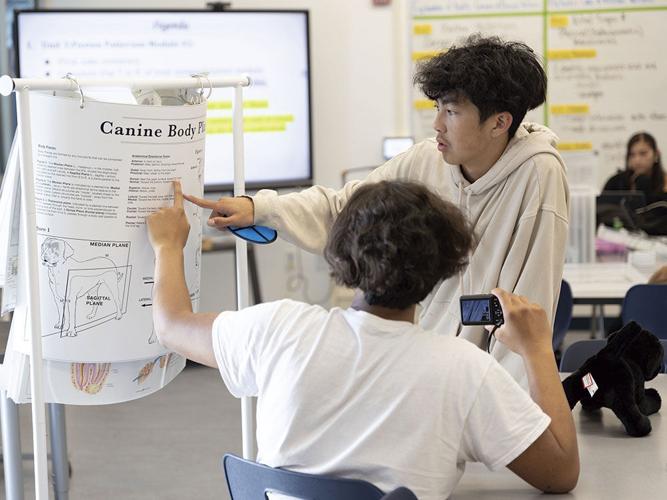
Marina High School students William Virtue and Kush McBride, both 15, learn about dogs’ anatomy on a poster, then study it in 3-D with a stuffed animal.
Students learn about custom design and fabrication, building mechanisms, coding, and assembling and working collaboratively with peers; some design the robots, some make instructional videos or design the project’s identity.
“If we want to prepare our students for careers that are competitive and high-paying, we need to give them the opportunity in high school,” Chen says. “If they’re not exposed to it in high school, how will they know to pick that major in college?”
When she was in high school, Chen says she was never exposed to fields that she might pursue, because she did not know where the path might lead. “I had no idea what engineering was, and so I missed out and I didn’t get into this until later in my life,” she says. “This is why I feel like it’s really important to get exposure in high school; I wasted my time the first time I went to college. So once I figured out what I really wanted to do, I re-enrolled, I went to UC Irvine, and got another bachelor’s degree in computer engineering.”
When she attended an all girls’ school in Texas in the 1970s, elective classes included home economics, sewing and crochet. “It was a very unfair, uneven opportunity,” she notes.
EVERY YEAR, about 20 MPUSD students work up to 16 hours a week in paid or unpaid internships in a variety of fields, including within the school district, and in the business and hospitality industry, including at The Lodge at Pebble Beach and Monterey Plaza Hotel & Spa.
Interns experience firsthand the work experience, from putting together a resume and submitting an application to showing up on time and following instructions. And in some cases, the training leads directly to a job.
For the past three years, The Lodge has hired interns out of MPUSD’s culinary programs; about 10 students apply and three or four get hired every year.
“Students get paid to work, then they graduate, and they just keep working, then they start to climb that ladder into this industry that they wouldn’t have had without the work-based learning push,” Sanchez says.
Benjamin Brown, executive chef for The Lodge, says MPUSD interns “have a very unique opportunity to work in a world-renowned resort that is right here in their backyard.” Brown notes he didn’t have similar opportunities when he was in high school in the early ’90s in Lake Tahoe: ”I don’t think we had a culinary program,” he says.
The chef and his team have an open house where they share details with advanced culinary students at Marina and Seaside high schools about Pebble Beach Company, show them the facilities and talk about career opportunities at The Lodge.
The interns learn basic culinary skills in their CTE culinary program, and staff at The Lodge evaluates their skills before onboarding them. “If I see that an intern has really good fine motor skills, we might place them in a fine dining restaurant,” Brown says.
Interns rotate to different areas, including bakery, the pizza oven or banquets. Brown says besides developing hard skills and experience, interns also learn communication skills and work independently.
Brown has hired at least three students for full-time positions who are earning over $20 per hour, plus company benefits.
(1) comment
As a former High School mathematics and science instructor, I can confidently say that the best learning is with hands-on experience. I also helps to have members of the community come into the classroom and share their experiences with the students. These programs which allow creativity for the students are an excellent way to prepare them for the future.
Welcome to the discussion.
Log In
Keep it Clean. Please avoid obscene, vulgar, lewd, racist or sexually-oriented language.
PLEASE TURN OFF YOUR CAPS LOCK.
Don't Threaten. Threats of harming another person will not be tolerated.
Be Truthful. Don't knowingly lie about anyone or anything.
Be Nice. No racism, sexism or any sort of -ism that is degrading to another person.
Be Proactive. Use the 'Report' link on each comment to let us know of abusive posts.
Share with Us. We'd love to hear eyewitness accounts, the history behind an article.