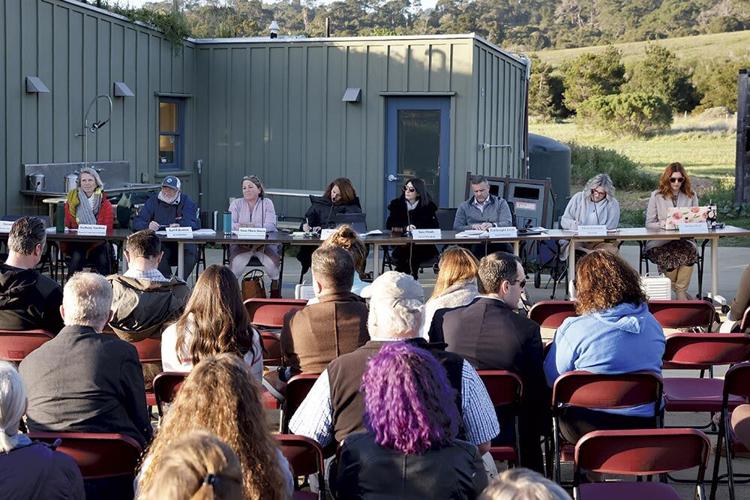

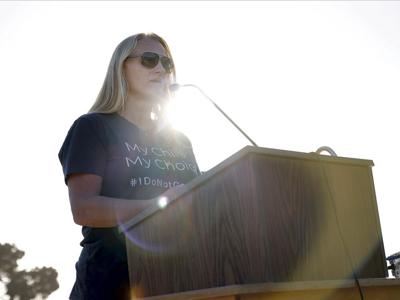
On the night of Dec. 15, 2021, the principal of Buena Vista Middle School invited parents and school board members to the band concert happening outdoors in the school pavilion.
Normally, for a meeting of the Spreckels Union School District, a 5:30pm meeting would be over comfortably before the holiday concert began at 7pm. Board member Michael B. Scott had promised his son, who plays trumpet in the band, that he would be there.
But Dec. 15 was not a normal board meeting for Spreckels Union, a tiny two-school district that serves 1,000 students. More than 100 parents and community members filled the auditorium of Spreckels Elementary School, occupying every chair and spilling over into the hallway. While the night’s agenda included some standard items, such as a discussion about SUSD enrollment (declining) and the PTO president spoke about a cookie dough and wrapping paper sale that generated over $30,000 (“a banner year”), the dozens of speakers were not there to talk about the night’s agenda. They were there to talk specifically about two teachers and generally about the role of teachers and public schools in the lives of children.
A few months earlier, teachers Kelly Baraki and Lori Caldeira had traveled to Palm Springs to attend a conference hosted by their union, the California Teachers Association, on LGBTQ+ issues. Back at home, the two ran Buena Vista’s gay-straight alliance – commonly called a GSA. Baraki and Caldeira gave a presentation titled “How we run a GSA in conservative communities” – the conservative community being Spreckels – on Oct. 30. Weeks passed without incident. Then on Nov. 18, conservative media outlets blew up with what became a viral story published on Substack, titled “How Activist Teachers Recruit Kids.” Conservative writer Abigail Shrier, the author of the 2020 book Irreversible Damage: The Transgender Craze Seducing Our Daughters, had obtained audio of Baraki and Caldeira’s presentation, recorded without Baraki and Caldeira’s knowledge.
Shrier’s report quoted a selection of phrases which, taken in isolation, fed the fear that teachers are actively trying to change students’ gender identity. One quote about recruiting new club members used the word “stalking.”
Shrier’s story seemed to be written with a particular audience in mind: parental rights activists, who are asking schools to back out of their children’s lives.
“‘For those of you that are running or are thinking of running your own GSA or GSA-type club, always remember that youth are the drivers of change,’” Shrier quoted Caldeira as saying.
It might sound like an innocuous quote, but in the context of parental rights it takes on a different tone: “If you want to bring a new world into existence, it seems – a good place to start is with other people’s kids.”
The question of whether schools should teach just the “three R’s” – reading, ’riting and ’rithmetic – or also things like character building, conflict resolution and civics is not new. But educators across the country are seeing a heightened sense among parents that schools have overstepped and should revert to the three R’s.
It’s happening at local school boards, and also at the state level. From January to September last year, 24 legislatures across the country introduced 54 separate bills intended to restrict teaching or teacher training on issues like race, racism and gender, according to a study by PEN America. In Virginia, Gov. Glenn Youngkin was elected largely on the basis of his promise to ban the teaching of critical race theory, the academic study of how race has shaped history and institutions.
In a left-leaning state like California, it’s unlikely bans like that stand a chance in the legislature. But they do stand a chance at local school boards, and an increasingly organized group of parental rights advocates seek to make changes at the local level, including in Monterey County.
On Dec. 15 in the Spreckels Elementary auditorium, Scott pushed back against Shrier’s framing for her conservative audience.
“The author of this article frames this issues facing transgender students as a war. We are not at war here,” he said. “Everyone loses in a war. War is contrary to our core values of compassion, kindness and respect.”
But opponents wanted war.
Dozens of parents spoke that night. One dad said, “I disagree. There is a war going on. It is a war of a small elite that are forcing things on young children and you are ignoring what we as parents value.” Applause followed. “I think it’s spiritual warfare. And I stand in the name of Jesus Christ, and say that we need to take back our school system.”

THE STORY ABOUT SPRECKELS QUICKLY BECAME NATIONAL NEWS. After Shrier’s story ran, other conservative outlets including The Epoch Times, The Daily Caller and The Federalist ran versions of it.
Then the story of one parent, Jessica Konen, who gave intensely emotional remarks to the board at that Dec. 15 meeting, also made the rounds in national conservative news outlets. Konen claimed that Baraki and Caldeira had coached her child into assuming a new gender identity and using a different name. A month later, Konen, represented by the conservative legal nonprofit Center for American Liberty, filed a claim against Spreckels Union, a precursor to a lawsuit. She alleges teachers and administrators at Buena Vista Middle School “were preying on her daughter.”
This story quickly gained major traction, but a network of involved parents and activists were already standing by to get involved. Dalila Epperson, founder of ACT Monterey Bay, was among those who spoke at the Spreckels board meeting Dec. 15. “One of the things we’ve been noticing is the school boards have not been listening to us,” she said. “This has been ongoing for the last year-and-a-half. This has been leaking out in breadcrumbs to us. Now we have something like this, it’s full in our face – it’s out there.”
It wasn’t just gender inclusivity Epperson was talking about. She added that ACT Monterey Bay was connected to other groups of “parents concerned about [critical race theory], mask mandates and vaccination mandates.”
When the Spreckels school board next convened on Jan. 6, there was a much smaller turnout. Just three members of the public spoke, rather than dozens. But the three suggested that all five current board members should expect challengers, and that parent activists would not fade away.
Epperson said, “I have a plan that helps parents run for school board every step of the way. Meanwhile, I suggest home schooling.”
EPPERSON IS A PARENT OF FOUR ADULT CHILDREN, the youngest of whom graduated from Marina High School. She started ACT Monterey Bay in January 2021, after nearly a year of remote learning. Her group networks with other parental rights groups, including Latinos for Medical Freedom (which pre-dates the pandemic, but has been especially outspoken against vaccination requirements and mask mandates) and California Parents United.
Epperson says ACT Monterey Bay has 67 members who connect on the messaging app Signal to share notes about where and when to appear at school board meetings. While relatively few in number, a little bit of coordination goes a long way. When the board of Salinas Union High School District met on June 22, 2021, their agenda included a consultant agreement that drew ire from the coalition of parental rights groups: an agreement for the 2021-22 school year to hire R. Tolteka Cuauhtin to offer professional development services, at a day rate of $3,750, to SUHSD staff.
Cuauhtin is the author of the book Rethinking Ethnic Studies and served on the California Department of Education’s advisory committee that developed the 2020 ethnic studies model curriculum. And parents showed up in large numbers to express their anger over critical race theory – although CRT isn’t explicitly part of SUHSD’s curriculum.
The first parent to speak that night, Kelly Schenkoske of Pacific Grove, set the tone for what would be roughly an hour of public comment, almost exclusively from parental rights activists who had a message for the Salinas Union board: End your ethnic studies classes.
Wearing a T-shirt with the text “Make Education Great Again,” Schenkoske said: “I am concerned about the political indoctrination in our classrooms… Since when did public education become a political activist organization? Our political ideologies should be left out of the classroom.”
Dozens of speakers echoed her, including Mike Lipe, who ran unsuccessfully for Salinas mayor in 2020, and who is a parent of five (his school-age children are home-schooled). “This board has become an activist group,” Lipe said. “There is no option for you other than to step down.”
Schenkoske and several other speakers were fired up about two brief texts in the ethnic studies curriculum, what educators call “energizers,” that refer to ancient Aztec customs.
The two texts were part of the state’s model curriculum – not a requirement, but a suggestion for local districts.
Each text is formatted as a poem. “We’re here to transform the world we’re spiraling, rotating & revolving in | giving thanks daily, tlazokamati, giving thanks daily, tlazokamati | healing & transforming as we’re evolving in this universe,” the “In Lak Ech Affirmation” reads.
Last year, several parents and the Californians for Equal Rights Foundation sued the California Department of Education, alleging the use of the names of Aztec deities made the texts religious – verboten in public schools.
(That did not stop Vanessa Madrid, a parent and organizer with the parental rights group Latinos for Medical Freedom, from saying at the same June board meeting: “Jesus was proven. He was crucified. He rose from the dead. He is the god that we serve. I want to raise up good members of society that fear the lord.”)
In January, the Department of Education agreed to settle by removing those two texts from the ethnic studies curriculum and paying plaintiffs’ attorneys $100,000.
“[The Department] agreed to delete those two energizers from the 800-page document out of an abundance of caution and in order to avoid prolonged and costly litigation,” spokesperson Maria Clayton writes by email.
But conservative media told a story of victory. An Epoch Times piece quoted Equal Rights Foundation President Frank Xu: “We are encouraged by this important, hard-fought victory.”

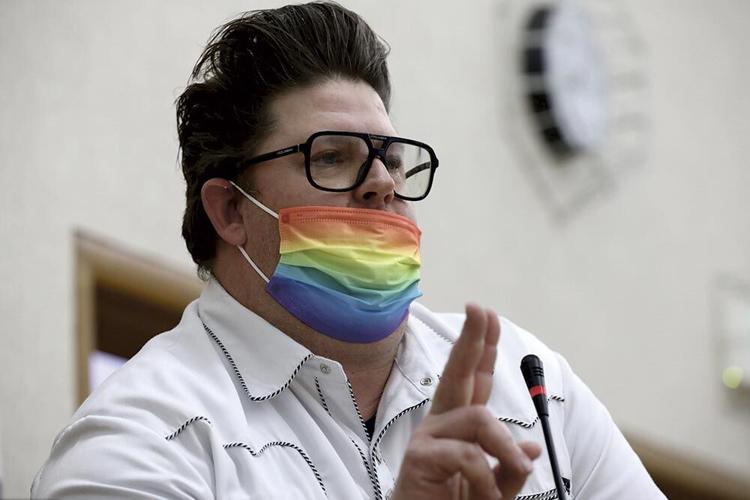
Mike Lipe recently started protesting against mask mandates outside of Spreckels Elementary School, earning a reprimand from the principal for scaring children. He is seen here speaking at a Spreckels USD meeting on Jan. 6.
THE BOARD OF THE SALINAS UNION HIGH SCHOOL DISTRICT adopted a one-semester ethnic studies requirement in 2019, which took effect in the 2020-21 school year. That puts the district roughly a decade ahead of California, where Assembly Bill 101 was signed into law in 2021 and enacts the same requirement, effective in 2029-30 school year.
Educators like to refer to a 2014 Stanford study that ethnic studies boosted freshman attendance by 21 percent, GPA by 1.4 points, and credits earned by 23. “These surprisingly large effects are consistent with the hypothesis that the course reduced dropout rates and suggest that culturally relevant teaching, when implemented in a supportive, high-fidelity context, can provide effective support to at-risk students,” the authors wrote.
After dozens of parents spoke against Salinas’ ethnic studies program on June 22, Superintendent Dan Burns read aloud two letters received in support of hiring Cuauhtin to help guide implementation of the curriculum. One came from Carissa Purnell, director of the Alisal Family Resource Center in Alisal Union School District. “Ethnic studies is where I found my voice, where I found my power,” she wrote, noting that she had studied Cuauhtin’s work in the course of earning her doctorate. “[In ethnic studies], I learned the history of not only where I come from, but it gave me the vocabulary to express what I felt.”
After the heated comment period ended, Social Studies Curriculum Specialist Mark Gomez presented on a civics education initiative, and he referenced the “healthy public comment session” that had just taken place as an example of why teaching civics might be beneficial.
In making the case for the civics program, Gomez said, “John Dewey once said, ‘Democracy has to be born anew every generation, and education is its midwife.’”
Gomez added: “It’s the role of education to help usher forth the continuing renewal of democracy in our society.”
QUESTIONS ABOUT WHAT ROLE EDUCATION SHOULD FILL IN SOCIETY ARE NOT NEW. “Schools always find themselves on the front sides of those social debates,” says Carmel Unified Superintendent Ted Knight. The challenge with those debates: “There’s no right answer for the entire community. If you’re talking about math, 2+2 is always equal to 4.
“Coming out of the pandemic, we are being asked to focus on kids’ mental health. But all across the country it’s, ‘you stick with chemistry, that’s what you know, let me deal with the mental health side.’”
Carmel Unified does not currently offer an ethnic studies class, so it’s stayed out of the CRT debate, but Knight is still careful to avoid getting caught up in it. “I will not talk about ‘equity’ here,” he says. “I will talk about ‘inclusion.’ People have really taken advantage of terms. No one’s taken the term inclusion yet; that’s pretty hard to tear down.”
In Salinas, the board has been more overtly progressive. Besides the ethnic studies requirement, in recent years they passed resolutions to take a stand against anti-Asian hate; include members of the LGBTQ+ community; and support Black Lives Matter and oppose hate speech.
“Our school board has been looked at as being very progressive,” Superintendent Dan Burns says. “They have a progressive mindset – which is really a growth mindset, more than anything.”
While heated public comment is not new, Burns says, the flavor has changed. “Schools have always been one of the first levels of participatory democracy. What’s new is the division of this culture war, and how these ideologies are spilling over into a school setting.”
One factor, he thinks, is streaming, which encourages grandstanding: “Five years ago we didn’t see someone hold up an iPhone while someone is speaking,” he says. “There’s an effort to use this platform – on both ends of the political spectrum – for the promotion of one’s own personal or political agenda.”
Burns expected some pushback on ethnic studies, but the national narrative about CRT changed the discussion. “Generally our community embraces this type of coursework because it really reflects our community,” he says. “[The opposition] started at a national level and spilled over to the local level.”
To Knight, the endless political debates in school districts point to an effort by the right to do something much bigger: “I think it’s part of the strategy,” he says. “If you ruin public education, you crush our democracy.”
TRACY HENDERSON IS AN ATTORNEY AND THE MOM of a sophomore at Carmel High School. Her family was splitting their time between Utah and Carmel early in the pandemic, and Henderson was horrified to see masked kids at her daughter’s school. So she got involved as a legal adviser to Utah Parents United, a 501(c)(4) that lobbied successfully for a state law banning mask requirements in K-12 schools.
“Their whole thing was about empowering parents. It was addicting to help parents using my legal skills,” Henderson says. So when her family returned to Carmel, she started California Parents United, with a focus on battling mask mandates in schools, which she says are based on a misinterpretation of California Department of Public Health guidance that is nonbinding. In January, she filed a lawsuit on behalf of Santa Monica Parents United against several Southern California school districts and the CDPH.
“I feel like I’m doing God’s work,” Henderson says, then adds: “I hope that doesn’t sound weird.”
Her own 16-year-old daughter prefers to wear a mask. “That’s the problem with all of our teenagers, they are all brainwashed and compliant in Carmel,” Henderson says.
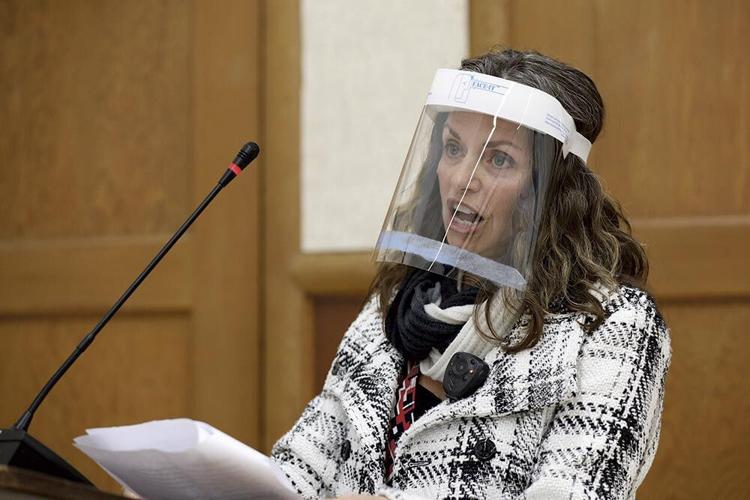
At a Dec. 15 CUSD board meeting, Henderson – maskless, as usual – created a stir. She wanted to speak to the board, and refused to do so from outside; Knight called the cops, and eventually the meeting was canceled. The district has since then moved its board meetings to be held outdoors. (Henderson, who has a doctor’s note indicating she cannot wear a mask, filed a claim against CUSD on Feb. 11, alleging Knight defamed her and filed a false police report; the board has yet to respond.)
Henderson argues that the mask issue is not a political one. “I’m not an anti-vaxxer, I’m not an anti-masker, I’m anti-mandate,” she says. “It’s about a parent’s right to choose.”
Again and again, parents and activists claim this is not a fight about politics. But politics are everywhere in these debates.
California Parents United is not currently incorporated, but Henderson plans to make it into a political action committee, which can then get involved in school board races around the state.
Schenkoske, who did not respond to requests for an interview, is an alternate member of the Monterey County Republican Central Committee. (Last year she also launched a podcast titled “A Time to Stand” about parental advocacy in education. One episode featured an interview with Kali Fontanilla, a former Salinas Union teacher who has become conservative media star opposing CRT. In the podcast, Fontanilla says, “I believe in systemic racism, and I believe it is mainly coming from the left.”)
In Spreckels on Dec. 15, Republican candidate for State Senate Vicki Nohrden spoke and said: “The future for our children and communities starts in education. The thing that concerns me the most is when schools want to undermine the authority of the parents.”
Nohrden added: “By the way, I do support school choice,” referring to charter schools.
Epperson, a Republican, is running for Congress against incumbent Jimmy Panetta, D-Carmel Valley. The second item on the platform on her website, below her anti-abortion stance, is “No CRT/sex ed/vax/mask mandates-school choice!”
Yet Epperson insists that her work at the school board level is not political: “It is not about politics,” she says. “It is simply about our children.”

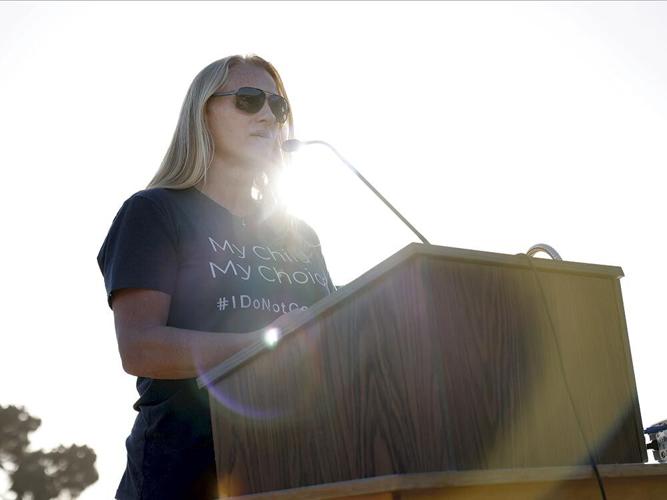
Dalila Epperson, a Republican candidate for Congress, started the parental rights advocacy group ACT Monterey Bay in 2021, and says members come from various political affiliations. "We never really considered it political," she says. "What we are rallying for are freedoms."
A COALITION OF GROUPS – California Parents United, Latinos for Medical Freedom, ACT Monterey Bay and California Schools Alliance – succeeded at removing a board member from the Monterey County Office of Education. In November, Annette Yee-Steck, who had previously served for 27 years on the Carmel Unified board, was appointed to a vacant seat after the death of an MCOE board member. Her term would last until a new board member was elected on Nov. 8, 2022.
Parental rights groups turned in a petition with 574 signatures to have Yee-Steck removed, and her term was terminated on Jan. 10, just two months after she was sworn in. The Area 1 seat now remains vacant until a special election in June.
Interest and engagement in school boards is on the upswing, says Salinas-based Republican political consultant Brian Higgins. “There’s been parental indifference for years and years,” he says – and that changed during remote learning due to Covid, when parents could watch lessons. “They want their kids to learn the things they learned when they were in school.”
It’s no secret that both Republicans and Democrats have long relied on a strategy of creating a “farm team” – getting promising candidates elected to school boards and water boards and the like, with a potentially bigger political future. But Higgins says he’s hearing more interest about running for school board than ever. “Based on what I’ve seen, it’s every school district locally,” he says.
Asked about whether the Monterey County Democratic Party is adjusting its strategy to address the focus on school boards, Chair Karen Araujo says no.
“We just stay on our game,” she says. “There’s no enemy to focus on. There is no battlefield to which we can show up. We are going to keep tending our garden instead.”
Anthony Rocha served on the board of Salinas Union High School District from 2018-2020, stepping down when he was elected to Salinas City Council as a progressive candidate. Even if outspoken conservative activists are relatively few in number, Rocha notes they could swing school board elections: “In these smaller races, it doesn’t take as much money to run. If you knock on enough doors, an election can be a shocker.
“They have to be taken very seriously, because misinformation is powerful and it’s dangerous.”
BACK IN SPRECKELS, a third-party investigation into Caldeira and Baraki being conducted by Sacramento-based law firm Van Dermyden Makus is still underway, and the teachers remain on leave. (They declined to be interviewed for this story.)
Their You Be You Club also remains suspended while district officials work on a revised policy for clubs; in the interim, the school is offering a wellness center twice a week at lunch.
Konen’s claim against the district is still pending. And Lipe has taken to protesting against a mask requirement in front of Spreckels Elementary School, prompting Principal Teresa Scherpinski to write a letter to parents on Feb. 18 about students being scared and crying amid horn-honking, profanities, shouting and crossing-guard safety issues.
“I believe in freedom of speech and support peaceful protest. My concern is that it is impacting our students’ well-being and safety,” Scherpinski wrote. “Every day at Spreckels we talk about being bucket fillers. We talk about bullies and being upstanders. I believe we should model that as adults.”
(2) comments
You can hear more from Tracy Henderson with this link.
https://open.spotify.com/episode/0rRiHxdEX7WwOMwh8SiKFD
You can hear more from Dalila Epperson here.
https://open.spotify.com/episode/60h4P08aQPTWjk79DYMWUW
Welcome to the discussion.
Log In
Keep it Clean. Please avoid obscene, vulgar, lewd, racist or sexually-oriented language.
PLEASE TURN OFF YOUR CAPS LOCK.
Don't Threaten. Threats of harming another person will not be tolerated.
Be Truthful. Don't knowingly lie about anyone or anything.
Be Nice. No racism, sexism or any sort of -ism that is degrading to another person.
Be Proactive. Use the 'Report' link on each comment to let us know of abusive posts.
Share with Us. We'd love to hear eyewitness accounts, the history behind an article.