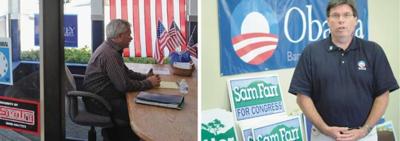

The spokesman for the Monterey County Republican Central Committee thinks the U.S. government ought to operate like organized crime.
“It should act more like the mafia,” Paul Bruno says.
He elaborates from there: Any experienced mafioso knows it’s unwise to kill a shop owner. After all, the cash flow dies with him. Better to brandish a gun or bring along heavies and take only partial contents of the register. Keep the income coming.
President Barack Obama, he thinks, just isn’t a smart enough gangster.
“We have government right now that’s anti-business to the point where it’s killing the shopkeeper,” he says.
Hearing a seasoned political leader define a crime syndicate as a model for good government qualifies as a little bizarre. But in the context of Monterey County politics, bizarre comes standard, and knows no allegiance to either side of the aisle.
Case in point: Even though Democrats claim a majority of the county’s registered voters – about 52 percent, more than double the registered Republicans – the Dems get dusted by the GOP fundraising machine. And not by a little, but often a factor of 10.
Also bizarre: The normally chatty local GOP doesn’t want to talk about issues – or at least any besides the economy. They inadvertently recruited a felon to their ranks this spring. And the former central committee chair has fallen out with some of its members for veering left and buddying up with groups like LandWatch and the Green Party.
But the most striking – and politically important – surprise up the GOP sleeve is something else. Despite the huge voter gap and the fact that local Democrats have gathered a collection of potential regional, state and rising national party stars, from Jason Burnett and Jane Parker to Luis Alejo and Jimmy Panetta, you can make a case that Republicans have more real, practical political power on the ground.
Only they’re being careful not to seem too much like Republicans, a strange twist in itself.
WHO, ME? REPUBLICAN?
Regional construction magnate Don Chapin is the only person to hold two elected offices in Monterey County (North County Fire Protection District and Lagunita School District).
He’s created the Salinas Valley Leadership Group, a political action committee (or PAC), to get “good people” elected to local office.
Its board is a decorated collection of conservative land use attorneys, chamber leaders and ag businessmen, the gold standard when it comes power politics in the valley.
The PAC’s thrown at least $27,000 at Republican candidates since it was formed in 2009, making it a major regional donor.
Chapin helped recruit and finance Byrl Smith, a devout Republican (whose late husband Jerry Smith was famous for his gung-ho development platform), to take on the most successful progressive fundraiser in the area, Jane Parker for the District 4 supervisor seat.
Chapin claims he’s looking more for demeanor and commitment to community rather than talent and political leaning.
“We’re not out trying to find dynamos,” he says. “[Smith] got out-campaigned and outspoken.”
He goes on to say identifying party affiliation might make him blush.
“I don’t believe in the party separation,” Chapin says. “Frankly, I’m embarrassed to tell you I’m either.” (For the record, he’s a Republican.)
When it comes to backing candidates, Chapin says the Leadership Group doesn’t even ask prospective candidates what their affiliation is: “We don’t care if you’re red, blue, green, orange. It matters not to us.”
Republican activists interviewed for this story, including Nan Lesnick, president of the local chapter of Republican Women Federated, resented special interests like unions and LandWatch unduly influencing campaigns – and believe Chapin does it more fairly.
“People willingly contribute to Don Chapin’s group. Union dues are compulsory. [Those funds] are going to candidates that don’t reflect the views of the union members,” Lesnick says.
Interestingly, one of the beneficiaries of that special interest cash – $55,000 from LandWatch board members and their political groups so far this year – is another Republican who’s distanced himself from the party.
Former Republican Central Committee chair Marc Del Piero is running against four-term incumbent Dave Potter for county supervisor in District 5, a thoroughly Democratic stronghold that’s home to U.S. Secretary of Defense Leon Panetta and his wife Sylvia, director of The Panetta Institute for Public Policy; Rep. Sam Farr, D-Carmel; and Assemblyman Bill Monning, D-Carmel.
Del Piero resigned as chair of the county GOP last November – “I haven’t had a conversation with any of those guys in literally months,” he says of the central committee – and has found new friends in the board members of LandWatch, slow-growthers who reliably oppose most every new development project in town – which is a little bit like Obama buddying up with Grover Norquist.
Potter and Democratic Central Committee chair Vinz Koller have been describing Del Piero on the campaign trail as a “wolf in sheep’s clothing.” But Del Piero insists his ambiguity is sincere. For instance, he’s still undecided on who he’ll vote for in the presidential contest this November: “You can ask me every question in the world but you can’t ask me that one,” he says. “It’s way too early and there’s too many things in play.”
The committee isn’t grateful he’s moving left. The party hasn’t formally endorsed its former leader, though his campaign literature is available at the headquarters.
But even Republican committee members who are far more eager to identify their party don’t want to define a position on much of anything else.
THE MAIN ISSUE: AVOIDING THE ISSUES
Before Republican Central Committee chair Peter Newman went on a cruise a few years back, Bruno bought him a George W. Bush cap to keep the liberals away.
Bruno himself jokes that he’s spreading Republicanism one lapel pin at a time. He collects the shiny little elephants at conventions, then takes them off his collar to give them out to whoever compliments his party pride.
“For some people it’s harder to say they’re Republican than it is to have Republican party values,” Bruno says. “The brand has had a lot of attacks.”
The National Rifle Association life member deploys a checklist to test whether non-identifiers are actually pachyderms at heart, by asking questions like these: “Do you need to be told the Slurpee size you can buy?” “Is [the estate tax, also known as the death tax] for me to give to my children?”
Notably absent from the checklist are social issues: gay marriage, immigration and equal pay for women among them. That’s a marked departure for a party that repeatedly deploys those very same wedge issues to activate its base nationally.
“For us to take our eyes off the economic recovery of this country is to take our eyes off the future,” says Bruno. “The Monterey County Republican party has stayed away from specific issues. We don’t sit here and debate gay marriage, we don’t debate abortion. We don’t take a position on them.”
On a recent afternoon at party headquarters, as local Republican staffers and volunteers prep new voter registration tabling materials, they’re invited to share thoughts on social issues.
But a series of suggested topics – Don’t Ask Don’t Tell, abortion – receive only one reply: Let’s talk about the economy.
Lesnick compares government entitlements to a homeowner taking a Hawaiian vacation even when the roof needs major repairs. “It’s really about money,” she says.
Newman has even crafted what’s known as the Monterey Model, a strategic plan for the local Republican party. It sets forth simple goals, like getting more Republicans elected to local offices like fire districts and school boards and raising more money, setting them on offense (see “Going Local All Over Again,” below) – and setting aside hot potato issues like Roe v. Wade.
“It stays away from the issues and things that divide people,” Bruno says. “We just don’t go there.”
NOT SO WEIRD: SCANDAL AND DISAGREEMENT
A life-size cardboard Mitt Romney greets visitors to the Republican Central Committee’s new red-white-and-blue-painted headquarters. But the party itself isn’t as shiny or clean-cut.
There’s plenty of talk of a unified platform, as former District 4 Supervisor candidate Smith summed up in a debate against Parker when she said her top three priorities were “jobs, jobs and jobs.” There are Republican successes like former Lt. Governor Abel Maldonado, who’s running for Congress (while trying to survive a $4 million tax dispute with the IRS), U.S. Rep. Jeff Denham (formerly a state senator for eastern Monterey County), and Jeanne Byrne, who won a seat on the Monterey Peninsula Water Management District in 2011 against a Democratic incumbent
But then there is a loyal party soldier like former Central Committee member Max Kidalov.
Kidalov, a law professor who served on the committee for a year and a half, was a Rick Santorum backer in the presidential primary before he resigned from his committee post in April.
He departed after a convicted felon, Robert Fenton, signed up to run for the committee. “You put your selfish desire for more yes-men and cronies first in your recruitment process,” Kidalov wrote in his resignation letter to Newman, who’d signed the nomination papers for Fenton.
Kidalov urged the party to pull its support for Fenton after some research unearthed a seedy past: In 2000, the Carmel Valley businessman pleaded no contest and served time for charges of bribing a public official after allegedly using fictitious accounts to siphon off $1.5 million from the L.A. County courts.
Fenton won a seat on the Central Committee, with 5.3 percent of the vote. But then came another strange turn of events: He changed his registration from Republican to decline-to-state – after the ballots were printed – and become ineligible for a party position.
Even before Newman – and other sitting members of the Central Committee, including Bruno and former California Real Estate Commissioner Jeff Davi – signed Fenton’s nomination papers, Kidalov had grown impatient with the party’s reluctance to develop a financial compliance program after being cited four times by the California Fair Political Practices Commission in the last decade.
They got off in 2003 and 2006 with FPPC warning letters, but paid fines for finance reporting errors in 2005 and 2011, when the FPPC issued the party a $25,000 penalty. (The county dems have never been cited by the FPPC.)
Chris Steinbruner, who was treasurer when $500,000 in campaign contributions went unreported, is named in the most recent FPPC complaint. He became vice-chair a year ago, which Kidalov views as proof committee leadership is just interested in protecting its own.
“I just didn’t see any focus on issues period,” he says. “The leadership clique made sure the message was neither liberal nor conservative, just cronyism.”
THE DEMOCRATIC POWER PARADOX
Vice President Joe Biden posed what he called the “defining question of our era” before a packed house at the Sunset Center in June: “Can we rebuild the middle class?” The seasoned orator put an elbow on the podium and leaned his chin on his hand, lending his talk a folksy, down-to-earth energy as well-practiced as it was well-received.
Unsurprisingly, he wasn’t shy about portraying the Republicans as an enemy of the middle class, for having 1950s-style social values and thinking of foreign policy in Cold War terms. “Ladies and gentlemen, this ain’t your father’s Republican Party,” Biden boomed to hundreds of cheering, blue-clad supporters.
Seats went for anywhere from $100 to $2,500 for the vice president’s pep talk. The only person to share the stage with Biden, though, was Carmel Mayor Jason Burnett. Burnett’s introduction and conspicuous presence provided the latest piece of evidence that has many believing the former Bush-era U.S. Environmental Protection Agency staffer and grandson of Hewlett-Packard co-founder David Packard is well-positioned to rise to Congress when Farr retires.
The front rows held a number of similarly ascendent local power brokers. Monterey County prosecutor Jimmy Panetta (son of Leon and Sylvia) had just earned his first elected office as a member of the Democratic Central Committee in June. At his swearing-in, Panetta gave what sounded like a stump speech thanking his grandfather Carmelo for instilling democratic principles.
“My dad would always ask, ‘Why did you leave your family, friends and property to come to the unknown?’ I eventually knew the answer by heart: ‘To give you guys a better life,’” Panetta said.
Monning was a local law professor two years ago, but after applying years of United Farm Workers organizing practice to his bid for state office, and now two terms in, he’s authored an impressive 41 bills and is poised to win a traditionally Republican seat in the State Senate (aided by redistricting that swung the district blue) after pulling in a stunning 63 percent of the vote in the primary.
A parallel landslide victory promoted Assemblyman Luis Alejo from Watsonville City Council to the capitol in 2010, and he’s got a strong Latino backing that supporters say could someday carry him to higher office. He’s stepped in to take the lead on volatile issues like the Salinas Valley Memorial Hospital audit and minimum wage while balancing needs of farm worker constituents with big-business contributors.
Shawn Bagley, a produce broker, was elected in July by California Democrats to become the Central Coast’s first-ever superdelegate to the Democratic National Committee. Since joining the local party eight years ago, Bagley has advanced to state-level party activities.
That collection of talent sits a great distance from 2004: As George W. Bush defeated Sen. John Kerry, the local Democratic committee didn’t even have a website.
“Back when I first started, you’d Google Monterey Democrats or Salinas democrats, and it would go to the Monterey County Republican Central Committee website,” Bagley recalls. “How’s that for starting out at ground zero?”
In 2004, the county’s Democratic Central Committee raised only a few thousand dollars. In 2008, the last presidential race, it raised $28,000. It’s still wildly out-fundraised by the Republicans, who logged $271,000 in 2008, and $162,000 back in 2004 when Bush was re-elected.
But Bagley says the groundswell has been promising. Back then, just two of the county supervisor seats, the highest-level local policymakers, were Democrats. Today, they claim four of five spots.
“Locally, there was a period when Republicans were in their ascendancy, and now that’s been reversed,” Koller says.
As long as you don’t believe all politics is local.
GOING LOCAL ALL OVER AGAIN
In the time Burnett got with Biden – partly in exchange for contributing the maximum $35,800 to the fundraiser – the mayor says Biden offered advice that helps explain why the veep made a habit of taking the train home to Delaware from Washington every night.
“He said, ‘Never miss a PTA event for a political event,’” Burnett says. “‘People are going to respect you more.’”
Around Monterey County, though, it’s the Republicans who have taken disciplined aim at community leadership posts – not exactly PTA positions, but a lot closer to parent-teacher than Assembly and Congress.
To wit: Countywide, there are hundreds of seats for offices like harbor districts, fire districts and small school boards most people have never heard of. If those seats reflected the county’s party registrations, Dems would command positions that outnumber Republicans by 86. But Democrats have just a slim 16-seat lead overall.
The Democrats concede they’re more interested in higher-stakes races, city councils and up. “It’s the quality that matters,” Koller says.
The Republicans have a few boards stacked almost entirely in their favor: the cities of Carmel and Del Rey Oaks, Salinas Valley Memorial Healthcare and Monterey Peninsula Airport districts, and the Moss Landing Harbor District.
Chapin’s Salinas Valley Leadership Group has made a concerted effort to focus on local agencies like the North Monterey County School Board, Hartnell Community College Board, the Monterey Peninsula Water Management District and Salinas Union School District.
It’s through using the old-school Democratic grassroots playbook – building up a “farm team” of local officeholders – that the Republicans have succeeded in building up a disproportionately influential footprint that, by virtue of being so close to the community, has real traction.
While Dems like Burnett play coy and think big – “I don’t have an aspiration for trying to be Carmel-by-the-Sea’s longest serving mayor,” he says – local electeds are influencing daily life in profound ways, calling the shots on schools, water supply and land use.
“Good government begins at home,” Bruno says. “These races impact our lives probably more than a lot of the other races. Local decisions affect us every day.”
(1) comment
Enjoyed your article Sara..you are so right..Republicans do not know who they are anymore and the Democrats are no different but they mock Republicans.
Welcome to the discussion.
Log In
Keep it Clean. Please avoid obscene, vulgar, lewd, racist or sexually-oriented language.
PLEASE TURN OFF YOUR CAPS LOCK.
Don't Threaten. Threats of harming another person will not be tolerated.
Be Truthful. Don't knowingly lie about anyone or anything.
Be Nice. No racism, sexism or any sort of -ism that is degrading to another person.
Be Proactive. Use the 'Report' link on each comment to let us know of abusive posts.
Share with Us. We'd love to hear eyewitness accounts, the history behind an article.