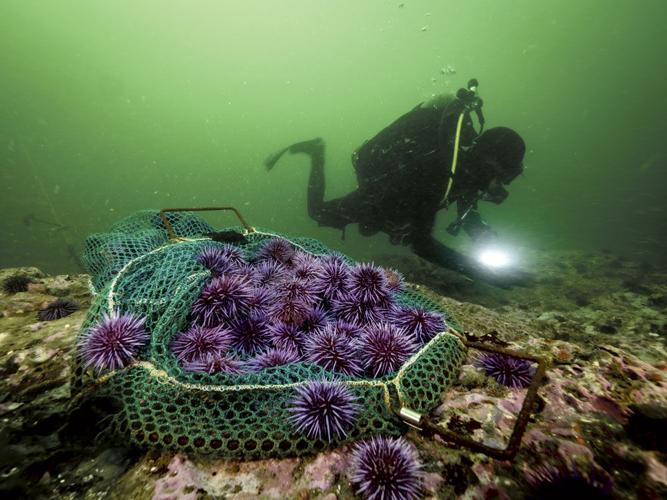

Imagine a future where the swaying kelp forests on the reefs of the Monterey Peninsula – alive with fish and invertebrates – are all gone, and replaced by barrens of urchins, purple and pink moonscapes inhospitable to nearly every other form of visible life.
That potential future is not some wild hypothetical. The transition toward it becoming reality is well underway.
The first blow came with the still-mysterious “sea star wasting syndrome” that hit the Pacific coast in 2013. That wiped out some sea stars, including sunflower stars, which feed on urchins, which in turn feed on kelp.
An even bigger blow started with a marine warming event first detected in the fall of 2013 that became known as “The Blob,” where sea temperatures off the Pacific coast registered more than 4 degrees warmer than usual over a span of hundreds of miles.
By the time The Blob dissipated in early 2016, it left a mark that lasts to this day – kelp forests along much of the California coast were decimated by the changed ocean conditions that created warm, nutrient-poor water. As kelp started to die off, weakened by a lack of nutrients, sea urchins proliferated in the vacuum.
It may seem counterintuitive that urchins would thrive in an environment devoid of their primary food source, but here’s the thing about urchins – they can slow down their normal metabolic rate and go into a sort of permanent hibernation. In these malnourished conditions, their gonads don’t grow large enough for sea otters to want to eat them, so the barrens persist, and a new, zombie-like ecosystem is formed.
When divers, scientists and others started noticing kelp forests dying off around the Monterey Peninsula in 2015 and earlier, many were alarmed. But Mark Carr, a marine ecology professor at UC Santa Cruz who’s considered one of the foremost experts on kelp forests, wasn’t one of them.
“It’s been 10 years now, and frankly people like me, marine ecologists, said, ‘Calm down, kelp will come back. Kelp comes and goes,’” Carr says. “We were wrong.”
Around the Monterey Peninsula, kelp forests have been dying off for a decade, overwhelmed by the sudden multitude of urchins, which keep migrating across the seafloor if they sense food nearby. And while scientists and regulators wrestled with the problem to try to better understand how to solve it – and if it could be solved – rogue divers set out with small hammers and started killing countless urchins, illegally, to protect the kelp forests they’d come to cherish.
Other divers have sought to work through the system legally, but have been frustrated by the tangle of regulatory agencies charged with protecting local waters. Many divers don’t want to do science experiments, they just want to restore kelp forests.
While local marine life has made a remarkable recovery from many of the human impacts on marine ecosystems over the past few centuries – otter hunting, whaling and overfishing sardines to name a few – a fundamental challenge facing local kelp forests is one that nobody has an answer for: climate change.
Can local kelp forests be saved?
It remains an open question, and in part, will come down to whether regulatory agencies make it a priority. Right now, they’re interested in gathering data and using it to make a plan.
But some divers say they have seen enough evidence, and believe they can bring kelp forests back, at least locally.
And to restore life, all they’re asking for is a license to cull.

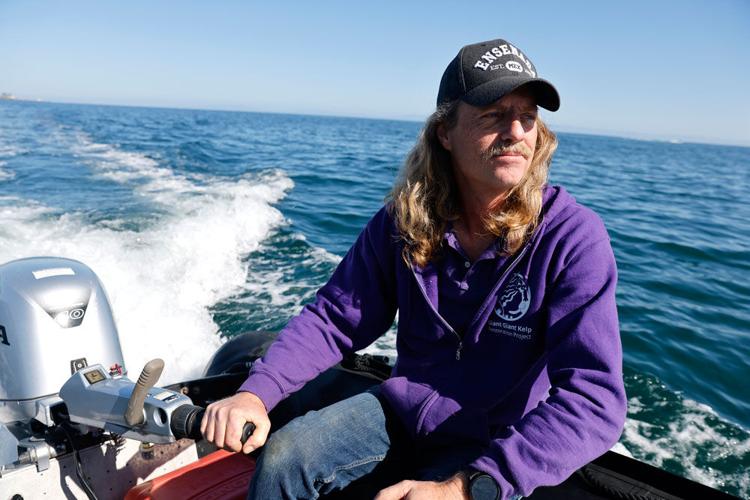
G2KR founder Rootsaert, who lives in Aromas, has become almost single-mindedly devoted to kelp restoration over the past decade.
Keith Rootsaert first started diving in 1985, and when he moved back to the area in 2009, he returned to it after a years-long hiatus. He was quickly struck by how much the ecosystems had changed over time – for one, by his eyes, there were considerably less fish.
“When I found it was so different,” Rootsaert says, “I decided I needed to get involved to make my observations more than anecdotal.”
So he started volunteering locally for two nonprofits: as an instructor for Reef Environmental Education Foundation, teaching people about fish and other life on the reefs, and as a diver with Reef Check, doing surveys both inside and outside marine protected areas to assess the ecological impact of MPAs.
He first noticed urchins starting to proliferate around Point Pinos in 2011. On a diving trip in the Puget Sound in October 2013, he saw sea stars suffering from wasting disease – “I was seeing them turn to goo,” he says – and then he saw the same thing when he came back to Monterey in November.
In 2014 and 2015, he started seeing kelp forests disappear, and urchin barrens around Pt. Pinos in 2016. The kelp at Lovers Point cove, he says, was lost in 2017, and he noticed the deforestation moved in an eastward direction, working its way down the Peninsula.
He did witness one instance where the kelp made a natural recovery – from Coral Street in Pacific Grove all the way around the point to Asilomar – but he says it only lasted from 2017-19. “Urchins turned around and ate it.”
In 2018, Rootsaert started his own group of volunteer divers, Giant Giant Kelp Restoration Project (G2KR), to try to address the problem legally. That same year, Reef Check got a scientific collection permit from the California Department of Fish and Wildlife to cull some urchins around Lovers Point to better understand the maximum threshold of urchin density that would allow for kelp to “recruit,” i.e. grow new plants.
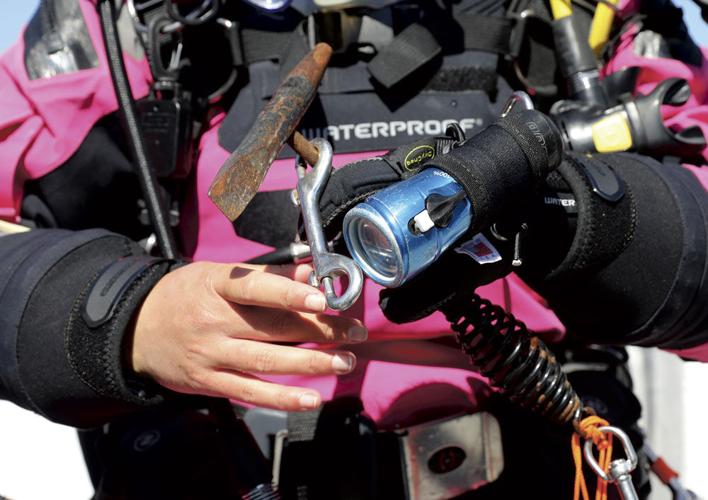
Rootsaert and fellow G2KR divers participated in that project, which started in 2019 and lasted two years. They would dive down with welding hammers – one side pointed, the other blunt – clipped to their buoyancy control devices, and then hit each urchin once or twice to split it open, killing it. But the kelp didn’t grow back, and in Rootsaert’s opinion, that was because the state wouldn’t allow the divers to cull enough urchins.
When that two-year project ended, he started pursuing his own project, and after repeated denials, was finally granted, in December 2020, an amendment to state sportfishing laws allowing urchin culling for three years on Tanker’s Reef, a shale reef off Del Monte Beach that is outside of state Marine Protected Areas.
Over the course of two-plus years, Rootsaert and G2KR divers culled hundreds of thousands of urchins – he estimates he’s culled over 200,000 himself – and restored 11 acres of kelp forest. But he wanted to go bigger, and repeatedly applied for (but was denied) permits to cull elsewhere.
At the same time, it started to become clear that the three-year legal amendment for Tanker’s was still set to expire on April 1, 2024. Rootsaert’s understanding was that if his team’s effort was successful, they would be allowed to continue culling there indefinitely. Instead, regulators wanted to assess the rate at which urchins would encroach on restored forest in the absence of culling. So G2KR divers walked away from the project at the end of July 2023, eight months before their permission expired.
Rootsaert feels like despite his best efforts and intentions, he got the rug pulled out from under him.
“It’s so fucked up. I just want to cull urchins,” he says. “Firemen put out fires. In the ocean, no one comes, it’s just us. And it’s raging, burning underwater.”
For now, as scientists study what happens at Tanker’s Reef over the next year, Rootsaert says he and others will be down there independently taking photos and video.
“All I can do,” he says, “is document the destruction.”

Before divers start culling, they ensure all their gear is properly clipped in to their buoyancy device and ready to go—that includes a welding hammer and a flashlight.
The various bureaucracies overseeing local waters make for an alphabet soup, and aside from the Fish and Game Commission, which issues scientific collection permits to those culling urchins, there’s the state Ocean Protection Council, the state Department of Fish and Wildlife and Monterey Bay National Marine Sanctuary.
Mike Esgro is a senior biodiversity program manager at OPC, which advises the governor on ocean policy and works with the Department of Fish and Wildlife on day-to-day management issues. Esgro learned to dive in 2014 and has since become OPC’s lead on kelp protection and restoration.
He emphasizes the state is trying to put together a toolkit for statewide kelp restoration. Part of that is assessing kelp’s ability to recover naturally, and exploring ways to promote that.
Nonetheless, he says, “I completely understand [Rootsaert’s] perspective,” adding that the idea of culling urchins “is a very emerging restoration method.” OPC is still trying to figure out how effective it is, the pros and cons and potential damage to the substrate, other species, and how self-sustaining it is, so you don’t have to “garden forever.”
The questions OPC and other agencies were asking when G2KR started culling at Tanker’s in 2021 was whether divers could cull below a 2-urchins-per-square-meter density; if they could self-organize; and whether kelp could revive and survive on its own.
“Keith and his team knocked number one and two out of the park,” Esgro says. “I have a lot of respect for Keith… A difference in perspective is how ready this method is, and even more than that, how it can scale up. The bar for conducting these more experimental types of methods is necessarily higher. That’s why we have to get an understanding of how this whole thing plays out.”
(As to number three, Rootsaert believes Tanker’s Reef is nowhere near resilient enough yet to survive the onslaught of urchins. “The state doesn’t want projects to succeed, they want them to fail, so they can say it’s impossible,” he says.)
Dan Abbott, the Central Coast regional manager for Reef Check, which advised G2KR in its Tanker’s Reef project and led the 2019-21 project at Lovers Point, echoes Esgro’s sentiments, and also lauds G2KR’s project.
“It definitely worked, that data is very clear,” Abbott says. “It went from a complete barren to a very healthy forest.”
But big picture, Abbott says: “We’ve tried removing urchins, we’ve shown that works. But it’s a tremendous amount of work, and is it scalable? Especially if you have to go back year after year.”
Since 2022, Reef Check has hired commercial divers – who don’t need a permit – to remove urchins in a barren south of Point Sur surrounded by kelp forests, and recently, the state granted the project a permit to cull, not just collect. Rootsaert wonders why. On Reef Check’s own website, the project description begins: “When a local community member of Big Sur indicated their concern for kelp forests, particularly at Big Sur Reef, a barren approximately 2.5 acres in size, Reef Check began surveying this site.”
Who is that community member? Rootsaert would sure like to know. Abbott says he can’t say – the person, or persons, want to keep their identity private, and he says they contributed money to offset the project’s cost.
Abbott is ultimately hopeful for the future of kelp forests, citing their resilience and ability to grow in a wide range of temperatures.
So too is MBNMS Resource Protection Coordinator Karen Grimmer, who also has nothing but positive things to say about G2KR’s work. “They’ve been really effective at urchin culling, and they’re adding to the knowledge that we need,” she says. “We need to figure out how to harness the enthusiasm and knowledge of Keith and the divers and work together on this problem, because it’s going to take everybody to solve it.”
Grimmer says hopefully by sometime in 2025 there should be data about the aftermath at Tanker’s Reef. She bristles at the notion that kelp forests have been “decimated” around the Monterey Peninsula – rather, she says, the depletion has been highly localized.
“I’m an optimist,” she adds. “It’s important to look at all the options, and do this research to see what actually works.”
The predominant kelp species around the Monterey Peninsula is giant kelp, the so-called “sequoia of the sea,” which can grow up to 150 feet tall. The other is bull kelp, which grows up to 60 feet, and is an annual, meaning it dies off every year. Giant kelp is a perennial, and sticks around.
That’s in part why the kelp die-off set in motion by sea star wasting disease and The Blob hit bull kelp even harder – they struggled to recruit and grow new plants, which is why the North Coast, where bull kelp are predominant, has lost more than 90 percent of its kelp forests in the last decade.
On the Central Coast, the loss has been more patchy – perhaps because the coastline is more varied – but around the Monterey Peninsula, kelp loss over the last decade exceeds 80 percent.
Mark Carr, the UCSC marine ecologist who was initially hopeful about kelp’s chances to rebound on its own, is now working on the science of how to bring kelp forests back.
As resilient as he believed kelp to be, the resilience of urchins has surprised him – he thought for sure the big storms in recent years would make a dent by ripping urchins off the reef.
“Many of us thought, this is it baby,” Carr says. “Yet, they’re still out there.”
That underscores how little scientists understand about the new dynamics of kelp forest ecosystems, but Carr can confidently say urchin barrens are stable ecosystems, despite their paucity of life.
There have been more surprises: Carr co-authored a paper that published in January that showed the persistent kelp forests around the Monterey Peninsula aren’t necessarily in the best spots for recovery – they’re holding on in some places where the water is warmer, and more nutrient-poor due to weak coastal upwelling, so they’re less reproductive. What’s been a better predictor for kelp forest resilience locally, the data shows, is protection from wave disturbance.
Carr adds that the loss of sunflower stars had far less impact locally than it did further north, because they weren’t all that abundant here to begin with. Rather, he says the die-off locally has largely been driven by climate change, which will continue to get worse.
So what to do? Carr’s been in meetings recently to address how to go about doing kelp restoration in a place, like the Monterey Peninsula, where nearly all the waters are protected. “This is a big deal,” he says. “It’s complicated, and that’s got to get navigated.”
In February, California Sea Grant, in partnership with OPC and CDFW, awarded a two-year grant to two, interlinked studies where Carr is the project lead. One will test culling purple and red urchins, and turban snails – which also eat kelp – on the edges of around eight remnant kelp forests on the Monterey Peninsula to see how much that helps and maybe expands them, and how much diver effort it takes. The other is to study temperatures, locations and methods for kelp restoration. Apart from culling, that could be the dispersal of kelp spores in places most likely to flourish.
The importance of at least trying to bring back kelp is manifold. One thing Carr’s research has shown is that urchin barrens aren’t driving other species to extinction, they’re just no longer thriving – imagine an ecosystem where 20 species, for example, were all more or less equally represented, and compare it to one where a single species dominates while the other 19 just hang on.
Kelp influences life not just within the forest, but life outside of it. One example is that juveniles of some rockfish species like to spend their youth under the protection of a kelp canopy before heading to deeper reefs when they’re mature. In the absence of nursery habitats, Carr says, rockfish numbers will decline.
And another reason is just for human enjoyment – kelp harbors fish for us to eat, and provides divers and kayakers a vibrant ecosystem to connect to. Diving in an urchin barren, on the other hand, is akin to hiking on the moon, except at least on the moon one could look up and see stars.
Even with all the smart, dedicated people working on kelp restoration, no one knows what the future holds, except that the sea will continue to get warmer.
And for the kelp adapted to cool Central Coast waters, that’s not a good thing.
Kelp deforestation caught everyone flat-footed, and it’s a scramble to figure out a plan. Officially, that will culminate in a statewide Kelp Management Restoration Plan that is projected to land in 2026.
But unlike the scientists and regulators, Rootsaert is antsy to get back to restoration. He’s seen enough, and he estimates there will soon be hundreds of millions of urchins around the Monterey Peninsula. “This is a 50 – to 100-year project,” he says.
If that’s the case, that gets back to the question about cost: Kelp forests are vital for biodiversity, and they’re important for fisheries, tourism and recreation, but exactly how much does the state value that? At what cost?
And as far as laws protecting waters now overrun by urchin barrens, what, exactly, are the laws trying to protect? Certainly not kelp forests, and all the species they harbor. The way things are trending, the kelp forest tank at the Monterey Bay Aquarium is set to become a living natural history exhibit.
In the meantime, Rootsaert says he and some fellow divers are looking at potentially working on a restoration project in Ensenada, Mexico, where the regulations are less stringent – they just want to get to work.
“We’re in a waiting mode. Why not start somewhere else?” he says. “We’re going to do something.”
Aside from potentially doing work in Mexico, they will independently monitor Tanker’s Reef to see their work eaten away.
While Rootsaert is not affiliated with divers who do illegal culling, he is aware of them, and notes their work might be skewing the data. “Almost half the kelp in Monterey is in a garden, it’s not natural,” he says. “It would never have survived without [divers].”
He knows how easy it is to kill urchins – all it takes is a small welding hammer that costs just a few bucks.
Yet how much impact those divers have on kelp restoration will continue to be an unknown for policymakers, because collectively, those divers call themselves Urchin Club, and they have only one rule – don’t talk about Urchin Club.
---
Correction 4/12 11am: This article has been corrected to reflect that G2KR got its collection permit from the California Department of Fish and Wildlife, not the state Fish and Game Commission, as originally stated.
Additionally, it’s been corrected to say that Tanker’s Reef is outside of state Marine Protected Areas, as opposed to outside of state or federal waters.
(2) comments
Just a point of information for folks who don't know... the thousands of urchins in these barrens, especially the ones away from the edges, are starving. If you open one up it is essentially empty, just a thin skin of tissue on the inside and outside of the test. Urchins can exist for years in this starved state, getting by on the diatoms that get started on their little patch of rock and catching pieces of drift seaweeds, especially after storms. That includes any tiny seaweed that gets started on their rock as well. That's one reason that commercial divers need to get paid... they can't sell these starved urchins as there is no uni. That's also why the otters don't bother with them.
The first time I went diving in Monterey Bay, just off Lover's Point in 1966, I was amazed at the thick kelp forest, and even more amazed at the prolific fish life hiding in the kelp. This past weekend I drove along the coast to check on the kelp from the ocean's edge. While still present in some areas, it appears much reduced. Life-cycles can be complex, and perhaps the kelp will return in abundance naturally, but I see no problem with providing an assist. There should be public hearings to determine the course of events as to whether/how we should assist.
Welcome to the discussion.
Log In
Keep it Clean. Please avoid obscene, vulgar, lewd, racist or sexually-oriented language.
PLEASE TURN OFF YOUR CAPS LOCK.
Don't Threaten. Threats of harming another person will not be tolerated.
Be Truthful. Don't knowingly lie about anyone or anything.
Be Nice. No racism, sexism or any sort of -ism that is degrading to another person.
Be Proactive. Use the 'Report' link on each comment to let us know of abusive posts.
Share with Us. We'd love to hear eyewitness accounts, the history behind an article.