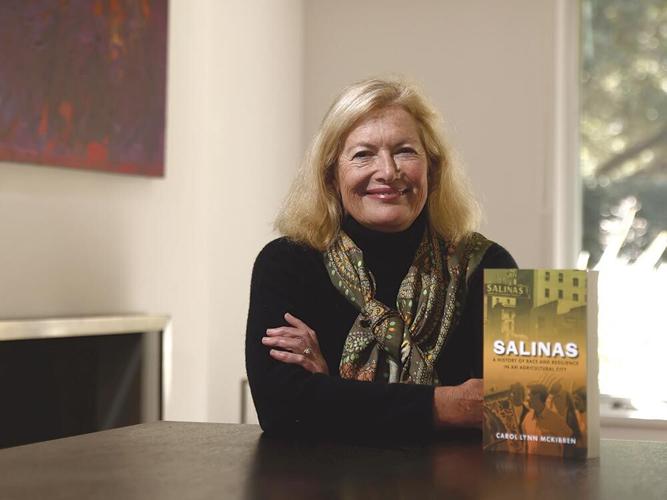


“I wanted to show that we are all historical actors,” Carol McKibben says.
CAROL LYNN MCKIBBEN’S LIFE AS A SCHOLAR BEGINS TECHNICALLY IN 1999, when she earned a PhD from UC Berkeley. But it really begins generations ago, with the story of her own grandparents immigrating from Europe to the U.S. in difficult circumstances. McKibben can tell you the story arc of each of her grandparents and their respective trials, including the Jewish grandfather who traveled in steerage, at age 5 with just his father – who died of typhus on their voyage. Her grandmother immigrated illegally from Sicily to San Jose, and eventually married her grandfather, also Sicilian, who arrived in the U.S. with just two brothers, and who started farming in Gilroy.
These details matter because they are McKibben’s story, but also because they are history, and she is the kind of historian drawn to the social dynamics that shaped the West. “I am interested in people rather than buildings,” she says.
That interest led her to write her dissertation about people whose lives had gone relatively unrecorded in the scheme of a more famous history – the Sicilian women and families who moved back and forth between villages in Italy and to Monterey, shaping the fishing industry and the culture. She turned it into her first book, Beyond Cannery Row: Sicilian Women, Immigration, and Community in Monterey, 1915-1999, published in 2006.
Her next book, Racial Beachhead: Diversity and Democracy in a Military Town, kept with the theme – examining the social histories of people and families who were historical actors but whose stories are underrepresented, in this case in Seaside.
Her 2022 book, Salinas: A History of Race and Resilience in an Agricultural City, does something similar, turning over the stories we think we know about monolithic blocs and diving deeper.
“I wanted to challenge the narrative predominant in our common understanding by looking at class and gender, and showing that in ways that required new sources,” she says. “Who makes history? We all make history. Nobody is on the margins – ask them. Nobody thinks of themselves as on the margins.”
The book is at once a definitive history of a specific city, and also a case study of city-building in California’s smaller urban hubs in rural areas. McKibben relied on interviews and reams of historical documents, including some never viewed before by the public or by scholars.
McKibben, who lives in Carmel, teaches about California history and urban history at Stanford University in the Department of History and Urban Studies and at the Bill Lane Center for the American West. Through the latter, she is now working on her next book about water politics on the Central Coast.
The Salinas history looks at the development of a city and how and why it came to be – the personal and financial factors that led to highly consequential moments, such as why the Alisal did not become the railroad stop and Salinas urban hub that it might have become, had one landowner’s greed not blocked progress. Compared to swampy Salinas – “a fine place for ducks and mosquitos but not for homes,” one newspaper reported – the Alisal was already established as a community with a school and a post office. Later decisions about development influenced the culture and community as well – things like the creation of shopping centers that drained the downtown, and migration of wealthier, mostly white residents to unincorporated communities on the periphery of Salinas.
As with all histories, Salinas’ is of course very much alive, and its story was unfolding even as McKibben worked on her book (see excerpt, p. 24). She spoke to the Weekly about what history reveals to us about the present. This interview has been edited for length and clarity.
Weekly: It’s your friendship with Ray Corpuz, former Salinas city manager (from 2012-2020) and former Seaside city manager (from 2005-2012) that led you to write this book. How did that happen?
McKibben: I had just published my dissertation, Beyond Cannery Row, and I was at a conference where a colleague said, did I know anything about Seaside? I did not, and I was embarrassed, because I’ve lived here forever. I made an appointment to meet the new Seaside city manager, Ray Corpuz. He was shocked there were no histories, even local histories, of Seaside.
I wrote [Racial Beachhead], and got really excited about it, because it allowed me to do what I always like to do, which is to disrupt the old narratives that ignore entire communities within communities and to investigate them as the complex groups that they are. When you’re looking from the outside in, you see homogeneity – in one sentence or two you dismiss the Latino community of Salinas, or the Black community of Seaside. That’s been the thrust of my work.
That is part of what makes this book read not like just a history book, but a very contemporary book about communities more generally. You write very explicitly about the white supremacist order, addressing it head-on.
When you close your eyes and jump back in time, it looks nothing like we imagined it to be. If you look at Salinas in the 19th century, you wouldn’t just see Chinese contract laborers – you’d see families, you’d see Chinese Americans, you’d see people who were fully part of that community, and they were city-builders – they weren’t just standing outside the realm of what was going on. And you’d see women front and center.
You also see the way a system based on white supremacy really works.
One example of that is Salinas billed itself as a white city in its advertisements. It could do that, because it was. What didn’t get put in the ads was that it was very multi-racial. Most of the populations that were decidedly not white lived on the outskirts of town that were not zoned – that’s how that order was maintained. If you don’t live in the city limits, you don’t vote, you don’t have a voice. An unintended consequence of annexing the Alisal was expanding the citizenry.

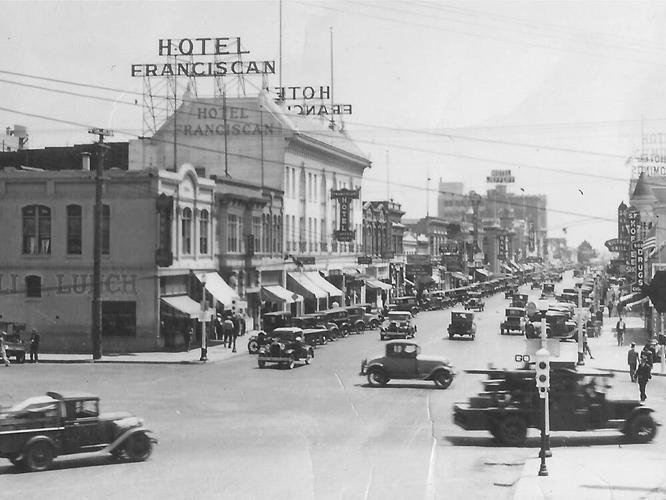
A Salinas street scene in 1929. From the beginning, the city was envisioned as an urban center in an agricultural region.
I want to ask you more about that. I was surprised to learn it was not a popular idea among Alisal residents, who would get certain city services and City Council representation, but it really was promoted by the city to expand its tax base.
It was really not a popular move. No, they don’t participate in city government, but they had a lot more freedom.
The other part of what I was trying to do is not to just talk about Salinas, but put it in a bigger context. This is American history. While the annexation was going on in Salinas, annexations were the order of the day in the 1960s. Everybody wanted “bigger is better,” because they got more federal funding. A bigger population meant you attracted more corporate investment too.
That’s exactly what was behind the effort in Salinas to expand its geography.
I have a working thesis that when people arrive in a place and become a stakeholder, that moment in time becomes their standard, and they are always nostalgic for that moment when they came to a place, before it inevitably changed.
That’s human nature. And it’s laughable, because for thousands and thousands of years, this place was pretty stable. The idea that most of our history began as an incorporated American city is nonsense. (Because it’s an urban history, I didn’t spend as much time as I would’ve liked on the thousands of years of history that came before the Spanish then Mexican state.)
We can wax nostalgic for every era, looking backwards, and looking forwards, too. There never is a golden era. It is only when everyone is dead and nobody can talk about the bad stuff that we can be nostalgic for a golden era – there wasn’t one.
It’s a good reason for writing history, to remind people the past wasn’t so perfect.
It was interesting to learn that the Alisal neighborhood pre-dated the Salinas City Center neighborhood, which was originally developed as a railroad stop, and also outcompeted Castroville, which was envisioned as the region’s big city.
The county seat and the railroad stop were not just a done deal. When you read local histories of this area, it sounds like it just happened by accident, or it was so obvious – but it was not obvious at the time. That’s an important takeaway, I hope, from my book: If you go back in time, nothing is obvious.
One topic throughout is who gets to be a decision-maker, and how much power they have. There is deliberate exclusion, placating groups of people. You write: “In the 1930s, the general population of Anglo Americans allowed nonwhite groups of mostly Asian and Mexican descent just enough space in city life to keep the peace; the power structure that was, first and foremost, built on racial exclusion made room for enterprising whites, and it allowed just enough space to appease Japanese, Chinese, Latino/a and Filipino/a American aspirants to the middle class. This strategy became the basis for the city’s organization and development going forward and precluded a more radical politics from taking root in Salinas. This is what happened in the rest of America too.”
That’s where class becomes important. As long as there is a path to the middle class – as long as everybody thinks, true or not, that they can with hard work buy a home, start a business, put down a stake, become a full citizen – then it creates a more moderate way of looking at the world. It encourages a more moderate politics.
We know a lot about the really violent strike of 1936. Labor organizers of the 1930s and John Steinbeck believed that a permanent class of peasants was forming. Five minutes after that strike there was a big retreat from that kind of organizing effort. People believed their way out was not through union organizing, but by becoming stakeholders.
You write about one challenge intrinsic to serving Salinas is that it’s very reliant on philanthropy: “The largesse of the philanthropists is still largesse. It is based on a concept of white supremacy and tolerance of others, rather than genuine equality.” How do we go beyond that?
I worry about that issue. Largesse is largesse, and it can be taken as well as given. I would argue there is an important role for the federal government here; we need a neutral party at the federal level to invest in communities and not rely on fundraising and nonprofits that can disappear tomorrow, and not rely on someone waking up in the morning and deciding to give a billion dollars.
It’s like the old saying about democracy: It’s not a good system except it’s better than everything else. It does kind of work.
Salinas, particularly the Alisal, has a lot of grassroots groups and nonprofits that are very organized, and what I would describe as a unique focus on teaching the art of organizing – groups that don’t do the work themselves, but help give the skills to people to organize themselves.
There’s a lot of hand-wringing about the failure of the United Farm Workers movement. But if you look at a lot of the people who were activists and organizers, many of them came right out of the fields, and still were activists and organizers.
Other people like [State Senator and former Salinas Mayor] Anna Caballero, [retired county supervisor and Assemblymember] Simon Salinas, [retired State Senator and Assemblymember] Bill Monning – they started as organizers and went into politics. They were not radicals on the left. They were moderates, they made changes. They’re my heroes and she-roes. They’re an inspiration.
One of my goals is to make people appreciate the past, not just look at Salinas farm workers and say, “Oh it was a failed movement.” Look at what came out of it too in a positive way.
It’s never good and evil.
One significant shift in labor relations seems to be during the bracero program, when agribusiness owners see workers are visiting laborers, not community members, with the false expectation they won’t stay and put down roots.
The largest corporate agriculturalists would like that. You don’t necessarily want those people to turn into voters, they are not going to vote for your interests.
But that tension has always existed. Farming is hard; about the only thing you can control are wages and labor. That’s why so much effort was made to do just that. They’re not evil. The profit margin is very thin.
I would have liked my subtitle to be, “It’s Complicated.” I wanted to humanize everyone on all sides.
You unearthed a tremendous amount of historical records, from places like the Monterey County Historical Society, but also the Grower-Shipper Association. I am curious about how you got in there. Had it ever been opened to the public or scholars before?
No. But they were very, very welcoming. I just discovered the minutes of their meetings in a closet in the basement one day. I looked at these and realized, especially in the ’30s, this organization did not expect anyone to read them.
It was only after the La Follette Committee hearings in 1937 investigating the 1936 strike that the meeting minutes became a lot more cautious and less explicit. So I had a little gold mine to work with.
It’s not a strictly academic history book, it’s a very readable history book. Who is the intended audience – is there an academic readership?
Yes, I want it to be a case study, because the Central Coast is usually ignored in California history, in favor of Los Angeles, San Francisco and Oakland. It’s not all about the big urban centers.
I wish a million histories of Stockton and Modesto would be incorporated into the bigger narrative of California history. Increasingly they are, because people like me are going in and writing them.
I love the discussion about how there’s a real blind spot in American culture and academic writing about rural life. And Salinas is both a rural community and an urban center.
That is a myth, that people growing up on farms were isolated. California was about city-building and town building, that was the first thing. The farming culture supported the town.
How much is history being weaponized?
It’s always been weaponized. This moment is unique. There are things that have happened that are unprecedented, and scary. But we have always lived in scary times – name one decade that wasn’t scary.
We’ve seen a recent movement to rename places that commemorate racist people. I was alarmed to read about C.D. Abbott’s anti-Chinese comments. What do you think about renaming?
Not all history should be commemorated. We should be embarrassed about slavery. If something is named for someone who represents that, by all means, rename that.
In Seaside, Oldemeyer Center was named after someone who was really racist. In my book I gave the history, and I asked why – someone who was on City Council at the time said, “We didn’t know.”
Those things happened because people think any dead old person is worth commemorating. That’s another reason we need to learn our histories, for better and for worse. We should be informed.

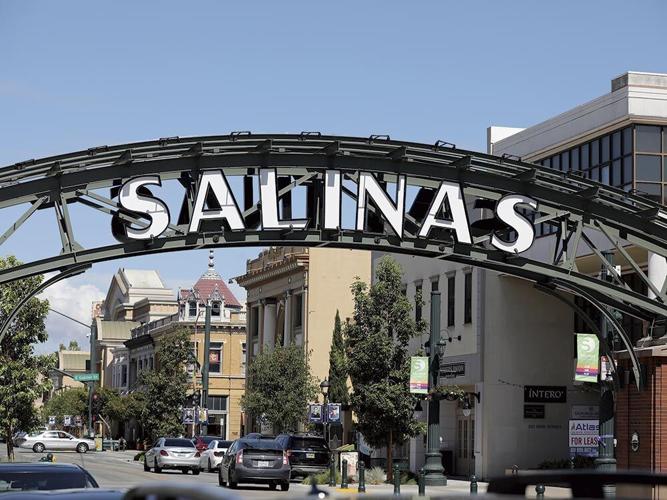
This celebratory arch was installed on South Main Street in downtown Salinas in 2021.
We see some issues repeating in the present. You write: “The new Latino/a majority became the face of Salinas through political representation, but there remains a glaring lack of representation of nonwhite groups (other than a very few Asians) in the elite echelon of agriculture, now referred to as ag tech, which can be seen as a dark side of Salinas’ historical pattern of inclusion without actual challenge to structural, pervasive racism. Salinas, in a nutshell, is an example of how and why racism proved to be so persistent in American life.” Do you have a prescription for Salinas?
When you know your past you can learn from it and do things differently. The Alisal Vibrancy Plan is not just top down – representation means everything. That’s why I gave so much space to changing of elections in Salinas from citywide to district-based. It changed the face of the city council, almost overnight.
From my perspective, things are changing for the better. There is a lot of interest in investing in Salinas’ history. I was worried it would sound too Pollyannaish at the end, because I do see some really positive change going on in Salinas. I do love the representation at the city council, and I do love how the education system has been transformed and I love that Adele Fresé was brought in as police chief. These are really great things.
We have to remember there is just one race, the human race.
The idea of race was invented by white people who wanted to justify slavery.
There are different cultures and ethnicities, but nobody looks like the other person. I wish we could just get over that, but we can’t get over it, we have to get through it.
(0) comments
Welcome to the discussion.
Log In
Keep it Clean. Please avoid obscene, vulgar, lewd, racist or sexually-oriented language.
PLEASE TURN OFF YOUR CAPS LOCK.
Don't Threaten. Threats of harming another person will not be tolerated.
Be Truthful. Don't knowingly lie about anyone or anything.
Be Nice. No racism, sexism or any sort of -ism that is degrading to another person.
Be Proactive. Use the 'Report' link on each comment to let us know of abusive posts.
Share with Us. We'd love to hear eyewitness accounts, the history behind an article.