
It’s Dec. 23, the Sunday before Christmas, and shopping is slower than on the last few weekends at the Big Red Barn flea market in Aromas, but there’s still brisk business going on.
Shoppers of all ages are perusing the dozens of outdoor booths selling new items. The booths stretch in a meandering fashion from one lot to the side of the 52-foot-high barn, once dubbed the “World’s Largest Hay Barn,” and over a creek to another sprawling space. Everything from clothing and jewelry to housewares and cleaning supplies, religious candles, produce and candy are for sale. Booths selling DVDs, CDs and cell phone covers are blaring dueling styles of Latin music.
The popular toy item among small boys this day appears to be a small orange basketball attached to the end of an elastic string that the boys flick away from themselves and try to catch as the balls snap back. It keeps the boys busy as their parents try to get some last-minute gift shopping done or pick up the week’s produce.
It’s the type of day that Frances Ellingwood, founder of the nearly 50-year-old flea market, would have loved. Vendors who have sold for decades at the Sundays-only flea market recall how the week before Christmas, the cheerful woman with bright red nails, well-coiffed blond hair and a bright red sweater emblazoned with ornaments would stop by to wish each vendor a “Merry Christmas.” For gifts she passed out homemade persimmon walnut cookies, made with fruit from a tree on the property, and let vendors know she wouldn’t be collecting the weekly fee, currently set at $45 per booth.
But a few years ago, Ellingwood’s health began to fail, and her Christmas visits to the vendors stopped. On Christmas of 2017, she was lying in a bed in a home in Pajaro Dunes in Santa Cruz County, about 12 miles away. On Friday, March 9, she died at age 79. There was no market on the following Sunday and the giant flag on the green hillside overlooking the property flew peacefully at half-staff in her honor.
Meanwhile, things were anything but peaceful in Aromas. As the gates to Ellingwood’s beloved market remained locked for several weeks, two men in her life – her partner in business and in life, Ken McPhail, and her longtime caregiver and friend, Manuel Delgadillo – were each claiming to be true heirs to her fortune, estimated between $8-$10 million. Both claimed to be holding her last will and testament, and both accused the other of misconduct. It took a Monterey County Superior Court judge to reopen the market last spring, allowing vendors to go back to selling their wares.
In the meantime the relationship between McPhail, Delgadillo and Ellingwood’s family was enflamed with an even more serious claim in court documents that McPhail caused Ellingwood’s death. “They’ve backed away from all of those because they’re not true,” says McPhail’s attorney, Larry Biegel.
Ellingwood’s family members withdrew their claims by mid-January, and Delgadillo amended his complaint regarding how Ellingwood died – but he has not backed down from his claim that McPhail “wasted, mismanaged and committed fraud upon the estate.” McPhail denies the claim in court documents, and contends Delgadillo used undue influence on Ellingwood to create the 2015 will.
As Biegel puts it, a lot of facts will need to be determined, and now only a court can do that.

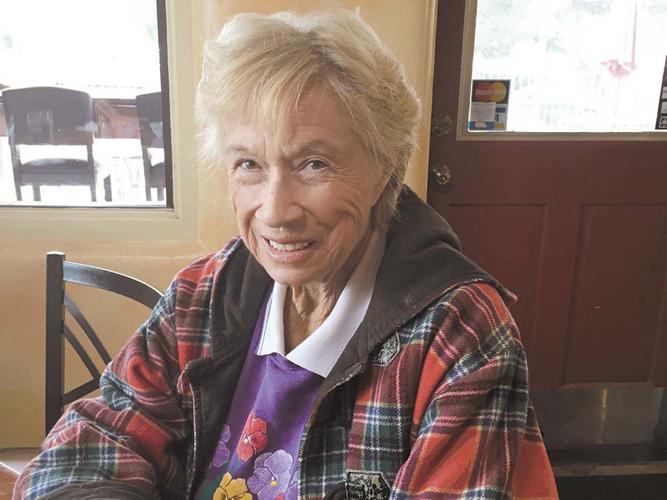
Frances Ellingwood, pictured three years before she died in 2018, took great pride in her appearance even as she aged, making sure her hair was always styled. A sister, Candida Stricklen, remembers Ellingwood wore long fake eyelashes that would melt when she cooked over a barbecue.
FRANCES ELLINGWOOD ONCE OWNED A CADILLAC featuring a bumper sticker that read, “Well behaved women rarely make history.”
“That perfectly describes Fran,” Delgadillo says.
“She was such a fun girl,” says her sister Candida Stricklen. Ellingwood loved to garden, fish and did her fair share of partying. “She was full of life.”
Somewhere between 1969 and 1970, Ellingwood had the large gray aluminum barn painted bright red to attract attention to her new antique business inside. Monterey County officials were not happy, according to Delgadillo, but Ellingwood put up a “fierce fight” and won. It was one of many battles she would have with the county over the next 48 years.
Ellingwood was born Frances Mable Ruda on May 1, 1938, in San Luis Obispo County. She was the eldest of eight children in what Stricklen describes as a “Brady Bunch” situation. Their mother had Ellingwood, another daughter and a son, then divorced their father and remarried Stricklen’s father who already had three children – then two more daughters were born. The family lived in a large home on River Road in Chualar, although Stricklen thinks her oldest sister didn’t live there long before she married Francis Alvin Ellingwood – Frances and Francis, although he went by “Al” – and the young couple traveled around the country while Al served as a pilot in the U.S. Air Force.
When Al was transferred from Florida to the Palm Springs area, his entrepreneurial wife paid people to dig up palm trees in Florida and ship them to California so she could sell them for landscaping projects.
“She could take a piece of dirt and within a month make something of it,” Stricklen says. “Wherever she goes she knows how to make money.”
It was Ellingwood who saw the potential of the barn as a way to make money in the 1960s, Stricklen says. She and Al purchased the property from her father-in-law, Harry Ellingwood, and in 1969 began selling antiques and Disney memorabilia from inside. She added additional stalls to rent to other businesses, and decorated it with an Old West theme. (Stricklen says Ellingwood got the Disney Company’s permission to use the name “Disneyana,” still emblazoned on the side of the barn.)
As the flea market’s popularity grew, the footprint spread in the area surrounding the barn. (The barn itself is now closed, after county officials found code compliance issues in 2009.)
The 20,000-square-foot, 52-foot-high barn was built in 1945 by the Kaiser Aluminum Company for Ellingwood’s father-in-law, Harry, according to a 2010 historical report. It’s approximately 22,000 pounds of aluminum held together by 100 tons of steel framing, all set on a massive pad of concrete. Harry used it to store hay, which he sold to the U.S. Army at Fort Ord, and provided the first hay-bale barriers used at Laguna Seca Raceway.
Ellingwood and Al divorced in 1994, but remained good friends until Al’s death in 2016. (Ellingwood eventually bought out Al’s half of the business.) She never married again, but she never went very long without the company of a man – she didn’t like to be alone, say those who knew her. Ken McPhail showed up at her doorstep, after a landscaper who worked for Ellingwood told McPhail he should go introduce himself. According to Stricklen, he never left.
With no children of her own, Ellingwood often “adopted” others, which included her employees and vendors or their children, says Stricklen. She put more than one through college and awarded many scholarships over the years.
Many of the vendors who sell at the flea market come from elsewhere in the state and stay overnight in the area on Saturdays so they can have their booths open by 9am on Sunday. Carmen Ramos and her family – including her adult disabled son who uses a wheelchair exclusively to get around – drive four hours round-trip from Fresno every weekend. They used to stay in motels on Saturday nights, but when those became too expensive, they slept in their car.
When Ellingwood found out, she agreed to let them stay in a trailer on site. County inspectors fined her for the trailer, but Ellingwood fought back. She paid a $1,000 fine and later talked county officials into allowing the trailer to stay, as a “caretakers unit.”
“She knew we had to take care of our vendors more than anything else,” Delgadillo says. “What was funny was she didn’t speak a word of Spanish, but she communicated with them.”

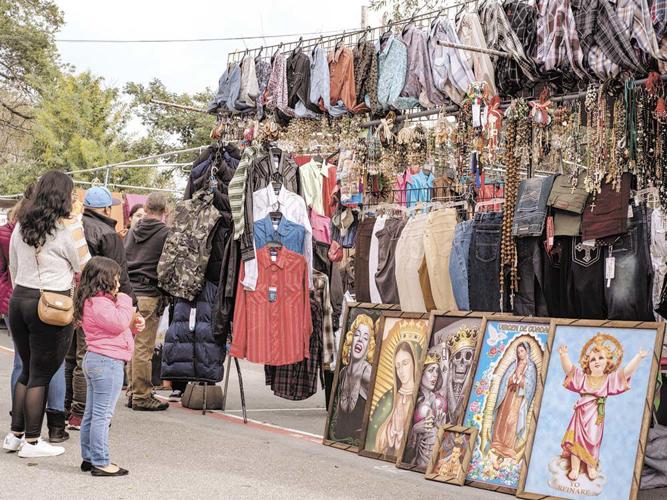
Clothing and religious art share a booth on a recent Sunday. Around 150 booths mean jobs for more than 300 people.
ABOUT 60 OF THE FLEA MARKET VENDORS ARE CROWDED INTO A COURTHOUSE HALLWAY on the morning of April 4, 2018, almost four weeks after Ellingwood died. Peppered throughout the space are attorneys in pressed suits, but the vendors are dressed like people who work hard outdoors, wearing jeans and jean jackets, running shoes or boots.
Off to one side of the courthouse hallway, four people are circled up for a serious conversation. Delgadillo is doing most of the talking as three of Ellingwood’s siblings – Stricklen, John Sargenti and Carleen Sargenti – listen intently. In Delgadillo’s hand is a copy of a will that he claims was written in 2015 by Ellingwood.
“My wishes are for my friend and longtime caregiver (Delgadillo) to operate my beloved business for as long as it’s financially possible and to help the vendors who have helped make my business so memorable,” the will states.
Delgadillo, the long-time manager of the flea market and friend of Ellingwood, is there to assert that this is the true copy of her will.
The crowd of vendors is there because the gates to the flea market have remained locked since Ellingwood’s death, and for many of the vendors, no Big Red Barn on Sundays means no income for the week. Some found temporary spots at other flea markets in the region, and some regularly appear at other markets, but many spend all week preparing for one big day of sales. It’s also more than just income – the market is a way of life, a social gathering spot and even an extended family for vendors. They were hoping that Monterey County Superior Court Judge Vanessa Vallarta would offer a path toward reopening the market.
The flea market’s relationship with Monterey County is complicated. The market makes money for the county through sales taxes paid by individual vendors. Ellingwood’s operating company, Stagecoach Territory, Inc., itself takes in between $27,000 and $29,000 a Sunday in summer months from parking, booth fees and beer and soda sales, alone. (That drops to about $15,000 in slower winter months.) On Jan. 27, an unseasonably warm winter day, Stagecoach made $29,000.
Before Ellingwood died, Stagecoach was embroiled in a nearly decade-long legal struggle with the county over the size of the market, which had grown beyond what was allowed in an earlier use permit. County Health Department officials raised concern about the ratio of food booths to bathrooms and handwashing stations, considered the most serious of the violations. The flea market was repeatedly out of compliance with health code.
The county prevailed in that court case on Jan. 26, 2018, and was granted an injunction that could have shut down the flea market for code violations. But recognizing the economic benefit of the market – plus the value for more than 150 small businesses, operated by people of color – officials continued to work with Delgadillo, McPhail and former Stagecoach attorney Patrick Palacios to keep the market open. They limited the number of booths until a septic system and permanent bathrooms could be built, with portable toilets in the meantime.
The court directed Stagecoach to pay $304,000 in Monterey County’s court costs and attorneys’ fees. The court agreed that the county could undertake the process of appointing a receiver – a neutral third-party manager – to take over operations of the company, with Delgadillo remaining as flea market manager.
Negotiations between the county and Stagecoach were slow going. From late January until late March of 2018, county employees clocked more than 69 hours in phone calls, emails and meetings with Stagecoach representatives, according to court records.
McPhail sent a check for the $304,000 to the Monterey County Board of Supervisors on Feb. 9, along with a letter pushing back against the receivership. In it, he objected to the county’s demands for a new septic system and toilets, among other things, and wrote that he cannot “accommodate the County’s demand to take my property,” referring to the receivership.
Instead, McPhail said, he was going to close the Big Red Barn.
“After thoughtful consideration, I will be closing the business after 48 years of operation,” he wrote. From his point of view, “I am being forced into this position all over use of portable toilets which I have used for 48 years to service an operation that runs one day a week.”
A few days later, Deputy County Counsel Brian Briggs wrote back to Palacios and McPhail, completely ignoring McPhail’s closure announcement. (Briggs tells the Weekly it wasn’t clear to him at the time if McPhail had authority to make such a decision.) Briggs thanks him for the check, and says he understands McPhail doesn’t want the receiver, so he offers an alternative plan for bringing in more toilets, among a few other requirements.
Despite the court granting the county’s request for an injunction, county officials worked to find a way to keep the flea market open.
“There are a lot of jobs at stake there,” says Briggs, of the more than 300 vendors. “The Board of Supervisors didn’t want to disenfranchise them.”

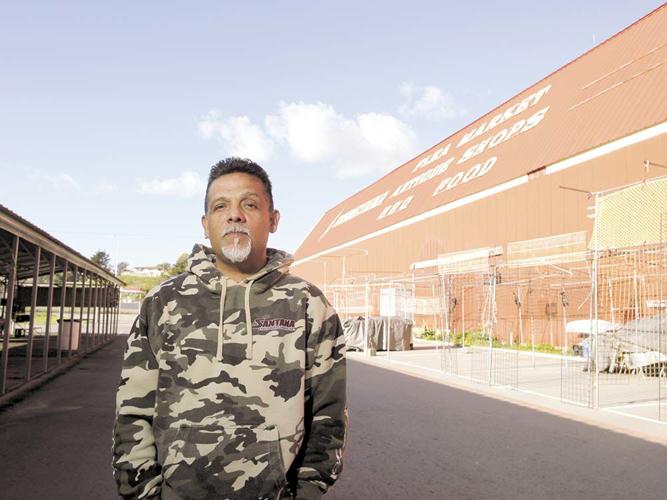
Manuel Delgadillo says he worked up to 60 hours a week unpaid for Frances Ellingwood since 2004, performing a range of duties from managing the flea market and day-to-day operations to helping her after three hip surgeries and other medical issues.
THE RECEIVERSHIP TALKS HAD BEGUN WHILE ELLINGWOOD WAS STILL ALIVE. After she died on March 9, county officials began to express more urgency about appointing a receiver to keep the Big Red Barn operating.
On March 13, Monterey County Deputy Director of Land Use John Dugan emailed McPhail to ask when he was going to comply with Briggs’ offer for an alternative to a receiver, offered the month before.
“Wife just passed away. A little busy,” McPhail replied.
A week later, on March 22, McPhail wrote to Briggs: “Based on your and supervisors (sic) demands I have chosen to close the business.”
(Biegel, McPhail’s attorney, contends McPhail’s statements were “posturing,” and that he never wanted to close the business.)
So by the next court hearing on April 4, vendors are understandably nervous about the market reopening, and the county is no longer offering an alternative to a receiver.
Both McPhail and Delgadillo had filed their separate wills by that time, and the vendors were trusting Delgadillo to keep the market open. Delgadillo promised them that he would, as well as resolve the county’s requirements for more bathrooms to accommodate more booths.
If McPhail were to inherit the Big Red Barn, it seemed likely he would close it down – he’d already said as much in writing – so vendors lined up against him. So did Ellingwood’s siblings. They declined to speak about McPhail, but according to court documents filed by an attorney representing McPhail, Stricklen told the attorney, “Ken McPhail is a bad man.”
Delgadillo and family members state in court documents they believe McPhail embezzled money from Stagecoach, or purchased expensive items like sports cars and a yacht for his own use. McPhail allegedly moved money out of Stagecoach accounts the Monday after Ellingwood’s death. Biegel notes that money was later returned upon request.
Biegel also acknowledges that Ellingwood was the “people person” and that McPhail can be “dour” at times, which could leave a negative impression. (McPhail declined to be interviewed for this story.)
“I find Ken McPhail to be a very smart man, and yes, he’s very gruff, but a soft side comes out in our meetings and I respect the hell out of him,” Biegel says.
At the end of the April 4 hearing, the matter of the wills is far from settled. But there’s some good news for the vendors, at least temporarily: McPhail and Delgadillo agreed to reopen the market with Delgadillo as manager. There’s a caveat from the county, which by then was insisting on a receiver. “I don’t believe either [McPhail or Delgadillo] can run [Stagecoach] at this time,” Briggs told the judge.
The market did reopen, but not for long. Delgadillo says when he showed up the following weekend, McPhail had fired the staff and brought in new employees Delgadillo felt he couldn’t work with, so he left. The market opened on April 8, county code enforcement showed up and found numerous violations. The most serious: The flea market is only allowed 30 food vendors, but that day there were 70. The bathrooms were over-taxed and filthy. The market was closed yet again as of April 15.
A few weeks later, the parties were back in court, appearing before Judge Susan Matcham. Matcham granted the county’s request to appoint a receiver, over McPhail’s objections. Matcham went with Sandra Hill, the administrator requested by the county.
As McPhail continued to talk to the judge about his involvement in running the business, Matcham emphasized that his management was over: “You won’t be involved anymore, Mr. McPhail. [The receiver] is going to do what I would do.”
On June 3, the Big Red Barn reopened, with Goodwill of Central Coast managing the flea market per an agreement approved by the court on May 29. On June 1, the Monterey County Environmental Health Bureau approved a plan for the number of booths and restrooms.
But the battle over which will is authentic – and the longer term fate of the Big Red Barn – remained unresolved.

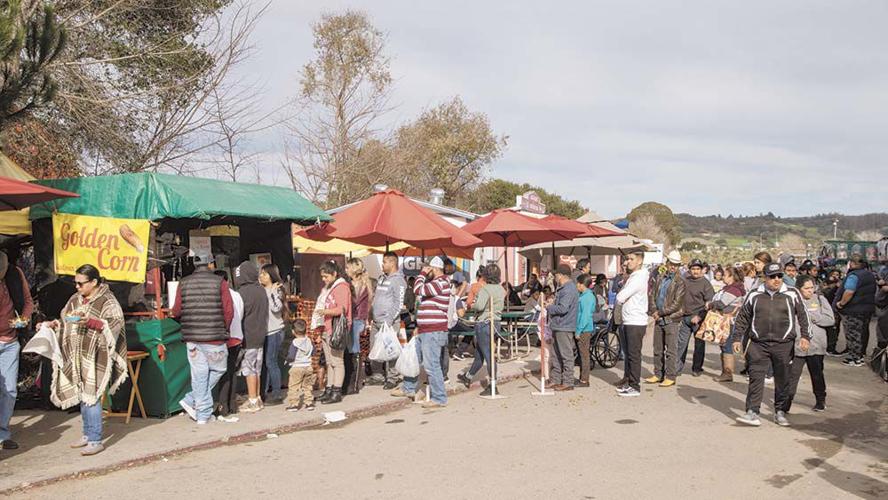
Food booths do brisk business at the flea market, especially when the weather is warm. On Jan. 27 the market took in $29,000, partly because beer sales were high that day.
ELLINGWOOD HAD AT LEAST FOUR WILLS OVER THE YEARS, according to Delgadillo. Biegel says they keep finding earlier wills, and that one done a few years before the 2011 version was similar in that it left the bulk of the estate to McPhail, with some bequests to family. There is no mention in the 2011 will of Delgadillo, who says Ellingwood promised him – at least three times – an inheritance to compensate him for years of unpaid service.
It’s a good question why Delgadillo would work for free for more than 14 years. He says he became friends with Ellingwood, and after sharing with her his dream of starting a tow truck business, she loaned him $6,000 for his first truck.
“I felt I owed this lady,” he says. “She taught me how to manage a business, she taught me how to manage people, most importantly she taught me how to manage myself.”
As the years went by and her health started to decline, she leaned on him more heavily. In 2015, Delgadillo says, she wanted to change her will to leave everything to him.
In a document filed in Monterey County Superior Court in September, McPhail contends that Delgadillo used “undue influence” as a caretaker to force Ellingwood to create the 2015 will. It also charges him with “perpetuating an actual fraud,” by taking advantage of an ailing woman, and accuses him of making untrue disparaging remarks about McPhail.
Delgadillo denies all the allegations, and contends it was McPhail who asserted influence over Ellingwood to create the 2011 will, and to put his own name on bank accounts and other business documents. In early 2017, Delgadillo says, he and Ellingwood’s attorney, Palacios, took McPhail off of all accounts. (Biegel says McPhail was later put back on.)
Over the last several months, depositions have been taken from family members, employees and others connected to the case. McPhail’s and Delgadillo’s depositions are set for February.
In the meantime, Hill, in her capacity as receiver, has been negotiating with the county on a minor amendment to the use permit that will allow the market to reclaim space for about 50 more booths. Plans are in the works for a new waste management system and permanent bathrooms.
Delgadillo filed a claim on Jan. 14 to be compensated for his past work. He does not include a set amount, but demands all of Ellingwood’s stock in Stagecoach be transferred to him immediately.
Vendors worry if McPhail’s will is deemed authentic and he inherits Stagecoach that he’d make good on his earlier pronouncements and shut down the market. They are hoping Delgadillo’s will wins.
Biegel demurs: “I have no reason to believe Mr. McPhail wants to close it down. It makes money. It makes money for the vendors and the business. It always has.”
The barn, however, sits on land that could be much more valuable to developers than a flea market, Delgadillo notes. “Needless to say, this property is very valuable, but not as a flea market,” he says.
Then why would Delgadillo opt to keep the market running?
“It’s what she wanted,” he answers.
(0) comments
Welcome to the discussion.
Log In
Keep it Clean. Please avoid obscene, vulgar, lewd, racist or sexually-oriented language.
PLEASE TURN OFF YOUR CAPS LOCK.
Don't Threaten. Threats of harming another person will not be tolerated.
Be Truthful. Don't knowingly lie about anyone or anything.
Be Nice. No racism, sexism or any sort of -ism that is degrading to another person.
Be Proactive. Use the 'Report' link on each comment to let us know of abusive posts.
Share with Us. We'd love to hear eyewitness accounts, the history behind an article.