
JULIA PLATT WAS FURIOUS. Mattie McDougall, the owner of the Lovers Point bathhouse concessions, had blocked public access to the beach, directly across the street from Platt’s Pacific Grove home. Platt would not have it. Access to the beach was a public right through a deed, she argued to the P.G. City Council, in a letter she sent in early January 1930. The city should tear down the barrier, no matter how many times McDougall replaced it.
The council chose to do nothing during its Jan. 16 meeting. The city was already embroiled in a legal dispute with McDougall over the property – let a court decide the issue, they said.
If the council wouldn’t take action, then Platt, 72, would. On Jan. 17, she brought a file and sawed off the lock. She tacked a sign on the opened gate:

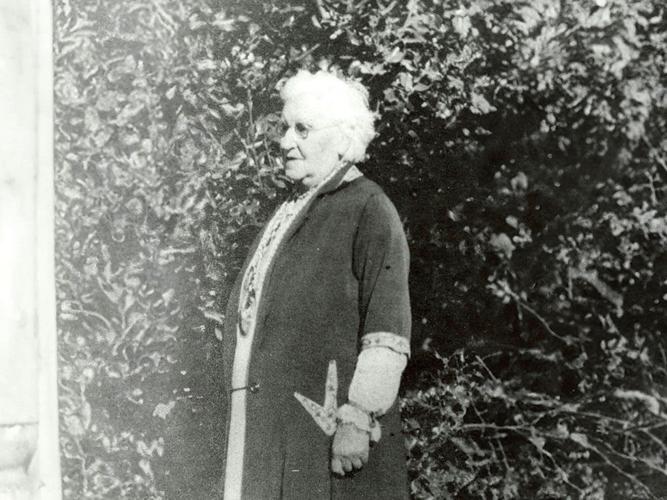
There aren’t many photos of Julia Platt. The one above was possibly taken around the time Platt ran for mayor of Pacific Grove in 1931, when she was 73.
Opened by Julia B. Platt. This entrance to the beach must be left open at all hours when the public might presumably wish to pass through. I act in the matter because the council and police department of Pacific Grove are men and possibly somewhat timid.
McDougall had a new lock put on, which Platt filed off again, according to an article in the Monterey Peninsula Herald at the time. The gate was then nailed shut from the inside. Platt told the Herald that she made sure her ax and saw were sharpened in preparation to take the gate down.
“The gate shall be open if I have to make a shambles of it. The public right must be protected,” she said.
Platt returned ready to do battle. Along with her sharpened tools, she brought a hammer and a stepstool. She also brought a news photographer and a crowd of onlookers.
Platt demolished the gate. McDougall gave up, and the gate remained open. Platt’s championing of public beach access, now the stuff of local legend, pre-dated the California Coastal Act, codifying public access to the state’s beaches, by 46 years.
Platt, it seems, was always ahead of her time and breaking down barriers. As a comparative embryologist and early neurologist from 1889-1899, she made discoveries scoffed at by male scientists but confirmed by others decades later. She earned a PhD in zoology from a German university in 1898, when there were no opportunities at U.S. universities.
In 1927 Platt wrote the city charter that Pacific Grove is guided by today, and in 1931 she became the town’s first woman mayor by an overwhelming majority.
Perhaps her greatest contribution was her vision to protect Monterey Bay from pollution created by the fishing and canning industries. Her appeal to the state for protected areas off P.G.’s coast planted the seeds for what today is the Monterey Bay National Marine Sanctuary.
“She’s an amazing person, and was one of those people that had so many different skills and so much impact, even on the way people are living here now,” says Stephen Palumbi, a marine biologist at the Hopkins Marine Station who co-wrote the book The Death & Life of Monterey Bay, published in 2011.
Steven J. Zottoli, a retired neurobiologist from Williams College in Massachusetts, studied Platt’s life extensively, with great admiration for her contributions to science, as well as her civic accomplishments in Pacific Grove.
“She was a force to be reckoned with,” Zottoli says.
~ ~ ~
AS OUTSPOKEN AND NONCONFORMING AS PLATT COULD BE, she managed to collect fans both in life and in the 91 years since she died in 1935. Zottoli might be one of her biggest, having co-authored a detailed article about Platt’s scientific career and co-founded the Julia Platt Club, a short-lived scientific speaker series at the University of Massachusetts, Amherst.
Zottoli had never heard of Platt until he overheard a conversation at dinner with other scientists. One of the scientists said he had read the “incredible” papers of Julia Barlow Platt, but, “‘she’s disappeared. I can’t find out where she went and what she did,’” Zottoli remembers him saying.
The chance comment launched Zottoli on an investigation to find out more. He traveled to archives, Platt’s childhood home in Vermont, and to P.G., where he spent the night at her former home on the corner of Ocean View and Grand avenues, now part of the Seven Gables Inn.
Along with Ernst-August Seyfarth, who handled the German portion of Platt’s work, Zottoli wrote the authoritative biography of Platt’s scientific accomplishments in a paper entitled, “Julia B. Platt (1857-1935): Pioneer Comparative Embryologist and Neuroscientist,” published in 1994 in the journal Brain, Behavior and Evolution.
Zottoli and Seyfarth were able to uncover much about Platt’s scientific career, but her childhood was a bit of mystery and there were other gaps in her personal life.
What is known is that she was born Julia Barlow Platt on Sept. 14, 1857 in San Francisco. Her father, George King Platt, died nine days after her birth. He had previously been state’s attorney for Vermont from 1840-1842. Zottoli says it’s not clear how he and the family wound up in San Francisco.
Platt’s mother, Ellen Barlow, moved the family back to Burlington, Vermont within view of the University of Vermont, which Platt entered in 1879, when she was around 24. She earned a bachelor’s of philosophy degree in three years.
In 1887, Platt began graduate studies at Harvard University in the Annex of the Museum of Comparative Zoology, according to the article. It was there she conducted research on segmentation of chick embryos and published her first study in 1889. Platt spent two summers at the Marine Biological Laboratory at Woods Hole, Massachusetts and studied at other U.S. universities. She also made three trips over the years to study in Germany and Italy.
In 1898, Platt applied to be a candidate for a doctoral degree in zoology from the University of Freiburg. The approval by the science faculty was unanimous and she received her diploma on May 28, 1898. She was only one of 20 women from the U.S. in the biological sciences to achieve a PhD, helping to break down the barriers for other women who followed.
~ ~ ~
PLATT MADE SEVERAL REMARKABLE SCIENTIFIC DISCOVERIES. The one that created a “ruckus,” as Zottoli says, challenged what scientists thought was possible when it came to germ layers, the three primary cell layers that form in the early stages of embryonic development: endoderm, ectoderm and mesoderm.

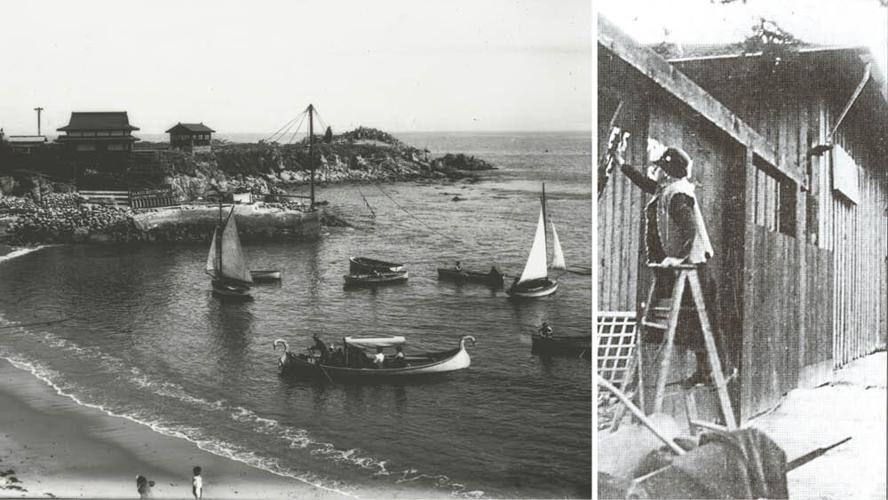
(left) Lovers Point in 1907, about eight years after Julia Platt arrived in Pacific Grove. The beach was a popular tourist destination, and included a Japanese tea house and glass-bottom boat tours. Platt took it upon herself over the years to keep the area clean and planted with flowers. (right)
Julia Platt made sure a news photographer was on hand when she demolished the gate blocking public access to Lovers Point Beach in 1930. Platt contended that state law and the original deed mandated public access. The owner of the bathhouse concession, Mattie McDougall, argued the declining morals of the public made the deed null and void. After the gate came down, McDougall gave up and the gate remained open.
At the time, scientists believed that each of the three layers gave rise to the development of specific structures, distinct from one another. For example, it was thought the ectoderm could not create the same structures as the mesoderm, but Platt proved otherwise.
“The germ layer was kind of set in stone. To have someone challenge it, and especially a woman – she got a lot of flak, I’m sure,” Zottoli says. Her findings were refuted by other scientists at the time, but eventually confirmed.
“It was heartening to see that the male scientists in the end supported her findings,” he says. “She faced not only barriers of accepting women, but barriers of accepting the results that women found. She stood her ground, and in some of the cases it was proved what she found was correct.”
Platt likely faced constant challenges and misogynistic treatment during her academic career. In one “cruel” instance, says Zottoli, the men at Woods Hole played a humiliating practical joke on Platt as she was leaning over, collecting specimens from a floating platform. According to an account retold in the article, Platt’s “ample girth and weight” caused the platform to sink into the water. Several men took advantage of the situation by stepping onto the platform, sinking it further and causing Platt to get soaked.
Zottoli is unsure Platt ever knew if she was vindicated by scientists who affirmed her discoveries, after she left biology.
“Once she went into civic duty, she went into it 100-percent,” he says. “I don’t think she ever looked back.”
~ ~ ~
EXACTLY HOW PLATT LANDED IN PACIFIC GROVE ISN’T FULLY KNOWN. Platt herself wrote that she was “attracted by the little city’s world-wide fame in the field of biological research,” referring to Hopkins Marine Station, opened seven years before she arrived. It was directly modeled after the Marine Biological Laboratory at Woods Hole by Stanford University’s first president, fish biologist David Starr Jordan. Perhaps Platt hoped she could work there one day.
Platt retiring from science to a life in P.G. didn’t make sense to Zotolli, he says, until he found a letter she wrote in 1899 to Jordan, the day after she saw him give a talk at Hopkins. She had hoped to catch him before he boarded his train the next day, but missed him. In her letter she made it clear she had been trying for some time to find a teaching job.
“A year has passed in which no opportunity has offered,” she wrote. “I have about concluded that there is no chance for me.” She asked Jordan what he would do if he were in her position. Zottoli says he could find no reply.
“Without work, life isn’t worth living,” Platt wrote. “If I cannot obtain the work I wish, then I must take up with the next best.”
~ ~ ~
THE “NEXT BEST” WAS DIVING INTO THE CIVIC LIFE OF PACIFIC GROVE, although the townsfolk were surely scandalized by her initial presence: She was a single woman with a PhD, not afraid to speak her mind nor, it turns out, punctuate her arguments with a bang.
Soon after arriving, Platt purchased five lots extending from Laurel Avenue down 17th Street and built a cottage and planted a lawn and garden. In 1902 she was becoming increasingly annoyed by the fact that people’s chickens were roaming freely on the streets, making their way into her garden.
“These creatures appeared to feel that long and unprotected use of the lots which I had purchased gave them rights and privileges thereon which were not listed in my deed,” Platt wrote in an article looking back that ran in the Grove Above High Tide in 1930.
Platt asked the mayor for his permission to shoot the chickens. “Why certainly, certainly,” she remembered him saying, adding that he probably thought she’d never actually do it.
“However, I bought a second-hand pistol, opened the gate of my wire fence and dared the chickens to come in. Two of them accepted the challenge. Bang, bang, and two dead chickens were thrown over the fence.”
The neighborhood was in an uproar, charging that Platt had endangered the lives of passersby and neighbors. The town’s marshal told her permission was withdrawn.
A constable suggested she circulate a petition asking the town’s board of trustees to pass an ordinance prohibiting chickens from roaming the streets, which she quickly did. Platt began attending board meetings, anxiously waiting for the ordinance to be passed. Meeting after meeting went by with no ordinance, until finally, Trustee B.A. Eardley returned from a trip to Alaska, surprised to see that she was still waiting.
“Haven’t they considered your petition yet, Miss Platt? I move that it be made an order of business at the next meeting of the board,” Eardley said. The motion carried, and on Oct. 6, 1902, an ordinance prohibiting chickens and other domestic fowl running free was passed.
~ ~ ~
PLATT’S CIVIC CAREER WAS OFF. In 1903 Platt was founder of the Women’s Civic Improvement Club, serving as its first president. She also created the Neighbors Club dedicated to civic improvements, and later the What-Why Club, focused on discussing municipal issues.
She also continued to attend board meetings, and, as reported in a 1946 article in Game and Gossip, a city councilmember was quoted as saying, “There was a packed house every time the council met in those days, everyone would come to hear what Julia Platt would have to say. She never hesitated to disagree and always spoke excitedly what was in her mind, but it certainly made people take interest.”
Around town Platt could often be seen in old-fashioned long skirts, wearing a hat (some descriptions said the hats were “mannish,” others called them sun hats), carrying a basket and pushing a wheelbarrow with pruning shears, shovel and other tools to pull weeds and plant flowers to beautify public spaces. She is credited with single-handedly improving Lovers Point from a weedy, littered spot to one filled with plantings and flowers.
Platt did something else unusual for the time. As a single woman she adopted a son, named Harold Platt.
In 1922, piqued that the city’s board of trustees was considering waiving property taxes on property owned by the Boy Scouts, Platt wrote a scathing four-page pamphlet called “The Holy City.” She first took the adult leaders of the Boy Scouts to task for taking out loans from residents (she accused them of using the boys to “beg” for money) that they did not pay back.
Platt also lambasted the city’s trustees for accepting a deed from the Del Monte Co. for the property with racist deed restrictions, even though they were common for the day. Specifically that the property not be used or occupied by “Asiatics or negroes, nor conveyed by deed or otherwise to persons belonging to other than the Caucasian race.”

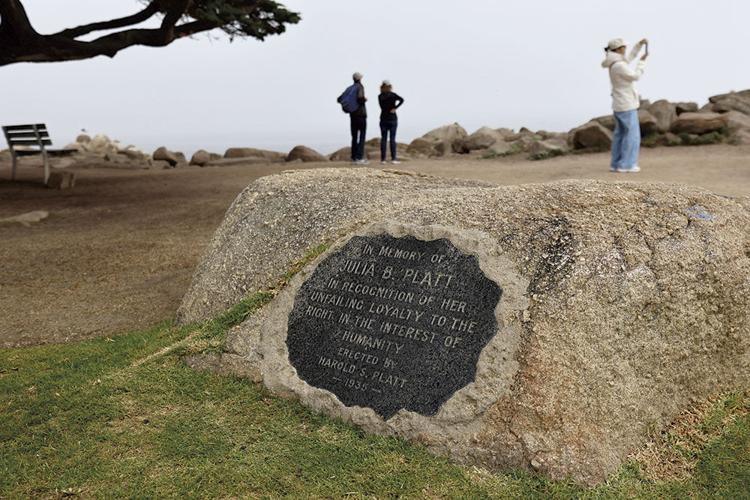
This bronze plaque in Lovers Point Park was dedicated to Platt by her son, Harold, in October 1935, four months after her death. “Today we have met to honor one who was outspoken in her beliefs; who was steadfast and unshakable in defending the civic interests; whose absolute integrity was never questioned; a woman of keen intellect, and highly courageous,” the Reverend Lee Sadler, of First Christian Church, said in his remarks for the occasion, as reported in the Pacific Grove Tribune.
Platt pointed out that Article 14 of the U.S. Constitution prohibited states from making or enforcing any law which impedes the privileges of citizens. She asked if the trustees “wished to teach the Boy Scouts of Pacific Grove that the nation’s highest law is undeserving of respect?”
The next point struck right to the heart of the matter. Even if the trustees were ignorant of the fact that the restrictions were not enforceable under the Constitution, “might by its very presence be induced to believe in the authority of the restrictions?”
~ ~ ~
OVER TIME, PLATT BECAME CONVINCED THAT P.G.’S FORM OF GOVERNMENT WAS LACKING. She and other residents wanted a council-manager form of government, that combined an elected city council with the appointment of a professional city manager. The town was getting bigger, and there were issues arising that Platt felt were beyond the capabilities of a volunteer board of trustees to manage.
Platt is credited with writing the town charter in 1927 as a representative of the Board of Freeholders, a group of town businessmen and others that included W.R. Holman of Holman Department Store. “Miss Platt’s charter,” as one opponent referred to it, included creating a seven-member elected council, which stands to this day. It was unsuccessfully challenged in 2022 with an amendment to change to a five-member council, and is back on the ballot as Measure Z this Nov. 5.
The campaign fight over the charter election was fierce, with both sides making their cases known in the local newspapers and on the streets. Holman wrote his own circular making the case for a charter, as chronicled in the book My Life in Pacific Grove, by Holman, then later annotated and edited by Heather Lazare, and published in 2022. Platt employed members of her Neighbors Club to round up votes.
A record number of Pagrovians showed up to vote. The charter won, 614-570. A municipal election followed in June to elect a mayor and six councilmembers.
As Palumbi and Sotka point out in their book, Platt included in the charter the very wording that helped bring Monterey Bay back from the brink of destruction in later years. In Section 3, titled “Inalienable Rights of City,” she included ownership of “lands under water” as one of those rights.
“This declaration puts the protection of the sea firmly in the hands of the town of Pacific Grove, a responsibility that Julia pursued single-mindedly through the last decade of her life,” Palumbi and Sotka wrote.
~ ~ ~
THERE’S AN OFTEN-TOLD STORY that Platt ran for mayor in April 1931 as a result of exasperated city councilmembers saying something to the effect of, “Well if you think you can do a better job, why don’t you run for mayor?”
Platt may have had another more compelling reason to run. A news story originally published in the San Jose Mercury Herald and reprinted in the Semi-Often, a P.G. newspaper, reported that Platt thought the success of the council-manager form of government depended on a change in the current administration. She told the reporter that she had recruited several businessmen to run for mayor, but all had declined. She would have to run herself.
“‘I’m no politician,’ she declares. ‘And I have no ambition to become famous as Pacific Grove’s woman mayor. I really don’t see what age or sex has to do with it, anyhow,’” the paper reported.
During the campaign for mayor she had to dispel a rumor that she was an atheist, which could have impacted her chances of winning in a predominantly Christian town. Platt took out an ad in a local paper declaring that she certainly was not an atheist; she was a Unitarian.
Platt won the election, 942 to 440, against the incumbent mayor. Her win made national news; even the Boston Globe devoted an entire column to her win and reported favorably on her first few weeks of administration.
~ ~ ~
NOW IN A POSITION OF POWER, Platt was able to leverage it on behalf of Monterey Bay. From her home at the corner of Ocean View and Grand that she named Roserox, with a large picture window that overlooked the bay, Platt had a front-row seat to the pollution from fishing and canneries, just on the other side of Hopkins Marine Station in Monterey.
Platt could foresee the worst that could happen to the bay should the overfishing and pollution continue. But, says Palumbi, she knew it was too big of a problem to solve herself. There were too many powerful interests that wanted the industry to remain in operation. Instead of throwing up her hands, she asked herself what she could do, he says.
Platt had inserted that phrase “lands under water” into the city’s charter, although she knew the state, not cities, owned underwater lands. Now as mayor, her solution was to write a state law that granted P.G. title to the land off its shores, along with some nearby lands. She drafted the scientists at Hopkins as her allies, and convinced the P.G. City Council to petition the California State Legislature for passage of the law.
On June 19, 1931, Gov. James Rolf signed the law into effect. A year later, the P.G. council passed an ordinance that was a local version of the act.
With this legal authority, Platt was able to create what Palumbi and Sotka called “a trust fund for future residents of Monterey Bay,” by establishing two protected areas off the coast. She designed the Hopkins Marine Life Refuge along with the Pacific Grove Marine Gardens along the city’s coast. In doing so, she stopped the possible creep of further industrialization of the rest off the coastline, starting after the Hovden Cannery, now the Monterey Bay Aquarium, next door to Hopkins.
“Both of these were unprecedented at the time,” Palumbi says. Platt’s vision, in 1931, was that these protected areas would become the nursery from which you could propagate sea life to help restore the rest of the bay. “She created a legacy for the future,” he says.
The bay eventually recovered ecologically, and in 1992 the Monterey Bay National Marine Sanctuary was created, stretching 276 miles from Marin County to Cambria. The Hopkins Marine Life Refuge and Pacific Grove Marine Gardens were combined in 2007 under the California Marine Life Protection Act, and renamed the Lovers Point Marine Life Refuge. Another refuge was created outside of the Aquarium, named after marine biologist Ed Ricketts.
Local marine scientists thought that naming a protected area after Ricketts – who supported his family by collecting and selling specimens from P.G.’s coastline and never advocated for setting aside protected areas – was unfair, Palumbi says. They requested the state rename the refuge after Platt.
On Oct. 1, 2014, the area officially became the Lovers Point-Julia Platt State Marine Reserve.
~ ~ ~
PLATT COMPLETED HER TERM AS MAYOR IN 1933. She died of a heart attack on May 31, 1935, at the age of 78. It was the year after her son Harold had married at Platt’s Ocean View home, when he was around 29 years old.
Platt’s will stated that she wanted to be buried at sea, which at that time meant 12 miles offshore. Her body was wrapped in canvas and placed in a wicker basket covered with flowers, fitting for her many years of beautifying her adopted hometown.
The custom was for city councilmembers to accompany the body of a mayor to their final resting place, so the P.G. City Council boarded the motor boat The Two Brothers with Platt’s body and headed out to sea, as described by Palumbi and Sotka based on historic reports. The waves were choppy and a few councilmembers reportedly were seasick, with some wishing they could trade places with Platt. Some accounts quip that it was an outspoken Platt getting in the last word with the council.
When they reached their destination, they affixed a 50-pound metal wheel to her chest and put her in the water feet first. “Accounts say that her body bobbed to the surface once, with her head above water, as if she were taking one last look at her beloved coastline,” Palumbi and Sotka wrote.
Harold Platt had a bronze plaque in granite stone dedicated at Lovers Point, within view of her home Roserox. “In memory of Julia Platt; In recognition of her unfailing loyalty to the right in the interest of humanity.” (
Sadly, Harold and his new bride were killed in an auto accident the next year. Roserox was sold by her estate and Platt’s money was left to the children of her sister Clara.)
There is a lesson of hope from Platt’s life, Palumbi says. If people are willing to work toward making things better, they can make a difference that last generations into the future. “That’s one of the lessons I take from Julia,” he says.
When Palumbi feels overwhelmed by big problems like climate change or kelp forest restoration, he remembers Platt, who saw a problem too big for her to solve, so she devised a plan to make a difference where she could. In his work, he now focuses on saving what can be saved, to help the planet recover later.
“I’m doing a Julia,” he says.
(2) comments
What a tale of bucking the system. She should be an inspiration to all who perecive wrong that needs to be righted. Some of my earliest memories are of the beach at Lovers Point, which was wonderful fun in the early 1950s. I can certainly see why she wished to beautify our area, and preserve if for posterity.
Thank you for writing this article! I read a book called Death and Life of Monterey Bay that focused on Julia Platt. She was instrumental in saving Monterey Bay.
Welcome to the discussion.
Log In
Keep it Clean. Please avoid obscene, vulgar, lewd, racist or sexually-oriented language.
PLEASE TURN OFF YOUR CAPS LOCK.
Don't Threaten. Threats of harming another person will not be tolerated.
Be Truthful. Don't knowingly lie about anyone or anything.
Be Nice. No racism, sexism or any sort of -ism that is degrading to another person.
Be Proactive. Use the 'Report' link on each comment to let us know of abusive posts.
Share with Us. We'd love to hear eyewitness accounts, the history behind an article.