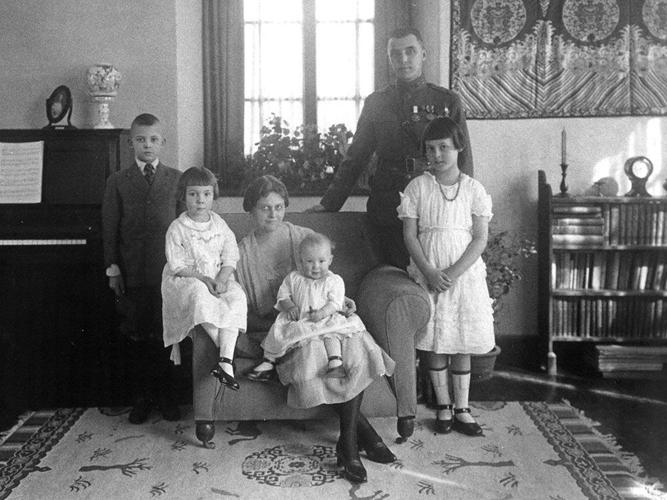



“Stilwell’s family was his fortress where he felt secure, where he loved and felt loved,” his great-granddaughters said in remarks in Chongqing, China, in August. The photo above shows Joseph and Winifred Stilwell and their children at home in Peking, circa 1922. From left to right: Joseph Jr., Winifred (“Doot”), Alison and Nancy.
Dignitaries gathered in August at a museum dedicated to an important figure from World War II. As with most such events, speeches were made and cameras rolled to capture the occasion.
Newspapers and television duly reported on the ceremony – except in the U.S., where recognition of the 140th anniversary of General Joseph Stilwell’s birth year was met largely with silence.
The setting was counterintuitive, perhaps: Chongqing, a city in the People’s Republic of China and home to the Stilwell Museum, the only venue in that country dedicated to the life of an American officer. “Vinegar Joe” was the scourge of many a less aggressive colleague, but also a quiet Carmel family man who liked to, as he described it, “putter around” the yard and roam Carmel Beach with his dog.
The war took him to China, where he tirelessly set about the unenviable task of holding together a fractured resistance during a critical period of the war. For this reason, says John Easterbrook, grandson of the general, “The Chinese know him better than Americans do.”
Easterbrook did not attend the ceremony in Chongqing – his daughters did, and delivered remarks – but he extended a thank you by mail to the Chinese government.
A month later, he received a reply. “I truly feel from the Stilwell family the friendly sentiments of the American people toward the Chinese people,” read the note. It praised Stilwell’s efforts during the war and declared him an old friend. “The people form the foundation of the China-U.S. relationship,” the letter continued, “and people-to-people friendship is the source of its growth.”
The sentiment may be surprising, considering the strained relationships between the U.S. and China. But it is made more extraordinary by its author – Xi Jinping, president of the People’s Republic of China.
“I don’t know of any other precedents of Xi Jinping – or other Chinese presidents – writing letters to foreign private citizens,” reports Dr. Vincent K.L. Chang, a professor at Leiden University in the Netherlands and senior research fellow at the Leiden Asia Center, by email. “At the same time, I also don’t know how often American citizens have sent friendly letters to the Chinese president. The recent developments strike me as rather unique and trend-breaking.”
The anniversary celebration and the exchange of pleasantries – Xi’s letter ends with a conversational “you are all welcome to visit China more often” – mark a transformation in the country’s diplomatic approach to the U.S.
For Stilwell’s descendants, who still have close ties to Monterey County, the softening tone seems to be bringing this diplomatic relationship full circle.
IN THE AFTERMATH OF THE COMMUNIST VICTORY over Chiang Kai-shek’s forces in 1949 that saw the nationalists flee to Taiwan, the official version of China’s involvement in World War II was framed as a distraction from the more significant class struggle that brought the communists to power. But that began to change in the 1980s, as the state began to drop the ideological narrative in favor of a national struggle by an embattled, long-suffering people.
According to professor Chang, this message was given greater refinement and emphasis starting in the 2000s, first by Hu Jintao’s government and then under the direction of Xi. Central to this telling are the Chinese people united against a common foe and the Communist Party’s contribution to the global coalition against Axis aggression.
The Stilwell museum was established in 1991, on the 45th anniversary of the general’s death in 1946. Along with a museum dedicated to the Flying Tigers, it became an important part of establishing this story, with renovations to the Chongqing facility occurring periodically, beginning in 2000.
“In today’s China, these historical narratives ultimately must fit within the centrally drawn bounds,” Chang relates. “But in this case, top-down and bottom-up dynamics are not conflicting. I personally know several people in Chongqing who have been involved in the curation of the Stilwell Museum exhibition, and they are all strongly dedicated to keeping this aspect of the city’s history alive and accessible.”
That spirit, when applied on an international scale, is known as “people’s diplomacy,” a bottom-up tool for improving state-to-state relationships. Xi also wrote a complimentary letter to surviving members of the Flying Tigers and China’s envoy to Washington, Qin Gang – outfitted in an American flying jacket of the era – addressed a reunion of the airmen who volunteered to fight in China.
Yuan Jiajun, a member of China’s 24-person Politburo, was on hand at the Stilwell Museum celebration, greeting Susan Cole and Nancy Millward – Easterbrook’s daughters and the general’s great-granddaughters.
In an email, Liu Pengyu, a spokesperson for the Chinese Embassy in the U.S., explains the significance of Xi’s letter to Easterbrook. “President Xi noted that to grow China-U.S. relations, the hope is in the people, the foundation lies among the people, and the future lies with the youth,” Liu writes. “The letter fully reflects the high importance that President Xi Jinping places on closer exchanges and communication between the people of the two countries.”
Liu notes there are 284 pairings between Chinese and American jurisdictions, like sister city relationships. While these cultural connections might look like they matter just at the surface level, they represent something more meaningful when it comes to China’s international relations strategy. “We are committed to working with the U.S. to explore the right way to get along with each other as two major countries, and China has always supported and encouraged people-to-people exchanges between the two countries,” Liu adds.
Xi and President Joe Biden met last year in Bali. Even as they disagreed about issues such as Chinese aggression in Taiwan, the White House’s official report of that meeting emphasizes the importance of interpersonal relationships, something both world leaders agreed with: “[Biden and Xi] also noted the importance of ties between the people of the United States and the People’s Republic of China.”
According to Chang, China’s leadership sees the diplomatic cold shoulder from the U.S. as both unnecessary and frustrating. People’s diplomacy – which includes visits with those considered friends, such as Henry Kissinger and Bill Gates – is a way to build alliances, one small group at a time.
Stilwell is crucial as a foundation for this type of diplomatic engagement. He fought alongside Chinese forces. He worked with the communist forces and contributed to the nation’s war effort.
“The [Chinese Communist Party] leadership is aware of its limited appeal in other parts of the world,” Chang explains. “Seen from this perspective, it is obvious that the Chinese government would engage positively and enthusiastically with Stilwell’s descendants.”

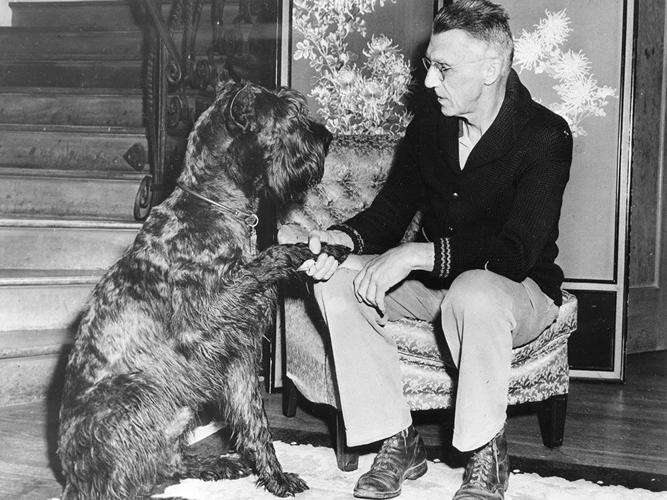
Joseph Stilwell with his giant schnauzer, Gary, at the family’s home in Carmel.
THE GENERAL AND HIS WIFE, Winifred, had chosen a bright Sunday morning to entertain junior officers newly posted to Fort Ord, where Stilwell served as commander of the 7th Infantry Division. The couple welcomed the group to their home in Carmel. And the day was nice enough that doors to the garden were left open, allowing the outside to flow in.
It was Dec. 7, 1941.
In her Pulitzer Prize-winning biography, Stilwell and the American Experience in China, 1911-1945, historian Barbara Tuchman describes the hasty scramble to plug in a radio after a phone call alerted them to the attack on Pearl Harbor, followed by the stunned consternation. “The realization flooded over them: out there, on the immense ocean beyond the window, war had begun,” Tuchman wrote.
Although initially tapped to lead the invasion of North Africa, Stilwell was instead sent to China to serve as military attaché to nationalist head Chiang Kai-shek, as well as commander of the China-Burma-India theater of operations. It was a proper choice, considering his background. Stilwell served three tours in China between the World Wars, using that time to become familiar with the armies, the people and the language. But it was a post many considered a backwater.
During World War II, Stilwell would not lead large armies. He spent more time cajoling, trying to keep up resistance while balancing the political whims of the British, the divided nationalist and communist armies, as well as his own government with the limited supplies at hand. He was removed from command – Stilwell was famously unimpressed by Chiang and his corrupt regime, dismissing him in private correspondence as “peanut” – and sent home a year before war in the Pacific came to an end.
Yet Stilwell became one of the war’s most notable figures. When he returned to Carmel in 1944 awaiting reassignment, Life magazine devoted several pages to a photo essay on the general and his dog, Gary, at play on Carmel Beach.
His public stature grew, even in defeat. Following a disastrous 1942 campaign in Burma that saw him lead a lengthy retreat over difficult terrain, Stilwell famously told reporters, “I claim we got a hell of a beating. We got run out of Burma, and it’s humiliating as hell. I think we ought to find out what caused it, go back and retake the place.”
“His words to the press after the walkout were blunt and straightforward,” Easterbrook observes. “Here was a guy who was telling the truth. It resonated with the public.”
Stilwell’s acerbic honesty earned him the nickname “Vinegar Joe.” But his care for the rank and file brought him a very different sobriquet: “Uncle Joe.”
Stilwell was responsible for installing a soldier’s club – reputedly with the longest bar in California – for enlisted men at Fort Ord. Even after the war, while in charge of the Presidio in San Francisco, the general would drop by to check on the facility, later known as Stilwell Hall. In the field, he cared little for the ceremony accorded to officers and would carry a rifle alongside the men.
He also had great respect for the ability of Chinese soldiers when under competent command. He helped initiate the effort to reach out to communist forces and constantly urged Washington to shift more equipment and other forms of support away from Chiang and to the Red Army, later known as the People’s Liberation Army.
Stilwell died in 1946 from cancer, while still on active duty. Upon hearing the news, the Chinese general responsible for organizing communist forces, Zhu De, honored him as a great general and great friend to the Chinese people.
During the recent ceremony hosted by China in Chongqing, Stilwell’s great-granddaughters joined with Zhu’s great-grandaughter and great-grandson to plant a friendship tree at the museum dedicated to Stilwell’s time in China.
MARKERS CELEBRATING STILWELL’S LEGACY are less impressive on this side of the Pacific. Stilwell Hall is gone, but there’s a community center, a park, an elementary school and the like that bear his name.
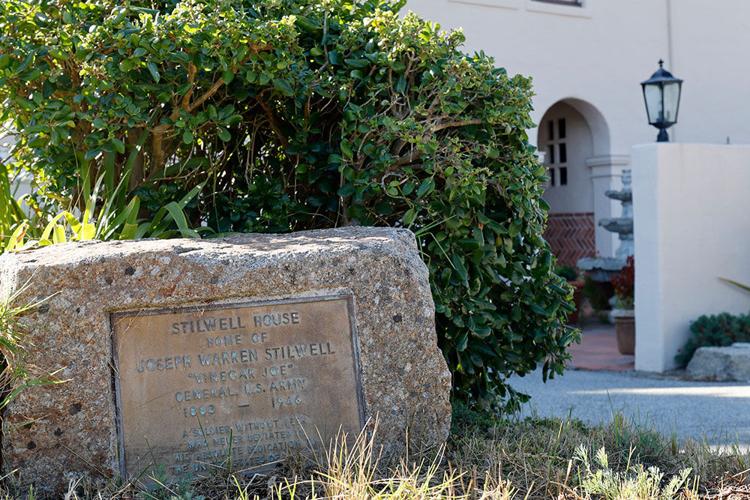
A plaque, mounted on a stone at the foot of the driveway, announces the historic significance of Stilwell’s former Carmel residence to passersby. “A soldier without peer who never deviated in his absolute dedication to the United States of America,” it reads.
“He was always talking about getting back to Carmel,” Easterbrook observes. “He could take out his frustrations on the bushes and trees. He could be a regular guy. There are all these references to Carmel in his diaries.” (When they spoke in Chongqing, his great-granddaughters described Stilwell’s extensive diaries as intensely private.)
The future general first saw the Monterey Peninsula as a young officer fresh from the U.S. Military Academy at West Point, New York on his way to duty in the Philippines in 1904. Several years later, he was posted at the Presidio in Monterey and scouted Carmel with his wife.
In Tuchman’s account, “Taking picnics on the beach and windswept walks on rocks pounded by the Pacific, they decided that here was the place where they wanted to live someday and make their home after retirement.”
Stilwell returned to Carmel in 1920, purchasing five lots close to the shore at Carmel Point. It took almost 15 years – a career soldier can rarely settle in one place – but the couple finally had a two-story house constructed on Inspiration Avenue for a sizable sum of $27,000.
It became home when Stilwell was assigned to Fort Ord in 1940. And it became a beacon for him during the turmoil to follow.
Writing to Winifred from China in 1942, Stilwell asked her to “Take a look out the window and give me by telepathy an idea of the patio, and flowers, and fish pool and lawn, the trees, the ocean, Point Lobos… ”
In another letter published by Theodore White in The Stilwell Papers, he laments “Don’t know where I’ll be for Christmas – maybe back here, maybe in India. It doesn’t matter a bit because I won’t be in Carmel.”
Taking command in San Francisco in 1946, Stilwell’s duties involved not only the Presidio, but also frequent trips to Washington, D.C. and other locations around the country. Yet his diaries continue to point to Carmel as his destination.
The entry for Jan. 20, 1946 has Stilwell arriving at the airport in Monterey in the early morning hours. “Got a car promptly,” it reads. “At Carmel, house shut tight. No answer to bell or yell. Finally got Win up.”
When home, he would tend to the landscaping. He always made an entry if he spotted a pheasant. March 17 was a bonanza in terms of bird watching: “Pheasants at our place (2) & Odells (4). They came at my whistle.” A few days later he observed “Two pheasants in Jeffers’.”
As the year progressed, there were increasing mentions of medical checkups. On Sept. 16 he was at the doctor to have “my belly looked at.” The result wasn’t promising. “Sure enough, something suspicious about liver.”
A few days later, the diary stops. Stilwell died in San Francisco less than a month later, on Oct. 12.
While he never had the chance to experience retired living at the house he had built, it remained in the family. “My grandmother was living in the house,” recalls Easterbrook, who was 6 when his grandfather died. “It was always nice to go back to Carmel. That was home.”

The Stilwell family home on Carmel Point. A private residence, it is still marked with a plaque indicating its historic significance.
CARMEL BECAME HOME not only for Stilwell in his later years, but also for two of his five children, Nancy Stilwell Easterbrook (Easterbrook’s mother) and Alison Stilwell Cameron (Easterbrook’s aunt). While they were raised in China by their general-father before returning to the United States, their lives always straddled both countries.
Meanwhile Cameron was establishing herself as a painter. She studied at Peking American School in Beijing, where she became one of very few Americans invited to study traditional Chinese painting technique under the mentorship of Prince P’u Ju and Yj Fei-An. The teaching technique was to learn upside down, sitting across the table from her instructor, according to a 2000 bulletin about Fort Ord history by the Monterey History and Art Association.
She held her first solo show at age 17 at the Peking Institute of Fine Art. At 19, back in the U.S., her art was exhibited in California Hall on the campus of UC Berkeley.
The family established themselves in Carmel; Cameron went on to paint a mural for Stilwell Hall on Fort Ord – it’s a windswept landscape in the Chinese style that she practiced. Her large-format landscapes featured recognizable local scenes of cypress trees on the coast, in the traditional Chinese style she’d studied as a teen. She also published a book on Chinese painting technique, and in her later years, showed her work at a gallery in Carmel.
It was not until 1979 that Nancy and Alison were finally able to visit China again, as relations between the two countries began to thaw after 30 years of tension. Easterbrook says his mother, Nancy, never forgot the Mandarin she’d learned as a child. She was rusty and took language classes in China, but regained her fluency. And as international travel picked up, the sisters began to lead tours for American visitors.
The sisters spoke to their tour members about how to further deepen a connection between the two counties, and from their guests, successfully solicited the first donations to what would become the Stilwell Scholarship.
The scholarship program supports Chinese students with $10,000 to study at what is now called the Middlebury Institute of International Studies at Monterey. (Nancy later donated a rental house in Carmel to MIIS, which the school sold after her death in 1997, endowing the scholarship.)
Since it launched in 1982, the Stilwell scholarship has supported more than 60 scholars from mainland China studying in the U.S., with at least $10,000 each. (The 2023-24 scholar, Da Sun, was just selected for studying translation and localization management.)
Easterbrook has traveled to China seeking donations from that side, as well, and has forged and maintained relationships with the scholars over the years. “It’s my grandfather’s legacy,” he says. “We want to keep that alive. We think it’s very important for not only this country and China, but for the world, that we stay friendly.”
While the scholarship represents a grand view, for the scholars who receive funds, it is far more personal. For Xiaoyan “Grace” Shen – a former scholarship recipient and now an associate professor at MIIS – it changed her life.

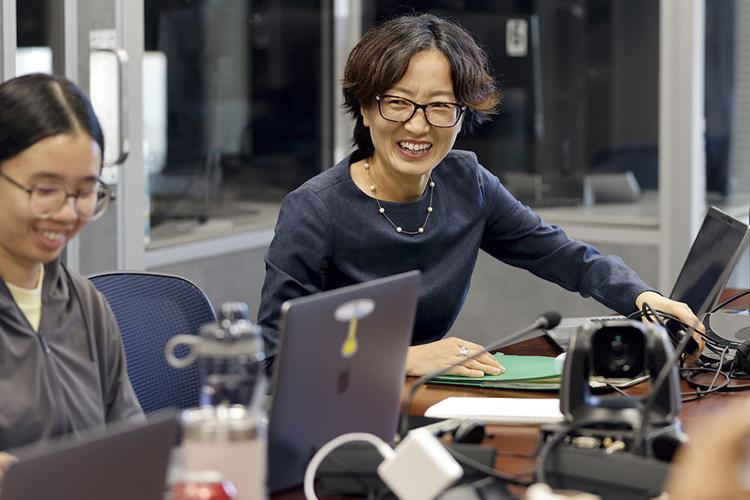
Xiaoyan (Grace) Shen teaching at the Middlebury Institute of International Studies. Her first opportunity to study and live abroad was supported with a Stilwell scholarship in 2007 at MIIS. She has translated for dignitaries including Jimmy Carter, Madeleine Albright and Tony Blair.
IN 2007, SHEN WAS A YOUNG PROFESSOR teaching English and interpretation at a university in Xi’an, China. She wanted to advance her career, and applied to study conference interpretation at MIIS, which would also be her first trip to the United States.
She’d never heard of General Stilwell (or the scholarship in his name) until she received a letter from MIIS congratulating her on a gift of $12,000, enough to cover roughly half her tuition in that time. Then came a letter from Easterbrook.
“I remember what I said exactly,” Shen says. “I don’t know what I can do to pay you back, but in Chinese we say, ‘For a drop of kindness, we will pay you back with a river of gratitude.’ He wrote back and said, ‘You don’t need to pay us back. What you can do is to help others one day, when you can.’”
For years, the help came in Shen’s direction. Her visa application went through instantly, something she attributes to a kind endorsement from Easterbrook. When she arrived at age 30 in the U.S., living abroad for the first time, he came to Monterey to show her around. He and previous scholars prepared a guide to what to know about living in Monterey for Chinese students, what Shen calls an “encyclopedia,” with information on where to shop for Chinese food and medicines.
Shen started as a second-year student, and completed her year of study, and had planned to go back to China, but her plans changed. Instead, she got a job teaching Chinese and decided to stay in the U.S.
But Shen grew tired of teaching Chinese. To advance her career and do conference interpretation, she’d have to go back home to China, where everything had changed.
She experienced culture shock returning to her home country. She was working as a freelance interpreter and teaching as an adjunct professor, struggling financially – not what she had dreamed of. “When I was back in China, it was one of the hardest times in my life,” Shen says.
During that difficult time, she kept up a correspondence with Easterbrook, who extended the kindness and support she needed in that 10-year period.
With instant recall, Shen can summon the specifics of times that Easterbrook reconnected. June 3, 2013, she offers – the date corresponded to a photo exhibition for a 100th-anniversary Stilwell event – Easterbrook was coming to China to give a talk, and Shen was eager to serve as his interpreter.
A subsequent event in 2017 became an important event for the Stilwell scholarship, in that it was the first time the family sought donations from China, and secured a significant gift from an anonymous Chinese donor, expanding the scholarship by 250 percent for 10 years.
And it helped further solidify Shen’s connection to Easterbrook and the scholarship fund that had helped her come study in Monterey years earlier.
“We are like family,” Shen says.
That close relationship again became critical when, finally, Shen got her career on track with her dreams. In 2019 she got a job at MIIS, and returned, this time to teach translation and interpretation. But she struggled again, acclimating to a new environment. “It was quite challenging,” Shen says. “It was John, again, who cheered me up and encouraged me to overcome all the challenges.”
She stuck with it. Her contract at MIIS was renewed, and for the academic year 2021-22 she received the Faculty Excellence Award. In a statement about the recognition, administrators described her approach to teaching as more akin to coaching – something Shen agreed with.
“In Chinese, 教育 (education) literally means ‘teaching and nurturing,’” she said at the time, explaining her goals: to foster “an empowering community in which the students’ experience is more ‘living in translation’ and ‘growing in translation’ instead of getting ‘lost in translation.’ This humanistic approach, I believe, is going to further consolidate our world-class translation and interpretation program.”
The concept is remarkably similar to the idea from the Chinese government about how to forge diplomatic relations: humanistically.

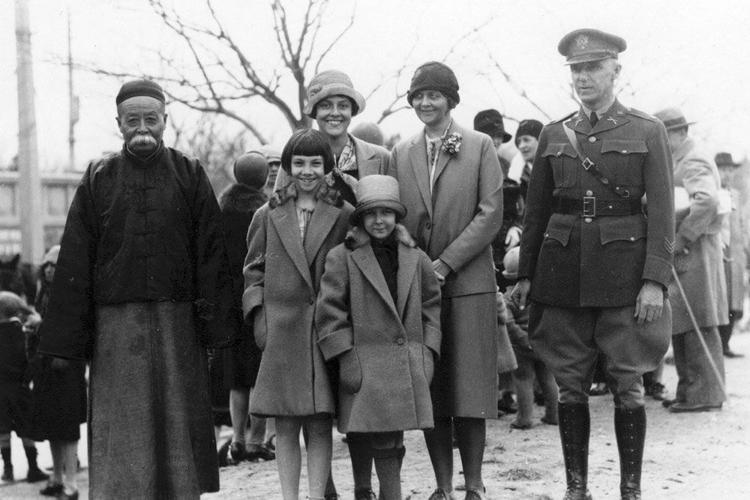
Tutor Guan Wenchun (left) lived with the Stilwell family on each of the general’s assignments in China in the 1920s and ’30s. “He became like a grandfather to the Stilwell children,” grandson John Easterbrook says. Joseph and Winifred are at the right, in the late 1920s. Daughters (tallest to shortest) are Nancy, Winifred (“Doot”) and Alison.
“THIS IS PART OF THE LEGACY– friendship with the Chinese people,” Easterbrook says, adding that the family remains in touch with Stilwell scholars. “They’re like daughters and sons.”
Text panels in the Chongqing Stilwell Museum continue this thread, praising in Stilwell’s service a “historical basis for developing friendly relations between the two peoples.” In the museum and in personal diplomacy, there is no residue of trade wars, of TikTok bans, of threats toward Taiwan.
There is a sense that Stilwell is an old friend.
“This is not mere rhetoric, but reflects actual policy,” professor Chang points out. “It is part of a broader effort by the Chinese state to use the memory of World War II for emphasizing its contributions to the world and improving friendly ties with the U.S.”
So an official ceremony at the only museum in China dedicated to an American general who lived in Carmel may not have gained much attention in the U.S., but the news featured prominently in the People’s Republic.
“They knew Stilwell as a friend,” Easterbrook says. “The Chinese people never forget a friend.”
(0) comments
Welcome to the discussion.
Log In
Keep it Clean. Please avoid obscene, vulgar, lewd, racist or sexually-oriented language.
PLEASE TURN OFF YOUR CAPS LOCK.
Don't Threaten. Threats of harming another person will not be tolerated.
Be Truthful. Don't knowingly lie about anyone or anything.
Be Nice. No racism, sexism or any sort of -ism that is degrading to another person.
Be Proactive. Use the 'Report' link on each comment to let us know of abusive posts.
Share with Us. We'd love to hear eyewitness accounts, the history behind an article.