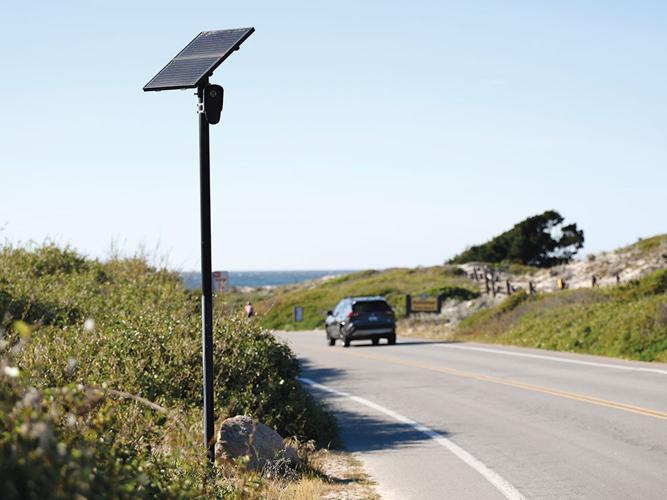


More than 300 automated license plate reader cameras have been installed around Monterey County in recent years by the company Flock Safety, in partnership with local law enforcement agencies (including in Pacific Grove, shown above).
THEY’RE WATCHING YOU – more than 300 automated license plate reader (ALPR) cameras in Monterey County alone – snapping point-in-time photos of your vehicle as you drive from home to work and everywhere in between, and storing the data in a cloud for law enforcement agencies, who use the data to track down stolen cars, missing persons and fugitives on the run.
The system of interconnected cameras in the county is courtesy of Flock Safety, an Atlanta-based company that runs a nationwide network of ALPR cameras used by roughly 5,000 law enforcement agencies across the country.
Although law enforcement agencies own the data collected by the cameras, Flock Safety owns the cameras. Law enforcement agencies pay to access the data they collect, which is stored on an Amazon Web Services Government Cloud until it’s deleted, generally within 30 days after its capture. The company states that the cameras only collect license plate numbers and vehicular features such as make, model, color and characteristics like dents, alterations and bumper stickers, and do not capture biometric data about drivers or passengers.
In Monterey County, law enforcement agencies in the cities of Salinas, Seaside, Monterey, Pacific Grove, Del Rey Oaks/Monterey Regional Airport, Sand City, Soledad and Greenfield, as well as the Monterey County Sheriff’s Office, all contract with Flock Safety. Although there is no official countywide map of all license plate reading cameras, camera locations in the City of Monterey are available on the city’s transparency portal. An unofficial open source map of the camera locations is posted at deflock.org.
State laws regulate which agencies California law enforcement can share ALPR data with. Senate Bill 34, passed in 2015, prohibits agencies from sharing ALPR camera data with out-of-state and federal agencies to prevent misuse of the information and to bolster privacy protections. And SB 54, known as the California Values Act, passed in 2017, prohibits state and local law enforcement agencies, including school police and security departments, from using money or personnel to investigate, interrogate, detain, detect, or arrest people for immigration enforcement purposes.
Due to public concerns and hard evidence that data collected by Flock Safety’s cameras had been inadvertently shared with out-of-state and federal agencies, including Immigration and Customs Enforcement (ICE), some jurisdictions in the state have recently decided to cancel their contracts with Flock Safety, such as Santa Clara County and the cities of Mountain View and Santa Cruz, which in January 2026 became the first city in California to end its contract with the company.
“Whether we are the first, second or last, our action is an act of defending the Constitution in the face of repeated efforts to get people to give up freedom for alleged safety which is not a trade I am willing to make,” Santa Cruz Mayor Fred Keeley says.
Keeley believes that the Santa Cruz Police Department did not intentionally share information with out-of-state and federal agencies, but that the information was accessed by other agencies nonetheless.
“I have voted against Flock because I believe that after 9/11, we were told to trade privacy for security,” he adds. “I was and am not convinced that such a trade is consistent with personal freedoms guaranteed under the U.S. Constitution.”
MONTEREY COUNTY SHERIFF TINA NIETO says she is “very supportive” of the use of ALPR cameras for investigative uses and stresses that they are not used for surveillance purposes.
“I know that there are groups out there that say, ‘Oh, they are surveilling the public,’ but that is against the law and it’s against my personal philosophy,” Nieto says. “We’re very aware of what’s happened with Flock, but the state laws are very specific. You cannot share the data outside of California with somebody else, because the feds could get access to it.”
Following the reports of breaches in other areas, the department’s IT team audited its Flock data to see if it was shared with an out-of-state or federal agency but did not find a breach and decided to keep doing business with Flock Safety.
However, a review of network audit reports – obtained by the Weekly through California Public Records Act requests (see p. 24) – shows a breach of state law, similar to Santa Cruz, occurred at the Monterey County Sheriff’s Office in 2025.
According to the Sheriff’s Office’s audit reports, the agency shared ALPR camera data with law enforcement agencies in numerous other states, including Colorado, Michigan, Tennessee, Massachusetts, Oregon, Texas, Utah, Rhode Island and others.
Nieto says that the breach of state law was unintentional and was not known to the Sheriff’s Office until the Weekly pointed it out. After studying the reports more thoroughly, Nieto says Flock Safety, not the Monterey County Sheriff’s Office, broke state law by allowing the department to share its data with out-of-state agencies.
“I was made aware that due to a statewide system configuration error by Flock, user agencies outside the state of California were able to do a query of the information in our database,” Nieto said. “After identifying this issue, Flock was able to make changes to the system configuration which prevented this from happening further. This feature was disabled for all California agencies in March 2025.”
Nieto says that despite the illegal data sharing, the Monterey County Sheriff’s Office will continue to use Flock Safety. “You don’t throw the baby out with the bathwater,” she says. “[It] shouldn’t happen again,” following changes made to the system by Flock Safety, she adds. Her department has explored other ALPR systems, but they are not cost-competitive.
“Right now, for us as a county, Flock makes fiscal sense, because we have invested the dollars in it. And it’s solving crimes that we would probably not solve otherwise.”
OTHER LAW ENFORCEMENT AGENCIES in Monterey County that use Flock Safety have shown only small signs that they are rethinking their relationships with Flock Safety or the use of ALPR cameras. Officials including Nieto and Seaside Police Chief Nick Borges express how useful of a tool the service is for their departments.
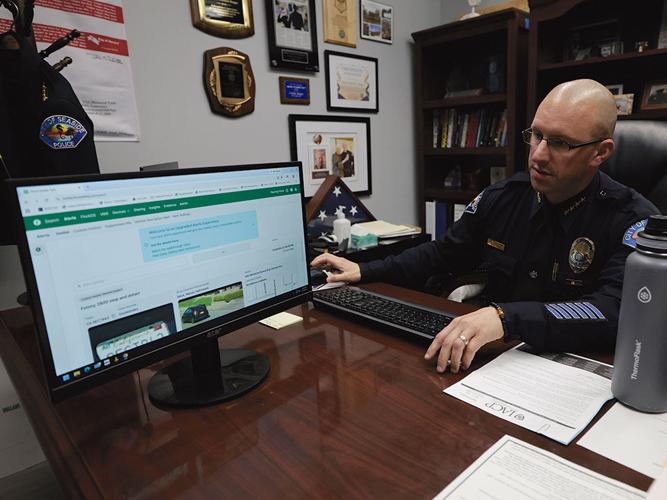
Borges invited the Weekly to Seaside Police headquarters to show how he and others in the department use the ALPR system, which sends alerts to officers’ phones when a vehicle of interest passes by one of the 30 cameras dispersed throughout the city, displaying an image of the vehicle, its plate number and last recorded location.
Borges says that once there is a “hit” on a vehicle they’re looking for, another will generally occur quickly, and officers can then determine which direction the vehicle is headed and make an arrest. He stresses that the cameras are not used for traffic or immigration enforcement.
“It’s been a really incredible tool for us to have and the biggest concern that I’ve been hearing lately is the concern of who we share [the data] with,” Borges says. “That’s why agencies or city governments have been dropping these things.”

Seaside Police Chief Nick Borges (top) shows how officers use the Flock Safety interface, which requires a case number associated with a police report in order to search for a vehicle.
According to Borges, the Seaside Police Department only shares the data collected by Flock Safety’s cameras, which is deleted 30 days after its capture, with agencies in California and one agency outside of the state: the Las Vegas Metropolitan Police Department. However, Borges says that the department is not breaking SB 34 because, “We can access their data but they cannot access ours.
“The reason we do that, and that was a recommendation from the company, is we’ve had a lot of people involved in high-level crimes and arrested them in Las Vegas,” Borges says. “People like to go to Las Vegas after they’ve committed a crime. That’s the only place outside of the state and we don’t share with federal entities.”
The department has to stay vigilant, though, with the Flock Safety software interface and Borges says they check it about once a week to ensure that the system is running as it should, nothing is being shared with the wrong agencies and nothing has been changed or hacked.
“This is technology,” Borges says. “This is computer software. It’s online. It’s in a cloud so yes, someone could potentially breach this and change our data. And that’s why we’re checking it regularly.”
Borges says that the department’s Flock Safety administrator may request or receive a request to share data with an outside law enforcement agency and if they are not careful, it is possible to click “yes” to a federal or out of state agency.
“If you’re not paying attention, you’ve just given that [permission] to ICE, or you’ve just given that to somebody you may not want to give that to in law enforcement.”
Sharing data with other law enforcement agencies, Borges elaborates, does not mean that another police department can pull an audit of every car that’s passed by an ALPR camera but can only see data for a vehicle that is associated with a crime or an investigation, as a vehicle search on the software interface requires a police report with an associated case number to curb potential abuse of the system.
Along with the ALPR camera system, the Flock Safety devices in Seaside are equipped with audio detection equipment that sends officers alerts for gunshots, fireworks, glass breaking and tire screeching.
“I really think this is a game changer,” Borges says.
“And it’s not just criminality, it’s also missing people. The same system that alerts about a stolen vehicle is also putting in Silver Alerts, Amber Alerts and Ebony Alerts – all of those things,” Borges adds, referencing California’s mass text message notification systems for missing children or at-risk adults. “If there’s a vehicle associated with any of those things, that vehicle will automatically be uploaded into this database.”
In one recent incident, the Flock system alerted Seaside PD to a stolen vehicle in the city. Officers responded to the alert and stopped the vehicle, and discovered it was stolen from San Antonio, Texas and was sold to the driver under false pretenses and at a low price that proved too good to be true.
In the policing era before the emergence of ALPR cameras, Borges explains, crimefighting took a lot more effort and motivation.
“In the old days, which was my era, you’re going to every business to try and find a camera. Then you’re trying to establish whether something is a Toyota or maybe a Mazda but it’s really blurry and it goes by fast,” Borges says. “If you have a good cop, they’re going to try and find cameras all throughout town, which is going to take all day.”
So for Borges, ALPR cameras save police officers and investigators time and energy and ultimately make them more effective at their jobs.
“My position is, if we are doing everything correctly and it’s working the way it’s supposed to, please don’t take this tool away from us,” Borges says. “If we do something wrong or make a mistake, we can totally understand that. But if it’s working and nobody’s privacy has been violated, and we’re totally monitoring this, this is one other tool that’s going to help us keep the public safe. I think it’s a phenomenal tool.”
THE INCREASED EFFICIENCY for police departments comes with a cost, according to retired attorney and retired professor of constitutional law and legal writing at Monterey College of Law Michelle “Mickey” Welsh, who voiced opposition to the initial installation of Flock Safety ALPR cameras in the City of Monterey in 2024.
For Welsh, police work should be difficult by design.
“Our system is designed to be cumbersome,” she says. “So that there’s a balance between ease of police operations and civil rights. It depends on your societal values and our society has always valued personal individual liberties above making it easier for law enforcement.”
Welsh penned a letter on behalf of the Monterey County chapter of the ACLU in 2024 to the Monterey City Council. The letter states, “ALPR systems will make our community less, not more, safe because they violate privacy, facilitate dangerous police stops, and risk exposing our immigrant community members to harm.”
(On April 2, 2024, Monterey City Council approved the police department’s recommendation to implement an ALPR system. The city now has 35 cameras installed.)

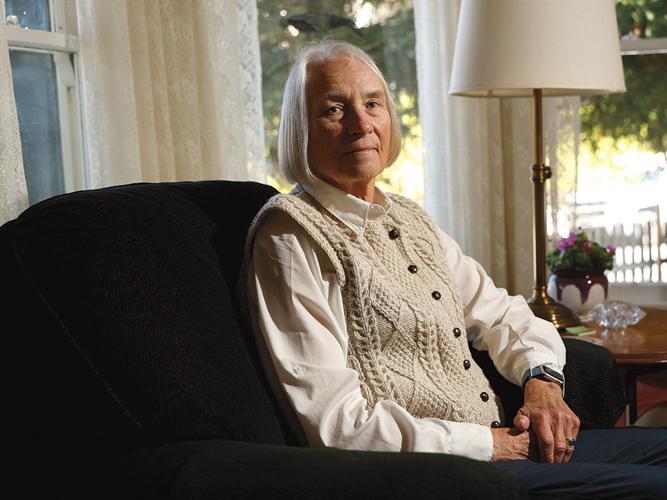
Michelle “Mickey” Welsh, a retired attorney and professor of constitutional law, says that the best way to prevent abuse of the data collected by automatic license plate readers is not to collect it in the first place.
“It’s very dangerous to begin conducting surveillance against ordinary people who have done nothing to violate any law whatsoever,” Welsh says. “There’s clearly not only no probable cause to be tracking people but there’s not even a reasonable suspicion that they’ve done anything.”
Welsh says that when Flock Safety or another ALPR camera service indiscriminately gathers data about the goings-on of every American with a vehicle with its nationwide network of cameras, it borders on breaking the Constitution’s Fourth Amendment, which protects people’s privacy and prohibits unreasonable searches and seizures by the government.
“That is exactly the kind of thing that our Constitution and our founders opposed,” Welsh says. “They had no clue that this level of sophistication would ever occur. But still, when the Fourth Amendment to the Bill of Rights was ratified, people were dealing with police coming into their homes – and this is not people coming into their homes and going through their papers – for which a warrant is clearly required. This is warrantless surveillance of everyone, everywhere.”
ALPR camera systems are legally allowed because they are posted in public roadways in plain view, where courts have found there is no reasonable expectation of privacy. Although police departments do have safeguards to prevent abusing the system, such as associating each license plate search with a police report, Welsh argues that the easiest way to prevent abuse of the system is to never gather the data at all.
Welsh says that for her, the issue has two aspects: the privacy violations that occur whenever someone drives through an intersection where a camera is recording, and what happens to the data after it is recorded and who has access to it.
“As they learned in Santa Cruz and Santa Clara [County] and many other places – over 30 jurisdictions have already canceled their Flock contracts or limited their use – the data has in fact been accessed, and has been accessed by other states and by federal agencies, to track people. And it has, in fact, been used to track protesters at rallies and it’s been used to identify and track undocumented people.”
In network audits produced by various local agencies in response to a Public Records Act requests, search time and date are listed on a spreadsheet for dozens of searches. (Some agencies also include license plate number, while others redact this information.) A column for “reason” mostly lists “investigation,” sometimes a specific felony charge, welfare check or missing person. One reason listed in a Seaside network audit on Feb. 3, 2025, is “immigration protest.”
Welsh is referring more broadly to incidents reported by organizations such as the Electric Frontier Foundation, showing that law enforcement agencies had conducted searches related to political demonstrations such as No Kings rallies, and Cal Matters, which found that California law enforcement agencies had shared data with ICE, a breach of the California Values Act.
IN THE CASES OF SANTA CRUZ AND THE MONTEREY COUNTY SHERIFF’S OFFICE, state law was broken when the departments shared data with outside agencies – unknowingly or not. After the news broke in Santa Cruz in late 2025, pressure from community members and groups, namely Get the Flock Out, the Santa Cruz City Council ultimately ended the city’s relationship with Flock Safety.
In Monterey County, no concrete community group has emerged to oppose the use of ALPR cameras, but there are individuals expressing concerns at local government meetings, such as Pacific Grove-based activist Colleen Ingram. Ingram is a co-founder of PG Progressives, helped restart Indivisible Monterey and is active with 50501 Monterey County.
“My primary concern is that the cameras are being used for much more than just license plate reading,” Ingram says. “It’s mass surveillance. It’s police-state surveillance that’s concerning.”
Ingram points out that the cameras are being sold to jurisdictions with the promise of protecting the public from murderers and kidnappers, but like Welsh, she believes that the drawbacks aren’t worth the benefits.
“We’re losing a lot of our rights and our privacy and they’re going to be weaponized against us at some point with this administration,” Ingram says. “And when people here bring up concerns about it, our cities just say that [Flock Safety] can’t do [illegal data searches] because it’s in our contract and we do audits. But how far do their audits go and how savvy are they with this technology?”
Ingram says she hopes local cities end their contracts with Flock Safety or at least allow the systems to be monitored or audited by a third party.
“Ultimately, they should be taken down,” she says. “But I know that’s not going to happen.”
SOME LOCAL OFFICIALS have expressed skepticism about the ALPR camera systems and illegal data sharing, like Soledad Mayor Anna Velazquez. In 2024, the Soledad City Council approved a contract with Flock Safety, and Velazquez says there weren’t many concerns about the system at that time.

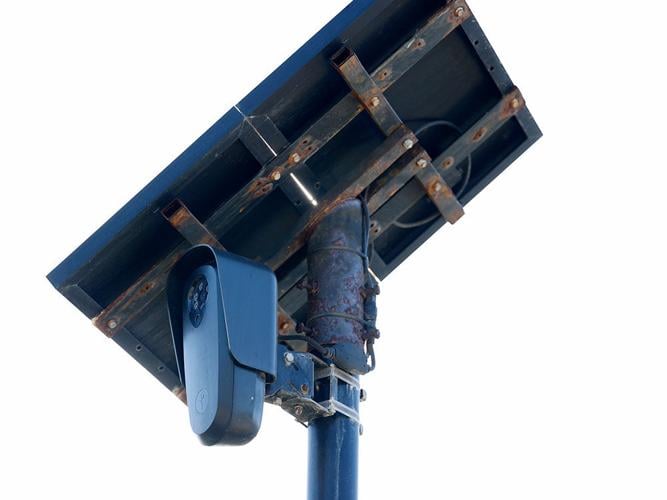
A Flock Safety camera in Pacific Grove is shown.
“When the City of Santa Cruz experienced their breach of contract, that’s when I started to get more concerned because we have that same system,” she says.
At a Soledad City Council meeting in late January, where a representative from Flock Safety gave a presentation about the system, Velazquez voiced those concerns and expressed the need for a local policy that would make it clear that Soledad would not share its Flock Safety data with federal immigration agencies.
“We want to ensure that we can keep our communities safe,” Velazquez says. “And at the same time, we want to ensure that our residents trust the police department and also trust us enough to report crime and not be afraid of our police department.”
“My hope is that the system will be a mechanism, another tool that law can use to fight criminal activity and be able to have a safer city,” Velazquez says.
“But also, we have to ensure that it’s not in any way, shape or form violating or compromising the trust of our community or that it’s violating or compromising the dignity or the civil rights of our community either.”
(0) comments
Welcome to the discussion.
Log In
Keep it Clean. Please avoid obscene, vulgar, lewd, racist or sexually-oriented language.
PLEASE TURN OFF YOUR CAPS LOCK.
Don't Threaten. Threats of harming another person will not be tolerated.
Be Truthful. Don't knowingly lie about anyone or anything.
Be Nice. No racism, sexism or any sort of -ism that is degrading to another person.
Be Proactive. Use the 'Report' link on each comment to let us know of abusive posts.
Share with Us. We'd love to hear eyewitness accounts, the history behind an article.