Jane Smiley’s novels take you on a complicated journey as you experience the pleasures and pitfalls of her characters’ inner lives. So it’s probably fitting that getting to the author’s home, located on a remote Carmel Valley road, is a trip that has perils of its own.
Heading up the driveway, I pass a sign that reads “Beware of Deaf Dog.” I stop my car to avoid running over a Jack Russell yipping fiercely at my visiting vehicle.
After getting out to make sure the pooch isn’t in danger, I see I’m being followed by a tall blonde woman in a blue Toyota Prius, watching the interaction with an expression that suggests she, too, is curious about the stranger’s identity.
“Who are you?’’ she asks quizzically.
After it’s explained that the intruder is a visiting journalist who had arrived impolitely early for a scheduled interview, Jane Smiley laughs, then explains there’s nothing out of the ordinary about the dog’s protectiveness, which seems of a piece with the pastoral menagerie that grounds the life she leads.
“That’sjust Fallon,’’ she says of the barking canine. “That’s the way he is with everyone. He was born in Santa Anita – we got him from a jockey who turned out to be a criminal.’’
In what seems like a typical day in the Smiley household, she and her longtime partner, Carmel builder Jack Canning, had been dealing with the illness of another dog, requiring a last-minute trip to the veterinarian before embarking on an ambitious cross-country tour to promote her newest book, Private Life.
It’s part of the extensive emotional voyage the Pulitzer Prize-winning author asks readers to join her in, with literary travels from the troubled Midwestern family chronicled in A Thousand Acres, for which she won the Pulitzer Prize in 1991, to Good Faith, a prescient 2003 fictional account of the follies of real-estate speculation that seems as relevant as this week’s business pages, to 2007’s Ten Days in the Hills, an angrily erotic reverie about a group of friends trying to make sense of the Iraq War as they escape into each others’ minds and bodies.
The common themes are the power of personal relationships, and the inescapable difficulties of being human.
Private Life, the 13th novel by the prodigiously talented and prolific author, who has also written a collection of short stories and three works of nonfiction, is loosely based on the real-life relationship between Smiley’s great aunt and her mad scientist husband, a piece of historical fiction that deals with the intractably timeless difficulties of any marriage. (The epigraph, by Rose Wilder Lane – the daughter of Laura Ingalls Wilder, author of Little House on the Prairie and one of the founders of the American libertarian movement at a time when it was far different from the Tea Party offshoot of today – says simply: “In those days all stories ended with the wedding.”)
As usual, Smiley takes the uniquely quirky particularities of human relationships, and gives them a meaning that goes beyond the dilemmas her characters face.
Her heroine, Margaret Mayfield, is considered on the brink of becoming an old maid in Missouri (where Smiley was raised) when she weds Captain Andrew Jackson Jefferson Early, a navy officer and astronomer with an uncanny, and it turns out, unjustified, belief in his own scientific theories, which he believes disprove those of Einstein.
When the couple moves to a naval base on Mare Island, outside San Francisco, she is drawn into the increasingly narrow world of his beliefs and grudges, against the backdrop of a world that is changing around them, influenced by events like the 1906 San Francisco earthquake, her miscarriage and subsequent inability to have children, and a changing pre-World War II anti-Japanese climate that uncomfortably echoes the immigration debates of our own day.
Heller McAlpin, reviewing A Private Life recently for www.barnesandnobleview.com, calls it a “lengthy drama of incompatibility that not-so-subtly promotes the idea that marriage is often a raw deal for women.
“Not surprisingly, this is by no means the first time that thrice-divorced Smiley has focused on a troubled marriage or voiced doubts about the institution as a whole,” the review adds.
Not surprising, indeed. The war – and fragile peace – between men and women is home turf for Smiley, whose work consistently explores the intricacies of relationships in ways that some of her more celebrated – and misogynistic – male literary counterparts have seen fit to neglect.
The new book seems like an abrupt about-face from Ten Days In The Hills, inspired by Boccaccio’s Decameron, as well as her escalating fury about the invasion of Iraq.
The characters she describes escape their political angst through a series of Hollywood Hills sexual encounters which John Updike – no stranger to literary prurience – said “set a new mark for explicitness in a work of non-pornographic intent’’ and Lemony Snicket author Daniel Handler once said included “the best handjob scene in American literature.’’
Even for a writer of such remarkable breath and depth, moving from describing multiple sexual encounters by a group of Los Angeles sophisticates to the frigid, loveless marriage depicted in Private Life seems like an exceptional act of literary aeronautics.
Upon closer inspection, though, it’s just Smiley being Smiley.
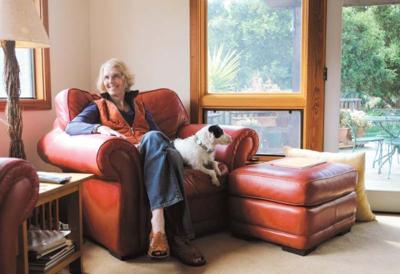
“I do believe the two books have a lot in common,’’ she says, bristling slightly at the idea of her protean output being contained within categories, as she sits back in a red armchair in her casually appointed living room, which includes a pool table, books and magazines strewn about on the counter and a cardboard box labeled Smiley Family Photos. Frida, her German shorthair, and Fallon, the aforementioned Jack Russell, vie for her attention (the latter ultimately settling for the lap of Smiley’s visitor).
“Define what the journey [from Hills to Life] would be,’’ she counters. “Can you explain to me what you think is so different about them?’’
Well, the style and subject matter in Hill’s is much more graphic, isn’t it?
Yes, Hills is sexier, Smiley concedes, allowing that writing frankly about sex is “absolutely’’ fun, before adding firmly: “Everything is fun – it’s just a different kind of fun.
“For me, the setting and the occasion of a particular book set up what could go into it and what can’t,” she explains, with the patience of the former English professor she was before giving up academia to move to Carmel Valley in 1996. “As a woman born in Missouri in the 1870s, there are things that are part of Margaret’s experience and that aren’t. Her husband, Andrew, is uncomfortable with sexuality – when he decides to have a sexual side to his marriage, he does it by reading books.”
Smiley raises an eyebrow.
“My grandmother, who was born in 1898, once told us grandchildren that she didn’t know how she came to have children until the ladies in her sewing circle told her,” she recalls. “I took that as a sign of how as a woman of her times, Margaret could have been awakened sexually, but she could also not have been.
“Those aren’t two possibilities in our day,’’ she adds, perhaps optimistically.
“Since the novel as a form is so personal itself, and inherently imperfect, each time I finish one, there are things I miss out on having written, and I get to go on and write something different,” she adds. “So to go from Ten Days in the Hills to Private Life is not that different from going from A Thousand Acres to Moo,” Smiley’s 1995 comic novel about academia.
It’s a belief system consistent with Smiley’s other convictions, including her disagreement with the currently fashionable view that the novel is dead.
“Oh no!’’ she responds, in a break from her customary Midwestern reserve. “As far as readers are concerned, it’s never been more alive.’’
Smiley, who said she had a Kindle but “gave it away,” and would have bought an iPad if the store hadn’t been out of it the days she visited – and can’t be bothered with an iPhone because she doesn’t get AT&T service in her woodsy retreat – avows that she is unbothered by the electronic revolution and its alleged threat to the future of print.
“Yeah, 200 years ago, it was illiteracy and the expensiveness of books [that was going to bring imminent doom and gloom],” she says dismissively, adding that “there are books in print now that were out of print for decades, and even centuries. Especially with the rise of the electronic book, there are more books to read than you’ll ever finish in your lifetime.’’
Smiley herself crams a multitude of experiences into a life span, managing to find the time to write between taking care of her family and the animals in her Carmel Valley kingdom. She has two grown daughters, Phoebe (she interrupts the conversation briefly to take a phone call congratulating her on getting a new job in Washington D.C.), Lucy Silag, a novelist (Beautiful Americans) herself, and her guitar-playing 14-year-old son, Axel. In their spare time, she and Canning take care of six horses.
Besides the just-released Private Life she has two other books coming out this October: a nonfiction piece, The Man Who Invented The Computer, a biography of Iowa digital pioneer John Atanasoff; and A Good Horse, the second in her cycle of children’s stories. Not to mention the articles she produces for magazines like Harper’s, where she famously challenged the cultural hegemony of Huckleberry Finn, and the political screeds she was regularly contributing to the Huffington Post during the Bush administration, though she’s since cut back.
“Well, it’s my job,” she says, seemingly unimpressed. “If I couldn’t do my job, I would suffer the consequences – put it that way.
“To write 13 Ways of Looking at the Novel was a labor of love. I enjoyed the reading and the writing – it was really more fun than I deserved.’’
In the 2005 work, she takes some sharp pokes at some books that are considered classics, like The Great Gatsby, of which she writes: “All the qualities of youth are present in the novel – snap judgments about others, overblown emotions, sharp observations about surfaces, self-hatred, and a lack of insight into women.”
She says she’s “not particularly” a modernist but is not exercised by differences in literary taste. The personal is political, she firmly believes, and reading is one of our most intimate relationships.
“If you don’t particularly like a book, you can always stop reading it, but what sometimes happens if you go on reading, is that you come to resent it more than you would if you stopped. It’s like making yourself date a guy you don’t particularly care for out of a sense of fear or obligation.”
The former Midwesterner feels that she’s found an ideal place to live and work on the Central Coast, after attending graduate school at the University of Iowa and teaching at Iowa State for 24 years.
Her ex-husband, an anti-nuclear activist, was a Californian who’d been yearning to return to the West Coast at the time, and her daughters were “transitioning” – one was a high school senior, and the other was headed to eighth grade – so it seemed like a nondisruptive time to make the move.
How did they settle on Carmel Valley?
“He wouldn’t go where there’d been a nuclear power plant – that left out San Diego and San Luis Obispo,’’ she laughs. “He also didn’t want to go north of the redwood line – that left out everything north of Castroville and Watsonville – wherever the redwood line is… Felton, I guess. I wouldn’t go to Santa Barbara, because that’s where his ex-wife was, and neither of us wanted to go to L.A.”
After hearing about this area from people who taught horseback riding, they landed happily – and have never looked back.
“Who wouldn’t prefer Monterey and the Peninsula to nearly every place in the world?” she asks, seemingly still amazed. “We’d been planning a trip for a year with friends to Tuscany when we moved here, but the whole time we were there, we wondered why we weren’t in Carmel Valley. The people here are great. When we came for a visit, the conversations we were hearing from people in every bar or restaurant were about horses. Who’d want to live anywhere else?”
Although Smiley has reduced her political writing – she says she just has too much other work to do – her views on the state of the world aren’t markedly more optimistic despite the change in administration.
“Their goal was to have strangled government in the bathtub, and they seem to have succeeded,” she says evenly. “Maybe they didn’t make it any smaller, but they made it very dysfunctional.”
Even if she isn’t openly opining on the issues of the day as much, her novels certainly reflect her opinions – and despair.
In Ten Days in the Hills, the unabated fury of her protagonist, Elena, is clear: “She was smiling, but the war was imminent. It was fun to lie here… in the well-cared-for wing of the charming house nestled at the top of the canyon on the west side of L.A., overlooking the shining Getty in Southern California, far from Washington and even farther from Iraq. It was a relief not to know personally any of the government officials who were setting up the deaths and dismemberments and talking about them reasonably… .She could imagine how it was when you wanted to do a certain thing – you thought, that’s the way life is sometimes, or they’ll get over it, or that’s not my problem. Of course the architects of the war felt that. And then there would be the afterthought, after the war was done, and countless agonies had gone unwitnessed or unexpressed. The afterthought would be, we did our best. Mistakes were made; some things are always unforeseeable. But actually, from beginning to end, indifference would be permanently on display, the indifference of those who made the war to the war’s resulting deaths and dismemberments. The warmakers knew they should care – everyone agreed they should care – but in fact, they didn’t, and you couldn’t get around it.”
For her part, Smiley insists that in the capacious fictional world she creates, the explicit political advocacy of Ten Days and the portrayal of the emotional world of the characters in Private Life are different ways of addressing the same themes.
“I don’t think this one is any less political – it’s more a parable than a direct commentary – but it has things to say about normal people being stuck in life with people who are terribly egomaniacal and dedicated to their own purposes to the exclusion of all else,’’ she says. “We see that all around us – it’s what our world is made up of. Let’s say you’re a person who disagreed with everything, let’s say, Dick Cheney ever did. [It’s] like being tied to a person you consider crazy, and yet you have no influence. He just does it and makes sure that no one can stop him. That’s how a lot of people in America felt.”
By the end of the book, Margaret had drawn a line in the sand with her husband, but her creator thinks that by then it’s too late to fix the ruins of life.
As usual, Smiley is focusing on the tragedies of human relationships, a subject she has staked out over the course of one of the most ambitious literary careers of our time.
“Can she alter his behavior?” she asks. “Probably not. There are obnoxious people all over the place. Sometimes you have to just walk away.”
She gives her heroine some of her own reading tastes, including a fondness for Sherlock Holmes.
But she doesn’t share Margaret’s view, revealed when Andrew first comes courting, that she prefers the company of books to that of people.
“I prefer the company of horses,” Jane Smiley says.
(0) comments
Welcome to the discussion.
Log In
Keep it Clean. Please avoid obscene, vulgar, lewd, racist or sexually-oriented language.
PLEASE TURN OFF YOUR CAPS LOCK.
Don't Threaten. Threats of harming another person will not be tolerated.
Be Truthful. Don't knowingly lie about anyone or anything.
Be Nice. No racism, sexism or any sort of -ism that is degrading to another person.
Be Proactive. Use the 'Report' link on each comment to let us know of abusive posts.
Share with Us. We'd love to hear eyewitness accounts, the history behind an article.