Aside from feeling like a lifetime ago, this past January seems downright sleepy in hindsight. The biggest stories of the month were merely a potential military conflict with Iran, the impeachment trial of President Donald Trump and the crowded Democratic presidential primary. Yawn.
Yet unbeknownst to most Americans, a deadly new virus, Covid-19, was silently spreading throughout the world, and by March, would upend the lives of every American.
In May, while most of the country was still cooped up at home trying avoid contracting Covid-19, racial justice protests swept the country in the wake of George Floyd’s death at the hands of Minneapolis police officers, the sight of which, caught on a bystander’s cell phone video, shocked and appalled the nation’s conscience.
This summer, with the pandemic still raging and protests still frequent in some cities, climate change-fueled disasters brought even more turmoil – severe weather and wind events hit the Midwest, hurricanes ravaged the southeast, and the West Coast saw the most devastating wildfire season in its history, the smoke from which drifted across the continent all the way to the Atlantic.
Then, amid the disasters and ongoing pandemic, a political shockwave rippled through the country Sept. 18 with the passing of iconic Supreme Court Justice Ruth Bader Ginsburg, leaving a vacancy on the court that Republicans hope to fill before a new Congress is seated next January.
This is in spite of a precedent Senate Republicans laid down in 2016 – when they said it was improper to confirm a Supreme Court justice in an election year – and now, in 2020, with the Nov. 3 election just weeks away, they plan to do it even as early voting has already begun in some states. (If Republicans succeed, six of the nine Supreme Court justices will have been appointed by Republican presidents, and of those six, only three – Clarence Thomas, Samuel Alito and John Roberts – would have been appointed by a president who won the popular vote.)
It is an election that, in the eyes of many, is the most important in the nation’s history, one that will profoundly alter the course of the country going forward.
That is largely because Donald Trump is president, and because he is president, even more chaos is expected in the coming weeks: Trump continues to tell the public the election will be “rigged,” that voting by mail is rife with fraud (despite overwhelming evidence showing it is not), and when asked in July whether he would accept the results of the election, Trump said, “I have to see.”
On Sept. 23, Trump made his intentions even more clear: “I think this will end up in the Supreme Court,” he said of the election results. “And I think it’s very important that we have nine justices.” Later that same day, when asked if he would commit to a peaceful transition of power, Trump said, “We’re going to have to see what happens.”
One of the lessons of 2020, it seems, is that as chaotic as things may seem at the moment, they can always get more so, and that in this year, they probably will.
Despite sowing doubt about the integrity of our elections, voters in Monterey County and across the state can at least take solace in knowing that in California, the election will be free and fair, and there is good reason to trust the system is safe.
But because this is 2020, a year of extraordinary challenges, voters should have a plan as to how they are going to vote.
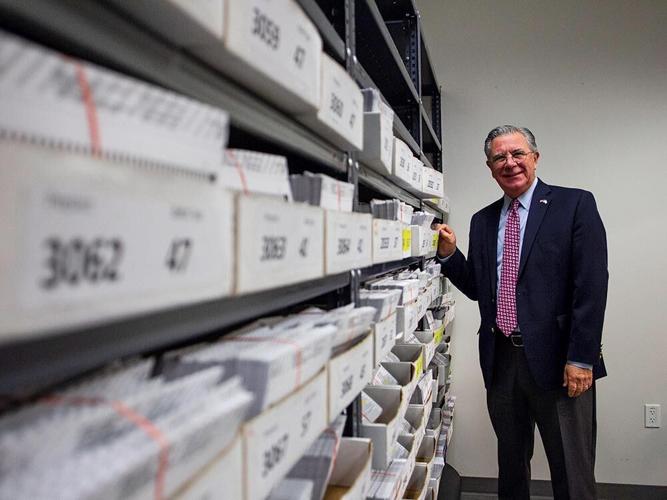
CLAUDIO VALENZUELA, MONTEREY COUNTY'S REGISTRAR OF VOTERS, says that even in the best of times, administering elections is “not for the faint of heart. And when you add the Covid-19 layer, it makes things quite interesting for us.”
In August, things got even more interesting: Valenzuela, who lives near River Road, was among the thousands of county residents who had to evacuate due to the River and Carmel fires. He missed a few days of work – “It was all a blur,” he says – and had to relocate his home office to a relative’s house in Salinas. But not to worry: He says the county’s election preparations are moving forward without a hitch.
“2020 has been quite challenging,” says Valenzuela, who is in his 19th year working at the county elections office. “But I’m still a tough bird, I’m hanging in there.”

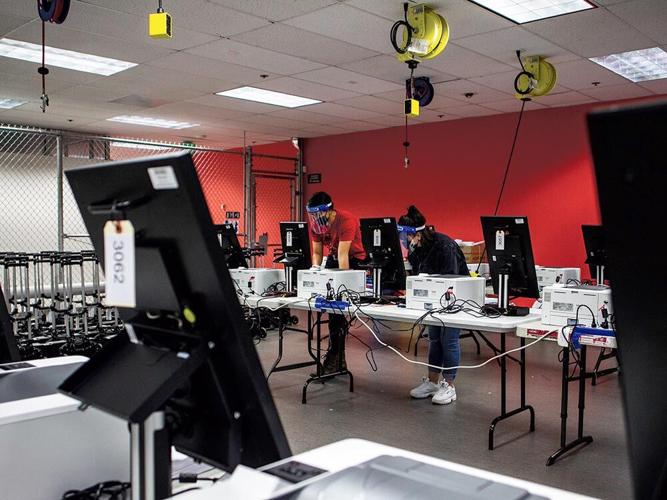
Monterey County Elections employees test the machines that enable voters with disabilities or with language barriers to cast their ballots.
And fortunately for county elections employees – there are 12 year-round staff – air scrubbers with HEPA air filters were installed in their office earlier this year as part of workplace safety protocols surrounding Covid-19. (While some staff still work from home on occasion, the entire staff returned to the office in June.) That was crucial in making their office safe and comfortable to work in as smoke filled the air throughout the county and entire West Coast in recent weeks as they prepare for the upcoming election.
Covid-19 is not only changing the workplace safety protocols at the elections office, it also changing how the election will be administered, both locally and across the state.
For the first time, every registered voter in California will receive an absentee ballot (also called a mail-in ballot – there’s no difference), which counties will send out to voters by Oct. 5. And because more voters are expected to use mail-in ballots this year due to the pandemic, new state laws aim to make that process smoother: Whereas previously the county couldn’t start tabulating ballots until 10 days before Election Day, officials can now start processing ballots as soon as they’re received. “It’s great for us,” Valenzuela says, “so we don’t have all the work accumulated.”
Another new change allowed by state law is that if a mail-in ballot is postmarked by Nov. 3, it will be counted if it arrives to the county election office as many as 17 days after election day – prior to this year, it had to be received within three days of Election Day.
The county has also tried to make it easier and safer this year for voters who plan to vote in-person: In addition to the early voting site at the county election office in Salinas, there will be another early voting site at Embassy Suites in Seaside. Both will open to voters beginning on Oct. 5.
And for those who do plan to vote in-person, whether early or on Election Day, there are new protocols in place to ensure adequate social distancing inside each polling place: A poll worker will wait outside the entrance of every polling place and, if the location has reached maximum capacity, the worker will take an arriving voter’s cell phone number (if they choose to offer it), and send them a text message when there’s an opening inside the polling place.
“It prevents people from congregating,” says Gina Martinez, Monterey County’s assistant registrar of voters. “Voters are waiting in the comfort of their own vehicle.”
Valenzuela adds that if a voter doesn’t have a phone, or doesn’t want to give out their number, the poll greeter can instead shout to them. He likens it to a queue management system employed by restaurants when they notify a diner a table is ready, and stresses that when voters offer their phone numbers, they are not attached to a name, and will be discarded after a notification text is sent.
“It’s very important for us to keep the privacy of voters,” Valenzuela says.
For voters planning to vote in person, there is another key piece of advice to take into account: Because the county is sending every voter a mail-in ballot, it is strongly advised those voting in person bring those ballots with them to the polling place so that poll workers can immediately be certain someone isn’t attempting to vote twice.
“The easiest way to vote in person is to bring the entire envelope they receive and turn it in at the polling place,” Valenzuela says.
Martinez adds, however, that the county is still encouraging voters to use the ballots they receive in the mail – they are the same ballots that voters receive at the polling place.
Referring to some of the disinformation circulating on the internet, she adds, “We’ve communicated with all the voters to tell them those votes are counted,” even if they are not reported immediately when early results are first announced. “The first results on Election Day are mail-in ballots.”
ONE OF THE SUMMER'S BIGGEST STORIES, UNEXPECTEDLY, HAS BEEN ABOUT THE MAIL.
Louis DeJoy, a Trump donor, was appointed May 6 as the nation’s next Postmaster General, despite apparent conflicts of interest – he holds a stake of as much as $75 million in a firm that is a subcontractor for the United States Postal Service, according to the New York Times.
After taking the helm, DeJoy implemented a number of controversial changes to USPS that slowed the delivery of mail, some of which were reversed, at least temporarily, after pushback by members of Congress.

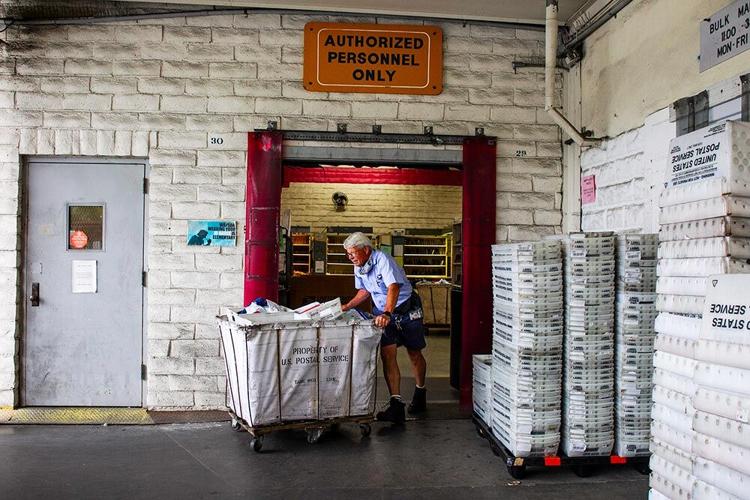
Dan Killough processes mail at the Monterey Post Office
Yet there is widespread concern among Democrats that there is a nefarious motive at play to halt or slow the delivery of mail-in ballots, which, polls show, are the favored voting method among Democrats this year amid the pandemic (while the majority of Republicans, polls show, plan to vote in-person this year).
It remains to be seen if issues affecting mail delivery have an impact on November’s election – some battleground states have far stricter rules than California about when a ballot must be received by election officials – but for voters in Monterey County, there is little cause for concern.
Representatives of the USPS processing center in San Jose, the location that serves the region, have assured local election officials they will prioritize ballots. Historically, it takes one to four days for vote-by-mail ballots to get from the San Jose plant to voters’ mailboxes.
The most important thing, Valenzuela says, is for voters to check their voting status on the county’s election website to ensure the county has the right mailing address. Also important: carefully follow the instructions on the ballot, and sign where applicable, including on the envelope.
There is also a new statewide service this year administered by the California Secretary of State that allows voters to track their mail-in ballot, and receive notifications when the ballot has been received, counted, or in some cases, flagged due to a lack of signature somewhere, or perhaps a signature that doesn’t match what the county has on file.
Martinez says a common reason for signatures to get flagged is that voters might develop a very different signature as the years pass, especially for a younger voter who, say, registered at 18 years old. For those with such concerns, she says, the best thing to do is re-register with a paper application – for those that have registered to vote online, the signature the county has on file will be from the Department of Motor Vehicles.
In any case, Valenzuela adds, invalidating a ballot due a signature that doesn’t match is not a decision made on the fly. Numerous election officials weigh in – they’ve been trained by handwriting experts from the FBI – and if questions still remain, it will even reach Valenzuela’s desk.
If a mail-in ballot is invalidated, Martinez says, “Whatever contact information we have, we’ll reach out to the voter.” Voters will then have time to “cure” their signature, up until two days before the election results are certified.
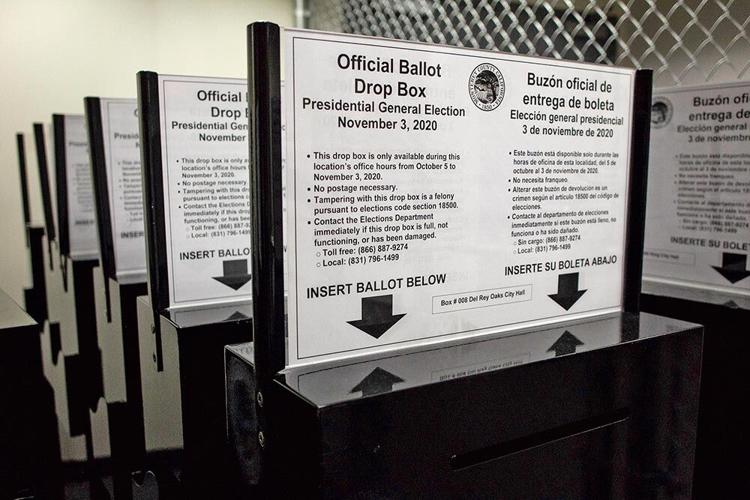
For those worried about using the Postal Service, but who still don’t want to vote in person, there are secure drop-off locations throughout the county. Fifteen drop-off locations will be open 24 hours a day from Oct. 5 until 8pm Nov. 3, and an additional eight locations will be open during business hours at local city halls, among other places.
Whether the dropboxes are outside or inside, various security protocols will be in place to ensure the ballots are safe, and Valenzuela says that depending on the location, they will be collected by county officials every 24-72 hours.
That collection of ballots, he adds, is also a process with extensive security protocols: For one, there is the “rule of twos”: at all times when handling ballots, two election officials must be present and sign off on an exchange in the chain of custody of the ballots.
Additionally, Valenzuela says, each dropbox is outfitted with two locks, and each of the two election officials picking up the ballots have only one key each – meaning both workers are required to access the ballots.
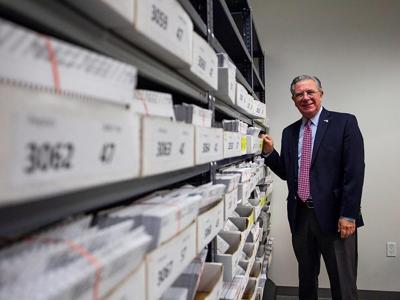
When ballots are taken to the elections office in Salinas where they are tallied, they are sealed in boxes and secured next to the vote tabulating machines; state law requires a paper trail for every vote. Between 1 and 6 percent of the ballots, Valenzuela adds, are audited manually every election to ensure the results line up with those generated by the tabulating machines.
Paper ballots are a key component for election security advocates: Not every state requires them, which opens up the possibility that voting machines – especially those connected to the internet – could be hacked by malign actors, foreign or domestic.
It’s not a concern local voters need to worry about in local or statewide elections, but it remains a potential issue in the biggest election of them all.
IT’S FAIR TO SAY VOTER ENTHUSIASM AND ENGAGEMENT IS EXTREMELY HIGH IN 2020, FOR OBVIOUS REASONS.
In Monterey County, there are now more than 202,000 registered voters out of 243,955 eligible residents, or 83 percent. and Valenzuela says those numbers keep climbing.
“Twelve years ago or so, we were still at between 150,000 to 160,000 [registered voters],” he says. There have been about 1,500 new registrations in roughly the past week alone.

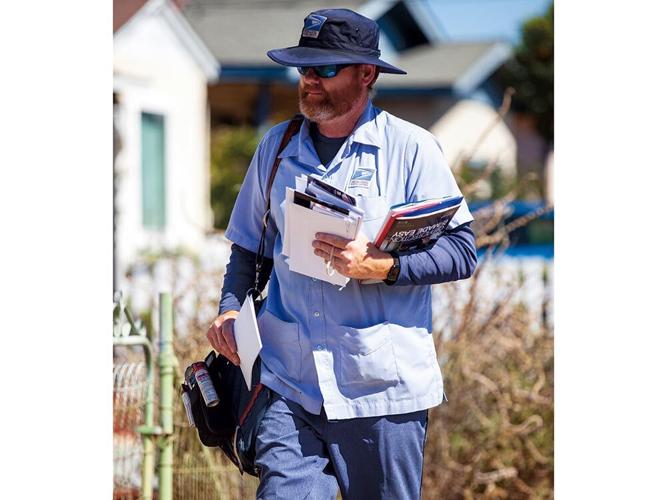
Timothy Appel delivers mail in Seaside.
That trend has also been statewide: Sam Mahood, press secretary for California Secretary of State Alex Padilla, says voter registration is at a record high in the state right now.
“We crossed the threshold of 21 million registered voters this summer,” Mahood says. “We have over 83 percent of eligible voters in California registered to vote. That’s the highest percentage since 1956.
“There’s been a big increase in the past few years,” Mahood says, adding that the number of ballots cast in the March primary in California – 9.6 million – was a state record for a primary.
“Voters are very engaged in this election,” Mahood says.
But because of rampant disinformation that can spread online, or that is spread by the president, among other things, Mahood says making sure voters are accurately informed, and that the presidential election is secured against threats foreign or domestic, is uniquely challenging at the moment.
“We’ve developed good relationships with a lot of professionals and rank-and-file membership at [the Department of Homeland Security] and the intelligence community,” Mahood says, “but it’s hard to have a robust national response to threats against the election when we have a conspiracy theorist in the White House.”
It is also widely expected that because there will be a massive increase in vote-by-mail ballots this year nationwide, voters might not know for several days who the winner of the presidential election will be unless there’s a blowout victory for either Joe Biden or Trump.
It’s the stuff of nightmares for many Democrats, who fear that in battleground states controlled by Republican legislatures, some mail-in ballots could be thrown out before being counted. Coupled with that fear is the possibility that Trump declares victory on election night based on early results, predominantly reflecting the votes of those who voted in person, before vote-by-mail ballots are fully counted.
Lest one think imagining such scenarios amounts to unnecessary hand-wringing from Biden supporters, they were also addressed by the FBI in a Sept. 22 announcement.
“The increased use of mail-in ballots due to Covid-19 protocols could leave officials with incomplete results on election night,” the announcement reads. “Foreign actors and cybercriminals could exploit the time required to certify and announce elections’ results by disseminating disinformation…
“For information about final election results,” the announcement recommends, “rely on state and local government officials.”
It may take time, and it may be a stressful time, but at least local voters should rest assured that all their ballots will be counted.
“It’s a process,” Valenzuela says. “We have to be methodical about it, with an emphasis on being accurate.
“Speed is not the goal here, we need to do it right.”

Secure dropboxes are lined up at the Monterey County Elections Office, ready to be distributed at 23 locations for voters to return vote-by-mail ballots.
(0) comments
Welcome to the discussion.
Log In
Keep it Clean. Please avoid obscene, vulgar, lewd, racist or sexually-oriented language.
PLEASE TURN OFF YOUR CAPS LOCK.
Don't Threaten. Threats of harming another person will not be tolerated.
Be Truthful. Don't knowingly lie about anyone or anything.
Be Nice. No racism, sexism or any sort of -ism that is degrading to another person.
Be Proactive. Use the 'Report' link on each comment to let us know of abusive posts.
Share with Us. We'd love to hear eyewitness accounts, the history behind an article.