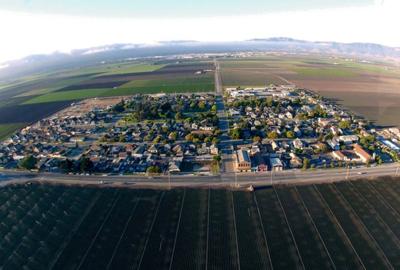
In Spreckels, the hiccup of an agrarian town outside Salinas with 16 square blocks and zero main streets, there are seemingly as many rules as there are households (229).
Rules like those outside the brick Spreckels Emporium store which, along with the neighboring post office and fire company, comprises “downtown.” They’re hand-written with a vigor that suggests seriousness: No skateboards. No hats. No bare chests. No naked feet. No food or drink from outside. No masks.
Rules like those on the sunken racquetball court in the public park: “Residents of Spreckels Memorial District Have Priority,” it reads. “Limit 1 Game or 1-hour rotation. Fees: $0.25 per player per hour. By order of Spreckels Memorial District.” (There’s a slot for quarters.)
There are rules for the unparalleled Fourth of July party, which happens Wednesday for the 42nd time (everything stops at 4pm sharp), rules for the Spreckels Sugar Company that gave the town its existence (workers who leave for war are guaranteed a job back) and rules for Tanimura & Antle Inc., which inherited its plant (treat truck drivers and farm workers with respect).
Then there are the rules from the “mayor.” While Spreckels is unincorporated and has no official position or city council, they do have a community services district that formed when the founding company, Spreckels Sugar Company, closed shop in 1982. Jim Riley, whose dad and granddad worked for the sugar plant during its 83-year run, is currently president, and has been on the district board since it started. He lives in one of the trademark craftsman-style 114-year-old Spreckels homes that cover the community. He has served as chairman, secretary and 20-year member of the volunteer fire company, and lived in Spreckels for nearly seven decades.
His rules regard the time-warp Spreckels Emporium and its insistent octogenarian owner, who stocks her endless shelves with large amounts of emptiness and small quantities of far-outdated items and contemporary candy, chips and soda. She’s both stubbornly private and famously feisty, and therefore as fascinating as the Spreckels sugar story itself.
“She’s nobody’s business,” Riley says. “You can mention [the store] was built in 1899 and still open today, and services farm workers and locals. That’s all that can be mentioned.”
The Emporium owner, Margot Scholler, agrees.
“You will not,” she says in a German accent, “write a story about zis store!”
I agreed to neither rule.
• • •
The noise was constant. The giant refiner at Spreckels Sugar processed sugar beets every hour of the day.
“The sound of massive machinery,” Riley says, “lots of steam escaping, the high-pitched sound of steam, trains banging, the rows and rows of beet trucks coming.”
This was the sound track to the story of how a community can grow as close as sugar beets to the Salinas Valley soil. When everybody who works at a factory lives in the tiny town across the street – the one the company built, plumbed and wired – any reminder that they’re in it together is redundant. They know who everyone else is and what they’re going through – and that they have one of the three eight-hour shifts that make up the 24-7 work weeks. Even the children get it.
“Kids didn’t make noise,” Riley says, “because a third of town was sleeping at any given time.”
Claus Spreckels founded the town in 1899, when the sugar plant became the world’s biggest, binging on 13 million gallons of water from local wells and processing 3,000 tons of beets a day.
The company may have left in the ’80s, but its imprint never will. Sugar beets still pop up “randomly” in the yard, according to resident and local celebrity chef Todd Fisher (see sidebar, p. 27).
“People who live there will forever associate with the sugar plant,” he says. “We’ve all got some form of memento.”
The impact appears permanent on the wider Salinas Valley as well. Claus Spreckels is credited for the Salad Bowl’s first raised row crops and for pioneering its underground irrigation.
“He put Salinas on the map agriculturally,” says Tanimura & Antle cofounder and CEO Rick Antle. “It was basically wheat crops for cattle feed before him.”
“The Spreckels Sugar Company built a vast network of wells, pumps, ditches and canals, all to bring water to the beet fields,” authors Gary Breschini, Mona Gudgel and Trudy Haversat write in Images of America: Spreckels. “This irrigation project transformed the dry ranches into fertile farmland. In subsequent years, the irrigation made the switch to row crops possible. In many ways, it was Claus Spreckels who turned the Salinas Valley green.”
When the plant closed, rising produce power Tanimura & Antle came in, purchased the property in three installments, and rooted the headquarters of its multi-state produce empire – which traffics in lettuce, green onions, strawberries and cucumbers – in the shadows of the towering Spreckels Sugar Company silos. The crucial rules there, according to Antle, are few but formidable.
One: Honor the farm worker with an above-industry $14 an hour, full medical, retirement, paid holidays, overtime and incentive pay. “We know the value of our work force,” he says. “If the vitality of agriculture went away, what would our community have left?”
Two: Accommodate the always-arriving truck driver with free parking, scales and robust burgers (and iceberg lettuce salads, naturally) at the T&A Cafe. “They go through a lot,” Antle says. “We’re in business because of them.”
Three: Help the region lead the way on pesticide regulation and worker safeguards. “Monterey County ag is so progressive, it’s light years ahead of the rest of the U.S.,” he says. “California, Arizona, they’re keeping up, but the rest of country has no idea of what impacts [growing] has.”
A major difference between the sugar and celery eras, he adds: None of his largely Latino company workers live in the company town anymore. (And not all of the residents are as in love with T&A as they were with Spreckels Sugar.)
But the sensation that Spreckels remains trapped in time certainly remains. The place feels part 1935 Steinbeck novel (sure enough, Tortilla Flat traveled there), part movie set (East of Eden had a scene), part Twilight Zone (at least several local kids think Riley’s house is haunted). Flags and porches proliferate. Everybody has a lawn and lives within four blocks of one another. Spreckels and sepia could be synonyms.
“I refer to it as the living Norman Rockwellian community,” Riley says.
Parents relax knowing their kids will be spotted by any number of neighbors as they walk down the street. County sheriffs hold responsibility for patrolling the unincorporated streets, but a preponderance of public safety officials who work in the surrounding area – residents like a Salinas fire chief, a Gonzales chief, a sheriff, a California Highway patrolman and the population of volunteer firemen – layer further security blankets.
“People move here for a small town,” says fire company chief Rich Foster, “for safety and a sense of belonging.”
“There’s a strong feeling of family,” fire company chairman Mike Peterson says. “People look out for one another.”
The post office doubles as a the town meeting place, the social network for a tiny town surrounded by fields.
“One person burps, 10 say, ‘Excuse you,’” Riley says. “If you’ve never lived in this town, you don’t understand.”
• • •
The noise is the scraping of steel against asphalt. Four meaty men summon it by pushing an antique fire-hose cart with huge, wood-spoke, steel-rim wheels down Llano Street before unspooling the hose, hooking it to a hydrant and pointing it at a target hung from a wire.
They’re members of the completely unpaid Spreckels Fire Company. The effort is timed – less than 30 seconds is righteous. Other events, like the bucket brigade – where teams try to move 50 gallons of water 20 feet in 40 seconds – help complete a Spreckels fireman muster competition just like the events the company participates in around the region all year, overflowing the fire station with trophies, plaques and pictures.
It’s also part of a singular day at Spreckels Memorial Park, the central town plot that’s the pride and joy of the collective residents, a block-sized space which enjoys its own Spreckels Memorial Park Board of Directors oversight and a full-time caretaker who lives across the street. Fourth of July festivities – three foot races for different ages through town and the surrounding fields, a vibrant parade with the fire company’s incredible old engines, the Monterey Bay Symphony Brass Ensemble and a menu of nonprofit-hosted food booths – draw an estimated 4,500 outsiders over the course of the day despite being more or less a word-of-mouth event.
“We swell out to the seams,” says event and fire company chairman Mike Peterson.
The rules for that event: Everything ends when the fire company says (4pm). Neighbors help clean up. And no sales rivalries. If someone’s already doing burgers, you’re doing dogs. The VFW does the domestic beers. The fire company keeps a corner on the lumpia market – they rolled 3,500 for the event at the station last week – and the water and Pepsi.
“Everyone has something,” Peterson says. “No one competes.”
The symphony ensemble, which asked to help out last year and returns enthusiastically this week, honors a park rule rather poetically: The signs by the picnic-baseball park area say “no amplified music. No boom boxes.”
The Independence Day bustle drowns out the normal noises – of parkland birdsong from the small stand of redwoods, of racket sports on the tennis court, of baseball on the modest field and shuffleboard next to the racquetball arena. For a day locals want people from elsewhere to enjoy the town’s 1922 chain-drive fire engine, aw-shucks disposition and adorable homes. Other days, it can seem like they’d prefer visitors make like sugar beet pollen in the stiff Spreckels wind.
• • •
The noise isn’t subtle, and it’s more of a tone – the sound of sharp sarcasm.
“Where are you from?”
It comes from a Spreckels woman who’s friends with the prickly owner of the Emporium. She stands chatting with the owner in conspiratorial whispers on a Monday afternoon and directs the question at a reporter I sent to sniff out the scene at the general store-type spot, where word is Scholler serves little more than bologna sandwiches in plastic bags and has chided – even expelled – people for using cell phones, taking pictures, touching the glass and opening the latch doors to the 1940s-style coolers before they know whether they want Coors tallboys or Bud bottles.
The reporter replies, “I live just over the dune, in Marina.”
The friend’s response: “Then what are you doing here then?”
Mainly he’s trying to figure out how and why such a place – a small country grocery, with maybe four or five short aisles, vintage signs for things like Hamms beer on the walls and almost nothing on the shelves, stays open. There are few randomly dispersed cans of dusty marshmallow spread, some faded Ivory soap bars, a mostly vacant rack of ancient packages of sewing buttons, an aged rack of steel-lidded jars of Clabber Girl baking soda, a weathered typewriter and some one-pound packages of sugar, though none bear the name of the town’s founder.
He tells her he’s “interested in history,” and that he’s a writer.
The two women look at him disgustedly. Having been hung up on twice before his visit (“I wouldn’t answer the zee phone if I wasn’t open!”) and felt their stares burrowing into the back of his head, he braces for what comes next.
The hunched German’s eyes, almost counter-level, narrow. Her impressively thick, salt and pepper eyebrows dissect her forehead, set at an angle that seems in opposition to his existence.
“Well, don’t you go and write no story ‘bout zis store,” she says, “’Cause zen zere’ll be people reading it and coming in here all zee time and I don’t nee dat!”
• • •
The noise purrs, groans into a crescendo and then erupts into a rumble. Quiet little Spreckels Memorial Park is washed in the exhaust of another of the 18-wheel truck.
Locals hate it. Truckers live it – but should they break the rules like this truck, following GPS rather than the multiple signs that shoo them to perimeter streets, they risk a hefty fine running hundreds of dollars.
Those that overlook Spreckels and its rules risk missing a community that sits at the heart of the area’s history. Those who skip the Fourth of July celebration risk missing the most remarkable morsel of Americana in the county – “a little west of the Midwest,” Peterson says. And those who miss Margot Scholler’s message – let’s keep things just the way they are, nice and quiet, because they’re better that way – risk her wrath.
I go by her place in pursuit of a final Spreckels noise: the squish of bologna meat, mayonaisse and American cheese between white bread, though I’m told she won’t sell to an outsider, reserving her limited handmade supply for loyal farm workers and locals.
When she tells me the dusty box of Jello Southern banana pudding I’m cradling isn’t for sale – “I have to have zomething on zee shelves” – I obey, put it back, and reduce my order to two bags of chips, a Butterfinger and a six-pack. And a bologna sandwich, please.
A noise hangs in the air as I await the verdict: The constant hum of an ancient display cooler. It feels almost hypnotic.
“It’s peaceful in here,” I say.
“Comfortable,” she corrects.
A smile, sweet as sugar, spreads wide across her face. She grabs a sandwich with a faded label on the plastic bag. My five items are just $7.70 all told.
I discourage you from making similar visits. Let the Emporium and Spreckels itself remain a testament to how uniquely beautiful things can be if left unmolested. But if you must visit, do it on the Fourth of July, and make sure you follow the rules.
Corby Anderson contributed to this story.
Spreckels Fourth of July happens Wednesday, July 4, starting 8am with the 1-mile kids run and including the noon parade, 1pm fireman muster and festivities in Spreckels memorial Park, Llano Avenue and Second Street, Spreckels (it’s easy to find – the town is four blocks long). Admission is free. Register to race at Active.com
(0) comments
Welcome to the discussion.
Log In
Keep it Clean. Please avoid obscene, vulgar, lewd, racist or sexually-oriented language.
PLEASE TURN OFF YOUR CAPS LOCK.
Don't Threaten. Threats of harming another person will not be tolerated.
Be Truthful. Don't knowingly lie about anyone or anything.
Be Nice. No racism, sexism or any sort of -ism that is degrading to another person.
Be Proactive. Use the 'Report' link on each comment to let us know of abusive posts.
Share with Us. We'd love to hear eyewitness accounts, the history behind an article.