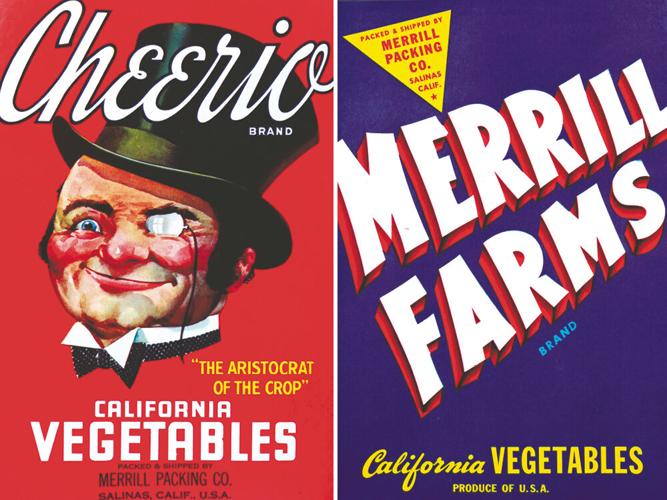

These labels were commissioned from a San Francisco artist by Thomas Russell Merrill, who founded Merrill Packing Company in 1933 and later Merrill Farms, which is still in business today. (His grandson, Ross Merrill, is now CEO.) These labels, designed in the 1930s, were glued onto wooden crates.
Through John Steinbeck’s writing, readers who had never laid eyes on the Salinas Valley could see with precision the Gabilan Mountains in the east, low, green and sparkling, letting the sunshine flood through the fields. To the west, they could imagine the foreboding Santa Lucia Mountains, creating a thick wall of shadow.
“He was trying to put Central California on the map,” says Susan Shillinglaw, a literary scholar, English professor at San Jose State University and former executive director for two Steinbeck centers (one in San Jose and the National Steinbeck Center in Salinas). “He’s a photographer in a way, like many of the great photographers of his time. He was like Edward Weston with words. His style was very sharp like a photograph,” she says.
But writing wasn’t the only way people living in the early 1900s could experience the Salinas Valley. They could taste the produce too, and by the turn of the century, most of the U.S. and Canada had access to impossibly cold lettuce, juicy tomatoes, and fruit plucked just days before, all grown in the Salinas Valley. With a robust agricultural industry, growers turned to artists to set their produce apart from other regional growers. But first, the region had to become the world’s “Salad Bowl,” by means of agricultural revolution.
In the 1860s, the Salinas Valley was dominated by the cattle industry. Dairy products and hides were harvested from Salinas and South County and shipped out from Monterey. By the late 1870s, agricultural land, if not given over to cows, was covered in large swaths of grains like barley and wheat. “Crops were much more dependent on rainfall, unlike today,” says Fiona Harris, parks museum assistant for Monterey County Parks.
In the 1880s, harnessing the water of the Salinas River and the surrounding creeks and tributaries made the topsoil of the valley more amenable to a variety of crops. Then in 1886, an extension of the Southern Pacific Railroad was constructed through the heart of South County, roughly where Highway 101 is today. By 1893, a little under a decade before Steinbeck was born, the refrigerated rail car was invented.
In 1938, new regulations on dairy were introduced and the local dairy industry was essentially decimated because so many local cattle were testing positive for tuberculosis. According to Harris, landowners saw the death of one industry as an opportunity to cash in early and often in another: row crops.
“Landowners saw that they could increase the price of the leases on their land. Now they could charge $50-$100 per acre,” she says.
Irrigation, transportation, refrigeration and a shift into row crops added to the Salinas Valley’s reputation as the Salad Bowl of the World. “It revolutionized the way the world thinks of fresh food. Irrigation came along and changed what we could grow here, and there were all these other technologies that made this area a reliable and dependable source,” Harris says. “It basically sparked globalization.”
With that growing global presence came a desire by growers to create recognizable branding that would identify them and the fertile California valley where the crops were grown.
“The marketing began to appear when Monterey County growers wanted to stand out and appeal to wholesalers,” Harris says. It started with simply stamping their wooden crates with a brand name, nothing flashy, usually just the last name of the grower. But they soon took advantage of a readily available and cheap technology: lithography.

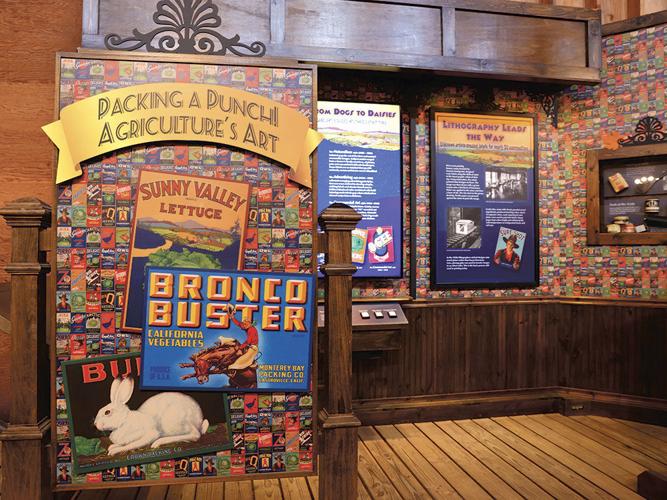
A display of historic produce labels at the Monterey County Agricultural and Rural Life Museum at San Lorenzo County Park in King City. Some images, like a white rabbit and a cowboy, bear no resemblance to the produce inside.
A printmaking technique that was prevalent at the turn of the century, lithographs were stamped-on designs that were quicker to make than wood block stamps that had to be hand carved. Relying on chemical reactions, lithographs were created by sketching out an image on limestone or metal with lithographic crayons or ink. They are then covered in layers of rosin, talc, gum arabic, and a mild acidic solution. The layers would then dissolve the areas around the ink, leaving a trace image. Transferable inks can be lightly rolled onto the design, and then repeatedly stamped onto a desired surface. In the early days of agribusiness, those surfaces were wooden crates. Later they were stamped onto cardboard boxes, which are still used by the industry today.
Many of those lithographs live on in exhibits around the county, including in the lobbies of some agribusiness headquarters like Merrill Farms in Salinas and at the Monterey County Agricultural and Rural Life Museum at San Lorenzo Park in King City, where Harris works.
But surprisingly little is documented about the actual business of lithographs in the historical record. “There’s very little about the lithographers or even the thought process of producing lithographs themselves,” Harris says.
Images vary widely and are sometimes nonsensical, without signaling what is inside the box. Images were inspired by local landscapes, cartoonish figures, and all kinds of grand animals like eagles. Why not? They weren’t beholden to any kind of standardization and the point was to be attention-grabbing.
“We don’t know a lot but what we have are beautiful, fun and vibrant designs,” Harris says. Her favorite design hangs in her office. It’s a lithograph in rich blues and greens depicting the lone cypress for Cypress Lettuce – which is ironic because lettuce is grown miles inland, not on the craggy Pebble Beach coast.
Ross Merrill, CEO of Merrill Farms – a company founded by his grandfather, Thomas Russell Merrill – notes the use of the San Francisco Ferry Building on the company’s 1930s Frisco brand “premium” label, selected as an iconic image before the Golden Gate Bridge was built. (The company historically distributed under the brands Merrill Farms, Frisco, Cheerio and Circle M, but in the 1990s, returned to the singular brand Merrill Farms, still in use today.)
In this new industrial agricultural revolution, Monterey County became known for all kinds of specialty crops: lettuce, wine grapes, globe artichokes, strawberries and more. Whole towns were defined by one crop, like the pink bean of King City or Gonzales’ table grapes.
In bold letters and imaginary sceneries, the variety of colorful lithographs communicated that whatever crisp leafy greens and ripe fruits grown in the Salinas Valley, anyone – from the rain-drenched ports of British Columbia to the bustling cities of the East Coast – could buy a piece of it. Labels contributed to the myth-making that somewhere out west, was a forever fertile land, masking any complicated history of labor, technology and government regulations. Steinbeck observed those same economic forces and wove them into his fiction seamlessly to comment on the harm it does to people at the fringes, like fieldworkers and food processors.
“All the vegetables and fruits, they do make the valley so enticing,” Shillinglaw says, remarking on some of the themes of Grapes of Wrath. “But when they get [to the Salinas Valley], everybody’s dreams and illusions disappear. They’re working hard for nothing, and are nibbling at the edges.”
(0) comments
Welcome to the discussion.
Log In
Keep it Clean. Please avoid obscene, vulgar, lewd, racist or sexually-oriented language.
PLEASE TURN OFF YOUR CAPS LOCK.
Don't Threaten. Threats of harming another person will not be tolerated.
Be Truthful. Don't knowingly lie about anyone or anything.
Be Nice. No racism, sexism or any sort of -ism that is degrading to another person.
Be Proactive. Use the 'Report' link on each comment to let us know of abusive posts.
Share with Us. We'd love to hear eyewitness accounts, the history behind an article.