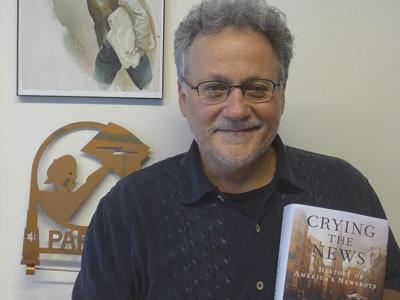

There is both a personal and an intellectual motive behind each piece of serious scholarship. At least that’s the case with Crying the News: A History of America’s Newsboys by Monterey-born journalist-turned-labor-historian Vincent DiGirolamo.
It cannot be overstated that the book’s publication in 2019 by Oxford University Press filled a clear gap in the history of American journalism – the distribution aspect. If that’s not enough, one can think about this 566-page volume as a deep, ambitious plunge into the history of American labor and American childhood. In the book, DiGirolamo argues that delivering news as a part-time gig was the most common first work experience for American youth from the time before the formation of the country up until the 1930s.
The phenomenon of newsboys began to disappear during the Progressive Era that brought much-needed regulations to the labor market – but not before playing a role in the history of the DiGirolamo family.
The family “came for the fish,” DiGirolamo says of their immigration, leaving Sicily around World War I and first trying their luck in overpopulated Boston. Soon, they made a move for Monterey, the second largest fishing port in the world in terms of tonnage being processed.
DiGirolamo’s grandfather and uncle Tony went first, to set things up. But some “little ragamuffins” couldn’t wait: One day, DiGirolamo’s father and uncle, not older than 6 or 7 (as a picture from 1931 that ran in the paper that day shows) were stopped at the port by a Boston reporter – they were on their way to California, they boldly confessed in an interview.
But the DiGirolamos weren’t just featured in the news, they also, or maybe mainly, delivered it – hustling as newsboys in Boston, and a couple of years later for the Herald in Monterey.
“My father remembers Pearl Harbor,” DiGirolamo says. “When they called from the paper: ‘Come down. We have a big news story.’’
Children, dozens of them – and other people who were not able to get waged jobs and were therefore forced into the gig economy (the disabled, retired and immigrants) – used to wait for papers in so-called “news alleys.” It was a street life: kids up at midnight, throwing dice and scuffling.
But DiGirolamo’s father also remembers the good moment – being taken to a restaurant by the family of the paper’s owner and trying pork chops for the first time. They also bought his father a pair of nice shoes. The duality of the experience – exploitation combined with some clear benefits for many – is meticulously registered on the pages of DiGirolamo’s book.
“They were entrepreneurial,” DiGirolamo says about American newsboys. “They were going out, selling papers and putting a coin in their mothers’ apron and she was able to buy milk that day.” His father also told him about how the big boys would take the little boys and shake them out of all their coins and that’s how little boys learned to hide money in their shoes. “And I was wondering to what degree that entrepreneurial instinct was a product of their childhood.”
DiGIROLAMO ALWAYS FELT THAT HE WAS BORN INTO A STORY. In Monterey, the past is present in the air – as stubborn as a fish odor. Even though he has spent the past 30 years on the East Coast, working as an associate professor of history at Baruch College of the City University of New York, DiGirolamo has been observing and analyzing Monterey for decades, hoping to come back permanently soon.
“I am from a big Monterey family,” he says. “My father was one of 13 children. Seven boys, six girls.” He grew up on abalone sandwiches before abalone got fancy and god-knows-how-much per pound. By the time he was growing up the fishing industry was already dwindling, and his family had ditched their boat and fish market for a restaurant called Angelo’s. But there was still Sicilian dialect being spoken on the Wharf, which itself was a carnival of tourists and fishermen. Sea lions barked all night long.
DiGirolamo couldn’t wait to start working, which he did at age 8. His first restaurant shift was on Sundays from 11am to 7pm. It was like a First Communion: a milestone, finally being one of the boys. Not to mention the pleasure of having money. It was at the restaurant that DiGirolamo encountered a newsboy himself for the first time.
“I remember a newsboy who would come to our restaurant in Monterey,” DiGirolamo says about what was, at that point, the remnants of a nationwide culture. “It was unusual because other newsboys would have their routes, but he was just walking around. He was shy, but not too shy to approach people. His name was Howard.”
DiGIROLAMO WAS INTERESTED IN HISTORY FROM A YOUNG AGE, and the Monterey Peninsula supported that – there was the Mission in Carmel, the Presidio, and myriad streets with mysterious names just begging the question: How did it all start? Who built the Wharf?
He started to pine for more education while working his first job outside the family. At age 19 he would work 12-hour shifts, before school, delivering liquor between Santa Cruz and Big Sur.
It was during that time that he first started to think about labor and the politics of labor – looking with jealousy at students at Monterey Peninsula College, sunbathing on green lawns. Soon he became one of them, followed by journalism studies at UC Berkeley. He graduated in 1978.
Later, after almost a decade in journalism, DiGirolamo says he got caught himself “practicing history without a license,” by which he means writing about history without a deeper knowledge of the subject. Journalists have to write with authority but they only play experts on the subject, DiGirolamo says, typically having just a week to explore it.
It was obvious he was interested in labor history – in 1982 he produced Monterey’s Boat People, a 30-minute documentary about the plight of Vietnamese refugees and earlier generations of Asian American fishermen in Monterey. It won awards at several film festivals and aired nationally on PBS in 1984.
So DiGirolamo went back to school – he received his MA in comparative social history from UC Santa Cruz in 1989 and his Ph.D. in history from Princeton University in 1997. He has taught history and writing at Santa Cruz, Princeton, George Mason, Colgate, and Stony Brook universities.
But even after this turn toward academia, he never planned to spend 30 years chronicling the history of America’s newsboys nationwide, amassing what is now a true archive with countless primary sources, including art and photography.
DiGIROLAMO’S CRITIQUE OF LABOR RELATIONS DOESN’T END AT THE NEWSBOYS – it extends to his own industry and to the present day. “My book couldn’t be written by someone living by themselves in the attic,” he says, citing the expenses, the travel and the many institutions involved in the project.
“It’s a two-tiered industry,” he says, of academia. “Some people have tenure and are thinking about retiring in Monterey,” he says, pointing at himself, “but a lot of others are paid per gig [class] and part of the gig economy.”
While the phenomenon of newsboys did go away, the gig economy certainly did not. The duality of a market that feeds with one hand and exploits with another is still part of the daily American experience, just as was the case for America’s newsboys. DiGirolamo is a believer in labor unions and their ability to shape future jobs, and is observing the union movement at both Amazon and Starbucks with great interest.
“There’s continuity,” he says. “Even people who deliver news today are often not paid earning wages.” Even when mastering distribution could make or break the paper, publishers tried to lower their cost by hiring from among the disadvantaged, or trying to define work as play. The difference now is that Western culture reveres childhood and so the shadow economy belongs to immigrants, or to anyone without a lot of choices economically, rather than children.
One of the biggest myths about the American newsboys is that they made it. Benjamin Franklin worked as a newsboy, and the list of illustrious alumni also includes names of future celebrities like Thomas Edison, Walt Disney, Warren Buffet, Jack London and Thomas Wolfe. For a long time, stories about newsboys becoming American entrepreneurs were considered proof that it was possible to overcome poverty and therefore the capitalist order is legitimate.
“The myth holds that individual character, not social class, shapes the structure of opportunity in America,” DiGirolamo says. But what this myth fails to account for is all the children who died while selling papers at midnight or were kidnapped on the job, as is reported to have been happening as late as 1970.
DiGirolamo wants to stay away from “urban nostalgia,” and is critical of the notion of the self-made. Newsboys were the product of the existing economy to which they had no choice but to adjust, he says. They were both winners and victims, not above taking advantage of customers by, for example, dirtying their faces to make people feel sorry for them. They reflected the complex, busy society they were part of. They were not islands of individualism and moral character, but necessary participants in penny capitalism.
“Contemporaries hailed [the newsboys] as both products and producers of press freedom, popular democracy, and national character, never mind that they were also scorned as ‘street Arabs and guttersnipes,’” he writes, in Crying the News.
“My own experience working as a child was positive,” DiGirolamo summarizes. “It felt good to have money and it taught me positive things.” But not all working arrangements are so positive – for children or adults. “One question is: Who is making the money? Is it the child making money, helping the family, or is it a stranger or a big industry?” DiGirolamo asks. “Work should give you experience and enhance, not take away, your opportunities.”
(0) comments
Welcome to the discussion.
Log In
Keep it Clean. Please avoid obscene, vulgar, lewd, racist or sexually-oriented language.
PLEASE TURN OFF YOUR CAPS LOCK.
Don't Threaten. Threats of harming another person will not be tolerated.
Be Truthful. Don't knowingly lie about anyone or anything.
Be Nice. No racism, sexism or any sort of -ism that is degrading to another person.
Be Proactive. Use the 'Report' link on each comment to let us know of abusive posts.
Share with Us. We'd love to hear eyewitness accounts, the history behind an article.