


It appeared Kim Jong Un, North Korea’s leader, was hiding something.
David Schmerler, a nonproliferation analyst at the Middlebury Institute of International Studies at Monterey, decided to investigate.
Schmerler is in front of two monitors in his small first-floor office at MIIS’ James Martin Center for Nonproliferation Studies. Also in the room is Jeffrey Lewis, the center’s director of the East Asia nonproliferation program.
It’s March 8, and Schmerler believes he has just caught North Korea in a lie.
That in itself is not an unusual thing: North Korean officials often lie about their missile capabilities and launches, and Lewis, Schmerler and their fellow colleagues often sniff those lies out.
That is, in part, what they do for a living.
In this particular instance, Schmerler discovered evidence showing that North Korea may have lied about its March 6 missile launch. Allegedly, the Democratic People’s Republic of Korea launched four ballistic missiles into the sea, west of Japan, but Schmerler found evidence that they may have launched five, including one that failed.
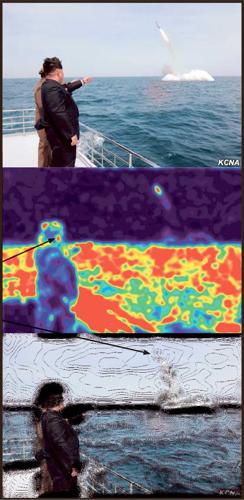
Here’s how he did it: There was a rumor afloat about a failed fifth missile in the March 6 military exercise, so Schmerler started looking for clues. He saw official photos of North Korea’s leader, Kim Jong Un, released to show the missile launch. Schmerler saw Kim partially blocking the computer monitor depicting the launches, a change from the norm – in successful launches, the entire monitor is visible. Perhaps, Schmerler thought, there was a reason for that.
He took screenshots of the monitor next to Kim – only the right half of the monitor is visible – and of the left half of the monitor from a photo taken from a different moment during the launch.
Splicing them together, he shows there are actually five missiles on the launch screen.
Schmerler explains this while sitting at his desk as Lewis stands behind him like a proud teacher. Both are all smiles, high on the thrill of discovery.
“This is a great example of what we do,” Lewis says.
“This is like CSI,” Schmerler adds.
Lewis puts it into context: “It’s really interesting to see what they lie about.”
By knowing what North Korea is lying about, they say, they know what North Korea cares about.
“Unlike international relations school, we study why this stuff is secret,” Lewis says, adding that even if the lie is inconsequential – like in this case, five missiles instead of four – it provides a window into what a government is concerned about, and with that, a picture of its foreign policy soul.
“[We’re] like an intelligence agency,” Lewis says.
Schmerler, who at 28 is close to 15 years younger than Lewis, believes reports of a fifth missile will eventually leak.
“The ball is now in play,” Schmerler says.
Lewis rests his chin on his hand. “We have to figure out what we’re going to do with this,” he says.
He leads the way up to his second-floor office, passing, at the top of the stairs, a rocket engine on a pedestal that’s roughly the size of a car engine.
Melissa Hanham, a fellow analyst, runs into Lewis in the hallway and asks if he’s heard the news; Lewis says yes. For about a minute, they discuss which media organization to share their intel with, but don’t come to a decision.

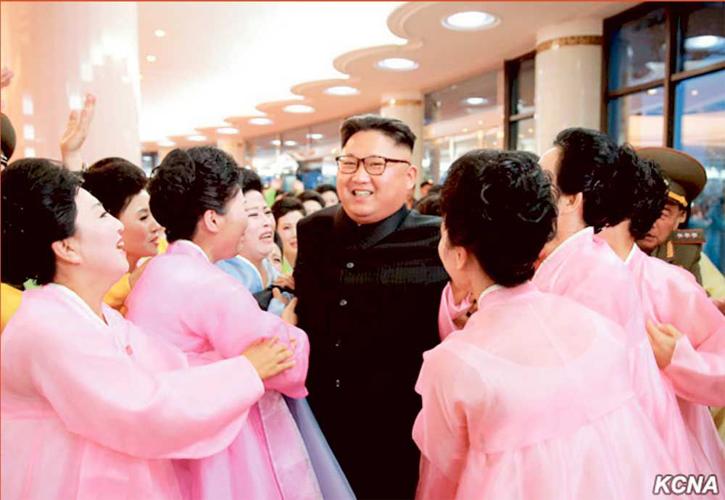
Aside from being North Korea’s “supreme leader,” Kim Jong Un’s other titles include Supreme Commander of the Korean People’s Army.
Lewis’ office is far more spacious than Schmerler’s, and is lined with bookshelves that include about 200 titles like The China Threat, Command and Control, Deception, The Eisenhower Diaries, Two Koreas and The Kissinger Transcripts.
As he takes a seat and opens up, he describes how he got into his unusual line of work – he was a philosophy major in college, and was fascinated with the process of how people come to know things.
That fascination eventually landed him in a Washington, D.C. think tank, and thrust him into the field of nonproliferation.
Lewis is a messenger, and a watchdog. His mission – like that of his colleagues – is to ensure that the American public (and the global public) have the best information possible about missiles and nuclear weapons, including information our government keeps classified.
“The fact that something is known in the bowels of the Pentagon doesn’t inform our policy debates,” Lewis says. “Sometimes we find U.S. intelligence assessments are wrong.”
An example he offers is when the U.S. invaded Iraq in 2003 based on weak intelligence, and started a war that has cost the U.S. trillions of dollars, led to countless deaths, destroyed a historic city and further destabilized the Middle East.
As a response to that disastrous invasion, Lewis launched his blog, armscontrolwonk.com, in 2004. It’s a one-stop shop for anyone interested in arms control, and a place to help make the public more informed about weapons of mass destruction.
And about two years ago, he started a podcast he co-hosts, also called “Arms Control Wonk,” where he engages in freewheeling conversations about everything from the Trump/Russia dossier to nuking the moon and hit-to-kill missile interceptors.
As cheerful as he comes across, the worst possible scenario – a nuclear war – is never far from his mind.
Lewis spoke to the Weekly about that scenario, and about Donald Trump, North Korea and what he thinks we should be paying more attention to.
Weekly: Given that it appears North Korea lied about the missile, what’s interesting about that lie?
Lewis: Well, it shouldn’t distract from the fact that four worked. That’s not a trivial thing. They are clearly sensitive to how the world perceives their program. No other country has done five nuclear tests and tested so many missiles and have so many people say, “You don’t actually have nuclear weapons.” It’s this really strange thing, and I don’t understand why people are so reluctant to accept it, but they are. For the North Koreans, it’s really important to demonstrate that yes, they do have this capability.
I think any sign of something not working is just too embarrassing for them, so they edit out any failure. The Iranians did the same thing.
I don’t think what happened on Monday matters that much, it’s just pride. Sometimes you catch people in a real lie, you figure out it’s a different type of missile than you thought, or the program is in a different place. There are consequential lies.
How concerned should Americans be about North Korea?
Very concerned. If you think about the missile test they just did, those weren’t tests of the missiles. They know those missiles work. They used to test those missiles out of a dedicated test site. The launches that we just saw were done by the actual military units that launch missiles. So those were exercises of the units, basically they were practicing. And what they were very clear they were practicing to do is to hit U.S. forces in South Korea and Japan, basically on the first day of [a war in which they are attacked]. Their theory is, instead of sitting back like Saddam [Hussein] and watching the United States flood all these forces into the region, they’re going to move very early to use nuclear weapons to destroy all those forces before we can invade them. That’s the context of this launch.

An image, top, released by the Korean Central News Agency, in its doctored form. The latter two show the same photo applied with two different high-tech filters – both of which come from France, and in their own way, illustrate irregularities in the image, or in Lewis’ words, “mathematical anomalies in the underlying data.”In the middle photo, Lewis points out how doctoring, or “noise,” is depicted by the color red. The sea is “noisy,” so mostly red. It’s also red on the KCNA logo that has been edited into the lower-right corner. Kim Jong Un’s hand is also red – Lewis suspects because there was a cigarette removed from the original photo – and so is his ear. That change is baffling. “They always do something to his ear. We don’t understand what it is or why, but they always Photoshop his ear,” Lewis says. “And the missile is bright red, so there’s something wrong with the missile.”A different filter, bottom, uses concentric lines to show how light moves through the image; that the lines don’t cross through the flame means the missile isn’t putting out any light, so according to Lewis, “It looks like a paint job.”
The U.S. is doing Foal Eagle, a big, annual military exercise with the South Koreans. So the North Koreans have counter-programmed their own launch exercise – we’re practicing invading them and they’re practicing nuking us.
The reason that’s dangerous is our exercises are based on the idea that we’re going to go first, that before they have the chance to use all these nuclear weapons, we’ll hit them really hard, we’ll knock out the leadership, we’ll disable the command-and-control structures so that they can’t give the order to use nuclear weapons. And their plan is to use the nuclear weapons before we can do that.
So we both plan to go first, and one of us is wrong about that.
That sounds like a terrifying scenario.
Yeah, it’s bad.
Does that mean at this point North Korea is basically untouchable?
No, because they don’t have an ICBM (intercontinental ballistic missile) with a nuclear weapon. They don’t have a nuclear weapon that can reach the United States.
But what everybody says is, they would never dare to do that because we would destroy them, right? And that might be true if they can’t reach the U.S. But I think the reason they want to build an ICBM with a nuclear weapon is precisely so that if they use nuclear weapons on the first day of the war, and we’re really angry about that, we have to pause, and calculate what will happen if we continue. Will they hit Washington [D.C.], or other places that people maybe care more about?
How has the Trump administration been received in the arms control community? Is it that different than Obama?
Well, sure, different than any president. Because he talks about nuclear weapons in a way that is… well, he talks about nuclear weapons like he talks about everything else, which is really loosely. There’s a lot of bravado, there’s a lot of exaggeration, there’s a lot of hyperbole, and this is a field where normally people are pretty careful about language. People are worried about being accurate, they’re worried about trying to be too alarmist, but also they know it’s a really important subject. Of all the fields, this is a field where you want to be careful, because you’re talking about the fate of the Earth.
Trump has mentioned dumping a bunch of money into our nuclear program. Is that a good idea?
No. First of all, it’s not possible. The Obama administration already has a modernization plan that it agreed to with the Senate to get the ratification of the new [Strategic Arms Reduction Treaty] in 2010. We reached this arms control agreement with the Russians. In exchange, the Obama administration agreed to replace basically the entirety the American nuclear arsenal over the next 20-30 years. So there’s already a full modernization program underway. And that program has to happen at a certain pace; if it’s delayed, the existing weapons will retire before the new ones are ready.
There’s already this maxed-out modernization program, and the problem is, heading into this year, people thought: “There’s just not enough money to do that.” And even if you had all the money in the world, it’s not clear you’ll be able to do everything on schedule because you basically have to do it all at the same time.
It’s a perfect plan, as long as you assume that in defense programs there are no cost overruns and no schedule delays. But unfortunately those things are going to happen.
What are your thoughts about the Iran nuclear deal?
It’s the best deal we were going to get. I can imagine a better deal, but you would have had to have made that deal 10 years earlier. In the mid-2000s, the only acceptable deal was zero centrifuges in Iran, and every year, Iran built more centrifuges.

Kim Jong Nam, the eldest half-brother of Kim Jong Un (pictured at left), was killed in Malaysia Feb. 13 by suspected North Korean agents.
One thing that comes across in an episode of your podcast, an episode about the “Trump Dump” dossier of intelligence, was that you seem to know a lot about the intelligence community. How did you come to know so much about that?
Well, I lived in D.C. for 16 years. If you work on national security issues, some significant number of your friends are going to be in that community. But professionally, it’s important to know. If you study nuclear weapons, part of what you’re studying is what the U.S. thinks about other countries, so you naturally start studying: How do we know that? How did we get that information? So you can’t really understand the history of nuclear proliferation unless you understand the intelligence about nuclear weapons.
What is your take on Obama’s legacy with nukes?
It depends on how you measure it. By the standard he set for himself, it was a tremendous disappointment. He didn’t do a whole lot that two more Bush terms wouldn’t have done. The way [Obama] tried to distinguish himself from Hillary Clinton in the primaries was by saying he, on foreign policy issues, was willing to think really differently about nuclear weapons. And for him, that was a symbol of him being a younger and more transformational figure. There’s nothing he did in eight years that Hillary Clinton wouldn’t have done.
I should also say he did visit Hiroshima, which was a big deal. He was the first president to do that, sitting or former.
A recent series of letters (Feb. 27) in The New Yorker shed light on the possibility – in the event of a nuclear war – of a “nuclear winter” that would drastically alter the Earth’s climate. Do you agree?
I don’t think they were wrong, but I think it’s hard to know. We don’t have great models about how lots and lots of nuclear weapons would interact with the climate. If you drop a nuclear weapon on a city, the explosion is one thing, but the other thing is there’ll be an enormous fire.
That’s what happened in Hiroshima, it burned. And you can actually get, from big bombing raids, firestorms. They were such a part of World War II that the U.S. used to drop incendiary bombs in order to create the fire, and they would lace it with timed bombs that would then explode to kill the firefighters as they came in to fight the fires, to make sure that the whole city burned.
We don’t model any of that. We just assume that when a nuclear weapon goes off, it’s a blast. We assume there’s no fire. So the idea that you would have this large nuclear war where you would use many nuclear weapons that would trigger these enormous urban fires where these cities are burning, there is basically no modeling for that, because it’s just too hard. It’s clearly going to have a huge impact, it’s just hard to know in such a complex system. And you know, we’ve never tried simultaneously setting most of the urban areas in a giant country on fire, thank God.
What are some things going on in the world you think the public should know more about?
North Korea has me super worried, which is why we do so much work on it. I definitely worry that the way the North Korean war plans interact with our war plans, and the war plans of the South Koreans, is really destabilizing.
I think relations with Russia have gotten really terrible. And Russia has a new enthusiasm for nuclear weapons, and if you combine that with things President Trump has said, as weird as it sounds, I don’t think a renewed arms race is out of the question.
Even though the big numbers aren’t there yet, both the U.S. and Russia are investing in a whole bunch of new systems. Maybe it’ll be a slower arms race – maybe it’ll be an arms jog or something – but there really is a prospect of a renewed competition with Russia that people haven’t accepted yet.
I could just run down the list. There’s a million ways nuclear weapons could go wrong. Nobody ever talks about South Asia, but India and Pakistan are in the middle of a really serious arms race. That’s a really, really dangerous situation. Unlike the U.S. and the Soviet Union, we were kind of far apart, so it took some time for the missiles to get from one place to the other. You didn’t have much time, but there were a couple of minutes where the president could make a decision. India and Pakistan are right next to each other – there’s no time. A crisis there could escalate so quickly.
So you’re running this giant science experiment with global security and hoping it will work out OK, and usually it does. Was it Martin Luther King Jr. who had this great comment about, “guided missiles and unguided men”? That more or less sums it up.
• • •
Postscript: Days later, Lewis and Schmerler have yet to officially release their findings. They are confident – if not certain – there was a fifth missile that either failed or was never launched, but they have yet to find evidence of it in satellite imagery.
“We really care about not getting things wrong,” Lewis says. “I’d rather be occasionally second and never wrong.”
(0) comments
Welcome to the discussion.
Log In
Keep it Clean. Please avoid obscene, vulgar, lewd, racist or sexually-oriented language.
PLEASE TURN OFF YOUR CAPS LOCK.
Don't Threaten. Threats of harming another person will not be tolerated.
Be Truthful. Don't knowingly lie about anyone or anything.
Be Nice. No racism, sexism or any sort of -ism that is degrading to another person.
Be Proactive. Use the 'Report' link on each comment to let us know of abusive posts.
Share with Us. We'd love to hear eyewitness accounts, the history behind an article.