The coolest fishiest most futuristic honest and adventurous Health & Fitness issue ever made.
We could call it the guinea-pig issue, because we personally tested 22-ingredient fruit diets and two different wearables, low-food-chain grub and highflying yoga, Jazzercize and Gyrotonic, deep freezing and CrossFit. Here’s what we found out.
—Mark C. Anderson
1
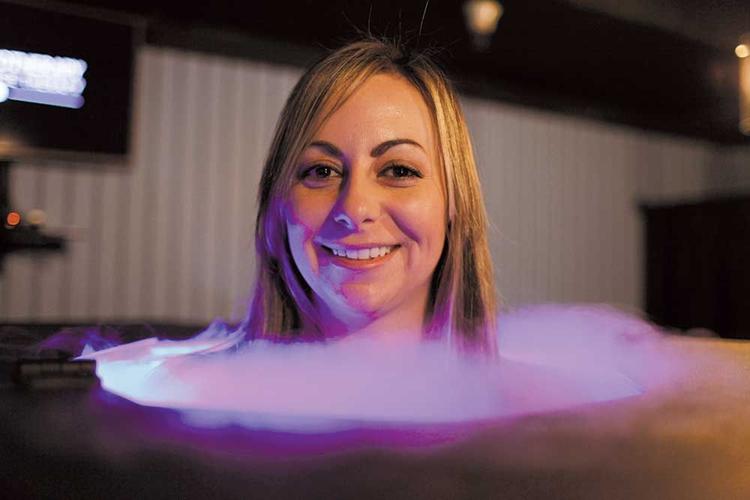
White nitrogen gas swirls around my body. I’m standing up, naked, in a cryogenic chamber smaller than a phone booth. Rubber booties and gloves keep my feet and hands tolerably warm while the rest of my skin prickles with goosebumps.
I feel like I’ve stepped outside in zero-degree weather. In reality, it’s more like -250 Fahrenheit.
There’s a crackly quality to this deep, dry cold. My skin goes frosty-pale. It occurs to me that if I were to flick a nipple, it might shatter.
Brittney Scarlett-Torres is at the chamber’s controls, reassuring me with bubbly small talk. As co-owner/operator of Glacé Cryotherapy, which she and her brother opened in The Carmel Barnyard a few months ago, she’s convinced the benefits are broad and deep.
The Carmel High grads – Brittney was class of 2003; younger brother Skyler Scarlett was 2008 – are both bright-eyed, chatty and quick to smile. During an interview they pass the conversational ball back and forth, explaining how they decided to go in on cryotherapy together. Skyler’s the researcher/technician of the team, while Brittney masterminds the nuts and bolts.
Like any siblings, they had their squabbles as kids. But now, if someone gets snappy, they just hop in the cryosauna. “It mellows us out,” Skyler says.
The idea germinated a couple of years ago, when Brittney’s husband asked Skyler, then an exercise physiology major at Chico State, if he’d heard of whole-body cryotherapy. Among the claimed benefits: pain reduction, calorie burn, endorphin release, mood enhancement, anti-aging effects, even a libido boost.
He was skeptical. What can be done in three minutes? he remembers thinking.
But research made him a believer. To convince potential clients, he posted 14 peer-reviewed clinical studies on the Glacé website.
What the science says: Cold stimulates the body to fight inflammation, a major culprit in both soreness (post-workout or injury) and chronic illness (like heart disease and arthritis). Exposure to low temperatures prompts the blood vessels to shrink, which reduces pain and accelerates healing – like an ice pack on a swollen muscle, but at a more intense, whole-body scale.
Other perks, according to Skyler: The cold stimulates collagen production, which is good for the skin. The sudden drop in skin temperature sends a surge of blood to the body’s core; when the session ends, that nutrient-rich blood flows back to the extremities. That warming-up process also kicks up metabolism. Brittney says a single session causes the body to burn an extra 500-800 calories throughout the day. For some clients, it also triggers an endorphin release she calls “the cryo-rush.”
Skyler shows me a photo collage of his topless torso, which progresses from doughy to sculpted six-pack over six months. Other than cryotherapy sessions once or twice a day, he says, all else was equal: biweekly workouts, clean eating.
Carmel Valley resident Chaz Bomio says he’s seen a definite improvement in his healing from post-bike-accident knee surgery after four cryo sessions. He also describes “an energy boost and a sense of well-being” that lasts for hours.
“The first time, wow, I wasn’t sure quite what I experienced. Then I got an idea what was going on,” he says. “It was an invigorating feeling.”
He signed up for a package of future sessions, convinced regular cryotherapy will improve his joints over the long term.
The siblings are stoked to be on the forefront of what they see as the next U.S. health trend. New spas are opening in San Diego and Las Vegas. Chiropractors and physicians are adding cryosaunas to their practices.
Not that whole-body cryotherapy is new. Dr. Toshiro Yamauchi invented it in Japan in the late 1970s. From there it reportedly migrated to Europe, where athletes and the general public picked up the trend. But the Scarlett siblings say it didn’t reach the U.S. until 2010, when a cryosauna opened in Texas. The Dallas Mavericks pro basketball team famously used cryogenic therapy on their way to the 2011 championship.
Before opening Glacé’s barn door Oct. 15, Brittney did a U.S. cryosauna tour, including Viking CryoTherapy in Los Gatos; four cryotherapy spas in SoCal (where, it’s rumored, certain celebrities freeze regularly); and one in Dallas.
Glacé’s books are already penciling out, Brittney says, despite a $60,000 investment in the American-made Impact Cryosauna and a liquid nitrogen bill topping $1,000 per month. People in cryotherapy circles are watching to see how it performs in little Carmel, she says.
Glacé customers get the best value in packages. The Scarletts say it takes a few visits to really feel the benefits, so I commit to three sessions. I’m a little nervous at first, especially filling out the waiver that spells out what I’m getting into: 3 minutes or less exposed to temperatures of -238 to -274 Fahrenheit.
I go into a small room, undress and put on the provided gloves, socks, rubber booties and bathrobe. The goal is to make sure nothing’s sweaty, because moisture makes the cold worse. Men are advised to leave their underwear on so they don’t get chilblains – the inflammation of small blood vessels when skin suddenly goes from cold to hot.
I step into the glowing blue chamber, where the operator (Brittney for my first session, Skyler for the next two) folds a plastic frame over my shoulders, leaving my head poking out on top. That’s so customers don’t inhale the pure nitrogen gas, which could make them pass out.
I slip off the robe and hand it over – they assure me they can’t see below the neck – and with a soft mechanical exhale, the white vapors snake around me.
We chit-chat while the timer runs. I rest my eyes on the mounted flatscreen, where there’s a picture of a desert. Think warm thoughts, I tell myself.
But the sudden chill is primal. My nerve receptors start sending increasingly urgent text messages to my brain:
Brrrrr.
No, seriously. BRRR.
GET OUT OR YOU WILL DIE.
That first visit, I called uncle at two minutes sharp. Brittney says that’s fine: You get all the health benefits if you make it at least 120 seconds. More than 180 and you get into frostbite territory.
The next visit, I push it two and a half minutes. Skyler uses a laser to read the surface temperature of my calf as I step out: 44 degrees.
At my third session, I finally get through the full 3 minutes, though the last few seconds bring a new tingle that borders on burning.
Afterward, it’s hard to put a finger on what I feel. It’s not the euphoric “cryo-rush” Brittney had described. My chronically sore neck and shoulders seem a little less achy, but the change is subtle enough that it could be a placebo effect.
But I’m not exactly feeling normal, either. I’m better than normal. Renewed. Rejuvenated. My steps are springy, like coils of energy are curling out from my core. My skin feels like soil thawed after a winter frost, spongy and warm in the sweet Carmel sunshine.
GLACÉ CRYOTHERAPY, 3777 The Barnyard Suite I-14, Carmel. Appointments preferred: 264-3733, glacecryotherapy@gmail.com. $40/first session, $99/intro three-pack, $65/regular session; discount packages available. More info at www.glacecryotherapy.com.
2
Time for a lunchtime jog. I plan to try out a brand-new Jawbone UP, a black bracelet designed to track my fitness in different ways – how far and fast I go, how many steps I take, how many calories I burn.
I open the package and realize it I need to charge it and call customer service to update the software. While I wait, I decide to eat a leftover slice of pizza from the Weekly fridge. After all, I’m not being measured yet.
I go running, swimming or hiking to tune out the world and the constant ping of electronics. I relentlessly mock my partner’s GPS-based Android app, whose female voice urges, “Let’s get started” at the beginning of a run. I am annoyed by her presence and her proclamations of our mile split times, but I am delighted to check how far and fast (or slow) I’ve gone at the end of a run.
So I was open to trying the latest iteration of personal fitness devices, unobtrusive clip-on bracelets designed for near-constant wear. Both Jawbone and FitBit models serve as pedometers and target a 10,000-step-a-day threshold, “the magical number,” according to FitBit’s blog.
“It should be enough to reduce your risk for disease and help you lead a longer, healthier life,” the blog states.
With that in mind, I undertook a few days wearing the UP ($129.99) and the FitBit Charge ($129.95), measuring my steps, my workouts, my sleep patterns.
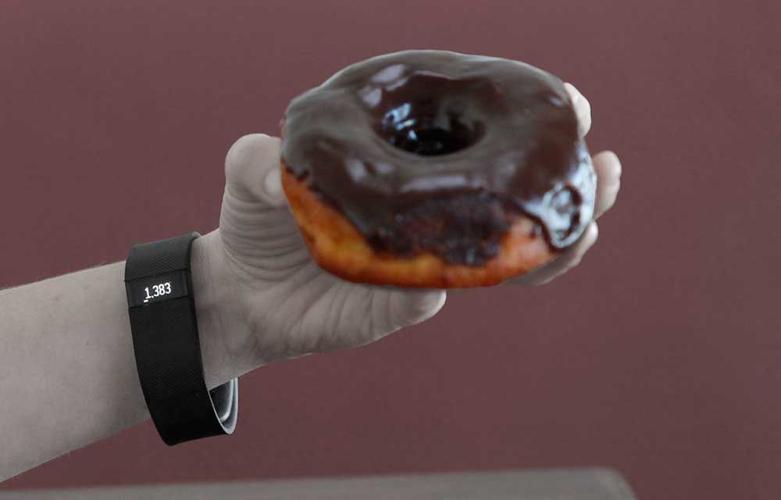
The morning of my first full day with the UP, I go for a run I’ve always believed to be 4 miles. I’m disappointed to learn it’s just 3.8. But the steps I’ve taken are enough that by 10:30am, as I walk to the office lobby, I hear an alert on my phone, via a bluetooth-connected app. I’ve reached 92 percent of my 10,000-step goal for the day. It’s mid-morning, and there are still donuts on the counter. I decide I’ve earned it, and help myself to a chocolate glaze.
The effect is counterintuitive. Personal fitness trackers are supposed to be motivational. But all it’s motivating me to do is to eat more pizza and donuts.
The pedometer rewards me for simple things like puttering around the office. One weekend day spent birdwatching with a friend – when the physically hardest thing I did was raise the binoculars – set my FitBit record to date: 19,223 steps over 7.64 miles. I did not break a sweat.
“For a lot of people, [personal fitness trackers] tend to be a distraction,” says Monterey Sports Center Fitness Manager Bill Rothschild. “Rather than focus on the workout itself, they focus on the technology support.”
For me, the most intriguing opportunity was a look at my sleep patterns. The devices measure my “active” versus “restless” sleep based on how much I move my wrist, and how many minutes it takes to fall back asleep after I wake up in the middle of the night.
The results seem accurate, if not enlightening: I spend about half the night sleeping deeply, or at least unmoving, and half the night restless. They highlight how much time I waste lounging in bed and reading the news on my phone in the morning before actually getting up and earning my 10,000-step badge.
As for measuring my workouts, I seem to get a lot of credit for doing nothing, and less credit than I think I deserve for working out.
But it works for a growing number of people, or at least it lets those people report impressive numbers. One Sports Center client used a tracker to keep off 130 pounds. And Salinas Valley Memorial Hospital’s annual 10-week exercise challenge, which launches Feb. 2, is all about tracking minutes of activity.
Last year, nearly 3,000 participants logged more than 6.3 million minutes of aerobic exercise. I wonder how much was slow-moving birdwatching.
“What you miss with the FitBit or Jawbone or other devices is that human, personal connection,” Rothschild says. “Having a portable device that gives you that feedback is not the same as a human being. And it does not necessarily have to be a trainer. A buddy helping make sure you show up at the gym is something you just can’t get from a device.”
Predictably, the fitness director recommends personal trainers over the devices that could replace them. But Rothschild’s lack of emphasis extends to the Sports Center’s clientele. “[Trackers] are not a big presence in our facility,” he says.
In fact, by way of a remodel, the Sports Center gym opened a new “core zone” Jan. 2, effectively an expansion of low-tech open floor space where clients can work on their abs and back muscles. And all those fancy settings on the cardio equipment? Most people at the gym don’t use them, Rothschild says.
They might be doing just as well. A Jan. 8 study published in the Journal of the American Medical Association found that wearable fitness trackers are mostly purchased, and mostly beneficial, to people who already have healthy habits – specifically, the wealthy and the young.
But even for the most well-intentioned, getting healthier is often more complicated than collecting data.
“The notion is that by recording and reporting information about behaviors such as physical activity or sleep patterns, these devices can educate and motivate individuals toward better habits and better health,” according to the JAMA study. “The gap between recording information and changing behavior is substantial, however, and while these devices are increasing in popularity, little evidence suggests that they are bridging that gap.”
The package of the Jawbone UP promises you will “get to know yourself.” I learn something I already knew: I can tell what feels right for my body, and I’ll do it whether or not a device tells me I’m supposed to.
That intuition, unscientific as it is, feels more accurate than any dataset.
For more about FitBit, visit www.FitBit.com; for more on Jawbone fitness trackers, visit www.jawbone.com

3
Salinas native Mike Holland, who asks that I refer to him as “Jazzer Dude,” first came to Jazzercise in the 1980s, the era of fabulous fitness and heyday of the Jane Fonda workout video.
After taking a few decades off, Holland started taking classes again seven years ago. He says much has changed about the iconic dance workout over the years.
“It’s not quite as girly as it was back in the ’80s, when it was all shiny leotards, leg warmers and big hair,” he says. “Jazzercise has evolved with the times, and that’s why it’s still around.”
Still around, indeed. While it has largely faded from pop culture over the last three decades, Jazzercise’s presence has quietly grown bigger than ever. According to the company’s website, more than 8,300 Jazzercise franchises operate globally.
As of last March, Holland is a licensed instructor and owner of one of those franchises, making him the only man in Monterey County in either respect. He leads several classes in Spreckels and Monterey throughout the week.
On a recent winter morning, I headed to Spreckels Veterans Memorial Building for Holland’s 8:30am class. After filling out a waiver (which more or less declares that I don’t expect a heart attack in pursuit of buns of steel), I enter the auditorium, where Holland is all smiles as he affixes his headset.
“You all ready for some Bruno Mars?” he says as the class gets into position (five women and two men, counting me). Then the music starts, and the 60-minute routine begins.
We start by slowly rolling our necks to the beat, then move down to the shoulders, abdomen and waist.
“Who else loves pelvises?” Holland says as we work our lower halves. “Yeah baby!”
Beside him on the stage is a “perceived exertion chart,” meant inform us how hard we should be working at different points in the workout. An arc on the chart rises from “resting,” peaks briefly at “very hard” and then gradually slides toward “light.”
From the easy, rolling motions (which “bathe our muscles in oxygen,” Holland says), the dancing begins. We sashay and step from side to side, hopping, skipping and jumping to a succession of Top 40 hits. We lift our legs with twirls and kicks, our arms with rolls, uppercuts and jabs. Twenty minutes in, without feeling like I’ve worked out very hard, I’m covered in sweat.
After another 10 minutes of fast-moving aerobic dance routines, in which I struggle to keep pace despite Holland’s narration of every move, we finally start our cool-down.
The workout finishes with light resistance training that incorporates 5 – to 7-pound barbells, giving our upper body muscles some flex while our lower body starts to relax.
When the 60 minutes end, I feel more energized than tired – one might even say “jazzed.” And while the workout was surely a big part of it, at least some of my good vibes come from Holland’s fun, playful style, which combines one part Richard Simmons, one part Austin Powers.
“You’ve got to love what you do,” says Holland, who also owns a fertilizer company and plays bass guitar. (He used to tour with Sam Kinnison, among others.) “If it wasn’t fun, I wouldn’t be doing it.”
And it’s something Holland sees himself teaching for many years to come.
“Jazzercise is in the 21st Century,” he says, “and it’s kicking ass.”
MIKE HOLLAND leads Jazzercise in the Spreckels Veterans Memorial Building, 5th and Llano Ave., Spreckels at 8:30am Tue and Thu and 3pm Mon-Tue. $10/session; $55/month ($45 prepay); $99/two months. In Monterey at 424 Adams St. at 5:30pm Mon, Wed, Fri and 8:30am Sun. $10/session; $45/month ($40 prepay); $80/two months. First class free at both locations. Students half-off.
4
- Alexandra Videmsky
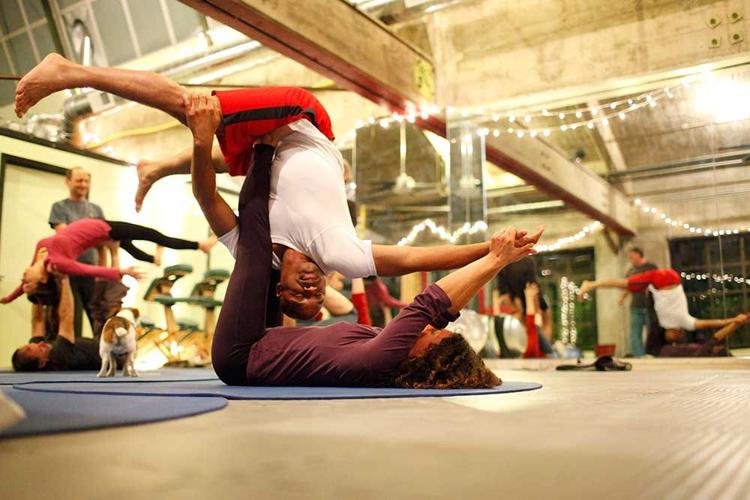
Going up into bird pose takes a little nerve. I have to drop my weight forward onto Jennifer Haydu’s feet and hands and trust her to support me as she’s laying on her back. From there, I raise my chest up and my arms out to the side like wings, all while she balances me on my hip bones.
Once I’m up there, it’s invigorating. My muscles feel engaged, I’m attuned to Haydu’s movement and more aware of how my body and balance interplay.
This is one pose in the practice of acroyoga, which combines yoga, acrobatics and Thai massage. One person acts as the base, raising the flyer into the air. There is usually a spotter ready to provide a steadying hand.
Haydu, 42, has been running Evolution Transformative Arts Studio for 10 years. She’s seen many approach it hesitantly.
“Usually people go, ‘I can’t do that.’ It can look really complicated, but it’s all physics,” she says.
The atmosphere in the Thursday evening classes is playful and mostly informal. Haydu calls it a “romper room,” complete with the occasional kid darting around. Participants chat and laugh while warming up with stretches, and pause to greet a little dog named Jackson, who belongs to a student.
Then participants partner up and start going into poses. At this point in the class, it’s mostly spontaneous – no teacher is guiding everybody into the same pose. People practice poses like throne (where the flyer is sitting upright on the base’s feet) and high-flying whale (where the flyer bends backward in the air, supported on the shoulderblades and ankles). Bases and flyers communicate verbally and through touch, guiding each other’s movements by push and pull.
When basic poses like bird and super yogi become second nature, participants move on to more advanced tricks. These incorporate more motion and twisting and start looking akin to what cheerleaders or gymnasts do. Haydu and an advanced student demonstrate a reel of cartwheels done over the base’s supportive feet, and then she climbs on his shoulders for a shoulder-stand. Next: hand-to-hand handstands, with the flyer totally inverted.
It may sound intimidating, but people are surprised by how much they can do. Kevin Ludwig, who has five years of experience, remembers the first time he balanced a partner on his feet and supported the flyer at the hips.
“I was shaking,” Ludwig says. “But every time you do it, it gets easier.”
Haydu guides an individualized process that balances self-improvement with contentment while emphasizing certain fundamentals.
“The physical part [of yoga] is secondary – it’s awareness training, breath work, self-study,” she says. “The way in for most people is physical, but hopefully they stay longer to realize it’s more than that.”
Ludwig explains why he loves it: “It’s the grounding feeling. Also, you’re doing the things you did as a kid again.” Things like somersaulting, lifting your partner into the air and stretching your arms like a bird are just plain fun. And learning to be in contact with another in a thoughtful way can build community and trust on top of strength and flexibility.
Haydu simplifies the whole effect. “It makes a lot of sense in the body,” she says.
As if to reinforce the sense of mutual support, by the end of class participants at Evolution wind down by exchanging massages.
Acroyoga classes meet 7-9pm Thursdays at Evolution Studios, 125 Oceanview Blvd., Suite 211, American Tin Cannery, Pacific Grove. $10/class. 601-0427, jennifer@evolutiontransformativearts.com

5
Ita (pronounced EE-tah) Pantilat can bench press almost twice her weight. She considers a brisk hour walk to and from the gym a nice way to warm up and cool down in preparation for benching and dead lifting hundreds of pounds. If she’s training for competition and finds she’s hungry, she drinks water. There doesn’t seem to be an undisciplined strand of DNA in her body.
I, on the other hand, can bench press roughly the weight of a Jack Russell terrier. I consider a brisk walk outdoors to be an inconvenient but necessary way to get back indoors. And when I’m training to write another column and I find I’m hungry, I eat cheese. Discipline is totally lacking in my DNA.
But I know there are things I can learn from the 63-year-old Pantilat. She’s a fierce, mighty, intense grandmother of four, born in Siberia, raised in Israel, an athlete and gymnast since early childhood. She married young, moved to Indiana with her husband so he could train as a runner in Bloomington, then landed with him in the Pacific Northwest, where he coached track and field before going into financial planning. They raised a family, and between her job as a registered nurse and the needs of her children, she stopped regular exercise.
Then came the merciless brain tumor – a fast-moving glioblastoma – that would take her husband Nathaniel’s life three months after he was diagnosed in 2001. Her daughters were grown and gone; her son was on the verge of leaving for college. And so Pantilat had time on her hands. She joined a gym.
“I never did weight lifting, but from gymnastics you develop a strong upper body,” Pantilat says. “And somehow, I liked it. I liked to lift the weights.”
She started with bodybuilding, but that didn’t do it for her. What did: Olympic-style weight lifting. She holds a world record for her age and weight class in benching (she took that honor at age 55), and world records for the snatch and the clean and jerk, too. She weighed 123 pounds when she benched 242.
Pantilat retired after 31 years as an R.N. and moved to Pacific Grove from Washington last July to be closer to her daughter, Talli van Sunder, owner of In Stride Physical Therapy, and van Sunder’s two children. Pantilat’s other daughter, Karen Rasmussen, is a naturopath in Washington. Her son Leor, an attorney and competitive trail runner, lives in the San Francisco Bay Area.
Pantilat’s knee is bugging her a little, but it doesn’t keep her from working out like a beast. I had an hour-long conversation with her, and here are some things I learned.
1. Don’t ever think you can’t do it. If something is creating a mental obstacle, that’s the time to attack it. But attacking it comes through practice.
“I go to the weights and I don’t have any doubts that I can’t do it,” Pantilat says. “But that confidence comes from training. I’m just standing and my mind doesn’t think about it. I’m thinking technique. I think about the weights.”
2. Doing something is better than doing nothing. Everyone’s busy. But everyone still has to do certain things – like breathing and eating.
“I didn’t exercise for many years when I had the kids and work,” she says. “But I feel better, so I do it. If it’s part of your daily routine, you continue. You can be surprised at how much your body can do.”
3. It’s not necessarily how much you lift, but how you lift it. Weights are like life – it doesn’t matter how strong you are if you can’t lift it (or, in the case of life, carry it) the right way.
“The more heavier you lift, the more your body gets used to it. It gets mentally easier,” she says. “But Olympic lifting is about the technique. Technique and speed and weight. You have to have control of your body.”
4. Everyone is carrying their own weight. Sometimes that weight is emotional, and sometimes it’s physical. Pantilat lost her husband when they were in their early 50s, then lost her father and sister just a few years ago. She tweaked her knee at a competition in September and is still working through the pain.
“I don’t judge anyone,” she says. “Everyone is different.”
MARY DUAN is the Weekly’s editor. Reach her at mary@mcweekly.com or follow her at twitter.com/maryrduan. For a video of Pantilat in action, visit www.mcweekly.com
6
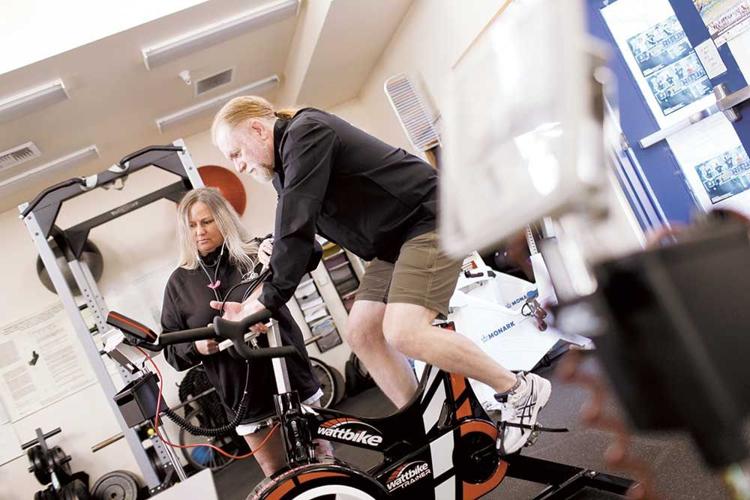
The health and fitness field is rife with misinformation and myth. Who can one trust? How about a couple of Ph.D.s? Kent Adams is a professor and chair of CSU Monterey Bay’s Kinesiology Department and director of the Exercise and Physiology Lab. Trish Sevene is a fellow professor and director of CSUMB’s Anatomy and Physiology Lab.
“We [teach] people how to change their behavior and instill evidence-based practices,” Sevene says.
They are married. And they are skeptics. Sevene even teaches a class called Healthy Skepticism. “It makes a difference where the data is coming from,” she says. “In health and fitness, everybody thinks because they eat and move, they can be an expert.”
Adams says credibility should be based on rigorous scientific methodology. “We’ve had numerous articles in peer-reviewed journals,” he says. “Science matters.”
From that standpoint, they offer some words of wisdom about the fictions clogging up their field of study:
Organic foods are healthier than conventional foods.
“The most recent analysis that compared [conventional and organic foods], found, as a whole, biologically, they’re equally healthy,” Sevene says.
The meta-analysis of 237 existing studies was published in the Annals of Internal Medicine in September 2012.
It found that organic and conventional produce have the same nutritional content. Organic foods have higher phosphorus levels, but most people are not deficient in that mineral. Organic chicken and pork have lower levels of antibiotic-resistant bacteria, and organic milk has nominally higher levels of omega-3 fatty acids. Organics are only 30-percent less likely to carry pesticides than their conventional counterparts.
The study found higher levels of pesticides in the urine of children who ate conventional foods. But Sevene says the data show a child could eat 1,508 servings of conventional strawberries with no ill effects.
The take-home is uplifting: “We have a great, healthy food supply,” she says.
Vitamins decrease the incidence of chronic disease.
“The data are really clear that unless you are sufficiently deficient, taking a multivitamin every day is not beneficial,” Sevene says. “There are some data that say it could be detrimental. One study [shows] a correlation, not a cause, that people who take a multivitamin every day are more likely to die of chronic disease. My hypothesis is that they think they may be covering their bases and not doing things like eating a healthy diet and getting all the nutrients they need.”
Lifting weights is unnecessary and makes you bulky.
Adams sees a bias against lifting weights. “People think that aerobic training is all you need,” he says. “You need resistance training to stimulate bone and muscle health. That yoga replaces resistance training is a myth.”
Sevene says women in particular are afraid lifting will make them appear less feminine. “Women don’t produce enough testosterone to get bulky doing resistance training,” she says.
Weight-lifting is important as people age, they say, to keep up physical capabilities like taking out the garbage or lifting up the grandkids. Adams says movement also helps with “function related to cognition and problem solving” by increasing blood flow to the brain, and decreasing depression and anxiety.
The paleo diet is the answer to obesity and chronic disease.
The paleo diet reasons that we are the sum of millions of years of evolution. And for most of those millions of years, our ancestors didn’t eat things like beans, grains or milk, much less Cheez Whiz or tofu. Food has evolved too fast for human evolution. That’s why we are ill-suited to much of what we eat, like gluten and dairy.
Sevene tackles two myths embedded in this diet fad. One: that there is a singular paleo diet. “If your ancestors lived by the water, they ate fish,” she says. “If they lived on the African plain, they ate more meat. In the tropics, fruits and vegetables.”
Two: that we can emulate prehistoric diets anyway. All the foods we consume have been selectively bred to make them more palatable and digestible. “That started when we domesticated crops 11,000 years ago,” she says. “There’s nothing you can eat today that is going to replicate what [our ancestors] ate.”
Here’s what she says about vegans: “People who are vegan make the argument that our intestinal tracts aren’t designed to eat meat. It’s perfect for what we are: omnivores.”
Read more of the skeptical couple’s myth-busting at www.mcweekly.com/myths
7
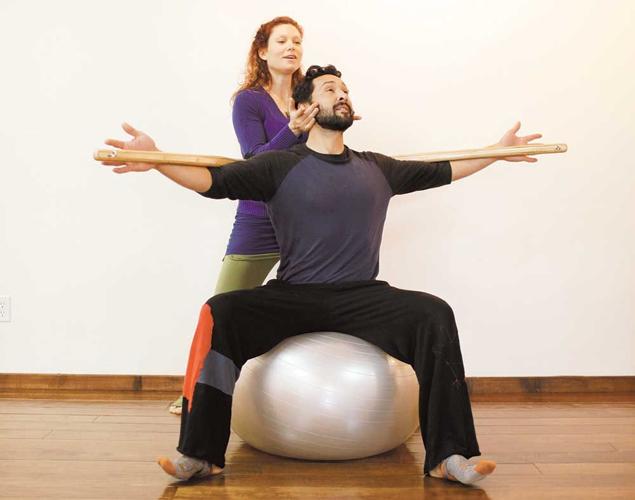
There is a saying in the Gyrotonic discipline that goes like this: “Stop moving, and you die.”
Breathing is movement, after all. As its founder Juliu Horvath says, “When something stops moving, it’s an expression of death. The more it moves, the more it’s an expression of life.”
By that logic, Domini Anne might never die.
The 38-year-old mother of one (with another on the way) helps clients recover from injuries and find greater body control and range of motion. She also travels the region and country to train other movement coaches as one of the world’s few specialized Gyrotonic and Gyrokinesis master trainers. Meanwhile she designs supple, eco-friendly threads for her luxury athletic wear line, Domini Anne. The vision is clothing you can both work out and socialize in. Think yoga gear with curbside cred.
The Weekly tracked the onetime professional ballerina to her Carmel studio to train on different apparatuses designed to, as the official Gyrotonic website puts it, “facilitate exercise sequences composed of spiraling, circular movements.”
One journalist called the primary contraption of pulleys and knobs (the pulley tower unit) “what you’d get if you crossbred a torture rack and a gynecologist’s examining table.” The workout is more of a cross between Pilates and tai chi.
• • •
Weekly: You’ve got some stuff going on.
Anne: For a while I felt like I had dueling passions and dueling careers. I had a feeling I had to give all of my time to one of them for it to succeed. Then I had an epiphany that I’m here on this Earth to help people love the experience of being in their body. And my two careers go hand in hand: freedom in Gyrotonics and freedom of movement in the clothing itself. They’re yoga clothes that look fancy enough to wear to dinner. As an instructor, you get tired of wearing sweatpants day in and day out. I started at 14 when I was a punk rocker and a ballerina. I didn’t want to change from striped tights and Doc Martens to pink.
You’ve called Gyrotonic the antithesis of weight lifting.
Not all styles only deal with contraction, but for the most part, they contract into the body, building a shorter, tighter muscle. We use muscular tension to create expansion and strength, like you feel with a yawn, a stretch that goes through your whole system. Gyrotonic never isolates one muscle. We’re looking at a chain, a whole circuit. That also sets it apart from Pilates.
Gyrotonic encourages play and nonrepetition. Why is that so important?
We believe that stagnation equals death. The cause of all disease is stagnation, be it emotional, physical, mental, spiritual. You’re building brain plasticity to adapt to whatever changes take place. You’re essentially able to move like Bruce Lee. Strength is flexibility, the ability to be able to work with whatever’s coming at you.
Juliu says, “Be like elephant, like rhinoceros, like a gazelle, like a bird.” What’s that about?
He’s talking about plasticity and playfulness. The ability to see a quality in an animal movement helps re-create a similar feeling. He says the three ideal animals are the octopus, the monkey and the cat. If you can find movement that follows all three of those, you will have the freest body possible. A cat is totally relaxed in the sun one minute, then hears a noise and is alert, going from zero to 1,000 in an instant. You hope to train your nervous system to be relaxed but active at any point.
If you could gift readers one bit of body awareness, what would that be?
Watch your breath move through your system and let the movement follow. There’s a ton of different breaths you can do – I’m teaching a breathing intensive now – and breathing is the power for movement. When you’re just contorting muscles, you only experience one-third of the power. You have a connected movement no matter what.
I’ve heard you say metaphor is important to your practice. Why is that?
They expand your mind. It’s easier to connect with an image than basic facts. You can see someone, hear something and feel something. When you give an image, you are hitting all three.
GROUP GYROTONIC classes are $20; private sessions $75/hour, packages available. Learn more at www.carmelgyrotonic.com. Clothing line infomation, images and sales at www.dominianne.com
8
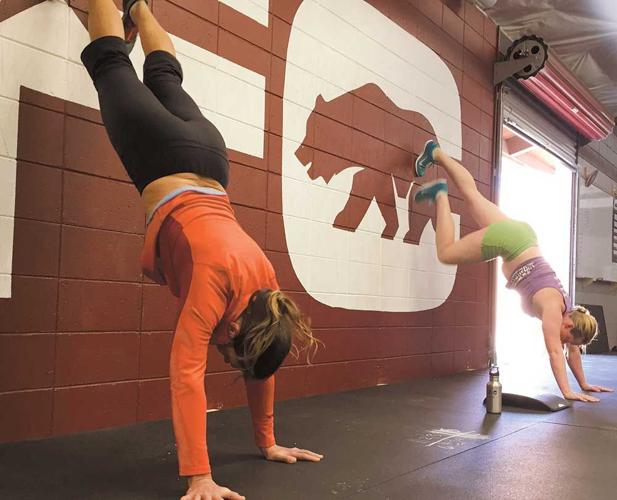
The ridiculously fit woman looking me over with a bit of mischief in her eye makes a prediction about my future. She is so right and so wrong at the same time.
“Tomorrow,” she says, “you’re going to be smoked.”
CrossFit coach Connie Keathley is so right: After this workout, in which I struggle to keep up with the other women in the class through wall walk-ups and double-under jumprope – followed by five three-minute sprints through a nonstop circuit of power cleans, pushups and squats – I will struggle up stairs.
But she is so wrong: Having done a different workout of the day (or WOD) at the same First City CrossFit the previous day, I am so already smoked. My quads sing a song of self-pity every time it comes back to the squats.
So why am I smiling?
Here’s why: When I look at the time I’m stunned to see how fast such a hard workout has gone. I’m inspired by those around me doing astounding amounts of reps without physiques like our trainer’s. I love the soundtrack when the rousing music stops and all I hear is our breathing.
It all goes back to the primary reason why the newest CrossFit gym in Monterey County, nestled in a big, well-outfitted space by the airport, is growing faster than any of its local siblings: They are taking the fundamental CrossFit principle that all levels of fitness are welcome, and turning it their own art form. I see seniors, sloggers and ultra racers all humming along on the eight rowing machines and pullup bars, genuinely engaged and cheering on each other.
Get more about First City, plus all the issue’s health stories, at www.mcweekly.com/healthandfitness
9
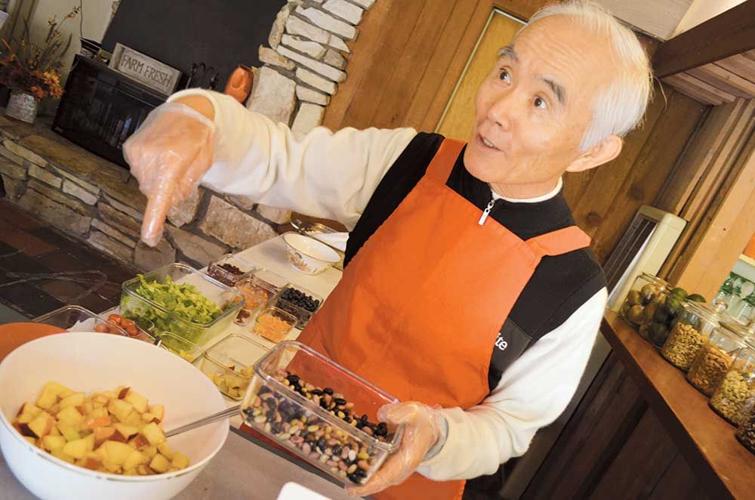
Between his poetry and paintings and veganism and meditation, Tong P. Kim is an interesting cat.
But there’s plenty more intrigue where that came from.
The new owner of the reinvented Carmel Valley Lodge (659-2261) reveals both a quick laugh and a long-abiding belief that humans are meant to live 170 years.
And that he’s eaten essentially the same fruit-nut-bean-lettuce medley almost every meal as far as he can remember.
That’s decades.
In the meantime, he’s also survived three armed robberies.
But before I go further, I should slow down, take a meditative breath, and explain how I came to meet him, starting with the letter that first introduced us.
~ ~ ~
The letter came in the book, which appeared in my Weekly cubby hole.
It went like this:
I am the new owner of the Carmel Valley Lodge and I would like to extend a special invitation to you to join me as my guest for a Rainbow Ssambap® feast.
I am also giving you a copy of my book 60 90 20 Rainbow Ssambap and I would love to personally share my experiences over a meal that may just change the way you live your life and health and wellness.
Then, I would like for you to join me as my personal guest in a game of golf at Pebble Beach.
Sincerely humble and humbly sincere,
Tong P. Kim
My first question after reading the letter: What is Rainbow Ssambap?
The answer, or at least part of it, appeared on page 18, with a recipe:
You need nuts (almonds, cashews, walnuts), fresh vegetables (one beet, three tomatoes, 20 cherry tomatoes, one carrot and any other vegetable that you want to eat), and fruits (apples, blueberries, bananas, lemons, avocados, etc.), but not salt water and food additives
1) Make a base – Put five sliced tomatoes the bottom of the blender, put one sliced beet, one carrot, two bananas, one avocado, 20 almonds, 20 cashews and five walnuts on top of it and blend them.
2) Pour it into a large bowl.
3) Add blueberries, strawberries, cherry tomatoes, one chopped apple, half of a lemon, some lettuce and any other vegetables, nuts or fruit you want to eat.
4) Mix and eat it.
The second question: Who is this guy?
That answer is more difficult to pin down, but not for shortage of clues.
Some answers from both sources:
• He worked as a barber on weekends to pay for high school, and graduated with a business degree from Yonsei University in Seoul, Korea.
• He moved to Southern California and spent time as a bank assistant manager and a kitchen assistant, working 16 hours a day to sock away money to open a gas station and grocery store, which led to the hotel business, but not before three armed robberies. The key to making it out alive: avoiding eye contact.
• He chaired the Korean American Association and Korean Language School in Monterey.
• In 1999, at the end of 17 years “searching for the meaning of life,” he camped alone for 100 days in the cold mountains somewhere in Korea or greater Asia.
• He says he spent five years learning to paint after Monet’s “Water Lilies” captured his heart, and has spent up to five years working on a single poem.
• He purchased the Carmel Valley Lodge for $5.25 million in August, “with the sole intention to guide others in transforming their lives to greater health and well-being,” according to a bio available at the lodge.
~ ~ ~
The combination sounds like something thrown at chefs on Top Chef or The Taste: several kinds of soaked beans, bananas, cherry tomatoes, chopped lemon with peel intact, walnuts.
So I understood this passage from his bio: “Some of the returning guests were disappointed to learn that waffles, cereal, milk and juice were no longer available… ”
We arrive to a mid-prep process he does “so guests can see what is in it,” surrounded by jars of beans and seeds and nuts. We talk as he assembled a layered whirlwind of ingredients on the base of mushy tomato-banana blend.
After reading the recipe several times to different people – whose reactions included “With all you save on food you can buy a resort!” and “He must s*** rainbows!” – and rapping with him at length about enzymes, the 100 lemon trees on property and why the book’s title includes “60 90 20,” I am ready to eat whatever he had in that blender.
“Lemon is very important!” he said excitedly through a Korean accent. “I would say number one food from the gods. Tomato is second. I eat 100 cherry [tomatoes] a day! And four regular!”
I asked him about his approach to organic and seasonality given such enthusiasm. He said he makes exceptions to both when he has to, peeling any conventionally farmed apples he might include, and relying on South American imports to keep his tomato love intact.
Finally, he took a big bowl to a little table in the dining room on the side of the lobby set with sliced kiwi dessert plates and generous goblets of single-vineyard Russian River Valley WesMar Pinot Noir.
And we ate.
It only got more interesting from there. For the rest of the story, visit www.mcweekly.com/edible.
~ ~ ~
The way Tong Kim tells it, the medical tests took two days and cost about $5,000 U.S., at a hospital “10 times bigger” than Community Hospital of the Monterey Peninsula (better known as CHOMP).
He had them check everything humanly possible. The inspiration, he writes: “If the result is good then [my wife] promised me that she would eat Rainbow Ssambap every day, as I have been.”
I couldn’t corroborate, because the doctor is in South Korea, but here’s what Kim says the doctor told him: His physical age was closer to 30 than Kim’s actual 72.
He swears by it, and I believe him.
One reason why: The poem that he calls his greatest yet, and hardest to create. It doubles as the valediction on his letters: “Sincerely Humble and Humbly Sincere.”
“I know [Rainbow Ssambap] has been great for me,” he writes, “but there wasn’t proof.”
He goes on:
“Since then I have been promoting Rainbow Ssambap religiously. Some of my friends jokingly call me a “Rainbow Ssambap” cult leader. I don’t mind because I am spreading a wonderful thing.
On the same page it breaks into a poem called “Horizon”:
Some say
It was born from the Heaven and the Ocean
Some mention
That it occasionally builds a double rainbow
bridge
Some claim
A cloud was doing a dangerous tightrope
walking
Other say
It is a cliff of a thousand miles fall
~ ~ ~
Healthy eating advocates encourage people to chew at least 14 times to break down food for better digestion.
I tend toward 22 with Rainbow Ssambap because there’s so much going on in there, because it’s so crunchy, because there are 22 ingredients and because it tastes surprisingly good.
The bell pepper and the lemon play shockingly well with the others.
Avocado and tomato connect the tastes. All the different nuts keep it exciting and diverse bite to bite. The lettuce cinches the textural experience.
As we’re prepping and eating, Kim takes me through a calculus that explains why “60 90 20.”
It’s partly derived from the age you take, more or less, to reach maturity (20), to reach retirement (60) and what he calls wisdom (90), but don’t quote me, because it wasn’t completely clear.
The punchline, though, was clear: They add up to 170, the true lifetime humans should enjoy.
As he writes in the book:
“According to science, the life of all animals, including humans, is six to seven times of their growth period.”
For humans that’s 22 to 24 years, he reasons, so we should be shooting for 132 to 168. Round up.
Hence his vision for Carmel Valley Lodge – which becomes clearer with a tour of the varied suites and their fireplaces and patios – with meditation through painting and poetry, swimming, horseback riding, yoga, deep breathing, spa treatments, health talks and more. He’s invested $500,000 in improvements al
Career Southern California spa manager Gio Stevagio has even stayed on permanently after the launch period because she’s so moved by Kim’s vision.
Oh, one more thing, a key to the proceedings: All meals will be vegan, including two meals of Rainbow Ssambap and a 10-course supper that is complemented by, according to lodge literature, “a glass of fine Pinot Noir,” because as Kim believes, “life is too short to drink cheap wine.”
I’m just not sure if he means life as we know it, or as he does.
As we say our goodbyes, he tells me we cannot have a meeting and feast like this in his native culture without something.
He hands me an envelope that I immediately open, close and hand back after a glimpse just long enough to see three incredibly crisp hundred-dollar bills.
He insists. I reply that I’d like to do a story, and accepting that would mess everything up.
See I have my life, as he has his.
Sincerely humble, and humbly sincere.
10
- Dr. Steven Packer
With the dramatically shifting landscape of health care insurance coverage for many Americans, it would be tempting to simply state the obvious: More coverage for more people equals more business for hospitals.
Community Hospital of the Monterey Peninsula has seen an uptick in visits at all of our facilities. In Monterey County, 37,000 additional residents obtained insurance coverage through expanded Medi-Cal eligibility under the Affordable Care Act (ACA). We saw nearly a 50-percent increase in the number of Medi-Cal patients needing hospitalization in 2014; many had no means of paying for care before.
Beyond more patients, there is something bigger to consider, something we at Community Hospital have focused on for nearly a decade – an opportunity to promote better health for every person in Monterey County.
Improved health care coverage means, theoretically, more people can access preventive care and reduce the number of acute/emergency visits to our hospital. A new paradigm in health care calls for a focus on well care vs. sick care and a commitment to keeping people out of the hospital whenever possible. In health care circles, it’s called “The Triple Aim” – better care, better health, lower costs.
At Community Hospital, we have been pursuing these goals. We are committed to improving lives by inspiring and helping all to achieve optimal health. We have developed a number of initiatives to help achieve this vision.
In 2011, we opened the now near-capacity Peninsula Wellness Center in Marina, a 34,000-square-foot medical fitness facility. In early 2012, we introduced Community Health Innovations (CHI), a subsidiary partnering with other providers to coordinate patient care, promote wellness and manage disease. Also in 2012, we added Aspire Health, a Medicare Advantage health plan to give seniors a local option for coordinated, customized care.
A year later we focused our attention inside the hospital to develop something not available anywhere on the Peninsula – an inpatient rehabilitation unit with a focus on quickly returning patients to their best possible quality of life following major illness or injury.
In 2014, we expanded Peninsula Primary Care to add a number of other medical specialties – cardiology, neurology, urology and infectious disease.
The ACA is not a panacea for challenges we will face in 2015. Ensuring there will be enough doctors to meet the demands of an aging population and an influx of newly insured patients remains daunting. Managing costs in an era of increasingly sophisticated and expensive medical technologies requires vigilance. And we must address our community’s health care needs while complying with ever-growing government regulations and unfunded mandates.
Our resolve is steadfast – to provide safe and reliable care based on prevention, wellness and, above all, an emphasis on optimal health.
STEVEN PACKER, MD, is president and CEO of CHOMP.

11
There is good crazy and bad crazy.
The good-craziest chef I know sent me a text about the good-craziest artist I've known last weekend.
The text included the above picture, at Cachagua General Store (659-1857), the best renegade one-night restaurant in the West, which reveals a sign by a new stash of books called Ed Leeper Memorial Book Thing that reads:
“Bring a book. Take a book. Bring a book back. Keep the book. You don’t even have to read your book...just love it.”
I love that.
(In a related note: Last week, I couldn't look ahead at 2015 without taking one look back at 2014 and the loss of Leeper, the survival of a friend and the discovery of my favorite taqueria.)
More food news nibbles:
• After a reality-bending first Relais & Chateau GourmetFest, the second ever is now set and scheduled for March 5-8.
• Then there's this: The lineup for the—holy caviar cannoli—eighth Pebble Beach Food & Wine, April 9-12, is out and up on the website.
• Paul Wetterau, former sommelier and manager at spots like Casanova and Marinus—and Weekly contributor behind pieces like 2007's "Spit Out: The sommelier certification test brutalizes a young wine pro"—is back in Carmel as GM for Casanova, itself fresh off a much-awaited update to its decor.
• The Kosher-style Deli Lunch and Bake Sale at Temple Beth El (424-9151), now a Salinas community tradition for 59 years, is served 9am-6pm Thursday, Jan. 29. Think large corned beef sandwiches, coleslaw and pickle, plus a wedge of cake ($12).
• Chef Brendan Jones of LOKAL (659-2125) and winemaker Mark Chesebro team up for a cooking demo and family-style dinner with wine pairings 6:30-9:30pm Wednesday, Jan. 28. Cost is $60 regular or $55 for Chesebro Club members. RSVP.
• Knuckles has a bunch of new craft beers—21st Amendment, Golden Road, Brew Dog and more—as fully reported with.
• Ten artisan winemakers along the River Road wine trail, including Hahn and Scheid, are sharing the love 11am-4pm on Valentine’s Day Saturday, Feb. 14. With the purchase of a Valentine’s Passport, visitors can enjoy wine and food pairings, special discounts and an entry to the grand prize drawing. Prices increase from $35 to $45 on Feb. 1. Available at www.riverroadwinetrail.com.
• Colleagues of the Arts' annual Mardi Gras lobster boil 6-9:30pm Friday, Feb. 6, with beads, masks, live acts and a Cajun lobster feast ($125, 607-9584 to reserve).
• All you can eat crab, pasta, salad and desserts are at the Salinas Sports Complex for the Young Farmers and Ranchers Crab Feed 6pm Saturday, Feb. 28. ($55, 751-3100)
More like this...
White nitrogen gas swirls around my body. I’m standing up, naked, in a cryogenic chamber smaller than a phone booth. Rubber booties and gloves keep my feet and hands tolerably warm while the rest of my skin prickles with goosebumps.
I feel like I’ve stepped outside in zero-degree weather. In reality, it’s more like -250 Fahrenheit.
There’s a crackly quality to this deep, dry cold. My skin goes frosty-pale. It occurs to me that if I were to flick a nipple, it might shatter.
Brittney Scarlett-Torres is at the chamber’s controls, reassuring me with bubbly small talk. As co-owner/operator of Glacé Cryotherapy, which she and her brother opened in The Carmel Barnyard a few months ago, she’s convinced the benefits are broad and deep.
The Carmel High grads – Brittney was class of 2003; younger brother Skyler Scarlett was 2008 – are both bright-eyed, chatty and quick to smile. During an interview they pass the conversational ball back and forth, explaining how they decided to go in on cryotherapy together. Skyler’s the researcher/technician of the team, while Brittney masterminds the nuts and bolts.
Like any siblings, they had their squabbles as kids. But now, if someone gets snappy, they just hop in the cryosauna. “It mellows us out,” Skyler says.
The idea germinated a couple of years ago, when Brittney’s husband asked Skyler, then an exercise physiology major at Chico State, if he’d heard of whole-body cryotherapy. Among the claimed benefits: pain reduction, calorie burn, endorphin release, mood enhancement, anti-aging effects, even a libido boost.
He was skeptical. What can be done in three minutes? he remembers thinking.
But research made him a believer. To convince potential clients, he posted 14 peer-reviewed clinical studies on the Glacé website.
What the science says: Cold stimulates the body to fight inflammation, a major culprit in both soreness (post-workout or injury) and chronic illness (like heart disease and arthritis). Exposure to low temperatures prompts the blood vessels to shrink, which reduces pain and accelerates healing – like an ice pack on a swollen muscle, but at a more intense, whole-body scale.
Other perks, according to Skyler: The cold stimulates collagen production, which is good for the skin. The sudden drop in skin temperature sends a surge of blood to the body’s core; when the session ends, that nutrient-rich blood flows back to the extremities. That warming-up process also kicks up metabolism. Brittney says a single session causes the body to burn an extra 500-800 calories throughout the day. For some clients, it also triggers an endorphin release she calls “the cryo-rush.”
Skyler shows me a photo collage of his topless torso, which progresses from doughy to sculpted six-pack over six months. Other than cryotherapy sessions once or twice a day, he says, all else was equal: biweekly workouts, clean eating.
Carmel Valley resident Chaz Bomio says he’s seen a definite improvement in his healing from post-bike-accident knee surgery after four cryo sessions. He also describes “an energy boost and a sense of well-being” that lasts for hours.
“The first time, wow, I wasn’t sure quite what I experienced. Then I got an idea what was going on,” he says. “It was an invigorating feeling.”
He signed up for a package of future sessions, convinced regular cryotherapy will improve his joints over the long term.
The siblings are stoked to be on the forefront of what they see as the next U.S. health trend. New spas are opening in San Diego and Las Vegas. Chiropractors and physicians are adding cryosaunas to their practices.
Not that whole-body cryotherapy is new. Dr. Toshiro Yamauchi invented it in Japan in the late 1970s. From there it reportedly migrated to Europe, where athletes and the general public picked up the trend. But the Scarlett siblings say it didn’t reach the U.S. until 2010, when a cryosauna opened in Texas. The Dallas Mavericks pro basketball team famously used cryogenic therapy on their way to the 2011 championship.
Before opening Glacé’s barn door Oct. 15, Brittney did a U.S. cryosauna tour, including Viking CryoTherapy in Los Gatos; four cryotherapy spas in SoCal (where, it’s rumored, certain celebrities freeze regularly); and one in Dallas.
Glacé’s books are already penciling out, Brittney says, despite a $60,000 investment in the American-made Impact Cryosauna and a liquid nitrogen bill topping $1,000 per month. People in cryotherapy circles are watching to see how it performs in little Carmel, she says.
Glacé customers get the best value in packages. The Scarletts say it takes a few visits to really feel the benefits, so I commit to three sessions. I’m a little nervous at first, especially filling out the waiver that spells out what I’m getting into: 3 minutes or less exposed to temperatures of -238 to -274 Fahrenheit.
I go into a small room, undress and put on the provided gloves, socks, rubber booties and bathrobe. The goal is to make sure nothing’s sweaty, because moisture makes the cold worse. Men are advised to leave their underwear on so they don’t get chilblains – the inflammation of small blood vessels when skin suddenly goes from cold to hot.
I step into the glowing blue chamber, where the operator (Brittney for my first session, Skyler for the next two) folds a plastic frame over my shoulders, leaving my head poking out on top. That’s so customers don’t inhale the pure nitrogen gas, which could make them pass out.
I slip off the robe and hand it over – they assure me they can’t see below the neck – and with a soft mechanical exhale, the white vapors snake around me.
We chit-chat while the timer runs. I rest my eyes on the mounted flatscreen, where there’s a picture of a desert. Think warm thoughts, I tell myself.
But the sudden chill is primal. My nerve receptors start sending increasingly urgent text messages to my brain:
Brrrrr.
No, seriously. BRRR.
GET OUT OR YOU WILL DIE.
That first visit, I called uncle at two minutes sharp. Brittney says that’s fine: You get all the health benefits if you make it at least 120 seconds. More than 180 and you get into frostbite territory.
The next visit, I push it two and a half minutes. Skyler uses a laser to read the surface temperature of my calf as I step out: 44 degrees.
At my third session, I finally get through the full 3 minutes, though the last few seconds bring a new tingle that borders on burning.
Afterward, it’s hard to put a finger on what I feel. It’s not the euphoric “cryo-rush” Brittney had described. My chronically sore neck and shoulders seem a little less achy, but the change is subtle enough that it could be a placebo effect.
But I’m not exactly feeling normal, either. I’m better than normal. Renewed. Rejuvenated. My steps are springy, like coils of energy are curling out from my core. My skin feels like soil thawed after a winter frost, spongy and warm in the sweet Carmel sunshine.
GLACÉ CRYOTHERAPY, 3777 The Barnyard Suite I-14, Carmel. Appointments preferred: 264-3733, glacecryotherapy@gmail.com. $40/first session, $99/intro three-pack, $65/regular session; discount packages available. More info at www.glacecryotherapy.com.
Time for a lunchtime jog. I plan to try out a brand-new Jawbone UP, a black bracelet designed to track my fitness in different ways – how far and fast I go, how many steps I take, how many calories I burn.
I open the package and realize it I need to charge it and call customer service to update the software. While I wait, I decide to eat a leftover slice of pizza from the Weekly fridge. After all, I’m not being measured yet.
I go running, swimming or hiking to tune out the world and the constant ping of electronics. I relentlessly mock my partner’s GPS-based Android app, whose female voice urges, “Let’s get started” at the beginning of a run. I am annoyed by her presence and her proclamations of our mile split times, but I am delighted to check how far and fast (or slow) I’ve gone at the end of a run.
So I was open to trying the latest iteration of personal fitness devices, unobtrusive clip-on bracelets designed for near-constant wear. Both Jawbone and FitBit models serve as pedometers and target a 10,000-step-a-day threshold, “the magical number,” according to FitBit’s blog.
“It should be enough to reduce your risk for disease and help you lead a longer, healthier life,” the blog states.
With that in mind, I undertook a few days wearing the UP ($129.99) and the FitBit Charge ($129.95), measuring my steps, my workouts, my sleep patterns.
The morning of my first full day with the UP, I go for a run I’ve always believed to be 4 miles. I’m disappointed to learn it’s just 3.8. But the steps I’ve taken are enough that by 10:30am, as I walk to the office lobby, I hear an alert on my phone, via a bluetooth-connected app. I’ve reached 92 percent of my 10,000-step goal for the day. It’s mid-morning, and there are still donuts on the counter. I decide I’ve earned it, and help myself to a chocolate glaze.
The effect is counterintuitive. Personal fitness trackers are supposed to be motivational. But all it’s motivating me to do is to eat more pizza and donuts.
The pedometer rewards me for simple things like puttering around the office. One weekend day spent birdwatching with a friend – when the physically hardest thing I did was raise the binoculars – set my FitBit record to date: 19,223 steps over 7.64 miles. I did not break a sweat.
“For a lot of people, [personal fitness trackers] tend to be a distraction,” says Monterey Sports Center Fitness Manager Bill Rothschild. “Rather than focus on the workout itself, they focus on the technology support.”
For me, the most intriguing opportunity was a look at my sleep patterns. The devices measure my “active” versus “restless” sleep based on how much I move my wrist, and how many minutes it takes to fall back asleep after I wake up in the middle of the night.
The results seem accurate, if not enlightening: I spend about half the night sleeping deeply, or at least unmoving, and half the night restless. They highlight how much time I waste lounging in bed and reading the news on my phone in the morning before actually getting up and earning my 10,000-step badge.
As for measuring my workouts, I seem to get a lot of credit for doing nothing, and less credit than I think I deserve for working out.
But it works for a growing number of people, or at least it lets those people report impressive numbers. One Sports Center client used a tracker to keep off 130 pounds. And Salinas Valley Memorial Hospital’s annual 10-week exercise challenge, which launches Feb. 2, is all about tracking minutes of activity.
Last year, nearly 3,000 participants logged more than 6.3 million minutes of aerobic exercise. I wonder how much was slow-moving birdwatching.
“What you miss with the FitBit or Jawbone or other devices is that human, personal connection,” Rothschild says. “Having a portable device that gives you that feedback is not the same as a human being. And it does not necessarily have to be a trainer. A buddy helping make sure you show up at the gym is something you just can’t get from a device.”
Predictably, the fitness director recommends personal trainers over the devices that could replace them. But Rothschild’s lack of emphasis extends to the Sports Center’s clientele. “[Trackers] are not a big presence in our facility,” he says.
In fact, by way of a remodel, the Sports Center gym opened a new “core zone” Jan. 2, effectively an expansion of low-tech open floor space where clients can work on their abs and back muscles. And all those fancy settings on the cardio equipment? Most people at the gym don’t use them, Rothschild says.
They might be doing just as well. A Jan. 8 study published in the Journal of the American Medical Association found that wearable fitness trackers are mostly purchased, and mostly beneficial, to people who already have healthy habits – specifically, the wealthy and the young.
But even for the most well-intentioned, getting healthier is often more complicated than collecting data.
“The notion is that by recording and reporting information about behaviors such as physical activity or sleep patterns, these devices can educate and motivate individuals toward better habits and better health,” according to the JAMA study. “The gap between recording information and changing behavior is substantial, however, and while these devices are increasing in popularity, little evidence suggests that they are bridging that gap.”
The package of the Jawbone UP promises you will “get to know yourself.” I learn something I already knew: I can tell what feels right for my body, and I’ll do it whether or not a device tells me I’m supposed to.
That intuition, unscientific as it is, feels more accurate than any dataset.
For more about FitBit, visit www.FitBit.com; for more on Jawbone fitness trackers, visit www.jawbone.com
Salinas native Mike Holland, who asks that I refer to him as “Jazzer Dude,” first came to Jazzercise in the 1980s, the era of fabulous fitness and heyday of the Jane Fonda workout video.
After taking a few decades off, Holland started taking classes again seven years ago. He says much has changed about the iconic dance workout over the years.
“It’s not quite as girly as it was back in the ’80s, when it was all shiny leotards, leg warmers and big hair,” he says. “Jazzercise has evolved with the times, and that’s why it’s still around.”
Still around, indeed. While it has largely faded from pop culture over the last three decades, Jazzercise’s presence has quietly grown bigger than ever. According to the company’s website, more than 8,300 Jazzercise franchises operate globally.
As of last March, Holland is a licensed instructor and owner of one of those franchises, making him the only man in Monterey County in either respect. He leads several classes in Spreckels and Monterey throughout the week.
On a recent winter morning, I headed to Spreckels Veterans Memorial Building for Holland’s 8:30am class. After filling out a waiver (which more or less declares that I don’t expect a heart attack in pursuit of buns of steel), I enter the auditorium, where Holland is all smiles as he affixes his headset.
“You all ready for some Bruno Mars?” he says as the class gets into position (five women and two men, counting me). Then the music starts, and the 60-minute routine begins.
We start by slowly rolling our necks to the beat, then move down to the shoulders, abdomen and waist.
“Who else loves pelvises?” Holland says as we work our lower halves. “Yeah baby!”
Beside him on the stage is a “perceived exertion chart,” meant inform us how hard we should be working at different points in the workout. An arc on the chart rises from “resting,” peaks briefly at “very hard” and then gradually slides toward “light.”
From the easy, rolling motions (which “bathe our muscles in oxygen,” Holland says), the dancing begins. We sashay and step from side to side, hopping, skipping and jumping to a succession of Top 40 hits. We lift our legs with twirls and kicks, our arms with rolls, uppercuts and jabs. Twenty minutes in, without feeling like I’ve worked out very hard, I’m covered in sweat.
After another 10 minutes of fast-moving aerobic dance routines, in which I struggle to keep pace despite Holland’s narration of every move, we finally start our cool-down.
The workout finishes with light resistance training that incorporates 5 – to 7-pound barbells, giving our upper body muscles some flex while our lower body starts to relax.
When the 60 minutes end, I feel more energized than tired – one might even say “jazzed.” And while the workout was surely a big part of it, at least some of my good vibes come from Holland’s fun, playful style, which combines one part Richard Simmons, one part Austin Powers.
“You’ve got to love what you do,” says Holland, who also owns a fertilizer company and plays bass guitar. (He used to tour with Sam Kinnison, among others.) “If it wasn’t fun, I wouldn’t be doing it.”
And it’s something Holland sees himself teaching for many years to come.
“Jazzercise is in the 21st Century,” he says, “and it’s kicking ass.”
MIKE HOLLAND leads Jazzercise in the Spreckels Veterans Memorial Building, 5th and Llano Ave., Spreckels at 8:30am Tue and Thu and 3pm Mon-Tue. $10/session; $55/month ($45 prepay); $99/two months. In Monterey at 424 Adams St. at 5:30pm Mon, Wed, Fri and 8:30am Sun. $10/session; $45/month ($40 prepay); $80/two months. First class free at both locations. Students half-off.
- Alexandra Videmsky
Going up into bird pose takes a little nerve. I have to drop my weight forward onto Jennifer Haydu’s feet and hands and trust her to support me as she’s laying on her back. From there, I raise my chest up and my arms out to the side like wings, all while she balances me on my hip bones.
Once I’m up there, it’s invigorating. My muscles feel engaged, I’m attuned to Haydu’s movement and more aware of how my body and balance interplay.
This is one pose in the practice of acroyoga, which combines yoga, acrobatics and Thai massage. One person acts as the base, raising the flyer into the air. There is usually a spotter ready to provide a steadying hand.
Haydu, 42, has been running Evolution Transformative Arts Studio for 10 years. She’s seen many approach it hesitantly.
“Usually people go, ‘I can’t do that.’ It can look really complicated, but it’s all physics,” she says.
The atmosphere in the Thursday evening classes is playful and mostly informal. Haydu calls it a “romper room,” complete with the occasional kid darting around. Participants chat and laugh while warming up with stretches, and pause to greet a little dog named Jackson, who belongs to a student.
Then participants partner up and start going into poses. At this point in the class, it’s mostly spontaneous – no teacher is guiding everybody into the same pose. People practice poses like throne (where the flyer is sitting upright on the base’s feet) and high-flying whale (where the flyer bends backward in the air, supported on the shoulderblades and ankles). Bases and flyers communicate verbally and through touch, guiding each other’s movements by push and pull.
When basic poses like bird and super yogi become second nature, participants move on to more advanced tricks. These incorporate more motion and twisting and start looking akin to what cheerleaders or gymnasts do. Haydu and an advanced student demonstrate a reel of cartwheels done over the base’s supportive feet, and then she climbs on his shoulders for a shoulder-stand. Next: hand-to-hand handstands, with the flyer totally inverted.
It may sound intimidating, but people are surprised by how much they can do. Kevin Ludwig, who has five years of experience, remembers the first time he balanced a partner on his feet and supported the flyer at the hips.
“I was shaking,” Ludwig says. “But every time you do it, it gets easier.”
Haydu guides an individualized process that balances self-improvement with contentment while emphasizing certain fundamentals.
“The physical part [of yoga] is secondary – it’s awareness training, breath work, self-study,” she says. “The way in for most people is physical, but hopefully they stay longer to realize it’s more than that.”
Ludwig explains why he loves it: “It’s the grounding feeling. Also, you’re doing the things you did as a kid again.” Things like somersaulting, lifting your partner into the air and stretching your arms like a bird are just plain fun. And learning to be in contact with another in a thoughtful way can build community and trust on top of strength and flexibility.
Haydu simplifies the whole effect. “It makes a lot of sense in the body,” she says.
As if to reinforce the sense of mutual support, by the end of class participants at Evolution wind down by exchanging massages.
Acroyoga classes meet 7-9pm Thursdays at Evolution Studios, 125 Oceanview Blvd., Suite 211, American Tin Cannery, Pacific Grove. $10/class. 601-0427, jennifer@evolutiontransformativearts.com
Ita (pronounced EE-tah) Pantilat can bench press almost twice her weight. She considers a brisk hour walk to and from the gym a nice way to warm up and cool down in preparation for benching and dead lifting hundreds of pounds. If she’s training for competition and finds she’s hungry, she drinks water. There doesn’t seem to be an undisciplined strand of DNA in her body.
I, on the other hand, can bench press roughly the weight of a Jack Russell terrier. I consider a brisk walk outdoors to be an inconvenient but necessary way to get back indoors. And when I’m training to write another column and I find I’m hungry, I eat cheese. Discipline is totally lacking in my DNA.
But I know there are things I can learn from the 63-year-old Pantilat. She’s a fierce, mighty, intense grandmother of four, born in Siberia, raised in Israel, an athlete and gymnast since early childhood. She married young, moved to Indiana with her husband so he could train as a runner in Bloomington, then landed with him in the Pacific Northwest, where he coached track and field before going into financial planning. They raised a family, and between her job as a registered nurse and the needs of her children, she stopped regular exercise.
Then came the merciless brain tumor – a fast-moving glioblastoma – that would take her husband Nathaniel’s life three months after he was diagnosed in 2001. Her daughters were grown and gone; her son was on the verge of leaving for college. And so Pantilat had time on her hands. She joined a gym.
“I never did weight lifting, but from gymnastics you develop a strong upper body,” Pantilat says. “And somehow, I liked it. I liked to lift the weights.”
She started with bodybuilding, but that didn’t do it for her. What did: Olympic-style weight lifting. She holds a world record for her age and weight class in benching (she took that honor at age 55), and world records for the snatch and the clean and jerk, too. She weighed 123 pounds when she benched 242.
Pantilat retired after 31 years as an R.N. and moved to Pacific Grove from Washington last July to be closer to her daughter, Talli van Sunder, owner of In Stride Physical Therapy, and van Sunder’s two children. Pantilat’s other daughter, Karen Rasmussen, is a naturopath in Washington. Her son Leor, an attorney and competitive trail runner, lives in the San Francisco Bay Area.
Pantilat’s knee is bugging her a little, but it doesn’t keep her from working out like a beast. I had an hour-long conversation with her, and here are some things I learned.
1. Don’t ever think you can’t do it. If something is creating a mental obstacle, that’s the time to attack it. But attacking it comes through practice.
“I go to the weights and I don’t have any doubts that I can’t do it,” Pantilat says. “But that confidence comes from training. I’m just standing and my mind doesn’t think about it. I’m thinking technique. I think about the weights.”
2. Doing something is better than doing nothing. Everyone’s busy. But everyone still has to do certain things – like breathing and eating.
“I didn’t exercise for many years when I had the kids and work,” she says. “But I feel better, so I do it. If it’s part of your daily routine, you continue. You can be surprised at how much your body can do.”
3. It’s not necessarily how much you lift, but how you lift it. Weights are like life – it doesn’t matter how strong you are if you can’t lift it (or, in the case of life, carry it) the right way.
“The more heavier you lift, the more your body gets used to it. It gets mentally easier,” she says. “But Olympic lifting is about the technique. Technique and speed and weight. You have to have control of your body.”
4. Everyone is carrying their own weight. Sometimes that weight is emotional, and sometimes it’s physical. Pantilat lost her husband when they were in their early 50s, then lost her father and sister just a few years ago. She tweaked her knee at a competition in September and is still working through the pain.
“I don’t judge anyone,” she says. “Everyone is different.”
MARY DUAN is the Weekly’s editor. Reach her at mary@mcweekly.com or follow her at twitter.com/maryrduan. For a video of Pantilat in action, visit www.mcweekly.com
The health and fitness field is rife with misinformation and myth. Who can one trust? How about a couple of Ph.D.s? Kent Adams is a professor and chair of CSU Monterey Bay’s Kinesiology Department and director of the Exercise and Physiology Lab. Trish Sevene is a fellow professor and director of CSUMB’s Anatomy and Physiology Lab.
“We [teach] people how to change their behavior and instill evidence-based practices,” Sevene says.
They are married. And they are skeptics. Sevene even teaches a class called Healthy Skepticism. “It makes a difference where the data is coming from,” she says. “In health and fitness, everybody thinks because they eat and move, they can be an expert.”
Adams says credibility should be based on rigorous scientific methodology. “We’ve had numerous articles in peer-reviewed journals,” he says. “Science matters.”
From that standpoint, they offer some words of wisdom about the fictions clogging up their field of study:
Organic foods are healthier than conventional foods.
“The most recent analysis that compared [conventional and organic foods], found, as a whole, biologically, they’re equally healthy,” Sevene says.
The meta-analysis of 237 existing studies was published in the Annals of Internal Medicine in September 2012.
It found that organic and conventional produce have the same nutritional content. Organic foods have higher phosphorus levels, but most people are not deficient in that mineral. Organic chicken and pork have lower levels of antibiotic-resistant bacteria, and organic milk has nominally higher levels of omega-3 fatty acids. Organics are only 30-percent less likely to carry pesticides than their conventional counterparts.
The study found higher levels of pesticides in the urine of children who ate conventional foods. But Sevene says the data show a child could eat 1,508 servings of conventional strawberries with no ill effects.
The take-home is uplifting: “We have a great, healthy food supply,” she says.
Vitamins decrease the incidence of chronic disease.
“The data are really clear that unless you are sufficiently deficient, taking a multivitamin every day is not beneficial,” Sevene says. “There are some data that say it could be detrimental. One study [shows] a correlation, not a cause, that people who take a multivitamin every day are more likely to die of chronic disease. My hypothesis is that they think they may be covering their bases and not doing things like eating a healthy diet and getting all the nutrients they need.”
Lifting weights is unnecessary and makes you bulky.
Adams sees a bias against lifting weights. “People think that aerobic training is all you need,” he says. “You need resistance training to stimulate bone and muscle health. That yoga replaces resistance training is a myth.”
Sevene says women in particular are afraid lifting will make them appear less feminine. “Women don’t produce enough testosterone to get bulky doing resistance training,” she says.
Weight-lifting is important as people age, they say, to keep up physical capabilities like taking out the garbage or lifting up the grandkids. Adams says movement also helps with “function related to cognition and problem solving” by increasing blood flow to the brain, and decreasing depression and anxiety.
The paleo diet is the answer to obesity and chronic disease.
The paleo diet reasons that we are the sum of millions of years of evolution. And for most of those millions of years, our ancestors didn’t eat things like beans, grains or milk, much less Cheez Whiz or tofu. Food has evolved too fast for human evolution. That’s why we are ill-suited to much of what we eat, like gluten and dairy.
Sevene tackles two myths embedded in this diet fad. One: that there is a singular paleo diet. “If your ancestors lived by the water, they ate fish,” she says. “If they lived on the African plain, they ate more meat. In the tropics, fruits and vegetables.”
Two: that we can emulate prehistoric diets anyway. All the foods we consume have been selectively bred to make them more palatable and digestible. “That started when we domesticated crops 11,000 years ago,” she says. “There’s nothing you can eat today that is going to replicate what [our ancestors] ate.”
Here’s what she says about vegans: “People who are vegan make the argument that our intestinal tracts aren’t designed to eat meat. It’s perfect for what we are: omnivores.”
Read more of the skeptical couple’s myth-busting at www.mcweekly.com/myths
There is a saying in the Gyrotonic discipline that goes like this: “Stop moving, and you die.”
Breathing is movement, after all. As its founder Juliu Horvath says, “When something stops moving, it’s an expression of death. The more it moves, the more it’s an expression of life.”
By that logic, Domini Anne might never die.
The 38-year-old mother of one (with another on the way) helps clients recover from injuries and find greater body control and range of motion. She also travels the region and country to train other movement coaches as one of the world’s few specialized Gyrotonic and Gyrokinesis master trainers. Meanwhile she designs supple, eco-friendly threads for her luxury athletic wear line, Domini Anne. The vision is clothing you can both work out and socialize in. Think yoga gear with curbside cred.
The Weekly tracked the onetime professional ballerina to her Carmel studio to train on different apparatuses designed to, as the official Gyrotonic website puts it, “facilitate exercise sequences composed of spiraling, circular movements.”
One journalist called the primary contraption of pulleys and knobs (the pulley tower unit) “what you’d get if you crossbred a torture rack and a gynecologist’s examining table.” The workout is more of a cross between Pilates and tai chi.
• • •
Weekly: You’ve got some stuff going on.
Anne: For a while I felt like I had dueling passions and dueling careers. I had a feeling I had to give all of my time to one of them for it to succeed. Then I had an epiphany that I’m here on this Earth to help people love the experience of being in their body. And my two careers go hand in hand: freedom in Gyrotonics and freedom of movement in the clothing itself. They’re yoga clothes that look fancy enough to wear to dinner. As an instructor, you get tired of wearing sweatpants day in and day out. I started at 14 when I was a punk rocker and a ballerina. I didn’t want to change from striped tights and Doc Martens to pink.
You’ve called Gyrotonic the antithesis of weight lifting.
Not all styles only deal with contraction, but for the most part, they contract into the body, building a shorter, tighter muscle. We use muscular tension to create expansion and strength, like you feel with a yawn, a stretch that goes through your whole system. Gyrotonic never isolates one muscle. We’re looking at a chain, a whole circuit. That also sets it apart from Pilates.
Gyrotonic encourages play and nonrepetition. Why is that so important?
We believe that stagnation equals death. The cause of all disease is stagnation, be it emotional, physical, mental, spiritual. You’re building brain plasticity to adapt to whatever changes take place. You’re essentially able to move like Bruce Lee. Strength is flexibility, the ability to be able to work with whatever’s coming at you.
Juliu says, “Be like elephant, like rhinoceros, like a gazelle, like a bird.” What’s that about?
He’s talking about plasticity and playfulness. The ability to see a quality in an animal movement helps re-create a similar feeling. He says the three ideal animals are the octopus, the monkey and the cat. If you can find movement that follows all three of those, you will have the freest body possible. A cat is totally relaxed in the sun one minute, then hears a noise and is alert, going from zero to 1,000 in an instant. You hope to train your nervous system to be relaxed but active at any point.
If you could gift readers one bit of body awareness, what would that be?
Watch your breath move through your system and let the movement follow. There’s a ton of different breaths you can do – I’m teaching a breathing intensive now – and breathing is the power for movement. When you’re just contorting muscles, you only experience one-third of the power. You have a connected movement no matter what.
I’ve heard you say metaphor is important to your practice. Why is that?
They expand your mind. It’s easier to connect with an image than basic facts. You can see someone, hear something and feel something. When you give an image, you are hitting all three.
GROUP GYROTONIC classes are $20; private sessions $75/hour, packages available. Learn more at www.carmelgyrotonic.com. Clothing line infomation, images and sales at www.dominianne.com
The ridiculously fit woman looking me over with a bit of mischief in her eye makes a prediction about my future. She is so right and so wrong at the same time.
“Tomorrow,” she says, “you’re going to be smoked.”
CrossFit coach Connie Keathley is so right: After this workout, in which I struggle to keep up with the other women in the class through wall walk-ups and double-under jumprope – followed by five three-minute sprints through a nonstop circuit of power cleans, pushups and squats – I will struggle up stairs.
But she is so wrong: Having done a different workout of the day (or WOD) at the same First City CrossFit the previous day, I am so already smoked. My quads sing a song of self-pity every time it comes back to the squats.
So why am I smiling?
Here’s why: When I look at the time I’m stunned to see how fast such a hard workout has gone. I’m inspired by those around me doing astounding amounts of reps without physiques like our trainer’s. I love the soundtrack when the rousing music stops and all I hear is our breathing.
It all goes back to the primary reason why the newest CrossFit gym in Monterey County, nestled in a big, well-outfitted space by the airport, is growing faster than any of its local siblings: They are taking the fundamental CrossFit principle that all levels of fitness are welcome, and turning it their own art form. I see seniors, sloggers and ultra racers all humming along on the eight rowing machines and pullup bars, genuinely engaged and cheering on each other.
Get more about First City, plus all the issue’s health stories, at www.mcweekly.com/healthandfitness
Between his poetry and paintings and veganism and meditation, Tong P. Kim is an interesting cat.
But there’s plenty more intrigue where that came from.
The new owner of the reinvented Carmel Valley Lodge (659-2261) reveals both a quick laugh and a long-abiding belief that humans are meant to live 170 years.
And that he’s eaten essentially the same fruit-nut-bean-lettuce medley almost every meal as far as he can remember.
That’s decades.
In the meantime, he’s also survived three armed robberies.
But before I go further, I should slow down, take a meditative breath, and explain how I came to meet him, starting with the letter that first introduced us.
~ ~ ~
The letter came in the book, which appeared in my Weekly cubby hole.
It went like this:
I am the new owner of the Carmel Valley Lodge and I would like to extend a special invitation to you to join me as my guest for a Rainbow Ssambap® feast.
I am also giving you a copy of my book 60 90 20 Rainbow Ssambap and I would love to personally share my experiences over a meal that may just change the way you live your life and health and wellness.
Then, I would like for you to join me as my personal guest in a game of golf at Pebble Beach.
Sincerely humble and humbly sincere,
Tong P. Kim
My first question after reading the letter: What is Rainbow Ssambap?
The answer, or at least part of it, appeared on page 18, with a recipe:
You need nuts (almonds, cashews, walnuts), fresh vegetables (one beet, three tomatoes, 20 cherry tomatoes, one carrot and any other vegetable that you want to eat), and fruits (apples, blueberries, bananas, lemons, avocados, etc.), but not salt water and food additives
1) Make a base – Put five sliced tomatoes the bottom of the blender, put one sliced beet, one carrot, two bananas, one avocado, 20 almonds, 20 cashews and five walnuts on top of it and blend them.
2) Pour it into a large bowl.
3) Add blueberries, strawberries, cherry tomatoes, one chopped apple, half of a lemon, some lettuce and any other vegetables, nuts or fruit you want to eat.
4) Mix and eat it.
The second question: Who is this guy?
That answer is more difficult to pin down, but not for shortage of clues.
Some answers from both sources:
• He worked as a barber on weekends to pay for high school, and graduated with a business degree from Yonsei University in Seoul, Korea.
• He moved to Southern California and spent time as a bank assistant manager and a kitchen assistant, working 16 hours a day to sock away money to open a gas station and grocery store, which led to the hotel business, but not before three armed robberies. The key to making it out alive: avoiding eye contact.
• He chaired the Korean American Association and Korean Language School in Monterey.
• In 1999, at the end of 17 years “searching for the meaning of life,” he camped alone for 100 days in the cold mountains somewhere in Korea or greater Asia.
• He says he spent five years learning to paint after Monet’s “Water Lilies” captured his heart, and has spent up to five years working on a single poem.
• He purchased the Carmel Valley Lodge for $5.25 million in August, “with the sole intention to guide others in transforming their lives to greater health and well-being,” according to a bio available at the lodge.
~ ~ ~
The combination sounds like something thrown at chefs on Top Chef or The Taste: several kinds of soaked beans, bananas, cherry tomatoes, chopped lemon with peel intact, walnuts.
So I understood this passage from his bio: “Some of the returning guests were disappointed to learn that waffles, cereal, milk and juice were no longer available… ”
We arrive to a mid-prep process he does “so guests can see what is in it,” surrounded by jars of beans and seeds and nuts. We talk as he assembled a layered whirlwind of ingredients on the base of mushy tomato-banana blend.
After reading the recipe several times to different people – whose reactions included “With all you save on food you can buy a resort!” and “He must s*** rainbows!” – and rapping with him at length about enzymes, the 100 lemon trees on property and why the book’s title includes “60 90 20,” I am ready to eat whatever he had in that blender.
“Lemon is very important!” he said excitedly through a Korean accent. “I would say number one food from the gods. Tomato is second. I eat 100 cherry [tomatoes] a day! And four regular!”
I asked him about his approach to organic and seasonality given such enthusiasm. He said he makes exceptions to both when he has to, peeling any conventionally farmed apples he might include, and relying on South American imports to keep his tomato love intact.
Finally, he took a big bowl to a little table in the dining room on the side of the lobby set with sliced kiwi dessert plates and generous goblets of single-vineyard Russian River Valley WesMar Pinot Noir.
And we ate.
It only got more interesting from there. For the rest of the story, visit www.mcweekly.com/edible.
~ ~ ~
The way Tong Kim tells it, the medical tests took two days and cost about $5,000 U.S., at a hospital “10 times bigger” than Community Hospital of the Monterey Peninsula (better known as CHOMP).
He had them check everything humanly possible. The inspiration, he writes: “If the result is good then [my wife] promised me that she would eat Rainbow Ssambap every day, as I have been.”
I couldn’t corroborate, because the doctor is in South Korea, but here’s what Kim says the doctor told him: His physical age was closer to 30 than Kim’s actual 72.
He swears by it, and I believe him.
One reason why: The poem that he calls his greatest yet, and hardest to create. It doubles as the valediction on his letters: “Sincerely Humble and Humbly Sincere.”
“I know [Rainbow Ssambap] has been great for me,” he writes, “but there wasn’t proof.”
He goes on:
“Since then I have been promoting Rainbow Ssambap religiously. Some of my friends jokingly call me a “Rainbow Ssambap” cult leader. I don’t mind because I am spreading a wonderful thing.
On the same page it breaks into a poem called “Horizon”:
Some say
It was born from the Heaven and the Ocean
Some mention
That it occasionally builds a double rainbow
bridge
Some claim
A cloud was doing a dangerous tightrope
walking
Other say
It is a cliff of a thousand miles fall
~ ~ ~
Healthy eating advocates encourage people to chew at least 14 times to break down food for better digestion.
I tend toward 22 with Rainbow Ssambap because there’s so much going on in there, because it’s so crunchy, because there are 22 ingredients and because it tastes surprisingly good.
The bell pepper and the lemon play shockingly well with the others.
Avocado and tomato connect the tastes. All the different nuts keep it exciting and diverse bite to bite. The lettuce cinches the textural experience.
As we’re prepping and eating, Kim takes me through a calculus that explains why “60 90 20.”
It’s partly derived from the age you take, more or less, to reach maturity (20), to reach retirement (60) and what he calls wisdom (90), but don’t quote me, because it wasn’t completely clear.
The punchline, though, was clear: They add up to 170, the true lifetime humans should enjoy.
As he writes in the book:
“According to science, the life of all animals, including humans, is six to seven times of their growth period.”
For humans that’s 22 to 24 years, he reasons, so we should be shooting for 132 to 168. Round up.
Hence his vision for Carmel Valley Lodge – which becomes clearer with a tour of the varied suites and their fireplaces and patios – with meditation through painting and poetry, swimming, horseback riding, yoga, deep breathing, spa treatments, health talks and more. He’s invested $500,000 in improvements al
Career Southern California spa manager Gio Stevagio has even stayed on permanently after the launch period because she’s so moved by Kim’s vision.
Oh, one more thing, a key to the proceedings: All meals will be vegan, including two meals of Rainbow Ssambap and a 10-course supper that is complemented by, according to lodge literature, “a glass of fine Pinot Noir,” because as Kim believes, “life is too short to drink cheap wine.”
I’m just not sure if he means life as we know it, or as he does.
As we say our goodbyes, he tells me we cannot have a meeting and feast like this in his native culture without something.
He hands me an envelope that I immediately open, close and hand back after a glimpse just long enough to see three incredibly crisp hundred-dollar bills.
He insists. I reply that I’d like to do a story, and accepting that would mess everything up.
See I have my life, as he has his.
Sincerely humble, and humbly sincere.
- Dr. Steven Packer
With the dramatically shifting landscape of health care insurance coverage for many Americans, it would be tempting to simply state the obvious: More coverage for more people equals more business for hospitals.
Community Hospital of the Monterey Peninsula has seen an uptick in visits at all of our facilities. In Monterey County, 37,000 additional residents obtained insurance coverage through expanded Medi-Cal eligibility under the Affordable Care Act (ACA). We saw nearly a 50-percent increase in the number of Medi-Cal patients needing hospitalization in 2014; many had no means of paying for care before.
Beyond more patients, there is something bigger to consider, something we at Community Hospital have focused on for nearly a decade – an opportunity to promote better health for every person in Monterey County.
Improved health care coverage means, theoretically, more people can access preventive care and reduce the number of acute/emergency visits to our hospital. A new paradigm in health care calls for a focus on well care vs. sick care and a commitment to keeping people out of the hospital whenever possible. In health care circles, it’s called “The Triple Aim” – better care, better health, lower costs.
At Community Hospital, we have been pursuing these goals. We are committed to improving lives by inspiring and helping all to achieve optimal health. We have developed a number of initiatives to help achieve this vision.
In 2011, we opened the now near-capacity Peninsula Wellness Center in Marina, a 34,000-square-foot medical fitness facility. In early 2012, we introduced Community Health Innovations (CHI), a subsidiary partnering with other providers to coordinate patient care, promote wellness and manage disease. Also in 2012, we added Aspire Health, a Medicare Advantage health plan to give seniors a local option for coordinated, customized care.
A year later we focused our attention inside the hospital to develop something not available anywhere on the Peninsula – an inpatient rehabilitation unit with a focus on quickly returning patients to their best possible quality of life following major illness or injury.
In 2014, we expanded Peninsula Primary Care to add a number of other medical specialties – cardiology, neurology, urology and infectious disease.
The ACA is not a panacea for challenges we will face in 2015. Ensuring there will be enough doctors to meet the demands of an aging population and an influx of newly insured patients remains daunting. Managing costs in an era of increasingly sophisticated and expensive medical technologies requires vigilance. And we must address our community’s health care needs while complying with ever-growing government regulations and unfunded mandates.
Our resolve is steadfast – to provide safe and reliable care based on prevention, wellness and, above all, an emphasis on optimal health.
STEVEN PACKER, MD, is president and CEO of CHOMP.
There is good crazy and bad crazy.
The good-craziest chef I know sent me a text about the good-craziest artist I've known last weekend.
The text included the above picture, at Cachagua General Store (659-1857), the best renegade one-night restaurant in the West, which reveals a sign by a new stash of books called Ed Leeper Memorial Book Thing that reads:
“Bring a book. Take a book. Bring a book back. Keep the book. You don’t even have to read your book...just love it.”
I love that.
(In a related note: Last week, I couldn't look ahead at 2015 without taking one look back at 2014 and the loss of Leeper, the survival of a friend and the discovery of my favorite taqueria.)
More food news nibbles:
• After a reality-bending first Relais & Chateau GourmetFest, the second ever is now set and scheduled for March 5-8.
• Then there's this: The lineup for the—holy caviar cannoli—eighth Pebble Beach Food & Wine, April 9-12, is out and up on the website.
• Paul Wetterau, former sommelier and manager at spots like Casanova and Marinus—and Weekly contributor behind pieces like 2007's "Spit Out: The sommelier certification test brutalizes a young wine pro"—is back in Carmel as GM for Casanova, itself fresh off a much-awaited update to its decor.
• The Kosher-style Deli Lunch and Bake Sale at Temple Beth El (424-9151), now a Salinas community tradition for 59 years, is served 9am-6pm Thursday, Jan. 29. Think large corned beef sandwiches, coleslaw and pickle, plus a wedge of cake ($12).
• Chef Brendan Jones of LOKAL (659-2125) and winemaker Mark Chesebro team up for a cooking demo and family-style dinner with wine pairings 6:30-9:30pm Wednesday, Jan. 28. Cost is $60 regular or $55 for Chesebro Club members. RSVP.
• Knuckles has a bunch of new craft beers—21st Amendment, Golden Road, Brew Dog and more—as fully reported with.
• Ten artisan winemakers along the River Road wine trail, including Hahn and Scheid, are sharing the love 11am-4pm on Valentine’s Day Saturday, Feb. 14. With the purchase of a Valentine’s Passport, visitors can enjoy wine and food pairings, special discounts and an entry to the grand prize drawing. Prices increase from $35 to $45 on Feb. 1. Available at www.riverroadwinetrail.com.
• Colleagues of the Arts' annual Mardi Gras lobster boil 6-9:30pm Friday, Feb. 6, with beads, masks, live acts and a Cajun lobster feast ($125, 607-9584 to reserve).
• All you can eat crab, pasta, salad and desserts are at the Salinas Sports Complex for the Young Farmers and Ranchers Crab Feed 6pm Saturday, Feb. 28. ($55, 751-3100)
More like this...
More information
advertisement
(1) comment
I love Glace' Cryotherapy!!! I have been consistently using the cryo chamber for 3 months now and its the best feeling ever. I golf 36 holes a week and workout 4 times a week, I use cryo just before my tee times and training sessions. I enjoy the cryo rush, the calorie burn and the skin tightness. I have also seen back, shoulder and neck pain relief which is the icing on the cake for me. In addition I also get a massive energy boost after my session, I feel more alert like I am ready to tackle the day and take anything on, its hard to explain, but I definitely recommend it to anyone.
Cheers Folks
Welcome to the discussion.
Log In
Keep it Clean. Please avoid obscene, vulgar, lewd, racist or sexually-oriented language.
PLEASE TURN OFF YOUR CAPS LOCK.
Don't Threaten. Threats of harming another person will not be tolerated.
Be Truthful. Don't knowingly lie about anyone or anything.
Be Nice. No racism, sexism or any sort of -ism that is degrading to another person.
Be Proactive. Use the 'Report' link on each comment to let us know of abusive posts.
Share with Us. We'd love to hear eyewitness accounts, the history behind an article.