
INSIDE A CIRCLE OF FLOWERS, about 50 people hold candles on Wednesday, June 1, inside Martin Luther King, Jr. Elementary School in Seaside. The adults and children are holding a vigil for 19 fourth-grade students and two teachers who were shot and killed inside Robb Elementary School in Uvalde, Texas on Tuesday, May 24.
In English and Spanish, people at the vigil shared their frustration and fear about mass shootings that keep happening – at schools, churches, supermarkets – and the lack of better gun regulations. They shared anger and sorrow, but also hope for their own community.
The shooting happened over 1,600 miles away, but felt close home for many families. Andre Cook, a literacy tutor with AmeriCorps at Del Rey Woods Elementary where his son is in fourth grade, says they talked about the shooting. Cook told Andre Jr. if an incident would happen at his school, he would do everything to protect him and other kids; Cook’s office is near the school’s entrance.
“It was a tough conversation,” Cook says. “As a parent, you don’t want to have that conversation with [a] child.”
Cook says the shooting at Columbine High School in Colorado in 1999 was a wakeup call showing that America was changing, yet regulations have not caught up. Since then, more than 311,000 students have experienced gun violence according to a database from The Washington Post. In 2021, there were 42 school shootings across the country and as of June 6, there have been 24 school shootings this year alone, and 28 people have been killed.
“There is not enough being done,” Cook says. “It’s terrible that this has become such a politicized issue. It shouldn’t be about politics. Children are not politics. Children are the future. They are the hope for tomorrow and if we keep arguing from the right and the left, not getting anywhere, then we are showing our kids nothing – we are giving them no hope.”
School administrators are trying to instill hope, but also to give students practical skills that might save their lives if a shooter is on campus.
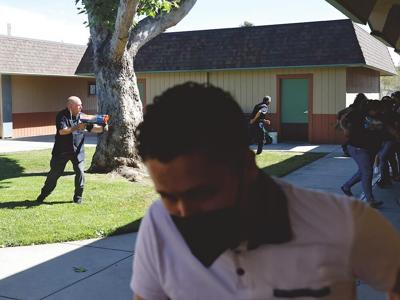
ON THE AFTERNOON OF THURSDAY, JUNE 9, June 9, bullets are flying at Virginia Rocca Barton Elementary School in Salinas. These are foam bullets, bright yellow in color, fired from a toy gun – this is a drill.
The man holding the toy gun is Michael Kimball, director of training consulting for MC Kimball Associates, LLC, contracted by the Alisal Union School District to help teachers and staff prepare for a potential shooting on campus. This fake shooting – scheduled well before Uvalde – helps them practice what they’ve learned, Kimball says, and connect the dots, reducing the time people would have to scatter or barricade in the event of a real shooting. “The body can only do what the brain has experienced first,” he says. “That is the reason for crisis rehearsal.”
Kimball, who has 32 years of law enforcement experience and survived during two active shooting events, says the goal of the drill is to teach people how to survive during an active shooting situation. He says it starts with situational awareness and something as simple as reporting unusual behavior.
Next come the steps of getting away from danger, finding a safe place to hide, creating a barricade – and then finally calling 911.
Why call 911 last? “As much as the police want to get there, they will never get there in time,” Kimball says.
In his training on June 9, the first drill has a group of about 15 staff quickly barricading a classroom door from the inside, dragging chairs and a desk against it – but Kimball is able to push it open easily. Failure.
On a second try, the group drags the heaviest-looking object in the room, a big cabinet, to block the door. They find a strap resembling a backpack strap to hold the lever on top closed, and maintenance worker Apolinario Vivit holds onto it with all his body weight, lying on the floor. This time around, Kimball can’t push it open – success.
Kimball recommends elementary school-aged kids do some sort of drill twice a month, and can include playing a game: building a fort or finding safe places in the school.
At Monterey Peninsula Unified School District, Superintendent PK Diffenbaugh notes that drills are designed for different age groups. “If done wrong, it can cause trauma to students,” he says.
Cook’s fourth-grade son does drills regularly. Cook says his only hope is that if anything happens on campus, kids would know what to do.
ALL MONTEREY COUNTY SCHOOLS HAVE A SAFETY PLAN, which is updated every March, covering scenarios such as fire, earthquake, sheltering in place – or an active shooting situation. The plans include drills and evacuation routes that are reviewed by local police and fire departments. The Monterey Office of Education works with first responders, law enforcement officials and school staff to get the same training and use the same language across protocols.
In the coming months, MCOE will launch a Safe and Healthy Schools Community Coalition, to make sure “our kids are getting all of the information and support that they need to live really healthy lives,” says County Superintendent Deneen Guss.
This coalition is based on the San Mateo Office of Education’s Safe Schools and Communities, a multi-agency collaborative that formed in 2013 after a shooting at Sandy Hook Elementary School in Connecticut left 20 children and six adults dead.
The process of forging a local coalition pre-dates the shooting in Uvalde – it has been in the works for over a year. MCOE officials expect the coalition to launch in August, at the beginning of the 2022-23 school year. The idea is to have safety and health information in one place, on everything from how to report suspected child abuse or human trafficking to school safety protocols.
At Salinas City Elementary School District, Salinas City Manager Steve Carrigan and Salinas Police Chief Roberto Filice spoke at a board meeting on June 6 about their preparations to respond to a potential active shooting. Assistant Superintendent Aldo Ramirez says it was important to get a message out to families: “We wanted to make sure that our community understood that we’re not in this kind of work alone.”
ON MAY 24, THE SAME DAY AS UVALDE'S SHOOTING, a Marina High School student was arrested for making threats to other students; Marina Police are still investigating this incident. On Aug. 16, 2021 a loaded gun was found on a student’s waistband at Salinas High School; two students were arrested. About three weeks later, on Sept. 9, 2021 a loaded gun was found at Washington Middle School in Salinas during a K-9 routine search.
The two Salinas incidents last year revived discussion about safety measures at Salinas Union High School District campuses. Board member Kristina Szaszy-Jones asked about the possibility of installing metal detectors, which would cost somewhere in the range of $40,000 to $80,000 per school. Superintendent Dan Burns noted that shootings have occurred even in schools that had metal detectors.
Alisal Union used to have open campuses, so community members could use recreational areas like basketball courts. Superintendent Jim Koenig says that started changing 10 years ago, after Sandy Hook.
These days, schools have measures to monitor and regulate access, such as one point of entrance, automatic locks and exterior fencing.
But there is consensus that the problem is bigger than anything any school district can fix.
“As long as there is easy access to semi-automatic weapons at a very young age – whether it’s purchasing it or getting it from a family member – I am really concerned about our ability to reduce these types of mass shootings,” Diffenbaugh says.
He says adding more locks and fences and security to schools is not the answer. “In order to really make the changes that we need to at the scale that we need to, I think we need much more investment in our youth than we’re currently providing.”
On June 8, after hearing testimony from survivors and parents affected during the Uvalde shooting, the U.S. House of Representatives passed gun control legislation called Protecting Our Kids Act. It includes raising the minimum age to buy some types of semiautomatic guns from 18 to 21; regulating firearms storage; creating a nationwide database to identify who is ineligible to purchase guns; and new federal offenses for gun trafficking.
As of June 12, there is also a bipartisan (if tentative) agreement in the Senate to advance similar legislation.
“Change might be on the horizon,” Guss says. “Will it be enough change? I don’t know, but any step toward curbing gun violence, both in schools and out of schools, will be a win.”
What many adults – and students – are asking for is tougher gun laws. Cook says his son and other kids want to get involved and create change to prevent future shootings, but at the same time, he says kids should be thinking about other things – TV shows, sports, homework. “They shouldn’t be worried about gun issues and gun laws,” Cook says.
But they are. On June 11, thousands of people across the country showed up for March for Our Lives, a student-led demonstration that supports gun legislation. About 200 people met at Window on the Bay in Monterey and they called for the end to gun violence.
(0) comments
Welcome to the discussion.
Log In
Keep it Clean. Please avoid obscene, vulgar, lewd, racist or sexually-oriented language.
PLEASE TURN OFF YOUR CAPS LOCK.
Don't Threaten. Threats of harming another person will not be tolerated.
Be Truthful. Don't knowingly lie about anyone or anything.
Be Nice. No racism, sexism or any sort of -ism that is degrading to another person.
Be Proactive. Use the 'Report' link on each comment to let us know of abusive posts.
Share with Us. We'd love to hear eyewitness accounts, the history behind an article.