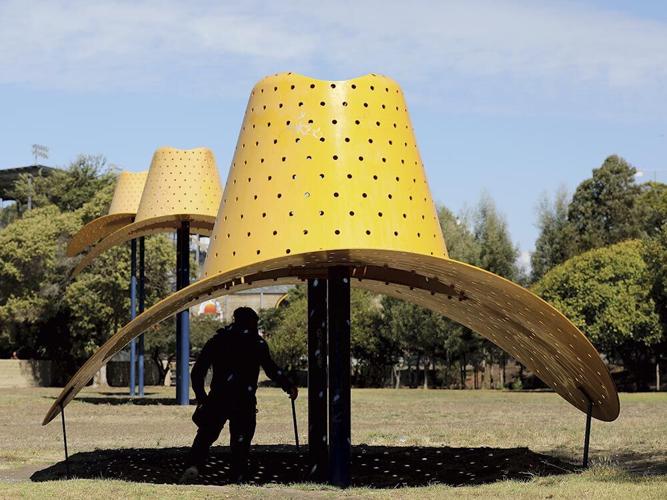
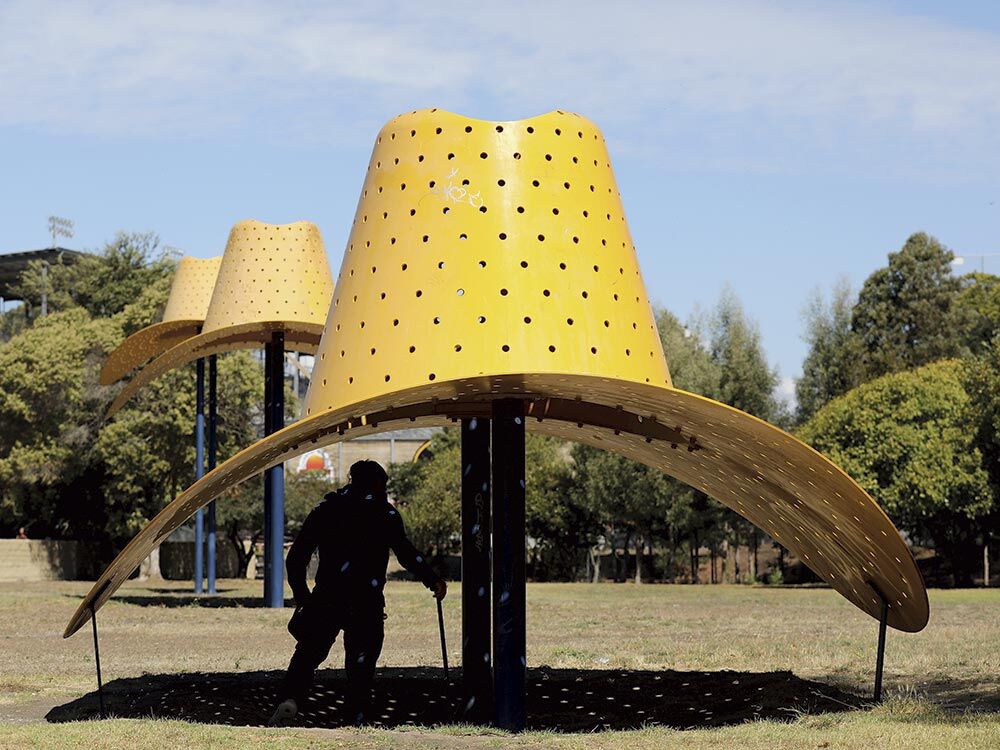
Claes Oldenburg and Coosje van Bruggen’s “Hat in Three Stages of Landing,” in Sherwood Park in Salinas. It was first installed 30 years ago, in 1982.
Sherwood Park, in a dusty section off North Main Street in Salinas, might seem an unlikely spot for a commissioned piece of sculpture by a world-famous artist – in this case, famed pop artist Claes Oldenburg, one of the holy trinity in the field, along with Andy Warhol and Roy Lichtenstein.
But when he was approached by local officials about creating something on the other side of the country, the New York-based artist was intrigued by the notion of doing something in a community known more for its agriculture than artistic culture.
The result: “Hats in Three Stages of Landing” – a trio of 18-foot lids that gave the appearance of descending as they were thrown from the nearby rodeo grounds into the park – was a labor of love. Literally. The project marked Oldenburg’s first joint effort, with his second wife, art critic Coosje van Bruggen.
Despite its destination, getting there was no walk in the park. In 1978, Oldenburg was approached by local officials after being recommended for a commissioned piece by the National Endowment for the Arts’ new public art program. He liked the idea, but the process hit a snag when Ted Thau, chair of the Salinas Outdoor Sculpture Advisory Committee, informed him that Proposition 13, Howard Jarvis’ tax-cutting measure, endangered municipal funding.
But the Salinas supporters were undeterred. Thau, arts advocate Helen Kingsley and architect Richard Rhodes put together a committee of bankers, ranchers and businessmen who pledged to make up the deficit, paying most of the $100,000 cost. They also successfully resisted criticism from locals, many would have preferred a more literal depiction of a sombrero.
In 1982, Oldenburg and van Bruggen made a triumphant return to Salinas – they’d scouted out the site on a previous trip – for the official installation of the long-running project, marking their first piece west of the Mississippi. (A young Leon Panetta spoke at the ceremony.)
But the controversies did not end there. As time passed, the jaunty hats fell into disrepair, with graffiti and other damage. Oldenburg was unhappy, even making noises about taking it down in the some 30 years after installing the piece.
Former Salinas mayor Dennis Donohue stepped in as peacemaker, visiting the artist at his New York loft and championing additional city funds. Amplified by a contribution from Oldenburg, the sculpture was restored and in 2013, a public unveiling of the “new” work was held at Sherwood Park, with the couple in attendance to mark their stamp of approval.
“My wife and I wanted to take artwork out of the hands of museums and dealers and work directly with communities,” Oldenburg told the Weekly at the time, noting the couple did 44 sculptures around the world with that principle in mind.
Donohue thinks it could still use broader recognition. “[“Hats] wasn’t universally beloved, but Salinas is the home of iconic figures like Steinbeck – keeping it here could enhance our reputation as a global destination,” he says. “I’m sure the sculptures have brought people into the city. It was, and remains, an economic opportunity.” He thinks even more could be done, perhaps by a public-private project digitizing Oldenburg’s work.
It’s a reasonable goal; Oldenburg’s death in July, at age 93, made international news.
“Pop Artist Made the Everyday Monumental,’’ read the headline of his New York Times obituary. “Taking ordinary objects like hamburgers and household items, he sculpted them in unfamiliar, often imposing dimensions.’’
Born in Switzerland, Oldenburg studied at the Art Institute of Chicago, moonlighting at the City News Bureau, where he illustrated comic strips – making him the only pop artist who ever drew comics professionally. Joining the New York art scene in the late ’50s, he debuted “Giant Toothpaste Tube,’’ the first of his famously puffy “soft” sculptures.
Later “Colossal Monuments’’ like his (very phallic) “Lipstick (Ascending) on Caterpillar Tracks,” “Clothespin” and “Cupid’s Bow” (a collaboration with van Bruggen), were installed In New Haven, Philadelphia and San Francisco, respectively.
Oldenburg’s career highlights spanned decades, from a solo exhibition at New York’s Museum of Modern Art as far back as 1969 to a retrospective jointly organized by the National Gallery of Art in Washington, D.C. and the Guggenheim Museum in 1995.
“I am for an art that does something other than sit on its ass in a museum,’’ he once wrote.
Under the circumstances, a community park seems an ideal place for an Oldenburg sculpture. But in 2022, many locals still look at it more as a playground structure. Claes who?
PUBLIC ART IS VIEWABLE IN PARKS AND OTHER VENUES, FOR FREE, OFTEN AT ANY HOUR. It doesn’t require the budget and planning associated with seeing artwork in other settings, like museums. The idea is that it is accessible to all of us. But just because it is there doesn’t mean it is always appreciated.
Over 20 years after the sculpture was installed, Salinas arts booster Trish Triumpho Sullivan asked her students at Everett Alvarez High School if they’d heard of “Hat in Three Stages of Landing.” They hadn’t. “Most young people in Salinas think they’re playground equipment,” she says.
But with Sullivan’s encouragement, they got with the program, creating soft sculptures of yellow Styrofoam hats (spray painted with graffiti) to show the delighted artist when he returned in 2013 to restore the work.
“They literally researched what kind of materials to use, then showed it off at First Night Monterey and the Colmo del Rodeo parade and Kiddie Kaper parades in Salinas,” Sullivan adds. “Claes told me he wanted to see young people in particular interacting with his work. He was tickled to see them embracing it.”
He and Dutch-born van Bruggen were also sensitive to the fact that the agricultural world was not just built by white people but by Latinos, Asians and Native Americans. It was an effort by a whole lot of people. Likewise, their sculpture was a collaboration. Sullivan says van Bruggen’s contributions to the project were critical, if perhaps overshadowed by her husband’s fame.
“Claes’ first sketches were of a bowler, or a derby, being tossed into the wind. Because of her, they ended up floating down – I thought that was kind of cool, like Mary Poppins,” Sullivan says
The entire adventure, from concept to installation to controversy and refurbishing, is being celebrated in a Hartnell College Gallery show, Hats in Three Stages of Landing – Memorial Exhibition for Claes Oldenburg, 1929-2022, which runs through Oct. 20. It includes preparatory models, documents and photographs and installations of the project, the first joint project between Oldenburg and van Bruggen. They went on to co-create many sculptures.
The couple shared a common vision of “the idea of the West,” says retired Hartnell art professor Gary Smith, who co-directs the gallery with Eric Bosler. “Although both of them were really European, they liked the aura and mystery of cowboys and wide open spaces. Most of the places he’d done installations before were fairly contained urban spaces – this was wide and open.”
As Smith told a Los Angeles Times reporter before the rededication ceremony, the distance between blue-collar Salinas and the tourist-friendly Monterey Peninsula can feel like “the longest 18 miles in the world.” So he was especially pleased that an internationally known artist chose to site his work in a diverse community, something that Oldenburg and van Bruggen strongly responded to.
“This is a diverse community – not just farmworkers, but ranchers – an incredibly diverse mixture. It’s something I really value about living in Monterey County,” Smith says. “A few years ago, I took a trip to Boston, and felt like something was wrong. After a while, I realized what it was: Everybody looked like me.”
Smith says community concerns about the Oldenburg project were not difficult to surmount. “The only real objection was when people criticized the shape and the breadth of the hats, that it was not a sombrero or a cowboy hat,” he recalls. “They said, “It looks like ladies’ garden hats.’ Oldenburg replied, ‘Ladies do wear hats when they garden.’”
For the restoration in the ’90s, Oldenburg painted over the graffiti, bringing the hats back to their original banana yellow. He was also insistent on correcting an omission to the bronze dedication plaque embedded in rock at the site.
“It’s big and clumsy,” he told the Weekly on his return. “And it clashes with the clean lines. The first thing I told the [restoration committee] was that they have to change the sign to include my wife’s name.”
Such oversights aside, the relative anonymity of the Oldenburg pieces reflects a larger issue with public art in Monterey County. Residents and visitors know all about name brands like Ansel Adams and Edward Weston, but too little about other major artists who’ve made a mark in the area. But there are many.

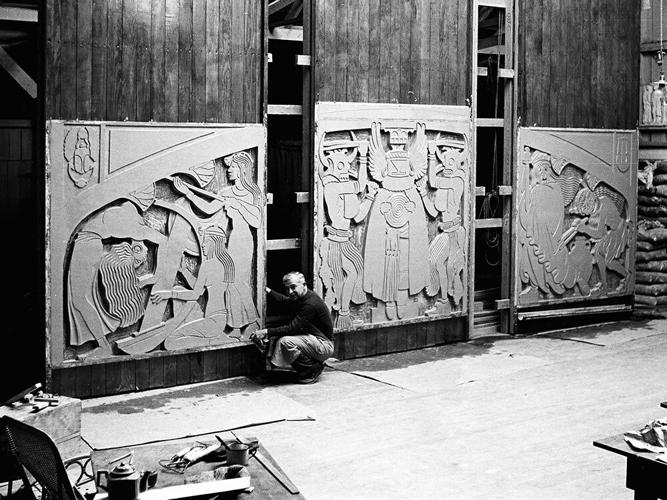
Jo Mora with three panels in progress for the King City High School Auditorium, seen in 1938.
JO MORA WAS BORN IN URUGUAY, AND MOVED FROM THE SAN FRANCISCO BAY Area to Carmel in 1920 to work on a cenotaph – a memorial without remains – of Father Junipero Serra at the Carmel Mission, as art historian and retired All Saint’s Day teacher Peter Hiller details in his definitive book The Life and Times of Jo Mora: Iconic Artist of the American West.
He was subsequently commissioned by developer Samuel F.B. Morse to do a statue of Serra in the Carmel Woods neighborhood. Amid the national controversy over the removal of statues memorializing Confederate generals, the statue was removed in 2020 amid outcry about Serra’s subjugation of indigenous people at the Mission. (It’s since been returned to a neighborhood group, but will not be publicly displayed.)
Hiller supported the removal of the sculpture. But he is at pains to celebrate other less known examples of Mora’s work on display at the repurposed Monterey County District Attorney’s Office in Salinas and the King City High School Auditorium. Each work was done in conjunction with Mora’s friend and Pebble Beach neighbor, architect Robert Stanton, whose work also deserves wider recognition.
“I like to describe the courthouse as a building that speaks,” Hiller says, referring to what now houses the District Attorney’s Office across from the Superior Court. When Mora took on the decorative entrance, he had pretty much free rein.
“Mora had large areas on which he could craft images telling the story of Monterey and California history,’’ Hiller wrote. “Each of the five travertine bas-relief panels above the west entrance represent a distinctive era in Monterey County history: the Indigenous period, the arrival of the Spanish, the Mission period, the coming of the white man and… the development of modern recreation.’’
There are also 62 busts between the second and third floor windows, and continuing around the exterior and interior courtyard representing specific and archetypal figures in California history: Scenes in the field of “Native American Man,” “Native American Woman,” “Pioneer Man and Pioneer Woman” and portraits of Serra, Juan Cabrillo and Juan Fremont.
In nine panels at the King City auditorium, Mora further expanded his palette. “From medieval musicians to modern-day filmmakers, Mora celebrated various cultures and archetypal performers from around the world,” Hiller wrote.
Through Hiller’s efforts, both buildings are now listed on the National Registry of Historic Places. He also acts as volunteer curator, lending his extensive expertise to the Monterey History and Art Association, which acquired the Jo Mora Archives in January and displays his work at Casa Serrano on Pacific Street.
Hiller has also put together “A Motorist’s Tour Guide for the Public Art of Jo Mora,” featuring everything from the Salinas and King City sites to the Salinas Rodeo Museum, which features the artist’s “Sweetheart of the Rodeo” poster – famously repurposed, with the artist’s consent, for the album of the same name by The Byrds – along with breakout maps and drawings at Harrison Memorial Library, the La Playa Hotel and “The Greeting,” a sculpture at 7th and Dolores in Carmel.

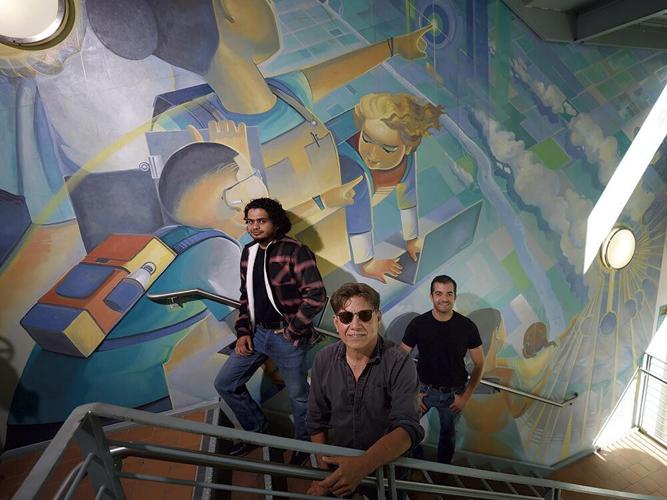
Artists Jose “Pepe” Nolasco, Jose Ortiz and Juan Carlos Padilla (from left to right) with their mural “Destination, Salinas,” inside the county government building in Salinas. The mural was officially unveiled on Sept. 27, 2022.
OTHER WORTHY WORK TODAY IS BEING DONE BY SALINAS-BASED ARTIST/EDUCATOR JOSE ORTIZ, who also runs the nonprofit Hijos del Sol (Children of the Sun) arts program, founded in 1994, at Sherwood Elementary School and is also the visual arts director for the Alisal Center for the Fine Arts.
Art by Hijos del Sol students – many of whom are now teachers in the program – are up all over Salinas, at sites like the Healthy Art program, which provides health services to immigrant communities, the Women, Infants and Children on East Alisal and offers arts mentorship programs at the Migrant Education Center in East Salinas.
Ortiz, who is from Tepehuáne stock (his mother and grandmother were medicine women), migrated to the U.S. when he was 10, enrolling in elementary school in Salinas. The budding artist joined the Salinas Art Association when he was 13; encouraged by Hartnell College instructors, he enrolled in the ethnic studies program at UC Santa Cruz rather than go out of state and leave the community he has dedicated his life to.
Most recently, Ortiz, who is inspired by everyone from graffiti artists to Diego Rivera to Michelangelo, received a $10,000 grant from the Arts Council for Monterey County for a commissioned mural in the stairwell of the Monterey County government building, just across a walkway from the Mora art deco faces. He has been working on the project with fellow artists Jose G. Nolasco, Juan Carlos Padillo and Angel Hernandez. A ribbon-cutting for the official unveiling of the mural took place on Sept. 27.
In his Arts Council proposal, Ortiz said he was impressed by the “natural light coming through the windows,” inspiring him to create a piece with an “aerial view of the fields surrounding Salinas Valley.” He also included two lights, incorporating the physical wall into the piece, with one family holding the lights up. Another family is shown extending their arms to honor the grandeur of the valley and a third family with their shirt sleeves rolled up.
“All people were working class at one time or another, despite their backgrounds – even the Rockefellers,” Ortiz notes. Keeping things modern, the group also includes images of laptops, reflecting electronic advances.
Jo Mora – and Claes Oldenburg – would surely approve.
Arts Council Executive Director Jacquie Atchison says Ortiz’s government building project came about in discussions with County Administrative Officer Charles McKee, who knew Ortiz’s work and respected his other contributions to the community with Hijos del Sol and the Alisal Center for the Fine Arts. “We also want to do a project for the West Side, from Monterey to Big Sur, but that won’t get started until next year,” Atchison says.
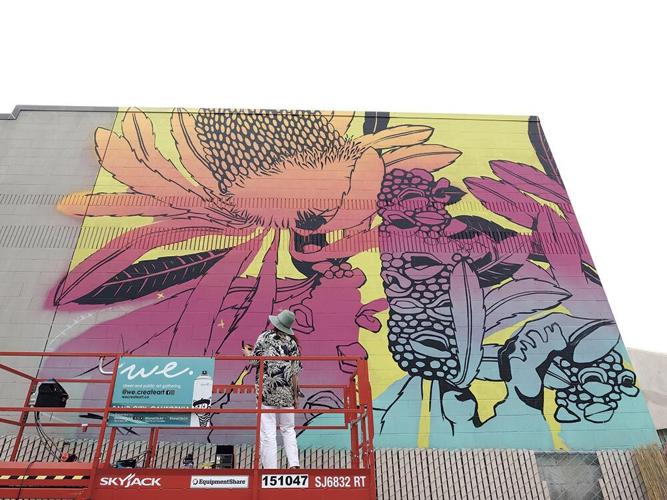
The Arts Council has also funded several murals, including a Sand City Art Park piece by Bryan Gage and Paul Richmond, and Gage’s Squid tribute on the Weekly building in Seaside. Annual visitors to the West End Celebration in Sand City for three years have been greeted with the final days of the we.Art Mural Festival, as a mix of international and local artists create a riot of colorful images, portraying Jimi Hendrix, a surfer perched on a whale’s nose, a bee. Local artists Hanif Wondir, Lisa Haas and Maryia Hyraharenk collaborated on a humpback whale mural that adorns the side of The Reef cannabis dispensary on Fremont Boulevard in Seaside. The Seaside Fire Department and Art and History Commission are currently seeking mural proposals from local artists to celebrate the community’s culture, fire safety and Fort Ord connection. (The application deadline is Oct. 31; learn more at bit.ly/firestation-rfp.)
The local arts community’s commitment to less affluent communities runs deep.
Veteran Cannery Row-based artist Dick Crispo helped get the Arts Council off the ground with Ilene Tuttle and Helen Kingsley, among others – including with the influential support of Ansel Adams – in 1982.
Back in 1973, Crispo and Sustainable Seaside founder Kay Cline had set up a Museum on Wheels program bringing art to rural communities. “I had taught in the migrant education program, and was very aware of how bad the arts situation was in smaller communities,” Crispo says. “Santa Cruz had already set up an Arts Council, but the people on the Peninsula were fighting over mailing lists and who pays for what. The important thing was to pull all these arts groups together.”
A few years later, he wrangled support from then-State Senator Henry Mello from Watsonville – who moonlighted as a jazz musician – and the California Arts Council for a pioneering mural, “America The Outside,” at Soledad State Prison.
The half-mile long project – undertaken with the proviso that it did not include gang insignias or other potentially inflammatory material – was overseen by Crispo, working with 10 volunteers and 10 paid prisoners. “The ones who got paid made $15 a day, but the best part of the deal was that they got early showers – if you go there late, the water was cold,” Crispo says.
Crispo’s ties to the arts community go back to when he was in high school in the mid-’60s, when he used to cut classes with a friend to play ping-pong at Henry Miller’s place in Big Sur. (He took a science class at Monterey Peninsula College with Joan Baez, and remembers Baez’s then-boyfriend, Bob Dylan, who tried to play the Polygon Bookstore in Cannery Row only to be told by the owner, “You can’t play your guitar and harmonica at the same time. It’s not going to work – it’s got to be one or the other.”)
A new coffee table book, Dick Crispo – A Lifetime in Art, celebrates his decades of work, which included a 1981 mural, called “Parking Lot Symphony” at the Calle de Principal garage in Monterey that was painted over by the city. “They said they couldn’t find my signature,” he says, shaking his head.
Despite such setbacks, the local public arts scene is alive, well and thriving.
Dennis Donohue said it wasn’t easy to get funding for the “Hats” restoration – “when you’re spending $100,000 in the middle of a recession, a lot of people are not pleased” – but he stayed the course.
“From generation to generation, people have a vision. Helen Kingsley and her people worked very hard to make this happen in the first place, and I wanted to respect that.”
Tweaking some of the critics was an incentive, too.
“The [San Francisco Chronicle columnist] Herb Caen once said that the only culture in Salinas is agriculture,” Donohue said. “That’s not true. I’m going to guess Herb never made the trip.”
Hats in Three Stages of Landing – Memorial Exhibition for Claes Oldenburg, 1929-2012 is on display until Oct. 20 at the Hartnell Gallery, 498 W. Alisal St., Salinas. Open 9-11am Monday-Thursday. Free; campus parking is $2 755-7691, hartnellcollegegallery.org

George Rose paints a mural in Sand City as part of the 2022 we.Art Mural Festival, the city’s third such festival that invites local and visiting artists to transform walls into art.
Public art is located all over Monterey County, viewable – for free – for all.
By Bradley Zeve
"Hat in Three Stages of Landing” helped put Monterey County on the public art map, but there is a lot to see locally, in a range of styles. This is a (partial) list of public artworks not to miss, that capture different styles and mediums. But there are dozens of others worth checking out.
Seaside resident Kat Morgan has been building a map of murals in Monterey County, an effort that began as a pandemic project exploring mostly empty streets. “One of the things I love about murals is that they are accessible to everyone,” she told the Weekly in 2021. “You don’t have to go into a museum or gallery.”
To view Morgan’s evolving map, visit bit.ly/MontereyMuralsMap. To view Morgan’s photos and other information about murals, visit instagram.com/muralsofmontereycounty.
- Richard MacDonald sculptures, “The Flair,” “Diana Earth and Moon,” “Joie de femme,” “Butterfly” (a tribute to Luciano Pavorotti), 16 Lower Ragsdale Drive (in Ryan Ranch), Monterey; “The Rain” in Carmel Plaza, Carmel
- Sand City murals, including the Sand City Art Park (at 525 Ortiz Ave.), throughout Sand City
- Greg Hawthorne sculpture, “Genoa,” outside The Independent building, 600 Ortiz Ave., Sand City
- Steven Whyte sculpture, Cannery Row monument (a tribute to John Steinbeck and characters of Cannery Row), foot of Prescott Avenue at Steinbeck Plaza on Cannery Row, Monterey
- Claes Oldenburg sculpture, “Hat in Three Stages of Landing,” behind Sherwood Hall, 940 N. Main St., Salinas
- Bryan Lustre mural at Sun Street Center, 637 Broadway St., King City
- Jose Ortiz/Hijos del Sol murals, “Destination Salinas,” inside county government building, 168 W. Alisal St., Salinas; at Del Rey Woods Elementary School, 1281 Plumas Ave., Seaside
- Sculpture garden at Monterey Museum of Art, between 559 Pacific St. and Calle Principal, Monterey
- Ray Troll-designed mural, painted by Roberto Salas and Guillermo Jauregui, former NOAA building, 1352 Lighthouse Ave., Pacific Grove
- Martin and Mireya Gomez mural, “Marina’s Gray Whale Migration,” Marina Post Office, 3100 De Forest Road, Marina
- Raymond Puccinelli sculpture, “Oscar” (panther mascot created through the WPA for Salinas Junior College, now Hartnell) at Hartnell College, 411 Central Ave., Salinas
- Bryan Gage mural, “The Squid,” Monterey County Weekly headquarters, facing the alleyway next to 1123 Fremont Blvd., Seaside
- Wah Chang sculpture of Dennis the Menace at Dennis the Menace Playground at El Estero Park, 777 Pearl St., Monterey (temporarily missing)
- Guillermo Granizo mosaic, “The Monterey Mural,” on the wall of the Monterey Conference Center, Del Monte Boulevard and Pacific Street, Monterey
- Larry Foster sculpture, “Gray Whale,” Pacific Grove Museum of Natural History, 165 Forest Ave., Pacific Grove
- Lloyd Hamrol sculpture, “De Anza Walk” stone slabs at the eastern edge of Lake El Estero Park at Fremont Boulevard, Monterey
Editor's note: The artist listed for the Dennis the Menace sculpture in Monterey has been updated to reflect the following correction. It is by Wah Chang, not Hank Ketchum; Ketchum is the cartoonist behind the original concept, not the sculptor.
(0) comments
Welcome to the discussion.
Log In
Keep it Clean. Please avoid obscene, vulgar, lewd, racist or sexually-oriented language.
PLEASE TURN OFF YOUR CAPS LOCK.
Don't Threaten. Threats of harming another person will not be tolerated.
Be Truthful. Don't knowingly lie about anyone or anything.
Be Nice. No racism, sexism or any sort of -ism that is degrading to another person.
Be Proactive. Use the 'Report' link on each comment to let us know of abusive posts.
Share with Us. We'd love to hear eyewitness accounts, the history behind an article.