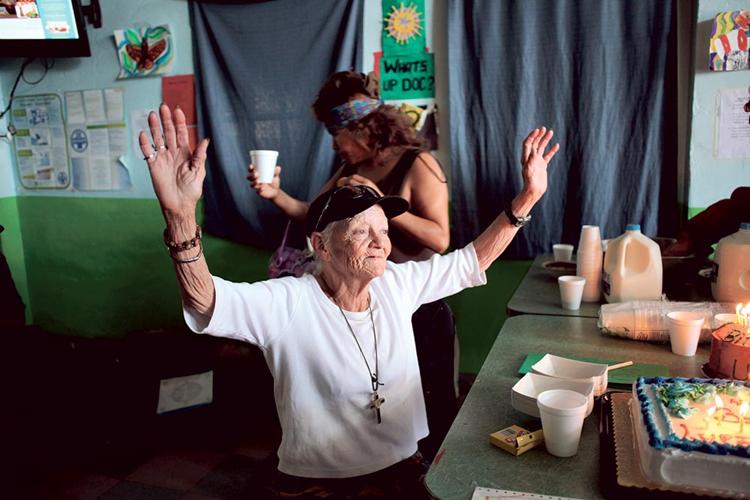

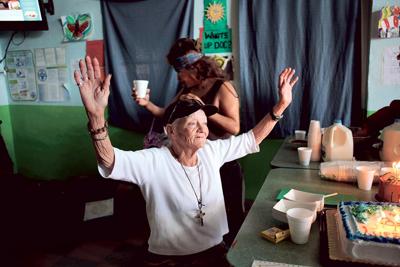
The woman twirls across the scuffed floor, her metal cane abandoned against a chair. Maria Lozano is inexhaustible, arms swinging and hips swaying to Mexican banda music.
“Yeah, she can dance,” a woman with mussy braids and purple sweatpants says to nobody in particular. “She reminds me of Ellen when she dances.”
Lozano shares talk show host Ellen DeGeneres’ swagger, but the similarities end there. Lozano is petite, hunched with age. A San Francisco Giants cap hides a mess of white hair and an oversize cross dangles around her neck. Her face is lined and cracked like the trunk of an ancient tree.
It’s Lozano’s 70th birthday, and the staff of Dorothy’s Place, a soup kitchen and homeless services provider in Salinas’ Chinatown, is throwing a party for the woman, known on the block as “Mama.” About 20 people and staff are here, some dancing a conga across the nonprofits’ green-and-pink tile floor, others sitting against a wall, concentrating on their slices of white-frosted cake.
“Gracias!” Lozano says, soaking in the attention. Her wrinkled cheeks cave when she moves her mouth. “Thank you so much everybody.”
A plastic table holds a birthday cake, tortilla chips and salsa, and a tank of black coffee. The cake says “Lupita,” her nickname, in blue icing. On the wall there’s a rack with pamphlets with tips like “Staying Alive: Prevent Overdose Death” and “Fumadores de Crack (Piperos).”
From the street, a woman walks in, her sweatshirt hood pulled tightly over her head. She pauses at the commotion, asking someone what’s going on.
Then she says, “If this is a party, I want some booze.”
• • •
Here’s a basic fact: Homelessness is growing in Monterey County. The last homeless census, taken Jan. 23, counted 2,590 homeless people living in shelters, in motels with vouchers provided by churches, charities or social service agencies, or out on the streets. That number has been climbing since 2007 – and it doesn’t include the hidden homeless, like those living on relatives’ couches, in illegally converted garages or in apartments crammed with multiple families.
The census estimates this year, more than 6,000 people experienced homelessness, a 58 percent increase from two years ago. Homeless advocates say fallout from the recession and Monterey County’s exorbitant housing and rental prices have steadily pushed people into the abyss of poverty.
And as homelessness has risen, so too has community reaction, from social outrage to nervous indignation. Some concerned citizens, like Monterey resident Tia Sukin, have taken the homeless into their own homes. Others have schemed to push the problem elsewhere, with efforts like an outdoor smoking ban proposed by the Monterey City Council to keep people from lingering on city streets.
Activists in Salinas and Monterey want more community support, while shopkeepers and commercial landlords are up in arms about the perceived impact of the homeless on business districts like Oldtown Salinas and Old Monterey. The homeless say, we need bathrooms and dignity! Business leaders say, we’re tired of panhandlers and hypodermic needles and shit – literally shit! – on the streets. Advocates say, there’s not enough help!
It’s a complicated issue, and everyone is pitching in with a solution, or at least trying to. But not every proposed step is a step in the right direction.
The Oldtown Salinas Association, for example, recently tried to stop First Methodist, a downtown church, from providing services to the poor. Some members of the business group claimed the presence of the homeless hurts local businesses, driving customers elsewhere and keeping families away from the Steinbeck Library located across the street from the church.
A similar story plays out across the lettuce curtain. The Monterey City Council has revived discussion on a sit-lie ordinance, a much-disputed proposal that would make it illegal to sit or lie on sidewalks and public places. The city had budgeted $40,000 for social services for the homeless, but in a move made Oct. 23 by the City Council, allocated half that money to pay for police overtime. Advocates say the overtime dollars could have come from funding not meant for social programs.
The upside of all the uproar is that homelessness, long an ignored scourge, has finally grabbed the public’s attention: While the amount of local homelessness soars past the national rate, the attention being paid to it is at an all-time high.
To Jill Allen, executive director of Dorothy’s Place, this signals an unprecedented opportunity for collaboration among warring parties – though it remains to be seen whether the talk will go beyond fingerpointing.
“None of us individually can solve [homelessness],” Allen says. “But if we all came together we could. I’m going to guess these are the beginnings of a trifecta – nonprofit, private industry, and government – collaboration. We’re watching the evolution.”
• • •
Welcome to Salinas’ Chinatown, home to the Japanese Buddhist Temple, historic buildings and ground zero for homeless blight in the county.
“I have never witnessed so many people suffering with mental health problems, suffering with substance abuse problems, and just being deposited here,” says Ryan Laudick, a Dorothy’s staffer. “This is an unmitigated war zone. You could drop a bomb and I don’t think it would look different than it does now.”
Chronic homelessness is more widespread in Monterey County than nationwide. About 30 percent of homeless here are classified as “chronic” – meaning they both have a disability and have been homelessness for a year or longer, or have had at least four episodes of homelessness in the last three years. That’s compared to 16 percent in the U.S. overall. Many in Chinatown fit that bill.
“I think Monterey County has always had the same problem with chronic homelessness,” says Allen, who’s been at Dorothy’s Place since 2005 and became executive director in July. “What changed was the economy took a nose dive.”
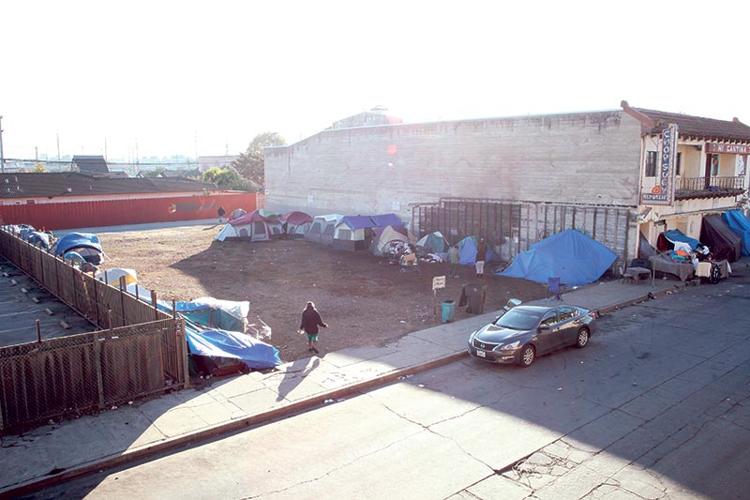
The day-to-day misery in the area is why Lozano’s birthday bash is such a welcome distraction. Everyone sings a chorus of “Happy Birthday” in English and then in Spanish. Then staff members pull out a candy-stuffed piñata. They string it up to a tree outside Dorothy’s Place, attracting a crowd of onlookers from surrounding Soledad Street. The block is lined with makeshift tents and beds stuffed under awnings.
Lozano is first to bat, but instead of using the designated whacking stick, she throws up her fists like a boxer and takes a few jabs at the piñata. When she’s done warming up, she grabs her cane.
“Stab it!” someone yells. “It’s the police – hit it!” screams another. A semi-circle forms as people look on. Lozano, bright-eyed and whooping, thrashes the figure, wielding her cane like a sword. Her energy is incredible. Staff members snap pictures with a digital camera.
“This is the first time I’ve wanted whatever she’s on right now,” Allen says dryly.

A view of Soledad Street from Dorothy’s Place. “This has become a crisis zone,” says Dorothy’s staffer Ryan Laudick.
While Monterey has no Chinatown, the Chinatown effect – or rather, the perceived threat of homelessness – has barrelled into the city’s discussion. A chorus of complaints by business owners prompted an April City Council workshop, where there were suggestions on everything from banning smoking and sleeping in cars to making it illegal to sit or lie on the sidewalk. Police Chief Phil Penko told the Weekly he’d seen more aggressive panhandling in the previous months than he had in 28 years on the job.
The city’s attempts to, in advocates’ views, criminalize homelessness led to a symposium at Monterey Peninsula College called “Hungry and Homeless in Paradise,” attended by the likes of County Supervisor Jane Parker, Councilman Alan Haffa and Mayor Chuck Della Sala. When it came time to take action, the council ultimately rejected sit-lie but is still considering a smoking ban. The car situation has evolved into a more innovative proposal of designating certain places for the homeless to park and sleep. (More on that later.)
Considering the uproar over sit-lie – at the council session May 21 Haffa gave a rousing speech in support of civil rights attendees described as “superhuman” – it would seem unthinkable that the issue would be brought up again. But in an October meeting, Councilwoman Libby Downey re-raised the possibility.
“It’s a travesty. Our community came out en masse to oppose it [last May],” says Monterey activist Timothy Barrett. “I’d like to see more creative thinking, more partnership and collaboration in response to these issues.”
To homeless advocates, these kinds of tactics unfairly target a population that is both diverse and vulnerable.
The 50 or so people who spend each night in Salinas’ Chinatown are a fraction of the county’s homeless. But the chronically homeless can become scapegoats for the problems plaguing downtown areas.
“Just because you see someone panhandling doesn’t mean they’re homeless,” says Tom Melville, executive officer of the Coalition of Homeless Services Providers. “If you see people misbehaving [it doesn’t mean they’re homeless]. That’s a behavioral issue.”
Advocates also point out that 79 percent of the homeless are locals – not people traveling through to get services.
In 2011, the Coalition of Homeless Services Providers collaborated with local governments and nonprofits on a new 10-year plan to end homelessness. The plan helps the county compete for federal funding. It’s a sweeping proposal, listing goals like increasing the county’s permanent housing stock for the homeless by 200 units and working with agencies and nonprofits to create a “housing pipeline.”
But, says Allen, the plan has had no impact on Chinatown. Advocates say resources are entirely too scarce – there are only 300 emergency shelter beds in the 3,800-square-mile county.
The goals enumerated in the plan just that: goals – not solutions, Allen says.
“We go to all these coalitions and sit around the table talking about homelessness, but the conversation inevitably goes to, ‘That takes money,’” she says. “So we sit around staring at each other.”
Federal funding makes up just a portion of nonprofits’ budgets. The U.S. Department of Housing and Urban Development gives local nonprofits $2 million a year for homeless efforts, but that money hasn’t increased, even when poverty ballooned during the recession. Dorothy’s relies heavily on other kinds of funding, like individual donors, but that money has dropped off significantly in the past year, Allen says.
The better approach is to take small chunks of the problem, find workable solutions and move on to the next piece of the puzzle, she says. That may be what’s happening right now – unless the momentum building over the past year peters out.

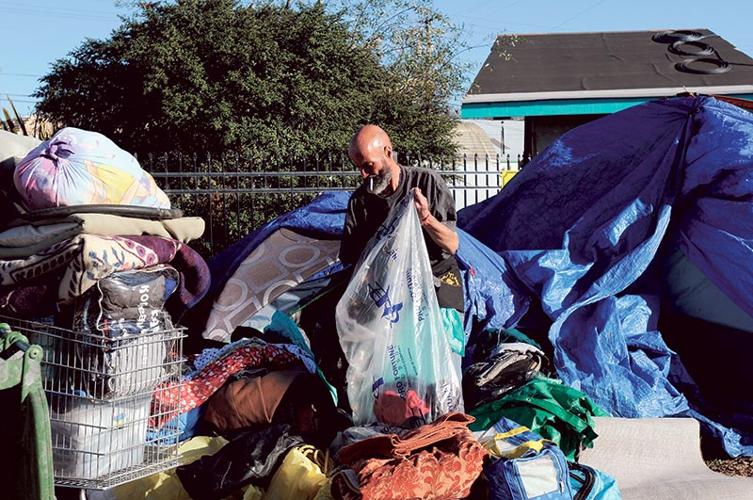
A man gathers his belongings during a city cleanup of Chinatown. “You look at the waste and filth and needles – we’re doing this to keep our community safe,” says Gary Petersen, director of Salinas’ Public Works. “Nobody likes doing this, but it has to be done.”
In January, a cleaning crew from Salinas’ Public Works Department tore through Chinatown, scattering people with their belongings packed into shopping carts. The same thing happens every few months: Homeless people build their camps, set up their mattress and blankets in dark corners, and soon Soledad Street is flush with rat-infested hovels and hidden drug dens. The city gives at least a week warning and comes by with front loaders and dump trucks, collecting everything on the street as the homeless gather their belongings and flee. A few days later they’re back, and the cycle begins again.
On this particular occasion some of the displaced staged a four-night protest in front of City Hall.
From this protest, and a subsequent meeting with Mayor Joe Gunter, an idea was sparked: a winter warming shelter.
The city’s been working to establish a warming shelter since July. The Coalition of Homeless Services Providers sent out a request for proposals for an operator, and the city took the lead on finding a facility. But there have been no solid bites by operators, and an original plan to fill an old municipal pool with 90 beds fell through. Plus, the city can’t front the cash to operate a shelter, though it’s trying to partner with nonprofits and the county.
“We’re just trying to keep that light on right now,” says Don Reynolds, a Public Works project manager who’s long been involved in the affairs of Chinatown. “I am working with the county and partners to get something up as soon as possible.”
Though the idea is struggling to get off the ground, it signals the prospect of more services in Salinas – a success in its own right. As far as Reynolds knows, there’s never been a warming shelter in the city. It would not only provide comfort to homeless men and women battling the cold, but would add much-needed beds to the county’s short supply of emergency housing stock for the homeless. Of the 542 homeless men and women counted in Monterey during the homeless census, 32 were found in emergency shelters. In Salinas, 128 of 532 people were in emergency shelters.
Monterey has its own innovative band-aid for the shelter problem: a proposed overnight parking program that would allow homeless people to sleep in their cars. A $32,000 parking program would designate 25 parking spots for the homeless in existing lots. The parking spaces would be spread out, as to not concentrate people in one district, and be near public restrooms. A case manager would check in to help people access resources.
“If we can allow a safe place to sleep where they won’t have to worry about being assaulted or being charged with a crime the hope is that they can transition into apartments and homes,” Haffa says.
The effort is spearheaded by aforementioned Monterey resident Tia Sukin and her husband Michael Fechter (an occasional contributor to the Weekly). Not only did Sukin, a consultant for the Defense Language Institute, prepare the proposal for an overnight parking program, but the couple has, on a few occasions, taken needy people into their own home. They’ve even paid for people to stay in motels while awaiting assistance.
“We’re just trying to be good neighbors,” Fechter says. “They’re making a big deal right now that there are some people hanging out panhandling in a way some people view as aggressive. But I would point out this is a very small percentage of people going through homelessness. It would be like cutting all student loans because a percentage of students don’t complete their coursework.”

The problems surrounding homelessness go wide and deep, but so do the solutions. Below is a …
Two threads run through every advocate’s analysis of the homeless problem in Monterey County: a lack of compassion and a lack of resources.
But it’s not just inadequate funding. Melville hints at a bigger, systemic problem. People across the nation, homeless or not, are having trouble accessing the basics: food, housing, health care.
“Why can’t a family earning minimum wage afford a place and to feed their children?” he asks. “We can send a man to the moon. We should be able to figure out how to take care of each other.”
It’ll take a lot of figuring. Monterey advocates are working on a jobs referral program and regional collaboration. Last year, Seth Pollack, director of service learning for CSU-Monterey Bay, managed to get portable toilets installed in Chinatown for a short time – but that fell through after a city sweep in January, and the homeless people maintaining the bathrooms were scattered. And on Oct. 31 the Oldtown Association held the first meeting of a task force of businesses, nonprofits, government reps and citizens they say will devise real solutions in coming months.
Allen joined the team, plugging an idea to form a partnership with the OSA to give Chinatown homeless jobs. There may not be city money, but there are businesses and potential employees.
“I think we have resources to solve a lot problems,” she says, but adds: “It’s not the first time we’ve pulled together committees.
“It usually evaporates into nothing because the problem is way too complex than anybody is willing to handle.”
A look at the Coalition of Homeless Services Providers’ 10-year plan reveals how overwhelming the problem can seem. For example, one item on the list – improving access to benefits like food stamps and cash aid – may be a non-starter as the government cut food stamp benefits on Nov. 1. And that’s just one of nine goals. (See sidebar, this page.)
Nevertheless, the problems are known and attention and energy being paid is higher than it’s ever been. In other words, at least the involved stakeholders aren’t swinging at homelessness blindfolded, and at least they’re swinging at it with an enthusiasm to match Maria Lozano’s.

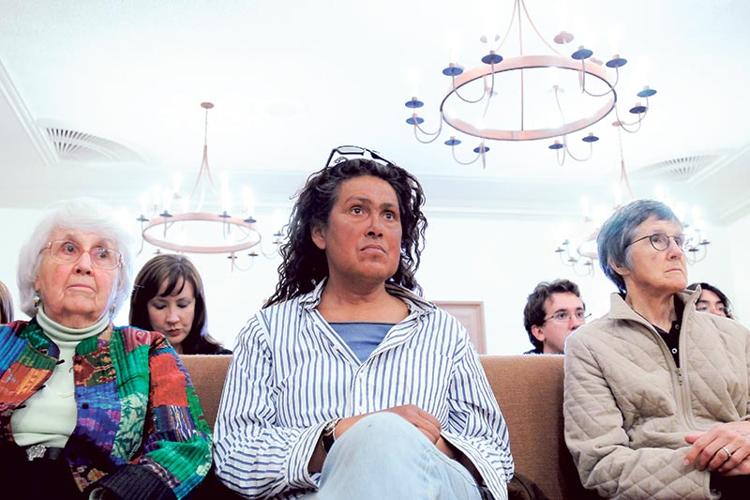
Sarah Luiz, (center), a homeless woman, attends a Monterey City Council meeting on sit-lie May 21. A Portland sit-lie ordinance was declared unconstitutional by a state judge in 2009.
(1) comment
First Presbyterian Church of Monterey is hosting:
Adult Education Series: Wednesdays, November 6, 13 and 20 • 6:30pm-8:00pm
There But for the Grace…A workshop series on Homelessness
Eye-opening, factual, interactive, thought-provoking, and quite possibly mind-changing are apt descriptions of this three-week workshop offered by our adult education and outreach committees. Space is limited, please RSVP to Jack Arnold to ensure a seat. fpcmonterey.org 373-3031
November 6: Who are the Homeless?
November 13: The Landscape of Homelessness on the Monterey Peninsula
November 20: Volunteers in Action
Welcome to the discussion.
Log In
Keep it Clean. Please avoid obscene, vulgar, lewd, racist or sexually-oriented language.
PLEASE TURN OFF YOUR CAPS LOCK.
Don't Threaten. Threats of harming another person will not be tolerated.
Be Truthful. Don't knowingly lie about anyone or anything.
Be Nice. No racism, sexism or any sort of -ism that is degrading to another person.
Be Proactive. Use the 'Report' link on each comment to let us know of abusive posts.
Share with Us. We'd love to hear eyewitness accounts, the history behind an article.