
ON A DREARY FEBRUARY AFTERNOON IN 2019, Marcus Ericsson stood under a shelter at the rear of a semi trailer. Although rain cut short the IndyCar test session scheduled for that day, the Arrow Schmidt Peterson driver beamed as he scanned the scene.

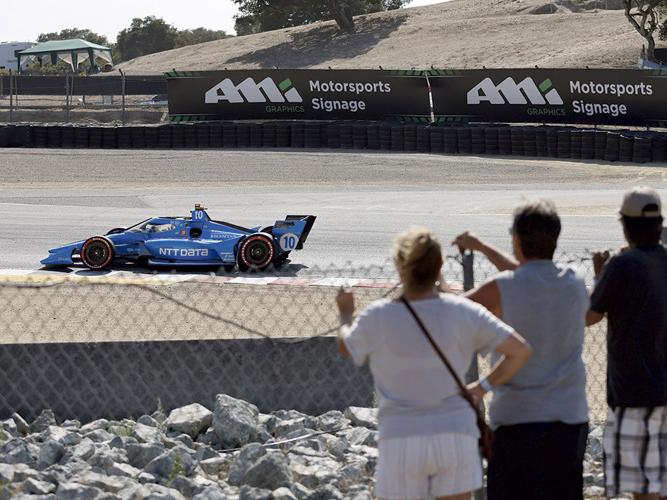
Fans watch Alex Palou exit Turn 5 during the 2022 IndyCar race.
The session marked the return of IndyCar to WeatherTech Raceway Laguna Seca after a 15-year absence. Many of the drivers had never been on the famed track before that morning, including Ericsson, a native of Sweden who had spent the last five years in the superlative world of Formula 1. The grim concrete and worn asphalt of the paddock – open to fans, who milled about peering into the garages – offered a dramatic contrast to the lights and glamor of the global series, and Ericsson basked in the simplicity.
“This is a proper old-school track,” he said with a broad smile.
LAGUNA SECA’S GRITTY CHARM IS NOT INTENTIONAL. It is rather the result of what might be called benign neglect – mismanagement, tight pursestrings, territorial battles, lawsuits, politics.
As a result, necessary maintenance was deferred, sometimes for decades. Since it was carved into Fort Ord land in 1957 until 2019, the track had been operated by the Sports Car Racing Association of the Monterey Peninsula, or SCRAMP, with the county holding the pursestrings after the land was deeded to the County of Monterey by the Department of Defense in 1974. The County Board of Supervisors was reluctant to give long-term control to SCRAMP. The organization was forced to renew its agreement with the county frequently, often every one to three years.
Under the circumstances, Laguna Seca languished. There was no incentive for SCRAMP to launch large-scale improvement projects with its future uncertain and little enthusiasm on the part of the county to approve expensive work.
That’s the situation Friends of Laguna Seca expects to address. In August of 2024, the nonprofit signed a 55-year concession agreement with the county, giving the organization financial responsibility for the county-owned recreation area and its storied racetrack. It was a historic decision, one that has the potential to set the facility toward a new and vastly improved future.

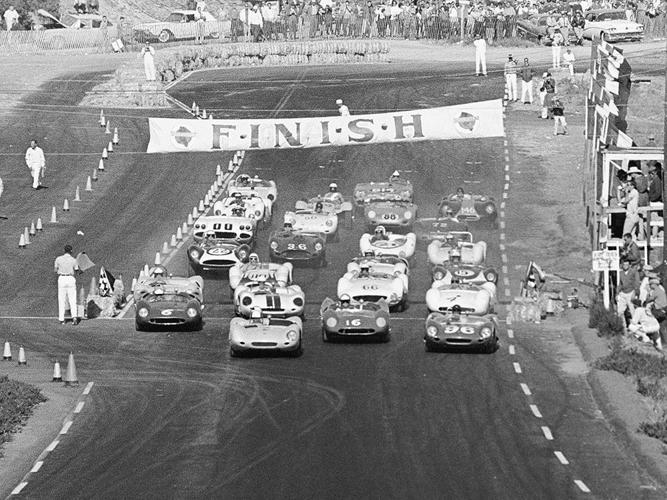
The start of the Pacific Grand Prix, circa 1961, with the likes of Sterling Moss and Dan Gurney competing.
Previously, the county had contracted with organizations – SCRAMP and then A&D Narigi – to manage day-to-day activities at the recreation area. Apart from projects funded through loans or philanthropic contributions, the county budgeted for costs. Now the $535,000 paid by the county to host the IMSA sports car race each year or the monthly $25,000 bill for utilities will be paid by Friends. On Jan. 1, FLS also took over management of events at the property.
The team at FLS has a vision for the track and its surrounding recreation area that is grand, but grounded. CEO Lauri Eberhart distills the speedway business into what she refers to as “the three Ts – tickets, traffic and toilets.” Simply put, fans want easy access to tickets and seating, as well as clean, modern facilities. They don’t want to be stalled on jammed roadways before and after an event.
That’s the functional basis of the spectator experience, but there is more. “This is a premier brand,” Eberhart says of Laguna Seca. “Making the physical plant represent that is going to take time. Twenty years from now the concept is building out the downtown area and the neighborhoods.”
Expectations have changed dramatically over the past 25 years. Race tracks are equipped with large high-definition screens, there are carnival rides, electronic games and even rock climbing walls, making the outing a family experience well beyond simply watching on-track competition. At Texas Motor Speedway, seating was removed to make room for a party deck. The menu at Charlotte Motor Speedway includes local artisanal cheese boards, pepper-crusted steak with heirloom tomatoes and grilled asparagus.
Amenities require more than elevated food offerings and an interactive midway, however. Tracks now employ apps to guide spectators. Some have added conveniences like designated rideshare drop-off and pickup areas.
“That’s the vision,” Eberhart says. “We have a lot of opportunities.”
In many ways, Laguna Seca has been left as a blank slate. The community layout addresses all aspects of the fan experience. What she refers to as “the downtown” includes dining, bars, shopping and entertainment. The “neighborhoods” are mixed use, with pavilions, luxury hospitality and seating around parts of the track where spectators tend to gravitate. Many of these would also be served by video screens, so those sitting in Turn 4, say, could catch action from the Corkscrew.

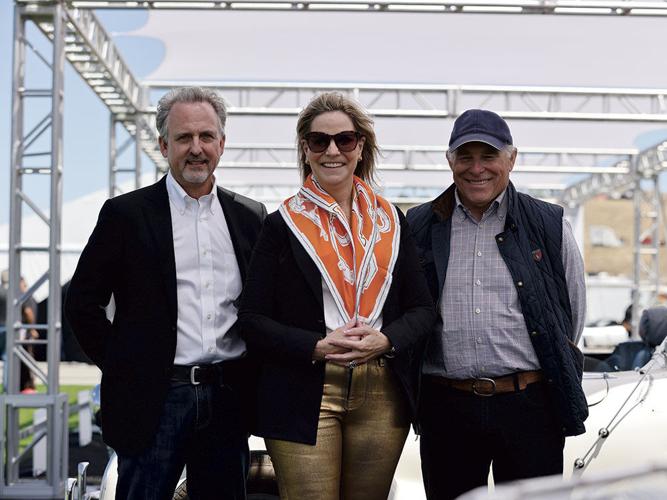
Friends of Laguna Seca President Ross Merrill, CEO Lauri Eberhart and Vice President Bruce Canepa (left to right) pose during a ceremony in August 2024 when the keys to the facility were handed over.
Yet the Friends team is mindful of Laguna Seca’s unique appeal. It is one of the few natural terrain tracks in the world used by major race series. The undulating layout is a favorite of drivers, both on track and on video screen, where the 11-turn, 2.23-mile course is the most popular among gamers. The Corkscrew, twisting sharply left and right as it plunges five stories down a steep slope, ranks as one of the most famous corners anywhere.
It is a proper old-school track. Even the open paddock, where fans mingle with race teams and peer into garages as they work, is unique. “We’re committed to keeping that flavor,” Eberhart says. “We want to capture the essence of the park in the master plan. We have to be intentional about that.”
FRIENDS OF LAGUNA SECA IS AN AMBITIOUS GROUP, but also one that is well-connected. They speak with confidence of raising and spending $50 million on the recreation area.
Its board president, Ross Merrill, operates Merrill Farms in the Salinas Valley; he is a fourth-generation vegetable producer with a deep interest in Laguna Seca and auto racing. His son, Thomas, won the 24 Hours of Daytona in 2023 and finished second at LeMans that year. Vice President Bruce Canepa is a former professional racer and owner of a classic sports car restoration company in Scotts Valley. He served on previous raceway boards and is behind the annual Rolex Monterey Motorsports Reunion.
Also serving on the board are Salinas attorney Jason Retterer, an expert on land use and environmental law, venture capitalist Jonathan Feiber, real estate developer Ned Spieker and Gordon McCall, who puts together the annual events The Quail, A Motorsports Gathering and The Quail Motorcycle Gathering.
Eberhart is one of the more important figures in motorsports. She acted as legal counsel for Charlotte Motor Speedway and Speedway Motorsports. The latter owns and operates 11 major race facilities across the country. Eberhart is also co-founder of Apollo Sports & Entertainment Law Group, a firm that advises sports leagues, sanctioning bodies, facilities and athletes – not only on legal issues, but also negotiating 10-digit financial transactions.
As Eberhart tells the story, she was unfamiliar with Canepa. But Humpy Wheeler, legendary promoter and general manager at Charlotte Motor Speedway, the hub of NASCAR, said she should takes Canepa’s call.
“He had me at ‘Laguna Seca,’” she recalls.
That was in 2016. As concerns over SCRAMP’s ability to properly manage the park grew, the county began courting other options. According to statements made at this time, SCRAMP officials said the organization had sunk $50 million into the facility since it opened in 1957, including a pit and garage upgrade in 2003. It formed an associated foundation, hoping to raise $50 million toward future work. At the same time, however, there were indications of trouble. A mismanaged promotion contract reportedly left SCRAMP temporarily teetering on bankruptcy. IndyCar racing – a fixture since 1983 – abandoned the track in 2004. The world’s top motorcycle racing series, MotoGP, came and went.
A 2016 lawsuit alleged that the organization used millions of dollars donated for track improvements on general operating expenses, instead. An assessment of SCRAMP’s accounting practices by the firm Hayashi Wayland three years later revealed “significant operational inefficiencies,” “numerous financial reporting and accounting weaknesses,” and “non-compliance with required audit reporting.” The report also cited cash management issues susceptible to fraud and, alarmingly, that SCRAMP “had significantly underreported an outstanding debt.” In 2019, according to county documents, the organization spent only $40,000 of the $150,000 required by contract and budgeted for by the county to market the IMSA race weekend.
By then, then-Assistant County Administrative Officer DeWayne Woods and the supervisors had enough. They had negotiated with International Speedway Corporation and then Friends of Laguna Seca to replace SCRAMP without coming to an agreement. In 2019, the county turned to a new firm, A&D Narigi, to manage the track on a three-year contract, later extended to five.
At the time, it was widely seen as a backroom deal. John Narigi, former general manager of Monterey Plaza Hotel & Spa, as well as a key figure in the hospitality industry, had close ties to Woods (now CFO at Central Coast Community Energy) and other officials. He also knew little about motorsports. The company was put together in response to the county’s request for proposals.
“I of course was the hotel guy and was not supposed to be slated for running the track and park,” Narigi says. “The county trusted me to be honest with them and to figure out how we could make it profitable.”

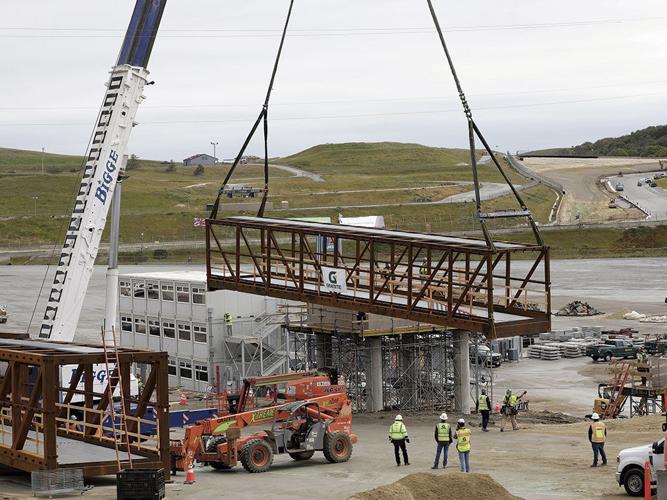
The new, ADA-compliant pedestrian bridge under construction in April of 2023, replacing a decades-old structure. That year also saw the track repaved for the first time since 2007.
By Narigi’s estimate at the time, $66 million would be needed to eventually bring the track up to standards – starting with replacing the pedestrian bridge over the start/finish line with a modern structure that is ADA-compliant and a complete resurfacing of the track in 2023, at a cost to the county of $14.9 million. Both were necessary repairs. The old bridge was unsturdy, with loose wood and dangling wires. Track officials claimed that the semi-annual Porsche Rennsport Reunion would move elsewhere if it were not replaced. But Narigi also turned his attention to upgrading raceday amenities. As a result, 40,000 fans turned out for the 2024 Firestone Grand Prix of Monterey.
“Coming from a hospitality background, we paid significant attention to the guest experience,” Narigi says. “That has really improved the look and feel of both our Rolex Reunions and the 2023 Porsche Rennsport Reunion, which was a huge success.”
“A&D did a good job turning it around,” Eberhart adds. “That was not easy. John and A&D get the credit for that.”
On that day in August when Friends completed the requirements to launch its concession agreement with the county, president Ross Merrill and the rest of its leadership team made it clear that A&D Narigi would continue to handle day-to-day operations. Just four months later, Narigi decided to step away when his contract expired at the end of 2024.
“I am very happy with the cooperative relationship we’ve developed with the county and the local business community,” he says, citing in particular the bridge and repaving projects. “I am also proud of paving the way for private capital to finally come in and run Laguna Seca how it should be run. Friends has a tremendously bright future. The best is yet to come.”
A PREMIER RACETRACK IS UNUSUAL COMPARED TO OTHER BUSINESSES. Each would like to host the top race series, organizations such as IndyCar, NASCAR, IMSA, MotoGP and Formula 1. There are dozens of others, running on dirt tracks, drag strips, road courses and ovals. Some are developmental, others frequent small venues, but all are under the direction of a sanctioning body.

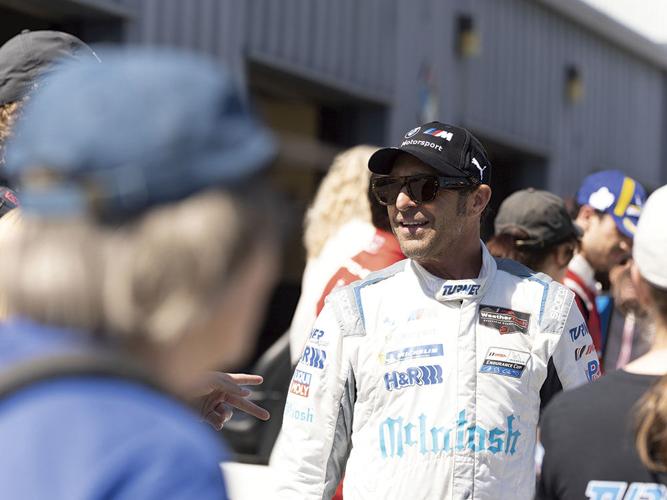
Turner Motorsports BMW driver Bill Auberlin greets fans after the 2023 IMSA race. The open paddock allows fans to get close to drivers.
Tracks essentially compete for a spot on the schedule of a sanctioned tour and must meet the standards for safety, team facilities, seating and the like of each. Events generally take four days, during which the sanctioning body assumes control of everything on the track and in the paddock. They set the rules. The reward for the track comes from sponsorships – WeatherTech’s naming rights deal is reportedly worth $1 million a year – vendor agreements and ticket sales. And that spills over to the county. According to a 2022 report, events and camping at the recreation area resulted in $250 million in spending at county businesses, dining establishments and hotels.
But there are costs, in the form of safety equipment, security, improvements, payroll (more than $2 million a year), etc. Most of all, there is a fee paid to the sanctioning body. When IndyCar returned to Laguna Seca, the agreement called for $1.2 million to the series for the 2019 event, increased to $1.3 million by 2024 – reasonable figures compared to Formula 1, which demands between $30 million and $60 million.
“We’re not doing that here,” Eberhart says.
There is a cautionary tale in the former Memphis Motorsports Park, built by a private group in 1986. It contained a drag strip, road course and an oval short track that brought in NASCAR’s truck series, IHRA drag races and ARCA, stock car’s equivalent of a minor league. In 2010 the complex sold at auction for a mere $1.9 million.
Chris Simmons, who competed on the Memphis road course, laid part of the blame for its demise on poor management. In an “obituary” for Driftopia, he wrote, “With ever-changing local management and seemingly nothing left to reinvest after large events… spectators were met with bathrooms that had no lights, inches of water on the floors from leaks that were refused repair” and so on – a textbook example of Eberhart’s “three Ts” gone awry.
Laguna Seca operates as one of just three major motorsports facilities on property owned by local governments, the others being Portland International Raceway in Oregon and the Milwaukee Mile, one of the oldest oval tracks in the country. That adds constraints not faced by private ownership groups. Any attempt to improve sightlines by tearing down a structure or to add garages or viewing pavilions must not only go through the usual permitting process, but also receive county approval.
Under SCRAMP’s management, some years were profitable, others not. For instance, 2013 saw over $15 million in revenue, but expenses left just $115,000 in the bank in a year that featured both the MotoGP World Championship and the FIM Superbike World Championship. In 2019, on the other hand, tax filings revealed $0 net income and $513,000 in revenue.
To prepare for the return of IndyCar, modifications had to be made to safety barriers around the track. The first IndyCar race on its return to the track reportedly lost money. But A&D Narigi brought the Carmel Valley diner Bear + Flag Roadside, known for its burgers, barbecue and beer selection, to the permanent dining structure in the paddock. The company also contracted with a greater range of vendors. Fans can now order craft cocktails, lobster and other unexpected offerings. A ferris wheel turned at one end of the midway at some events.
Beyond race weekends, the A&D team also added community gatherings. Some of these were automobile-related. But a stargazing event, with telescopes and expertise from the Monterey Institute for Research in Astronomy, drew over 300 people on its first evening.
“We improved our events significantly and both attendance and sponsorship support have increased,” Narigi says. “We’ve made it profitable over the past few years with very limited resources and an incredible team.”
Eberhart observes with a smile that Friends will have no problem spending money on improvements to the facility, including its campground. The nonprofit model means that profits must be directed to the needs of the recreation area.
“We’re not paying shareholders,” she adds. But with its motorsports business acumen, the organization plans to follow Narigi’s lead, running operations on a for-profit model.
BEFORE ANY PLANNED AMENITIES, however, Friends must develop a master plan and address longstanding maintenance issues. The master plan will include everything from repairs of immediate necessity to long-term improvements, to be presented to the Board of Supervisors in August. The first few months have been a time of transition. Everything from bills to payroll had to be shifted over from county accounts. Eberhart expects 2025 to be a year of stabilization – making the most urgent fixes – and assessment.
“Deferred maintenance is like fixing the water heater at your house,” Eberhart explains. “You don’t see it happening, but it has to be done. We have to be methodical.”
Drainage is an issue for a circuit laid out around a dry lake bed. In fact, the storms of 2023 caused part of the slope overlooking Turn 2 to collapse. And while the track has been resurfaced, the paddock has been ravaged by the heavy car haulers since the last major work was done in 2003.
“The paddock remodel would happen in the nearer term,” Eberhart says. “It’s a high-priority project. It needs to be redone.”
Friends’ agreement with the county outlines expectations in detail. In the concession arrangement with FLS, the county stands to potentially generate revenue – starting in 2028, Friends will pay the county 10 percent of its net revenue annually. Fifty percent of income must go into capital improvements.
The first phase of the contract is for five-and-a-half years. If Friends invests at least $10 million into the track during that time, it can extend the contract by 25 years. If during that period it spends another $40 million, it can tack on another 25 years. The agreement requires regular reports to the supervisors. All improvements become property of the county.

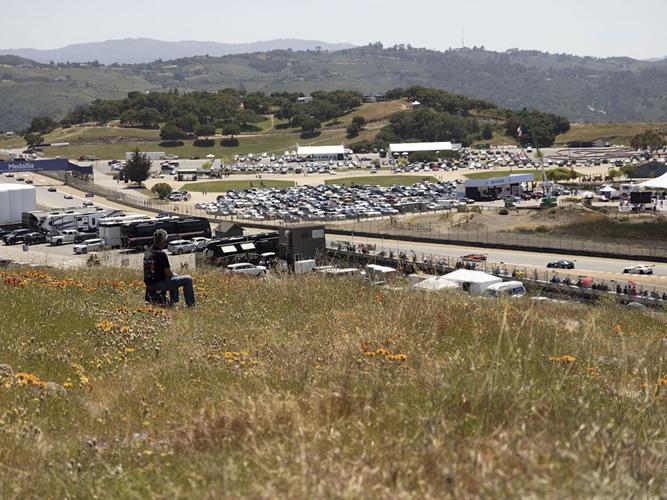
The hillsides of Laguna Seca offer sweeping vistas.
The master plan will reflect Friends’ long-term vision for changes and improvements. It is subject to the California Environmental Quality Act and is bound by Laguna Seca’s historical use, which in part limits the track to five major racing events, six mid-sized racing events – perhaps a nebulous designation – plus a number of small events. A sound impact assessment is part of that process.
Sound impact and the lack of environmental review were at the center of a lawsuit that sought to block the concession agreement. Filed in 2023 by the Highway 68 Coalition, the suit claimed that the county’s approved use permit does not specifically address motorsports and that the last environmental impact review (EIR) of the park – dating to 1983, according to court documents – did not assess noise from the track.
The 1983 EIR does note that race activity and noise generated would remain unchanged, “therefore no change in raceway-related noise at existing residences would be anticipated.” In recent years, the number of major racing events at WeatherTech Raceway have been steady. The track is often rented for private events.
The coalition settled out of court in 2024 at essentially status quo but the suit contributed to delaying the start of the FLS contract, which had originally been signed in July 2023. The sound impact study and mitigation measures demanded by the suit was already part of the FLS proposal, first submitted when the group had previously sought a contract with the county in 2016.
One of the first steps FLS took after the August signing ceremony was to hire a local sound engineer. Eberhart declined to reveal the person or company – work will not begin until the first major race dates starting in May – but noted that noise measurements would be taken and analyzed by SoundPLAN, a noise remediation software. The resulting model can determine where landscaping or structures can be used to lessen the raceday rumble.
“It’s actually kind of cool,” Eberhart says. “I was nerding out.”
Friends has committed to spend $2 million on the sound mitigation plan. The Board of Supervisors had approved $3 million to be invested into renovation of pit road suites, maintenance and drainage. And there is one other annoyance also to be addressed, one not as sexy as sound modeling software or as cool as raceday smartphone apps.
“Traffic is a focus in 2025,” Eberhart says. “We’re looking at how to do that.”
CARS HAD JUST CYCLED THROUGH PIT STOPS during the 2019 California 8 Hours. In the Bentley Team M-Sport garage, a few of the mechanics stretched out on the floor, heads propped against a tire here, a tool box there. Jon Shervinton instead used the break to step out the back of the garage and take in the scene.
The team – and Shervinton – is based in England. The international race series had taken them to legendary tracks. But for the mechanic, this stop was different.
“People talk about Laguna Seca. And when they talk about Laguna Seca, they talk about the Corkscrew. But I haven’t seen it. I suppose it’s up there somewhere,” he said, gesturing toward the steep hill where letters spell out C-O-R-K-S-C-R-E-W. “I’m going to get home and people will ask what it was like, but I don’t know.”
That Laguna Seca languished has not hurt its reputation among racing fans. But there is a feeling in the racing community that the long-term concession agreement came just in time. Friends of Laguna Seca cleared the first difficult corner, raising the $6 million necessary to get started.
“There are a lot of unknowns,” Eberhart says. “This is a beloved track. We’re laying the foundation.”
(0) comments
Welcome to the discussion.
Log In
Keep it Clean. Please avoid obscene, vulgar, lewd, racist or sexually-oriented language.
PLEASE TURN OFF YOUR CAPS LOCK.
Don't Threaten. Threats of harming another person will not be tolerated.
Be Truthful. Don't knowingly lie about anyone or anything.
Be Nice. No racism, sexism or any sort of -ism that is degrading to another person.
Be Proactive. Use the 'Report' link on each comment to let us know of abusive posts.
Share with Us. We'd love to hear eyewitness accounts, the history behind an article.