
The Monterey Peninsula is filled with landscape painting, but more and more artists dare to ask: Where is the rest of the arts?
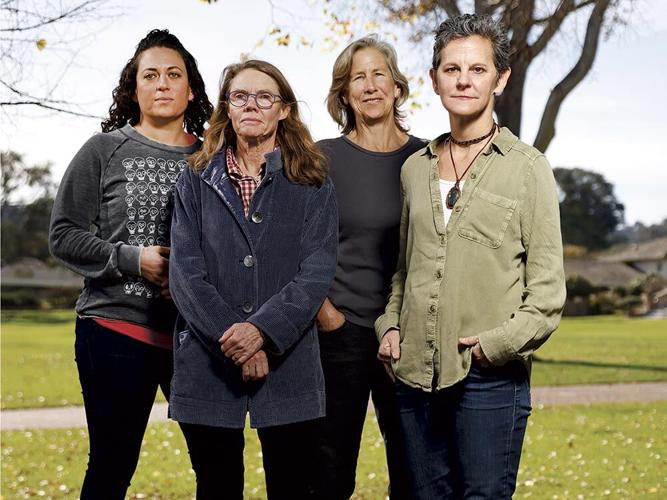
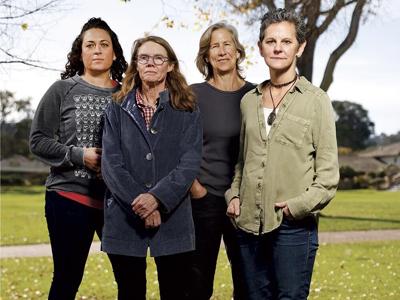
All four women who stand behind the edgy exhibit Courage Within: Women Without Shelter, now on display at the Monterey Museum of Art, arrived in the area and found themselves asking this very question. It was this absence that forced them to find each other and create infrastructure they were not able to find, even in what is historically understood as a mecca for the arts. There is another way of looking at this area and its long history of pieces with titles such as “A Lonely Cypress in Monterey.”
The stories of local homeless women – that artists Melissa Smedley, Amanda Salm, Denese Sanders and Dora Lisa Rosenbaum learned about during seven months of workshops they designed and conducted throughout 2019 and 2020 at three different local sites – speak of a similar but much more acute absence. That includes the lack of basic social infrastructure that causes single women, often older, often local residents for years, sometimes with jobs and cars they end up sleeping in, to not be able to afford a roof over their heads.
“They are, or were, special education teachers or administration workers,” Smedley says, offering fragments of stories she collected during the workshops. She has binder of clips she would be delighted to share with anyone who is willing to listen, as well as a copy of the 2016 book Evicted by Matthew Desmond. “The point is, there’s not very much that separates us. In life, sometimes things happen at once.” She mentions survivor’s guilt (definition: the emotion you experience when you pass a homeless person on the street, torn between two, maybe more, interpretations of what you see and your own role in it.)
There are about 500 homeless women on the Monterey Peninsula who seek help from local nonprofits and services, such as the Fund For Homeless Women, a grant-making entity within the Community Foundation for Monterey County, and which is largely responsible for the project. (It’s not the first time MMA is collaborating with the fund; in 2017, the museum showed photos made with polaroid cameras distributed to homeless women, in an exhibit titled What We See: Photographs by Women Without Shelter.) But what is really scary, Rosenbaum points out, is “the unknown,” the actual number that is unknown, that may never be known – all those women who do not go to a local church or shelter to shower or have a hot meal.
Of those who do, about 40 to 50 women worked in some capacity with the four artists. Some parts of the exhibit are more than an inspiration. Their voices and touch got incorporated into the exhibit, even if mostly in an anonymous form.
For the last three years, Sanders, Smedley, Rosenbaum and Salm have been working as an artistic collective called Critical Ground, and that is how they approached the project – as a quartet. The task given them by the Fund For Homeless Women, MMA and the Arts Council for Monterey County (also a funder) wasn’t easy, mostly because so much was left to their invention; it was understood there would be an exhibit at the end, but it was left open-ended.
The idea was to involve women at Gathering for Women (a day center that is a hub of services for local unsheltered women), I-HELP (an emergency housing program with transportation to local churches that offers indoor sleeping spaces and nightly meals) and Women in Transition (transitional housing and support in finding employment and permanent housing) in a series of workshops.
Critical Ground spent six months designing the workshops – with journal-making, printmaking and painting – and led seven sessions in each facility. One of the products of this collaborative work is a piece titled “Flow” (floor canvas, acrylic paint) that is featured in the exhibit. This is how it was born in Critical Ground’s own words: “After engaging the women in a breathing warm-up and discussion around the ‘present moment,’ Critical Ground taught the women a wet style of painting using a palette of liquid colors applied to canvas using flat brushes. Slowly lifting and manipulating the canvas with quiet reflection, the colors and brush strokes merge and flow into one another.”
The work on view ranges from traditional media to textile to installation, sound and performance.
“The hope is to open a portal for empathy,” Smedley says. Her own performative work approached the subject of discomfort in the most literal way: to talk about our discomfort in approaching homeless people and their discomfort in life, she is making herself physically uncomfortable, sitting in a rectangular box, an oversized one – that one you receive your book in from Amazon and wonder why it was sent in a box that would fit a baby elephant. “We are all expected to fit in,” Smedley observes.
Sanders is the group’s visionary. She created the space and invited Rosenbaum in. Rosenbaum met Salm in a swimming pool and told her about a critique group she had in mind. Sanders joined and recruited her best person-in-arts, Smedley.
For the four of them, the workshops have been an eye-opening experience that made the group stronger and tighter. As Rosenbaum said in the chaos of the week before the Jan. 27 opening at MMA, they are “itching” to get back to their regular meetings as Critical Ground.

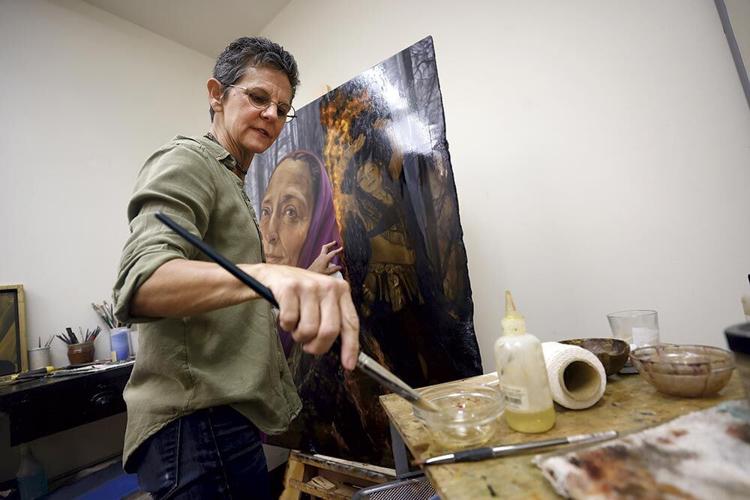
Denese Sanders in her studio, working on the oil-on-wood-panel piece titled “Turning Point,” which is shown at the exhibit. Sanders’ Open Ground Studios in Seaside is separate from Critical Ground’s function, but it has housed some of the group’s meetings and many of the collaborations.
Note: This caption has been updated to reflect the final name of the artwork, "Turning Point." This story originally published the working title, "Charred Phoenix," but that is not its final title.
THE VISIONARY
Denese Sanders (paintings, drawings, printmaking and book arts)
Sanders has been here “a while,” she says – since 2003. She is sitting on a sunny bench opposite the Monterey Museum of Art, adding, with her clothing, three shades to the already impressive palette of greens naturally present on leafy Friendly Plaza in downtown Monterey.
Originally from Wisconsin, Sanders talks proudly about a sleep-in at the state’s Capitol building during anti-Apartheid demonstrations in the ’80s. In her 20s, she studied printmaking in Paris, with French equipment, which taught her early on that she can do this “without spending thousands and thousands of dollars.” In her formative years, she worked in Minneapolis, where she opened a printmaking studio at 27. Married life brought her to California and only in Monterey she came to fully appreciate the large art community she had up north.
“I worked with the Minnesota State Art Board,” she says. “The state receives so much federal, regional and local funds for the arts. When I arrived, I was looking for edgy contemporary work, and from my perspective, as a 40-year-old mid-career artist, there was nothing happening here. I’m not here to paint pretty pictures. I’m here to see what you think.”
Sanders spent years involved in Arts Habitat, looking around for a studio for herself. Pacific Grove Art Center has wonderful studios, she says, but only 17 of them, and the waitlist is 20 years, she jokes. (While PGAC can’t confirm the wait time, they are full, with a waitlist of 25, and they don’t see any of the current occupants leaving anytime soon.)
In 2013, Sanders opened Open Ground Studios, where adults can take art classes. “It took me 10 years to allow myself to do that,” she says. “Real estate is so freaking expensive here. In most cities, there is a warehouse district that gets changed into art studios because nobody wants it. And I wanted to work around other artists.”
She met Smedley, probably 15 years ago, and Rosenbaum appeared in the picture the moment Critical Ground opened. They formed a group in 2017, adding Salm to the collective. They would meet every other month for two hours, discussing their art in depth. A year into such sessions, they were asked if they would be interested in a project that would involve homeless women. They agreed, not suspecting the process would take three years.
Covid aside, in 2021 Sanders was “out of commission for eight months” she says, fighting cancer. The group and the project kept her going, she says, and the minute she felt good enough, she got back to her studio with a sense of great urgency.
Aside from pieces they created together or with the women, each of them brought in three pieces of their own. For Sanders, that was a series of five paintings of eyes and two large portraits of women she met. One (“Turning Point”) was a Big Sur resident whose life changed after a disabling injury.
A second portrait is something that Sanders keeps thinking about. The woman in the portrait titled “Through the Cracks” panicked; she decided she didn’t want to be seen.
“I never saw her again and I need to see her again,” Sanders says. “So now the portrait is wrapped – her face unrecognizable. When I was making the portrait, I asked her: ‘Show me how you want people to see you.’ And she took this very proud pose that demanded: ‘See me. I shouldn’t have been in this position.’
“Now her portrait is waiting for her – her identity hidden under 2,000 yards of crochet thread.”

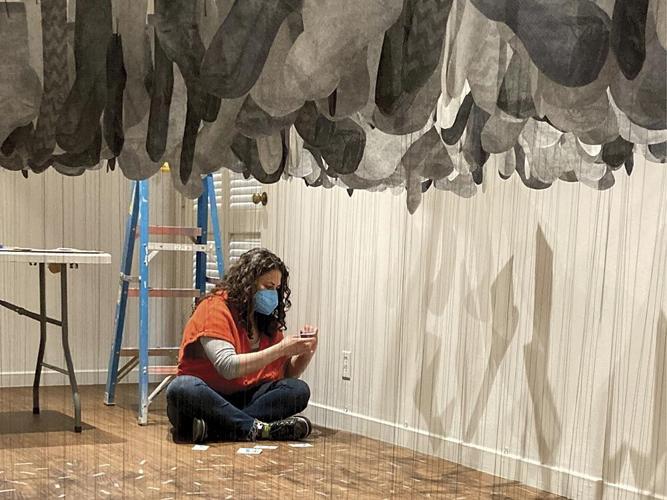
Dora Lisa Rosenbaum at work on installing “Unheld,” which features 500 suspended socks, etchings on thin mulberry paper that appears fragile, but is actually strong.
THE INVENTOR
Dora Lisa Rosenbaum (print, installation, mixed-media)
It was Rosenbaum’s idea. She wanted to have a critique group, a formal gathering of minds; age and gender didn’t matter. “I wanted someone to bounce ideas off,” she says. She is wearing an orange sweater and she just parked her orange car on Pacific Street near the museum, and a few days ago she was running around the museum in fluorescent orange sneakers. Just like Sanders, she insisted on conducting an interview in the sun.
“The world of printmaking can be confusing,” she explains of her craft, “because there are gazillion different kinds of printmaking.” Her specialty is etching on copper with ferric chloride.
Rosenbaum is the youngster of the group. In her early 40s, she is about 20 years younger than the others. Born in Guatemala, she moved to the U.S. when she was 2 and grew up in upstate New York. She pursued art as an undergrad, followed by a printmaking school in Venice and fine arts in Rome. She arrived in Monterey in 2011 with her husband, now an instructor at the Defense Language Institute. At first, she had a studio in Santa Cruz before she determined the commute was impossible. Then, she found Sanders at Open Ground Studios, followed by the forming of Critical Ground.
“I was looking for a place for myself and found it,” she says. “It has been an amazing experience, opening and reaffirming.”
The collective meets every two months, rotating between their studios. Of 120 minutes, a full hour is given to one of them, and 20 minutes to others (Sanders brings a stopwatch).
“I have had several shows since I joined,” Rosenbaum says, “and it’s nice to have your own support group with you at the openings.”
This is the first time Rosenbaum has tried combining arts and social issues. In Courage Within, she presents three pieces. The first, titled “Hold,” is a series of little drawings, each 7-by-7 inches, on paper that is made of recycled denim.
The series grew out of Rosenbaum’s interest in the objects we choose to live with and their importance to and impact on our identities. In one of the workshops, she asked the women to consider an object that was important to them and to write a few sentences about it. “Handwriting is interesting to me,” she says. “Just like clothes, it shows your identity. Those messages are private so you cannot really read what they wrote.”
Another piece, titled “Burdens,” is a bunch of bags and backpacks that look normal but weigh tons. They are sculptures made of concrete. They represent the duality of treasures that each of those women carry around with themselves, that are at the same time a physical burden that makes their life exhausting.
Finally, “Unheld” consists of 500 socks (copper etchings on mulberry paper) that are hanging from the museum ceiling. They refer to the symbolic 500 women who are known to seek help locally, and to the fact socks remain the most requested item by homeless people. They are made from a thin Japanese paper that looks fragile, but is strong. The printed socks installed at MMA sway in place, precariously suspended, much like these women’s lives.
“It’s not my characteristic to open up to people,” Rosenbaum says of the process. “The workshops were draining, both taking in and giving. But what I learned is that being homeless is exhausting. And the worst thing is that we don’t know how many more homeless women are out there. We don’t even know how to reach them.”

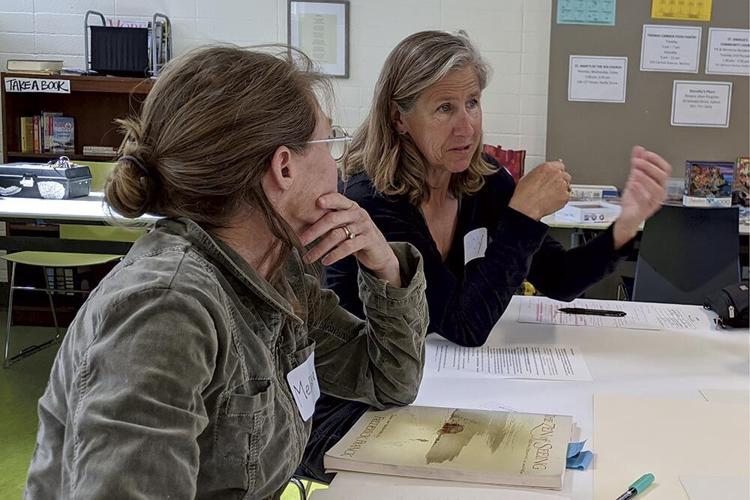
Artists Melissa Smedley (left) and Amanda Salm at one of their workshops with homeless women that took place over a three-year period. They came up with some ideas for solutions. “Other things that people can do are to watch their local government very closely to ensure that affordable housing quotas and measures are emphasized and upheld,” Smedley writes.
THE MEDIATOR
Amanda Salm (textiles, sculpture)
Her mother was a book designer and Mandy Salm is pretty sure that the early world of her mother’s graphics laid her artistic foundations. She moved to the area in 1999, but has early memories of Carmel where her aunt used to live. “There are so many painters here,” she says about Monterey County, “but it was impossible to get good art feedback.”
Salm was raised in the Bay Area, went to San Jose State, then – still pursuing art – moved to upstate New York. Before she discovered textiles, she enrolled in a design program, but there was a weaving studio across… you know how the fairytale goes from here. In New York, for the first time, Salm lived in what she described as “extreme climate.” (Before you roll your eyes, learn that she has been swimming in Monterey Bay all year long, no wetsuit, for the past 30 years.) But in New York, Salm learned what it means to be from the South – she would pick radically different colors than her peers. “The more South you are, the warmer the culture gets, the more relaxed is the way of living,” she says, wearing simple beige, shorts and a T-shirt that she’s chosen for a Zoom interview. “The colors are brighter, more vibrant and music has a stronger beat.”
Before returning to Santa Cruz and then coming to Monterey County (she now lives in Pacific Grove), Salm spent four years in Hawaii designing fabric for clothing. She discovered horsehair as fabric thanks to her husband, a rodeo rider. She then discovered that Native Americans in Arizona used to use it to make baskets; horsehair used to also be used in making wire, rope and upholstery. To make her fabric beautiful, Salm – recently certified as a master gardener – works with natural dyes: Japanese indigo, chamomile from South America, and motherwort.
She was heartbroken by the workshops, especially the second workshop, in which the artists encountered older women. Local churches would gather sleeping bags and hot food and pads, and the women would gather for dinner and a prayer circle. Critical Ground would join them and offer workshops, even if many of those women were too exhausted to expend any more energy. At the same time, there is something incredible about making something with your own hands, and many of them chose to make something, “something to be proud of,” Salm says.
“I had no interactions with homeless people before,” she says. “But we all got very aware of them during the pandemic. We just don’t know how to deal with them without trepidation.”
One of her projects featured at the exhibit is titled “Address.” It’s 128 houses, each one 7 inches tall and 4.5 inches wide, made of shredded and molded paper; the number refers to the average waiting time to be housed as a homeless woman in Monterey County.
“Shredded forms and statements related to one’s having a home comprise these 128 molded paper houses,” she wrote. “Each house signifies approximately one week of waiting for a place to call home, to have mail delivered to your own address.”
Her other work is titled “Roof” and at 9 feet tall, it’s a sort of an open tent made of a delicate white organza. “This piece is an attempt to look at the positive actions happening in producing, adapting and solving the problems of creating enough shelters needed for the un – and insufficiently housed,” Salm wrote about the piece. An accompanying QR code highlights some of these important steps being taken by different organizations.
“There are so many obstacles to affordable housing,” Salm says. “Everybody says: ‘Not in my backyard.’ But housing those people is the most cost-effective thing we can do.”
She believes the current network of programs is designed to keep people out. It’s designed so they would give up, she says.

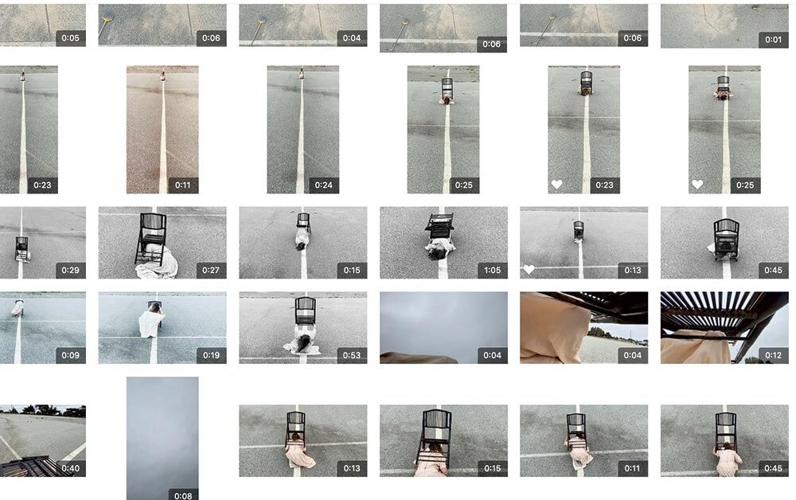
Melissa Smedley’s “Can you Hear Me?” is an incantation in spoken word, with video stills shown above. After a few weeks of conducting evening art workshops with the women, they began to enter the artist’s narrative as she went about her daily (sheltered) activities. This underscored the contrast between the women’s lives, her own, and the wherewithal it takes to hold even one life together.
THE SYNTHESIZER
Melissa Smedley (public sculpture, performance, video)
You can find Melissa Smedley behind a gigantic head of green cabbage – it’s not a metaphor, you can visit her website where she is advocating for the “Lettuce Pray” and “Lettuce Beds From Sea to Shining Sea,” invoking food insecurity and lack of an adequate immigration policy in the U.S. at once.
She calls herself Artist in Large, a living sculpture, an Art Ranger, who runs the Department of Homeland Inspirations, now in the form of a podcast. If you want to understand what Smedley means by art, think of people like performance and conceptual artist Suzanne Lacy, or German artist Joseph Beuys, who was a key figure in the development of Happenings.
“At some point I realized that my process is the most interesting thing in art,” she says, explaining what she means by living sculpture, or public sculpture, as she calls it sometimes. “That my process is sculpture and that my body becomes sculpture.”
Smedley received her undergraduate education at Brown and continued at UC San Diego. She has been in the area for the last 16 years, but finding her people took a while. Her art shifted from personal to societal when she became a mother, she says. That tendency deepened with time, also throughout her friendship with Sanders. Together, they did shows that would address reproductive rights or climate change.
“We need diversity in housing, and that takes political will,” Smedley says. She is one of those artists who really puts themselves out there, risking social controversy (for example, performing in a costume made of wires and boxes as “the most technological woman on the planet,” as she did in the past). Smedley firmly believes in art as social practice.
Belonging to the collective makes her feel like she is being taken seriously in art and in life, she says. “Plus, you know, we also go through shit in life. We also need to take a dog to the vet.”
But her worries seem so easily fixable when she compares her life to the lives of the women she met.
“Can you believe that there is no single federal program that would address unaccompanied women specifically? In the meantime, look at the Pentagon budget.”
Smedley used to work as a bicycle messenger so she used to speak to homeless people all the time – “But yes, it’s intimidating,” she says. “People don’t know what to do.”
Her pieces in the exhibition are the hardest to describe. As in previous cases, there are a lot of conceptual undercurrents, but there is also an element of performance that cannot be reviewed up front. “Can you Hear Me?” is an incantation/spoken word performance that attempts to address the shocking contrast between people’s lives, where one person is sitting on their sofa, petting a cat while someone else doesn’t have a place to brush their teeth properly. “Housekeeping: Keeping House” is a six-minute video installation projected on bed linens. In this series of video performances, the artist uses her body as a sculptural form to contemplate and embody the psychological spaces of the struggles reported by the women. These performances and object challenges depict an isolated figure mustering through tasks with persistence. This piece involves recorded voices of the women the artist met at the workshops.
Smedley’s third piece is an installation titled “Hanging by a Thread.” This moving sculpture, made of recovered metal discards, shoes, concrete, glass, shredded currency – and a rotisserie motor – is a visual reflection of the labyrinth of precariousness that the women face, the grind of living on the street, or in a car, often endured for years.
“It’s an extremely local problem,” Smedley says, calling places such as Van Buren Senior Center in Monterey a godsend to some people. She raises a binder of news clippings and resources. She has done her research and she is annoyed. “We cannot just look away, that’s too easy,” she says. “One of the things those women talk about is that they want to be seen. They want to be acknowledged as full-fledged human beings.”
(0) comments
Welcome to the discussion.
Log In
Keep it Clean. Please avoid obscene, vulgar, lewd, racist or sexually-oriented language.
PLEASE TURN OFF YOUR CAPS LOCK.
Don't Threaten. Threats of harming another person will not be tolerated.
Be Truthful. Don't knowingly lie about anyone or anything.
Be Nice. No racism, sexism or any sort of -ism that is degrading to another person.
Be Proactive. Use the 'Report' link on each comment to let us know of abusive posts.
Share with Us. We'd love to hear eyewitness accounts, the history behind an article.