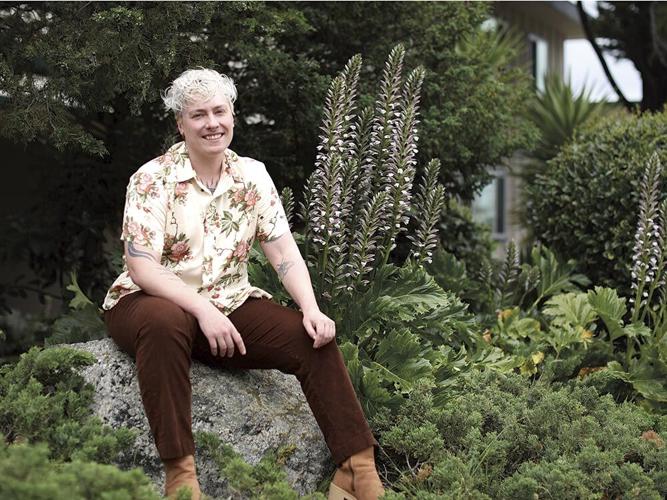


Scout Luketish is a writer, artist and a nonprofit employee. He works for We Will Rise, a project that aims to stop bullying, and One Starfish, a local safe parking service for homeless people.
IN 21ST-CENTURY CALIFORNIA, gay and straight people expect to encounter each other in every walk of life. Many businesses market to the gay crowd, seeking the stereotypical quality stamp in the world of food, drinks and design. Gay people are celebrated, part of the fun. This growing tolerance, while still in progress, has not been widely extended – so far – to transgender people, many of whom remain in the LGBTQIA+ underground.
Transgender rights are among the most politicized in the nation. According to the Trans Legislation Tracker, 558 bills have been introduced in 49 states so far this year that would limit trans people’s ability to access health care, education, athletics and legal recognition; 82 bills have passed and 365 others remain active. Bills target everything from drag shows to sports team membership to how birth certificate information appears.
There is also physical violence. A transgender Florida teen, Chad Sanford, was physically brutalized in 2021 and in 2022; in 2023, a 15-year old transgender girl, Brianna Ghey, was stabbed to death in the UK.
“Being openly trans is still a big risk for trans people,” says Tee Anderson, a trans man from Monterey, noting both the social and physical risk.
Currently, Medicaid covers transgender-related health care in 26 U.S. states, and excludes transgender-related health care for all ages in nine states. In the last couple of years, 19 states have enacted bans or restrictions on transgender care. In the meantime, California proclaimed itself a “refuge” state for transgender youth and their families.
“The same arguments that were once used with the gay people are now being used against trans people,” says Scout Luketish, a trans man from Seaside.
Common arguments presented by anti-trans groups include that individual experiences are a cultural fad, a phase, a choice. But one way that many trans people describe their experience is the feeling of being assigned the “wrong” gender at birth.
“They talk about protecting children,” says Tahani Lopez, a trans woman from Salinas. “But what about trans kids, dying at school, kicked out of the house? That’s why a lot of us are silent.”
Step back and look at gender versus sex (see glossary, p. 24) and gender is revealed as a tool we use to organize society. According to philosopher Joan Dunayer and other feminist theorists, societies started to emphasize gender when people stopped being hunter-gatherers and men settled down to raise food – among constantly lactating cattle, constantly lactating women, and benefitting from the children that would come every year (hands for work). The rest is history – the last 10,000 years of it.
For Pride Month (June), the Weekly is featuring profiles of four transgender community members. Two are trans men from the East Coast, who chose Monterey County as their homes. Tahani Lopez is a young trans woman from Salinas, in love with uber-feminine 1950s style. Another Salinas resident, Angela Soto Cerros, questions gender identification altogether, and is nonbinary.
Trying to explain hate against trans people, Soto Cerros says: “The simplest answer is: People don’t want to go outside of their comfort zone. The moment something contradicts their belief, it’s a threat. That’s what causes hate. Some people are genuinely afraid and lack resources, or are simply not ready to be educated. Others are using it to their personal advantage.”
Luketish believes that trans people already have many allies and will find more allies among cisgender people as their stories are shared. This is why he wants to be part of this article – to inspire more allyship.
Scout Luketish
- Gender: Man
- Pronouns: He/They
- Age: 33
- Residence: Seaside
Monterey County is the place where Scout Luketish finally found his place.
California was on Luketish’s mind all his life – the big outdoors, the ocean, so different from the landlocked Rust Belt he is from. But before arriving in Monterey County, where he met his girlfriend and found employment at We Will Rise, a nonprofit that organizes anti-bullying classes, he tried Florida.
Luketish didn’t have good reasons to move to Florida except to follow a friend. He was working remotely for his family business while Florida was turning politically redder. Luketish left to go through the pandemic with his family in Pennsylvania, but has been observing Florida’s hardening political climate and Gov. Ron DeSantis’ attacks on the LGBTQIA+ community ever since.
“You know about the legislation, right?” he asks, referring to the Florida law widely called the “Don’t Say Gay” bill. The law states that “classroom instruction by school personnel or third parties on sexual orientation or gender identity may not occur in kindergarten through grade 3 or in a manner that is not age-appropriate or developmentally appropriate for students in accordance with state standards.” That means not talking about gay people’s existence until a certain age. The law took effect in July 2022.
Compared to Florida, Monterey County feels safe and accepting, even if overall it’s “still scary to be out in public,” Luketish says. He has short platinum blonde hair; he is friendly and smiles a lot.
An artist and a fiction writer, Luketish adores magical realism, the British history novel writer Hilary Mantel and queer horror. He works as a case manager at You Will Rise, alongside artist and activist Paul Richmond, whom he greatly admires. He also works for One Starfish, another nonprofit that offers safe overnight parking to homeless people living in their vehicles. “I used to sleep in my car,” he says, explaining his motivation.
Luketish wanted to leave Pennsylvania because he didn’t feel like he belonged. He grew up in a conservative and pretty religious environment, he says, and has a sister who is also trans. He knew since childhood he was trans, but didn’t have the language to describe it. “I do miss it sometimes,” he says about his hometown, adding the whole family is still there. “Nobody ever left Pittsburgh.”
In his early 20s, Luketish thought some gender fluidity would be enough. He started to transition hormonally (testosterone) and culturally (name, clothes) in his late 20s, and feels “a lot happier now,” he says. His girlfriend is also trans, and he says that lets them connect as partners on a “much deeper level.”
When he was still living in Pennsylvania and taking hormones for the first time, Luketish worked for a rural construction company. There, he had a few incidents of harassment – the harassers were always male, and always a group, he says.
During the pandemic, Luketish was staying with his parents and used it as an opportunity to come out as trans. It was “a bit rocky,” he says. “It’s scary to test how much people love you.” But all is well what ends well: “They’ve chilled out and are accepting.”
It was also difficult when it came to religion because Luketish grew up in the church. There, he found more confusion than tolerance. “Jesus never said anything about being gay or trans,” he says, suggesting the church should also be open-minded.

Tahani Lopez is thinking about starting a career as a hairdresser and is interested in fashion.
Tahani Lopez
- Gender: Woman
- Pronouns: She/Her
- Age: 20
- Residence: Salinas
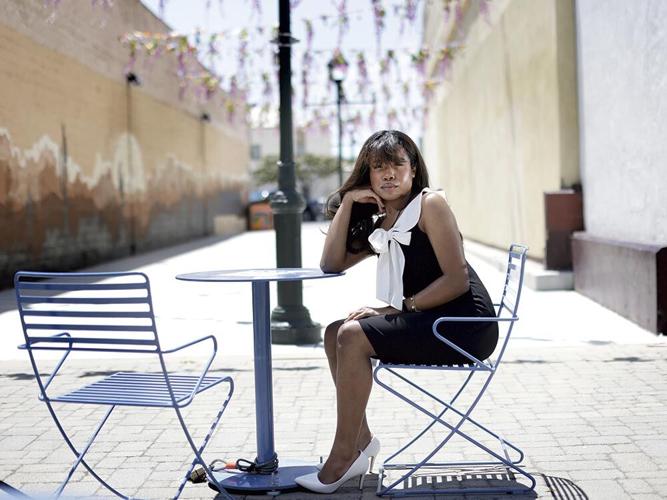
While waiting for an interview on a Sunday afternoon in downtown Salinas, Tahani Lopez looks like a Black Marilyn Monroe or Sandy Olsson “before she met Danny,” she says, defining the style she is going for (a Grease reference – she also adores Audrey Hepburn). She is with her mother, Rosemary Lopez, who escorted her to the interview and kisses her for good luck, and is wearing a light summer dress and white heels with pointed tips. Lopez has shiny lip gloss, long eyelashes, and hair up in a sweet, tiny bun, topped with a white ribbon. A soft sweater is falling from her arms.
Lopez’s manner is similarly gentle – her gestures, her steps, her concerns are feminine. She wears a crystal on her neck to keep her calm and is currently looking for a calm place to work, possibly as a hairdresser.
“I’ve always known,” she says about being transgender. As a child, she would wear a towel as a high hairdo and be interested in makeup. When she was 14, she came out to her mom as gay.
“She said she still loved me,” Lopez says. Lopez is half Latina, half Black; she never knew her dad.
Her mom’s cousin, Aunt Angel, is also trans. In fact. Lopez’s mom would help her cousin do drag. They wondered if Lopez “might be trans too.” When her daughter eventually came out as trans, she just said: “I love you so much.”
There was a new name to be picked and Lopez first thought about “Mercedes.” But then another trans woman, who she met in San Francisco, told her about Tahani and Lopez loved it. That source of inspiration has since died, and Tahani never had a chance to thank her for what she considers a gift from someone who shared her experience. She has legally changed her name, and overall found people in her life to be accepting.
That being said, Lopez is careful, and talks about the stages young trans people must go through. Despite what the public hears from the right-wing media, a trans person can’t do much before they are 18. They can start therapy and, when they are 16, they can start taking hormones.
In other words, all is reversible, Lopez says – not that she is going back, working on mastering her coquette style instead. In terms of surgery, she is only thinking about it, and points out soberly that “any surgery is a risk.” There’s also the cost – $45,000.
Lopez “passes” as trans, appearing to most people as a beautiful young woman. Still, she has been harassed, as many young women are. During her 18th birthday party in a park, a rude guy on a bike requested a blow job. When Lopez said something back, he freaked out, “because my voice is quite deep.”
When not looking for work, Lopez draws, goes for walks, visits vintage shops and hangs out with her best friend April.
Meanwhile, Lopez feels just like Marilyn Monroe must have felt in her beloved ’50s, “a misunderstood girl looking for love.”
“She speaks to me,” Lopez says about Monroe.

Tee Anderson is a visual artist and a software engineer. He is into surfing and enjoys dancing.
Tee Anderson
- Gender: Man
- Pronouns: He/Him
- Age: 39
- Residence: Monterey
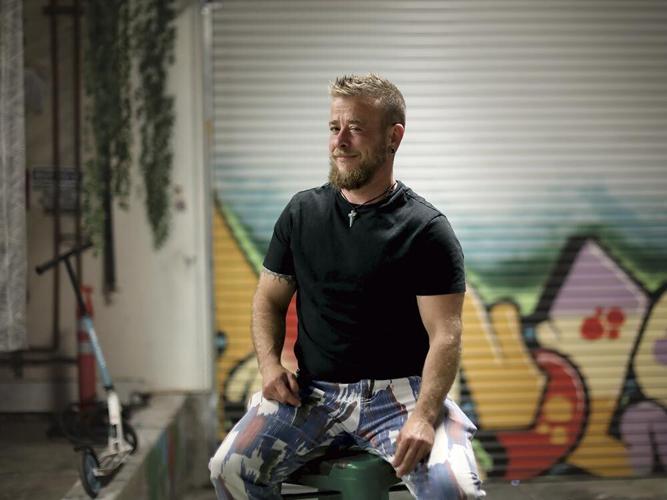
Talking to Tee Anderson is rewarding for two reasons. First, he jokes all the time. His humor is self-deprecating, deep, bordering on absurd, as when he says he won’t get a penis because it could “fall off.”
“Maybe if I was 20,” he says, hands in his pockets, his hairy face wrinkled in comical pondering.
The second reason is his readiness to communicate in the most authentic way he can find, and that means that he is ready to talk – openly and wisely – about his vulnerabilities: childhood trauma and mental illness. When talking about his past he touches his eyes frequently, rubbing them as if to remove fatigue. He shares his story from The Shop in Monterey, where he paints after he is done with his day job in tech, as a software engineer working as a contractor to the U.S. Department of Defense.
Anderson is one of the most visible trans men in Monterey County, perhaps because he is an artist. “I did art in school and I didn’t think I was that good,” he says. It was his wife, Amy Anderson, who pushed him back in that direction. She helped him with two crucial decisions in his life: transitioning, and re-becoming an artist.
In his art, he moved from oil on canvas to acrylic, and another important part of his craft is painting surfboards. His style is orange and blue-soaked; his landscapes are psychedelic wonderlands where dragons and magical sea creatures, but not much more in terms of representation, are allowed. For the most part, it’s just clashes of colors, waves, bright spots. Anderson had his first exhibit in 2021 and continues to work after hours, often documenting his work on Instagram.
Like Luketish, Anderson is originally from Pennsylvania. His parents divorced when he and his twin sister were young. Childhood abuse led to PTSD, he says; he was diagnosed as bipolar and his wife, a psychiatric social worker, suspects he has ADHD. He didn’t get along with his stepfather, who always called him “clumsy,” and left home when still a teenager. His childhood included hearing family members describe people in the queer community using slurs.
Proving that he is equal to other men was always important to Anderson, even before his transition. He fought to show he’s equal, loading trucks and doing other “manly” jobs better than most men.
He met his wife at an LGBTQIA+ event in Pennsylvania. Their relationship is 14 years strong, and Anderson makes a joke that it’s the time after which married couples divorce. But it’s clear that meeting his wife was extremely important to Anderson, who took his wife’s surname when they got married; he felt no connection to his own family name, he says. He calls his wife the better “three-fourths” of the couple.
Many of Anderson’s interests align with those of an archetypal American man: cars, construction, sports. But he is also very keen on dancing.
Anderson transitioned about six years ago. “It’s been better than I thought it’s going to be,” he says. Monterey County does not have a big trans community he says, but he feels safe here.
That is not the case everywhere. He recently reconnected with his twin sister in Idaho. They went out to an Indian fusion restaurant where, despite knowing his story, she continued to publicly use “she” and “her” pronouns, and introduced Anderson as her sister; he said she doesn’t really “believe” in being trans. It made people look at them.
“‘Listen,’ I told her, ‘I don’t care if you believe it or not. You put me in danger.’”
Despite that visit, Anderson and his sister still talk on the phone every day. Fortunately, in English, the second-person singular (you) doesn’t require using pronouns.

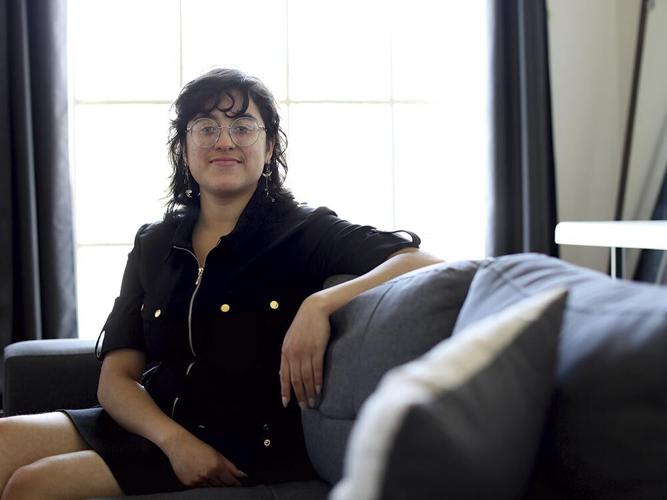
Angela Soto Cerros lives and works in Salinas. They run an LGBTQIA+ program for youth at The Epicenter in Salinas.
Angela Soto Cerros
- Gender: Nonbinary
- Pronouns: They/Them
- Age: 22
- Residence: Salinas
Angela Soto Cerros, 22, always forgets they weren’t born in Salinas. Rather, Soto Cerros was born in Nebraska, “which is weird,” they say. Their family moved to California when Soto Cerros was not even 3 years old because Nebraska weather was making the child sick. Their mom’s family is from El Salvador, dad’s from Mexico.
Soto Cerros is nonbinary and employed by The Epicenter, a nonprofit in Salinas, as an LGBTQIA+ services student worker. They recently graduated from CSU Monterey Bay with a degree in psychology.
Growing up, Soto Cerros noticed how gendered the Spanish language is, and that there are no ways of describing the LGBTQIA+ community without being derogatory. In Spanish, reality is divided by gender, which provides order – masculine nouns end in a “o” and feminine nouns end in an “a.” Adjectives follow.
“When I got older I realized that homophobia and transphobia are ingrained in communities everywhere,” Soto Cerros says. “It goes way back to Spaniards coming to America and the conquest. Those kinds of hate messages are ingrained in the language, music and systemic cultural beliefs.”
The gender assigned at birth to Soto Cerros was female. They were raised with the expectation to become a mom, a loyal wife, do all the traditional housework, wear dresses, act girlish. They were expected to start working after completing high school or already be married right out of high school.
“I didn’t really care about gender as much as everybody did,” they say, turning the tables, pointing out that it’s often cisgender men and women who over-emphasize gender identity. “I wanted to do my own thing.”
In high school, Soto Cerros had their first queer relationship and felt they had to hide it. One time their mom asked her when watching Ellen DeGeneres on TV if they are “like that woman.” Soto Cerros understood what that meant. “It was a message that coming out is not safe,” they say. Soto Cerros eventually did come out and was accepted, but feels it happened only in the context of their parents’ divorce and power shifts in the family.
In sophomore year of high school, Soto Cerros became involved at The Epicenter (which serves youth ages 16-24, including the queer community), first as a volunteer. That’s one of few places in their experience they’ve found to be inclusive “and they meant it. A lot of places say they are inclusive but there are a lot of microaggression there,” they say. “It’s just a sticker to get more revenue.”
Because of their female presentation, Soto Cerros says they don’t experience much social harassment. “Except for my family, nobody knows. To anybody else, I’m just a girl.” Everybody else does experience confusion regarding what it means to be nonbinary. “A lot of people think that a nonbinary person is this androgynous, skinny Caucasian,” Soto Cerros says. “That’s the image from the media.”
Sometimes people comment on their leg hair or armpit hair. How does Soto Cerros react? “Dude, we are literally all going to die,” they say, improvising an answer. “Don’t even worry about it.”
Soto Cerros feels that humanity is at the early stage of this new era. They are bothered by how hard it is to get hormonal therapy for those who want it, and how little support there is for surgical transition.
“We are definitely going toward a more progressive state, but it’s still a struggle,” they say. “Open minds and open hearts will decide our future.”
(0) comments
Welcome to the discussion.
Log In
Keep it Clean. Please avoid obscene, vulgar, lewd, racist or sexually-oriented language.
PLEASE TURN OFF YOUR CAPS LOCK.
Don't Threaten. Threats of harming another person will not be tolerated.
Be Truthful. Don't knowingly lie about anyone or anything.
Be Nice. No racism, sexism or any sort of -ism that is degrading to another person.
Be Proactive. Use the 'Report' link on each comment to let us know of abusive posts.
Share with Us. We'd love to hear eyewitness accounts, the history behind an article.