





The pandemic was an unusually stressful time for East Garrison resident Mitsuyo Kohama, a night doctor at the Community Hospital of the Monterey Peninsula.
In the little free time she had at her home, which she and husband Ibrahim Shelton bought in 2017, she found some peace by gardening in flower pots they had put in their front yard. The pots brought life to a landscape in which plants initially put in the ground by a developer were dying or already dead.
The couple thought nothing of it – so far as they were concerned, they were beautifying their neighborhood, not detracting from it. Then came a warning letter last spring from a property management company for East Garrison Community Association – the development’s homeowners’ association – stating that there was “an excess amount of potted plants and other garden decor” that required approval from the HOA’s Architectural Review Committee. “NOTHING can be placed, kept stored, or parked on the common area without the prior consent of the Board. Owners may not place rubbish, debris, or other unsightly or unsanitary materials on the common area.”
Kohama and Shelton were shocked, and struggled to fathom why they couldn’t have flower pots on property they own – they had been there for years, with no complaints. For Kohama, it felt like the HOA was trying to take away one of the few things she cherished.

Ibrahim Shelton and Mitsuyo Kohama with the flower pots the HOA has asked them to remove for violating its rules and regulations. Kohama says gardening helps relieve her stress from working as a night doctor at CHOMP.
“I have really high stress and gardening really helps my soul,” she says, adding that she’s still recovering from the height of the Covid-19 pandemic – an acutely trying time for those who worked in hospitals – and that though she’s only in her 40s, the stress of her job already has her thinking of an early retirement. She and Shelton, a professor at CSU Monterey Bay, have four kids, which is one of the reasons they bought a home in East Garrison – it was an affordable option for a young family that needed some room.
The couple doesn’t have a problem with living in an HOA-run community. So far as they’re concerned, as long as they’re paying their monthly dues – which have gone up from $125 per month to $150 and now $162 this year – they should be free to live their lives and be left alone if they’re not causing harm to anyone else.
“We’re going to do our part, and not deface the outside of the crib, but other than that, don’t bother us man, we shouldn’t have to worry,” Shelton says. “And let my wife do her gardening.”
When talking about the drama, she laughs, but it’s an at-her-wits-end kind of laugh and masks how deeply upset the ordeal has made her and Shelton.
“Leave my pots alone so I don’t go crazy and can still save people’s lives!” she says pleadingly. Shelton adds, “I don’t want to worry about pots, you know what I mean?”
“It is a beautiful community, but it has the worst HOA in America.”
They attended an HOA meeting via Zoom to voice their concerns about the flower pot edict, but Kohama alleges they were muted when they tried to speak.
Kohama and Shelton are just two of many homeowners the Weekly spoke to in the course of reporting this story, and every single one of them expressed fear of retaliation from the HOA. Some refused to go on the record due to that fear. Only a fraction of the residents interviewed are named in this report, because there are so many grievances.
The overarching story they all tell is that over the course of the last year-plus, leadership changes in the HOA – which has a board of four residents and one seat for a representative from a developer – combined with a new company managing the HOA, The Management Trust, have turned what was once a peaceful, neighborly community into what they view as a de facto authoritarian state with few checks on its power.
And while the residents the Weekly spoke to would much prefer to mind their own business and live their lives, fear of the HOA hangs over them like a sword of Damocles. The HOA can levy fines against homeowners for violating rules and regulations – which are extremely vague in many cases, and subject to wide degrees of interpretation. And while the HOA can’t foreclose on a homeowner for not paying fines like it can for unpaid HOA fees, it can sue the homeowner to recover them, or recoup them in escrow when the home is ultimately sold.
A homeowner can contest the fines in a hearing before the HOA board and property management company – the same people issuing the fines.
It’s a darkly ironic turn for a community named after part of the former Fort Ord, where servicemembers once trained before being deployed overseas, ostensibly for the purpose of combating authoritarian regimes.
That fight has now come home.

More than a hundred striped parking spaces line Ord Avenue by former Army mess halls, but they sit mostly vacant, waiting to serve a yet-to-be-built town center and arts district that homeowners were promised.
LIKE MANY PLANNED COMMUNITIES, East Garrison was envisioned to be a utopia of sorts, a mostly single-family home development of up to 1,470 units. Approved by the County Board of Supervisors in 2005, the townlet on the northeast of the former Fort Ord was going to be pretty enough for a postcard.
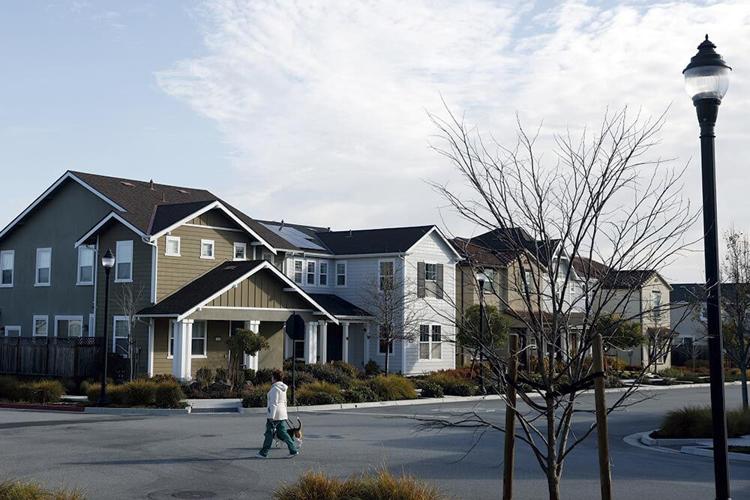
In some ways, it’s lived up to that promise: It’s tidy, the homes look nice (if homogeneous) and much of it could pass for a set on The Truman Show. But it’s not yet finished, and some of the amenities that homeowners were promised when they bought the homes – mainly, a town center that would hopefully have at least a cafe and someplace to eat and gather – have yet to materialize.
One thing that makes East Garrison unlike many local communities is that it’s mired in nesting dolls of bureaucracy. It has its own community services district, which is managed by the County of Monterey (the district’s board is appointed by the Board of Supervisors), and it has two different homeowners’ associations – a master HOA that encompasses both the single-family homes and the townhomes, and a separate HOA for just the townhomes.
The properties are also subject to Mello-Roos taxes, which stem from state legislation from the early 1980s named in part after Henry Mello, who was a longtime state senator for the Central Coast. That legislation was passed as a way to finance the upkeep of new developments in perpetuity, so that the burden of maintaining roads and other infrastructure didn’t fall on a municipality, but on property owners. Even if the taxes and fees are higher than most homes, everyone the Weekly spoke with was more or less prepared for that. But, as the amenities they feel like they bought into fail to come to fruition with each passing year, many feel like they were sold a false bill of goods.
A plaque outside an entrance to the East Garrison fire station states that it’s a community room, but only a group organized and funded to the extent that it has its own insurance policy, like the county’s community service district, can meet there.
There’s a narrow, rectangular art park with pedestals for sculptures, but there are no sculptures on them.
In the community’s central park, Lincoln Park – a public park managed by the county – there’s a community bulletin board, but members of the community have not been allowed to post anything on it. That same park has a snack shack that’s been utilized just one time in the last eight years, according to residents interviewed for this story. Shannon Rose, who bought her East Garrison home in 2018 and for one month last spring served on the master HOA board, says she had to fight tirelessly just to get the community services district’s board to allow a food truck, Tacos Don Beto, to come to Lincoln Park every Thursday evening so that residents can gather and build friendships in their nascent community.
On Ord Avenue there are more than a hundred striped, diagonal parking spaces in front of derelict former mess halls. The area is supposed to be the future location of an arts neighborhood and near a yet-to-be-built town center, but the spaces sit empty, pristine. At the same time the HOA is asking that residents register their car every year for a parking permit.
And there is also a fear among residents that the HOA intends to inspect every homeowner’s garage annually in order to get a parking permit, ostensibly to ensure that it still has enough space to accommodate a car. Yet it’s perfectly legal for a homeowner to park on their driveway, or the street. Whether or not it’s legal for the HOA to demand such garage inspections? That might be up for a judge to decide, depending on if the HOA’s leadership actually tries to require it for a homeowner who resists.
AS TENSIONS HAVE ELEVATED IN RECENT WEEKS, the community’s primary Facebook page got taken offline Feb. 5 for a few days, as one of its administrators, in a post, said board members had complained to her that some of the comments were “libelous” and “maliciously twisted facts.” And at a sparsely attended East Garrison CSD meeting at the fire station on Feb. 7, there was even a security guard hired to watch over everything – which residents say is unprecedented – but there was little for him to look at except his phone.
Tensions are high, and residents have been taking to social media to voice their discontent, and over the past year, some residents received cease and desist letters from the HOA’s law firm, Tinnelly Law Group, which is paid from fees paid by the homeowners themselves, to warn them off of making “defamatory” statements about board members online.
Tamrynn Clegg, who’s now on the master HOA board, received such a letter on June 16, 2023, which starts off with: “We have been informed that you have a history of disparaging the board,” before going to demand that she “cease and desist” from making such comments. “While you are obviously unsatisfied with the board’s execution of its obligations, you should be aware that the board is granted broad discretionary powers when exercising its obligations under the governing documents.”
Given that the board is a small, unpaid group of volunteers who may or may not have any expertise in governance, and who are “granted broad discretionary powers,” according to Tinnelly’s letter, it doesn’t stretch the imagination to think of the ways such a dynamic could go wrong.
Clegg ran for the HOA board last summer in a field of five candidates vying for two open seats, and did so on a platform of reforming the board’s leadership. “We have to make our governing documents make sense,” she says. “And we need to take what the community has to say into consideration… We don’t need to have our hands in every decision our homeowners are making.
“I want to ensure the rules we’re enforcing are reasonable, not capricious,” she continues.
In an election last September, Clegg was elected by a wide margin – out of 375 ballots, she earned 198 votes. In second place was Deborah Kelly with 164 votes.
But even if they vote together, they’re only two votes out of five, and the other two residents on the master HOA – aside from the developer’s seat – own townhomes, and also serve on the three-member townhome HOA. Clegg is steadfast in her commitment to reform how the board and the management company operate, but it takes more time to fix things than it does to break them.

Tamrynn Clegg, holding two letters the HOA’s law firm sent to her in 2023 in the months before she was elected to the HOA’s board.
STEPHANIE AND GUSTAVO ALMOST LOST THEIR HOME. (The couple doesn’t want to use their last names, but not for fear of retaliation from the HOA; their professions can bring them into contact with those who’ve been convicted of crimes.)
The couple owns a townhome that’s deed-restricted and subsidized for lower-income residents. Apart from that, one thing that separates all the townhomes from the single-family homes is that the owners don’t own the land their home sits on, they just own the structure, which they are not allowed to alter. They pay monthly fees to two HOAs: One for the master HOA, another for the townhome HOA.
The couple hit hard times financially during the pandemic, and entered into a payment plan with the previous property management company, Associa, to ensure they weren’t getting dinged with late fees when they couldn’t make their HOA payments.
But once the current property management company, The Management Trust, took over in late 2022, things quickly got dicey for the couple. They say they were slapped with fines from the townhome HOA over a table and two chairs on their porch, even though they’d previously gotten approval for the furniture through the HOA’s Architectural Review Committee. They say that paperwork was reportedly lost in the shuffle between the two management companies.
“I want to ensure the rules we’re enforcing are reasonable, not capricious.”
Those fines stacked atop of the balance they still owed the HOA that they were on a payment plan to pay off. Gustavo says that while trying to get the fines overturned and explain they were on a previously agreed-to payment plan, their original outstanding balance of about $900 quickly ballooned into the thousands with late fees and interest, which Gustavo estimates were in the range of $3,000-$4,000.
Within months, he says, their outstanding balance was sent to a collection agency and a lien was put on their townhome – if they couldn’t pay it off, they could be foreclosed on and lose their home. Feeling like they had no other option, they took to social media and launched a GoFundMe page, and East Garrison neighbors quickly came through with thousands of dollars and staved off a foreclosure.
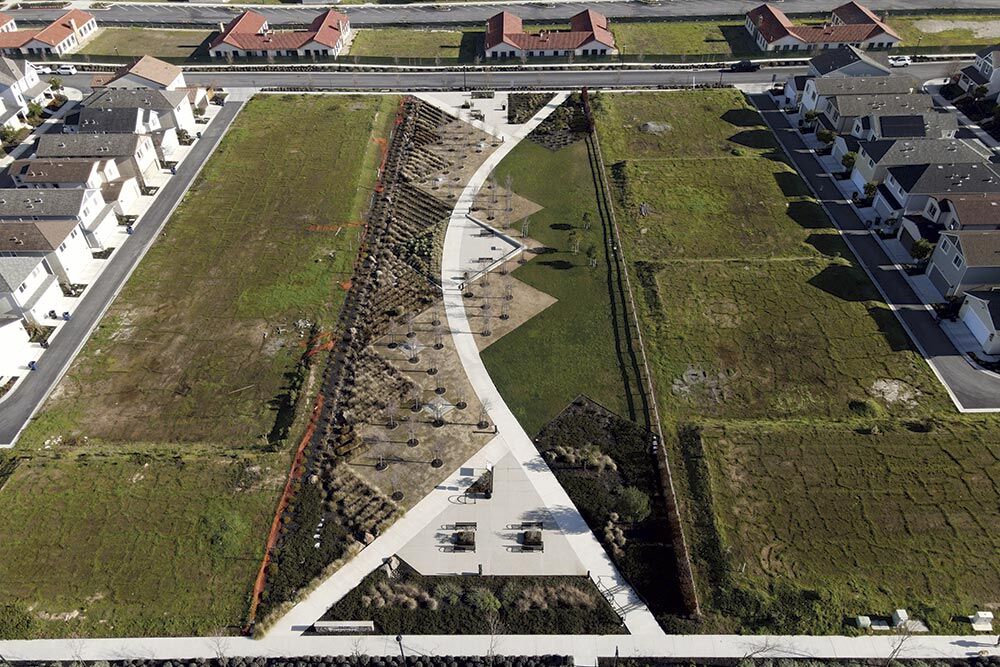
East Garrison’s Art Park, a lovely rectangular strip of manicured land with pedestals for sculptures – except there are no sculptures on them.
AMONG THE GoFundMe DONORS WAS THOMAS JOHNSON, a recently retired professor of Taliban studies at the Naval Postgraduate School. Johnson knows some of the residents of the townhomes, in part because they house a cluster of immigrants from Afghanistan.
Johnson says there was a “tremendous sense of community” when he moved to East Garrison in 2016, but that “this community is not close to what it was when I moved in.” He adds there’s a sense there are cars that drive the community’s streets not to patrol them, but to try and catch potential violations of the HOA’s rules and regulations and subsequently levy fines. “I don’t enjoy living here anymore. You feel like you’re being spied upon.”
One thing Johnson stresses repeatedly is that the HOA, and its property management company and legal counsel, work for the residents, not the other way around.
Stephanie feels the same way, and says, “There have been many times when, if we could move, we would have.”
Former townhome owner David Garcia, who grew up in Salinas, is one resident who did decide to move, even though when he bought his home in 2018, he thought it would be his forever home, a place he could raise his family. But feeling like the deed-restricted lower-income townhome owners like him, many of whom are minorities, were being targeted by the townhome HOA leadership, he sold his home and moved his family to Tulare, where he continues to work remotely as a software developer for a nonprofit.
He misses living in Monterey County – it’s closer to the ocean and he has family here – but he says he felt he had to move “for my mental health,” adding that “I have kids now, and I need to be a good person.” While he doesn’t enjoy living in Tulare as much as the Salinas area, he says, “At least I don’t have to deal with the HOA.”
Among other people who’ve sold their East Garrison homes recently at least in part because of the HOA are Cindy May, who worked at CHOMP, and like Garcia thought the community could be her forever home. On top of all the taxes and escalating HOA dues, however, the drama became too much for her. She also asked questions about the HOA’s budgetary expenses, but never got answers. In January, she moved into the in-law unit at her daughter and son-in-law’s house in Chico. Her daughter, Rachel, and Rachel’s husband, also owned a single-family home in East Garrison for three years which they sold in 2023. Rachel says that almost immediately after buying the home, she had remorse.
“It’s probably the worst community to live in in America,” says Rachel, who serves in the military, which is partly how she came to live in the area. She, her brother and her mom lived in an HOA community when she was growing up north of San Diego, but East Garrison, Rachel says, is different. That feeling started in the first week after she bought her home when she was still in the process of moving in – she got a warning letter that the waste bins she had in her back patio were visible to a neighbor.
“It is a beautiful community, but it has the worst HOA in America, and the way they’re running it is nothing short of illegal,” Rachel observes.
By contrast, Cindy and Rachel say that when they arrived back to their Chico home recently, there was a note from their new HOA thanking them for putting up holiday lights – and it had a candy cane attached to it.
“It was so refreshing,” Cindy says. “There can be very nice, basic HOAs. It’s kind of heartbreaking though, because I loved my house, I love my friends, but it all got to be too much.”

The neighborhoods in East Garrison are immaculate, but mask concerns that have some residents questioning if they should sell and move elsewhere.
GREGORY YANCEY, a private investigator and retired correctional officer who lives in a townhome, was elected to the master HOA board in 2022, while also serving on the townhome HOA board. Also serving on the townhome board is J.D. Esteban, a mail carrier who’s now also president of the master HOA. The two serve alongside Clegg, Kelly and Dennis Hudspeth of Century Communities, who holds the developer’s seat.
The master HOA board, when Yancey was president last July, appointed Esteban to a vacant seat on the master board despite pleas from residents to hold the seat open until board elections in September 2023. At the September master HOA meeting, the same day votes were counted for the election for two open seats, the board made appointments: Esteban was to be president, and Yancey would be treasurer.
The fact that two townhome owners are holding powerful positions on the master HOA board – despite the fact that the single family homes far outnumber the townhomes in East Garrison – is a matter of consternation for some single-family home owners.
Over the course of the past year, residents have launched six petitions – four online, two on paper – asking for a special meeting to discuss key community issues; asking that Yancey resign from the master HOA board; hold the vacant board seat open so that it could be filled by a candidate in the September 2023 election; do a financial audit of the HOA and make some basic rule changes, like how much time is allowed for bringing in waste bins and disallowing garage inspections; asking Yancey (again) and Esteban to resign; and asking for a recall of all three board members of the townhome HOA.
To date, according to those interviewed for this story, none of the requests in those petitions have been heeded.
Kadidia Cooper, a single-family homeowner in East Garrison who works as a chief financial officer for a nonprofit, has repeatedly asked for the HOA’s financial records, which as a homeowner she’s legally entitled to receive. But she still hasn’t gotten them despite repeated requests since last summer. She’s filed two complaints with the state Attorney General, but so far nothing has come of it.
“I don’t enjoy living here anymore. You feel like you’re being spied upon.”
Because one question many residents are curious about, but have no way of knowing the answer, is what exactly are all their HOA dues being spent on? And if that information isn’t being readily shared with them, doubts creep in. Residents wonder if there is something nefarious or fraudulent going on? Is it just incompetence? And if it’s none of those things, why can’t they see the records?
Veronica Rodriguez, TMT’s property manager for East Garrison, didn’t respond to a request for comment about residents’ concerns, nor did Yancey (Esteban could not be reached).
Fed up, a coalition of residents, Concerned Neighbors of East Garrison, retained legal counsel. On Jan. 18, attorney Gary Redenbacher, on behalf of the coalition, sent a scathing letter to The Management Trust and members of the board to inform them he is advising homeowners not able to inspect financial documents to begin a formal dispute resolution process, and potentially hold individual board members accountable for obstruction.
He also calls the HOA’s demand to inspect garages illegal and “nonsensical.” He writes, “I have advised my clients that the sheriff should be called and an arrest requested should anyone from management or the board be foolish enough to trespass onto private property.”
And as for the cease and desist letters sent to residents for criticizing the board on social media, he writes, “These letters appear to be little more than a transparent attempt to stifle free speech. One would think that any law firm would understand that writing such letters are not only not in accord with the law, but invites litigation under a panoply of California and federal laws meant to protect constitutional rights.”

Above: There are varying sizes of homes in East Garrison, but very few of them have anything resembling a backyard – instead, they have front yards, managed by the HOA.
PATRICK JOHANSEN, founder of the volunteer-run HOA Reform Leaders National Group, lives in Washington state and, though now retired, he’s devoted to helping HOA members around the country navigate their challenges. He no longer lives in an HOA, but he once did, and when things started to go sideways, he sued the HOA and won.
He feels driven to help others suffering under bad management, in part because of guilt he feels for abandoning his neighbors still under the HOA’s thumb. “I felt like I was leaving an open bear trap in a school yard,” he says.
The best path, he believes, is for states to create an HOA department that would investigate complaints, which would protect homeowners from being preyed upon by having to pay unjust fines in the event they can’t shell out enough money for an attorney. And that’s a lot of people: Per the U.S. Census, in 2022, 71 percent of newly completed homes in western states are part of an HOA.
But even if that does eventually happen – California creating an investigatory body to look into HOA abuses – it’s not going to help the residents of East Garrison anytime soon.
And many of them have other concerns too – about the private transfer fees homeowners have to pay when selling their homes, and whether or not there will ever be a town center – but those are different stories.
Right now, the primary concern many residents have is what’s going on with the HOA, and where the money’s going. The next chapter of the story, it seems, might be written in court documents.
But acrimony doesn’t seem to be anyone’s goal – they just want East Garrison to feel like home.
(4) comments
As someone who has seen both sides, living in an HOA and serving on an HOA board, I can tell you from years of experience that yes, HOA board members can include persons who have control issues, and little actual experience in managing or dealing with people. On the flip side, people who buy into an HOA are far too often woefully undereducated as to what an HOA community is and how it works. Did your real estate agent go over all of the rules and regs, the governing documents, etc. BEFORE you signed the final papers? I see this all the time. Frustrated decorators and would be gardeners think that they should be allowed to place whatever pot, plant, or decoration on what is legally recorded as common property. That porch, exterior wall, stair or front landscape may not be yours to decorate as you please. And the reasons should be obvious. Reason #1 is that it establishes a precedent where everyone else begins to do likewise and a planned community begins to look like a flea market has taken over. Same happens when an HOA allows people to run dogs off leash. It may be one or two dog owners to start, and then every other dog owner in the community thinks it is okay to have dogs running all over the place. Finally, there may be code and liability reaons for not cluttering access ways, walks, stairs porches, etc. If you are unhappy with a board or board member, organize a meeting. rally support and run for a board seat when it comes available. You'll be surprised once you are on the other side of that equation.
I bought a house in East Garrison five years ago. The location is great. The people are amazing. There have always been the typical HOA issues. But things changed last year. Rules got interpreted differently and fines were issued for things like flower pots and a nail in the front door. Suddenly, we’re being asked to give our wi-fi passwords to connect the HOA’s new front yard irrigation controllers and to give our car details annually.
Repeated requests for dialogue via Townhalls and Special Meetings were denied. Some of those who spoke out received Cease and Desist letters from the HOA law firm. Some owners say there are accounting issues such as being signed up for automatic debit even though they didn’t give their bank details or permission, account statements that simultaneously show credit and overdue balance, and erroneous late fees that are reversed only after months of hassle.
We see reports that two systems used by the HOA’s management company both had recent cybersecurity incidents, one of which exposed bank account numbers. The other was a big cause of filing for bankruptcy after racking up $824 million of debt due to customer mass exit. Yet, our asks for details on data management and privacy go unanswered. Questions about the accuracy of $18,000+ in late fees assessed in 2023 go unanswered.
It wasn’t always this way. As the Monterey County Weekly article says, things changed last year. In 2023, the President (not voted in last time) of the Townhome sub-HOA became President of the Master HOA and we got a new Management Company.
In the fall, two people who campaigned on change were elected to the Master HOA in a landslide. With record turnout, they received about 350 votes between them. Voters assumed they would be seated into the key Officer roles. Instead, on election day, despite objections, the President moved to the Treasurer role and an unelected person became President, due to the swing vote of another unelected person (he holds the builder seat.) Now, the same two men are the President and Treasurer of both the sub and Master HOA.
From what I see at Master HOA Board meetings, this majority voting bloc, made up of two unelected people, prevents the two women elected by about 1/3 of the community, from delivering the change they campaigned on. The myth of “just wait and vote them out” has been dispelled. We voted in record numbers and it made no difference.
But, by shining a light, maybe the MC Weekly article has helped turn the tide toward responsiveness. The three seats on the Townhome sub-HOA are filled by three men who were not voted in last time (two of whom are also on the master HOA). The recent petition to Recall the whole sub-HOA Board succeeded and an election date was set for June. Hopefully, that will bring some change for the 150 townhomes.
And, hopefully, legislators will help turn the tide on statewide and national HOA reform, such as that proposed at https://hoareformleaders.com. Reform is needed because, for the 60 million people living in HOAs in the US, there’s virtually no viable recourse for when things go wrong, like an HOA not following the law. There’s no “HOA Police” to call for help. The truth is that homeowners just want home to feel like home. That should be a given under the law and not left to the luck of the draw.
Nice story on the East Garrison HOA. Glad our HOA is much more open and consultative.
It's interesting that people like talking about the legality of the issues, while obviously not understanding the law. Look to the originating documents, for example. People enter into an HOA for the collective whole, giving deference to case-by-case does not allow for a well-maintained community. Instead, one by one, people find a reason why they should not have to adhere to the general rules. Put your planter pots in the back of the house, pay your late fees, and you live in a community, people drive around. Sorry
Welcome to the discussion.
Log In
Keep it Clean. Please avoid obscene, vulgar, lewd, racist or sexually-oriented language.
PLEASE TURN OFF YOUR CAPS LOCK.
Don't Threaten. Threats of harming another person will not be tolerated.
Be Truthful. Don't knowingly lie about anyone or anything.
Be Nice. No racism, sexism or any sort of -ism that is degrading to another person.
Be Proactive. Use the 'Report' link on each comment to let us know of abusive posts.
Share with Us. We'd love to hear eyewitness accounts, the history behind an article.