
EVEN WHEN THE SEA IS ROUGH, Monterey Bay commercial fishermen still find a way to bring fresh seafood back to shore.
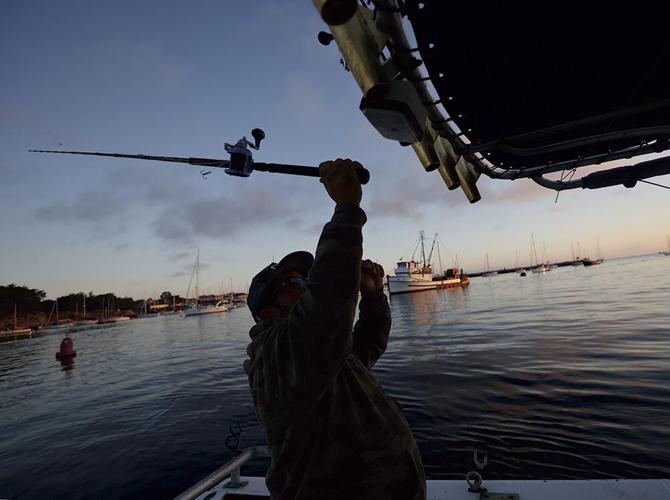
Early on a brisk Friday morning in August, the seas are calm as the sun peeks over the hills and Joseph Lucido heads to the docks to try and catch halibut. The full-time commercial fisherman shoves off from Wharf 2 in Monterey, then cruises along the coast. A little over a mile from the sandy shores of Marina, Lucido stops to get his lines ready and to catch bait for the day. “Fresh squid is the best for halibut,” he says. He checks his fish finder, and starts to snag squid.
Lucido is a Monterey native who grew up around the wharf; his parents owned a restaurant, The Cove, serving breakfast and lunch. Starting at a young age he got to know local fishermen, and was invited to go out and learn the art of fishing. After a trip to Bristol Bay in Alaska with his grandfather, he was hooked. At 16 he bought his first boat, then worked on a number of charter boats from age 16 to 30; he eventually acquired a 21-foot Robalo boat he takes out solo. He catches crab, salmon, halibut, bonito and lingcod during their respective seasons, with the bulk of his fishing happening between May and October. A few years ago, he worked with the harbor and the city to allow dockside sales.
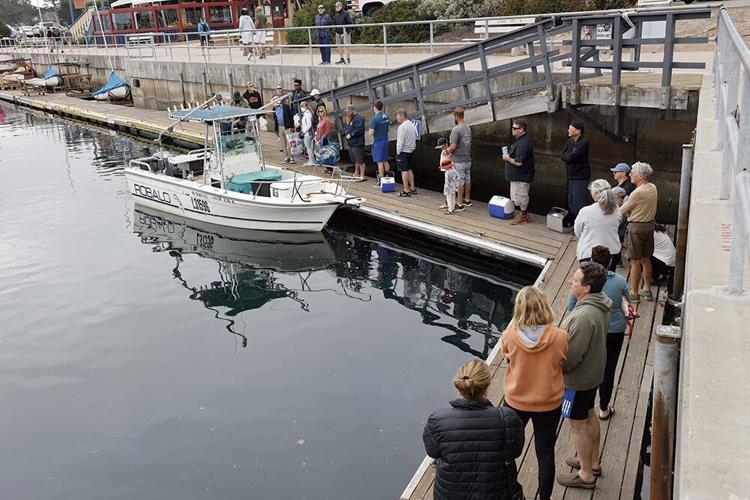
The city and harbor started allowing dock sales in 2020 and for Lucido, this has been a boon. He posts on social media when the fish will be available and customers start lining up nearly two hours before he returns to shore.
“The harbor encouraged it and was very helpful to allow fishermen to sell dockside,” he says. “It brings the community down to that side of the harbor.”
Selling fish dockside is not the only option for Lucido; he also sells to wholesaler Robbie’s Ocean Fresh Seafood at the end of Wharf 2.
After two or three days of solid fishing, Lucido brings his fresh fish to the dock of Wharf 2, just below London Bridge Pub. A line of customers is already waiting. King salmon was available this past season, in August, at $10 a pound, whole fish only. The fish are pulled from the ice chests and Lucido weighs and cuts the fish based on the customer requests. Julia Lucido, Joe’s wife, sits on the dock and collects the payments and hands out receipts; careful records are kept for the California Department of Fish and Wildlife and for tax purposes. Lucido’s daughter is also on the deck to help. Lucia, 10, is in charge of handing out the cut fish.
There are an ever-growing number of regulations on fishing that can change from year to year. In 2022, the salmon season was just 45 days, down from 57 days the year before; tough weather conditions left commercial fisherman with even fewer available days. But they made due.
“I think most were happy with what they caught this year, even though we lost a couple of days,” Lucido says.
Challenges aside – on the business side, the regulatory side and the weather side – the Monterey Bay fishing industry is thriving, says Melissa Mahoney, executive director of the Monterey Bay Fisheries Trust. “There are people that don’t believe that fish is sustainable and that our fisheries are in bad shape. That’s not true, our fisheries are strong,” Mahoney says.
In 2013, the Office of National Marine Sanctuaries conducted a three-year analysis of the commercial fishery in the Monterey Bay National Marine Sanctuary and reported the average annual revenue from the harvested seafood was $26 million across 34 different species.
The nonprofit trust works to promote the local fishing industry and to help the community see the benefits of locally caught seafood. “We have the most sustainable, most healthy and most delicious seafood here,” Mahoney says.
The trust provides resources like a seasonality guide and tips on fish storage and preparation, and helps fishermen recover lost gear. They also promote local fishermen’s dock sales through social media and email campaigns.
Lucido is one of many Monterey Bay fishermen making a living from the sea, and one of two whose story is told in this photo essay.

Left: One challenge for Neil Gugliemo is finding consistent help, even within family; he has three sons and a daughter. “My sons used to fish with me when they were teenagers, but they didn’t like the hours – we took an extended trip to Alaska and after that they decided it wasn’t for them,” he says. “It is really hard to find good deckhands that want to work the hours; it is not for everyone.”
NEIL GUGLIEMO COMES FROM A LONG LINE OF FISHERMEN. His great grandfather, his grandfather, his father and his uncles were all fishermen. Gugliemo started his fishing career near Los Angeles in San Pedro, fishing for halibut, crab, swordfish and lobster. Now he looks for sardines, mackerel and squid. “Monterey is a beautiful place to fish,” he says.
Leaving in the evenings on weeknights, the 80-and-a-half year-old – he insists on noting the half – heads out to drop his net and collect fish. “It is getting harder and harder. The price of fuel, insurance, the regulations and price of fish is affecting the way I can survive,” he explains. “The price of sardines hasn’t gone up. Five years ago it was around $1,000 for a ton, today it is about $1,017.
“The shipping has gone up so much,” Gugliemo adds. “Shipping fish overseas is becoming more and more difficult; buyers don’t want to pay for the shipping containers.” Despite that assessment, a lot of the sardines, squid and mackerel are sent to countries around the world.
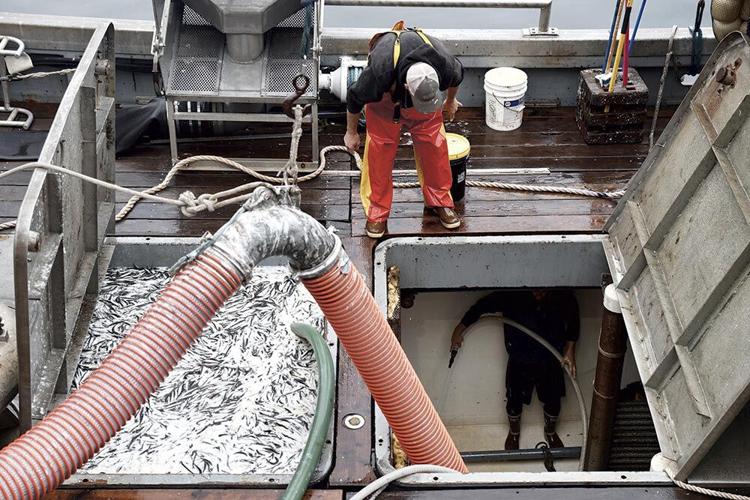
On a foggy October morning, Gugliemo’s boat, the Trionfo, has just returned from a night of fishing and Wharf 2 is buzzing with the sounds of pumps as sardines are unloaded. Gugliemo looks on from the top deck, making sure it is going smoothly. Two large holding tanks in the center of the boat contain the night’s catch and are pumped up to the dock where the fish are sorted and pumped into large red bins filled with ice. The bins are loaded into a semi truck to be transported to a processing facility.
After nearly 65 years of fishing, Gugliemo still enjoys being out on the water. “I love it, you have your good days and bad days. One day there are tons of fish and the next day there is nothing to catch in the bay.”
With the growing awareness of the need to protect environmental sustainability of fisheries, Gugliemo feels that fishermen often get a bad rap. “We all do our part to make sure that we don’t overfish and can still make a living,” he says.
He’s been outspoken about the environmental responsibilities of the industry, and works with researchers from NOAA Fisheries and the Department of Fish and Wildlife every year to help assess the populations and health of the Monterey Bay squid fishery. He’s also an active member of the California Wetfish Producers Association, which helps fund the CDFW’s research on the squid population.
“Without fish we are done,” Gugliemo says.

Customers wait for king salmon as Joe Lucido returns in his boat in August. Compared to market prices of $30 to $70 per pound, the king salmon Lucido sells direct to consumers at the wharf are a deal. This year he brought in 15- to 20-pounders, selling them for $10 a pound as a whole fish.
He’s been fishing commercially for 65 years, reading the weather and conditions to go out when the fishing is best. It’s a demanding career, but one that he fell in love with as a teenager – a passion that he sustains into his mid-80s.
Lucido, who is 42, represents a younger generation of fishermen but similarly has seen that it’s not for everyone.
“I see many people try to be commercial fishermen – they buy a boat and go out a few times. Within a few months or a year they are selling the boat,” he says. (His own small boat is unnamed.)
To make it work takes a community, he adds: “You need to have a community of friends, a tight-knit group that helps each other out.”
Despite a reputation for being competitive, Lucido adds, local fishermen actually prefer to share. He gets on the phone with other fishermen to talk about the best spots and fish counts. “You’ve got to roll with the punches – it’s tough to do, and especially if you don’t have a good working group, it is really hard to make it happen.”
(0) comments
Welcome to the discussion.
Log In
Keep it Clean. Please avoid obscene, vulgar, lewd, racist or sexually-oriented language.
PLEASE TURN OFF YOUR CAPS LOCK.
Don't Threaten. Threats of harming another person will not be tolerated.
Be Truthful. Don't knowingly lie about anyone or anything.
Be Nice. No racism, sexism or any sort of -ism that is degrading to another person.
Be Proactive. Use the 'Report' link on each comment to let us know of abusive posts.
Share with Us. We'd love to hear eyewitness accounts, the history behind an article.