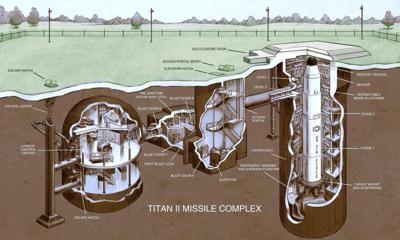
In the autumn of 1980, at a massive underground missile silo in rural Arkansas, the course of human history almost changed forever.
When celebrated journalist and local resident Eric Schlosser learned how just a small bit of clumsiness nearly led to the detonation of a thermonuclear warhead on American soil – one with the equivalent of four pounds of high explosives for every person then living on Earth – his course certainly did change.
That course, into the dark heart of America’s nuclear weapons, began in Colorado Springs, as he was researching a very different, but similarly mighty force – our nation’s fast food industry. That research ultimately culminated with his bestselling book Fast Food Nation, a groundbreaking exposé that forever altered the way American’s view fast food. As he was seeking for the right project to take on next, he began spending time with local Air Force personnel, and began hearing again and again about nuclear near disasters that had been kept from the public. And then he heard about the Damascus accident (see excerpt, opposite page), a chilling event that nearly unleashed a firestorm big enough to consume the state of Arkansas. As he began to learn more about that incident, he realized that just under the surface was something much bigger, and scarier than a single, devasting accident – the past and present dangers of our nuclear arsenal. After five years of research and another one in writing, he has brought us a harrowing, page-turning book that is a must read for anyone remotely interested in nuclear – and American – security.

On September 18, 1980, at about 6:30pm, Senior Airman David F. Powell and Airman Jeffrey L. …
The unraveling progression of that incident in Damascus threads the narrative of Command and Control, which examines the development and proliferation of America’s nuclear arsenal, the many accidents and near misses that have occurred over the years since its inception, and the grave risk we still face from the very mega-weapons that were designed to protect us.
I first became acquainted with the book back in March, when unexpected circumstances forced Schlosser, a Monterey Peninsula resident, to bring in another fact checker in the closing moments before his deadline. I met him at his house on a Sunday at around 5pm, and he presented me with a cardboard box stacked with documents and books. The first thing he demanded was that I remain sworn to secrecy about everything I read until the book was published. He then presented me with a section of text that needed checking, highlighting certain points and advising me where I might find the relevant source material.
“So, do you want all this done tonight?” I asked, a little incredulous.
“I don’t even know if it’s possible,” he said, “but if you can get it done, that would be great.”
He made little attempt to veil his desperation, and my heart sank – the last thing I wanted was to disappoint one of my idols. I put on a good face and vowed to do my best, but privately I was terrified of coming up short.
After feverishly working until 3am (and almost, but not quite finishing), I arrived back at his house the next morning, where I would spend the next five days doing much of the same: scanning through hundreds of pages of documents, books and articles. Often times, I would flip through a dull, declassified Air Force report a few hundred pages long and find only a handful of sentences highlighted. The depth of Schlosser’s research, seen firsthand, was awe-inspiring.
The office he disappeared into everyday to finish his endnotes was, in my mind, a top-secret laboratory. He never let me look inside. But every afternoon we would hang out briefly on his patio and bask in the sun, and he would talk candidly about nuclear weapons, and writing. More than once, he likened himself to a farmer, laboring for six years in research and writing to make this book come alive. Or as he said it, “for the crop to come in.”
But from an outsider’s perspective looking in, his work to create Command and Control seemed more akin to a nuclear weapons designer: He delved deep into complex problems. He focused on elegant structure, ensuring all the pieces fit together just right. He wrestled with the darkest of all eventualities. And in the end, he wrote a book that is masterfully researched and conceived, that is both explosive and haunting, and most urgently, intended to make this country safer.

The Titan II missile silos that operated across the country from 1963 to 1987, 54 in total, harbored an annihilating power that threatened nearby residents far more than they could have ever known.
• • •
While in Colorado Springs, Colo., Schlosser was interested in learning more about space warfare. But as he spent more time with Air Force personnel stationed there – many of whom had formerly spent time working in missile silos – the subject of nuclear weapons kept creeping into conversation. “I found myself more interested in the stories they were telling me of near-misses than I was in space,” Schlosser says.
And then he heard about Damascus.
What began initially as an account of that incident alone became, through research, something much bigger. Though he’d been interested in nuclear weapons in his youth, and had studied nuclear strategy and game theory at Princeton, he realized his ignorance about the past and present realities of our nuclear arsenal “was profound.”
“The story got bigger,” he says, “and to me, it became much more important than the thrilling story of just one accident. It became the story of just how close we came to having many, many accidents.”
The first near miss of the nuclear age, we learn from his book, happened at its very beginning, in July, 1945. On the night before testing the first atomic bomb near Carrizozo, N.M., a young Harvard-trained chemist named Donald Hornig was ordered, for security purposes, to guard the weapon until morning (he drew the short straw on account of his youth). It just so happened that on that night there was a violent electrical storm, one which threatened to set off the bomb’s “X-unit,” a detonating component that was highly sensitive to electricity. It was a fact that Hornig was all too aware of – he had designed the X-unit, and a week prior one had fired prematurely (outside of a bomb) due to a lightning storm. At midnight, Hornig was given permission to abandon his post, which he did happily. The bomb survived the night, and at 5:30 the next morning, scientists and military personnel witnessed the world’s first atomic explosion, a mushroom cloud that reached eight miles into the sky.
“It didn’t happen,” Schlosser says of that first near miss, “but it really could’ve.”
The same truth holds, he says, for the many near misses since. “The fine line has always been there.”
A quick run through of some of the accidents that Schlosser has gleaned from declassified documents is a terrifying exercise: In 1958, on a runway in Morocco, a B-47 carrying a hydrogen bomb blew a tire and quickly caught fire, consuming the bomb, which burned but did not detonate. The U.S. government kept the incident secret, informing only the King of Morocco.
Not even one month later, due to the mechanical failure of a locking pin, an atomic bomb fell out of a B-47 and landed in a yard in South Carolina. Though it lacked a nuclear core, the high explosives it contained carved a crater 50 feet wide and 35 feet deep, blowing the doors off a nearby house. Thankfully only a half dozen chickens were killed.
In 1961, a B-52 carrying two hydrogen bombs took off from Goldsboro, N.C., for a routine circular route along the East Coast. As it finished its second loop, the plane sprung a fuel leak and soon began spinning out of control. As it fell, a bomb was pulled from the plane by g-forces, its arming wires yanked out. When that bomb parachuted to the ground in a field outside Faro, N.C., its nose sent a firing signal, but the core did not explode – only a single ready/safe switch in the cockpit had prevented a thermonuclear detonation. The other bomb’s chute failed to open, and it sank more than 70 feet into the ground, never to be recovered.
These examples are a few of many that Schlosser has uncovered, and they vividly illustrate a point that he brings home repeatedly.
“It’s hard to think of a machine that we use in our lives that doesn’t screw up occasionally,” he says. “But there are some machines that, when they go wrong, have much greater consequences.”
His examination of recent mishaps is no less troubling and – given the technological advancements of the age – maybe even more so. Take an incident that occurred in 2007, when six cruise missiles armed with nuclear warheads were mistakenly loaded onto a B-52 in North Dakota. They sat on the plane overnight, and were flown the next morning to a base in Louisiana (in violation of U.S. law), where they sat for nine hours before anybody realized they were missing. Occasional human error, Schlosser reminds us, is every bit as unavoidable as the mechanical kind.
That event thankfully led to the recent (and long overdue) advent of bar codes on nuclear weapons in lieu of serial numbers that had to be written down when they changed hands. Finally, our military can now track its nuclear weapons like FedEx can track its packages.
• • •
With degrees in history from both Princeton and Oxford, Schlosser’s command of the past and his talent for research are on full display in Command and Control. The endnotes alone are more than 100 pages long, in small print. (“My notes are insane,” he says. “If someone reads the book and doesn’t even look at the notes, it wouldn’t bother me at all. I wanted to put them there to be completely transparent, the opposite of the government.”)
But it is Schlosser’s gift for storytelling that brings the book to life. He assembles the Damascus narrative through countless hours of interviews with men who were there. He describes how they looked, their personalities, their backgrounds, their family lives. But most revealing of all, he tells us their thoughts in the moments as the disaster unfolds, and ultimately escalates. The result is a hair-raising, minute-by-minute account of the most rarefied order.
The last piece I fact checked for Command and Control was the climactic finish to the Damascus accident. Truth be told, I had difficulty interrupting my reading to check on the facts. Even more difficult was to not be able to talk about it with anyone but Eric. Keeping that story to myself over the last six months has been the hardest secret I’ve had to keep.
• • •
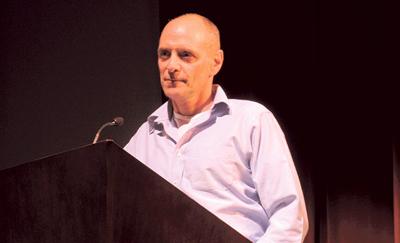
“If I had been talking about food, that place would have been packed,” Schlosser told me recently, after a talk he gave in San Francisco. We were back at his hotel, one-on-one for the first time since March. I denied him his right to sulk, and told him he had been great.
And he was. In a too-sparsely filled auditorium that evening, Schlosser summarized key points. His voice retained its characteristic passion, and the crowd stayed rapt. And though on the exterior he was cool, calm and collected as always, it was apparent to my eyes that I was looking at a man on fire. The urgency he feels about the subject of nuclear weapons burns within, impossible to fully contain.
“This problem never went away, this danger never went away,” he said in closing, “but our memory of it has, our thinking about it has. And ultimately, the point of my book is to remind people these weapons are out there, they’re ready to be used… and that we need to have a national discussion and debate on these sorts of questions. How many nuclear weapons do we need? What do we need them for? Where will we aim them? Why would we use them? When would we use them? Do we need to get rid of them entirely? These are issues of fundamental importance, and without a national debate on them, decisions are going to be made as they were made throughout the Cold War – by a small number of policymakers in Washington D.C., acting in secret.”
“Good things can happen,” he continued, “and I think the president of the United States right now is right on the mark on these issues, and all he’s lacking is a movement.”
The impact of Command and Control might not be immediate, but it will be game-changing. The alarming risks of retaining a nuclear arsenal of America’s size (at the time of Schlosser’s writing, approximately 4,650 nuclear weapons) are meticulously illustrated, and seem to dwarf the threat they were designed to protect us from. This book will bring nuclear weapons back to the forefront of the nation’s psyche. It’s that powerful.
And hopefully, it can spark the kind of popular movement that Schlosser says Obama is lacking, and America’s nuclear age can end in the same way it began: as a near miss.
(0) comments
Welcome to the discussion.
Log In
Keep it Clean. Please avoid obscene, vulgar, lewd, racist or sexually-oriented language.
PLEASE TURN OFF YOUR CAPS LOCK.
Don't Threaten. Threats of harming another person will not be tolerated.
Be Truthful. Don't knowingly lie about anyone or anything.
Be Nice. No racism, sexism or any sort of -ism that is degrading to another person.
Be Proactive. Use the 'Report' link on each comment to let us know of abusive posts.
Share with Us. We'd love to hear eyewitness accounts, the history behind an article.