


On Monday, Jan. 20, President-elect Donald Trump will once again get sworn into office, and in doing so, swear to support and defend the Constitution of the United States against all enemies, foreign or domestic.
In his first term, Trump was impeached twice – but not convicted by the Senate – for failing to uphold that oath. And yet, four years later, for the first time, Trump won the popular vote in his bid for the presidency.
No need to foment a deadly insurrection on the Capitol this time around.
Trump made many promises in his campaign, one of which is to enact “the largest deportation program in American history.”
But as anyone who paid close attention to Trump’s first term knows, it’s not clear he cares if any of those things get done. Only just over 50 miles of new wall at the southern border were built in Trump’s first term, and Mexico didn’t pay for it, nor did Trump pay a political price for claiming it would.
Now, Trump’s making outlandish claims about tariffs solving economic woes (America’s economy recovered better and faster than any Western country post-Covid), and has repeatedly suggested seizing the Panama Canal, annexing Greenland and even Canada.
Meanwhile Trump’s Cabinet nominees, with maybe a few exceptions, have been controversial picks. Kash Patel, for instance, Trump’s pick to lead the FBI, thinks the Jan. 6 insurrection was planned by the FBI. Tulsi Gabbard, a former Democratic congresswoman from Hawaii who ran for president in 2016, who Trump tapped to be director of national intelligence, traveled to meet now-deposed Syrian dictator Bashar al-Assad in 2017, despite his chemical attacks on his own people. She also blames NATO for why Russia invaded Ukraine. Gone are the so-called “adults in the room” from Trump’s first term, and the second is shaping up to be even more chaotic.
Yet unlike Trump’s first term, when Democratic voters and electeds united in resistance right after his election, the vibes on the left feel different this time.
Maggie Haberman, a political reporter with the New York Times, said recently in an interview with journalist Kara Swisher: “[Democrats] seem sapped of energy right now.”
Politico’s Jonathan Martin, one of the most dialed-in political reporters in the country, put it like this recently on a podcast: “The winds are definitely not blowing toward full resistance,” he said. “The interregnum after 2016… was dramatically different than now. Democrats were to the barricades, and now Democrats are more to the bar. They want to drown their sorrows and watch football, or not think about this at all.”

Monterey County’s congressional representative Jimmy Panetta (District 19) was re-elected by large a margin, and says he will look to work with Republicans if opportunities present themselves.
The two members of the U.S. House of Representatives who, collectively, represent Monterey County’s residents in Washington, are thinking about it. The two Democrats aren’t exactly optimistic about what they can achieve for their districts in the coming years, but say they’re going to give it their level-best.
U.S. REP. JIMMY PANETTA, D-Carmel Valley, was first elected in 2016, and from the outset of his time in Washington, he was, and remains, committed to reaching across the aisle to Republicans – bipartisanship is core to his politics.
When asked how he plans to fight for his constituents in Trump 2.0, he says, “I think obviously from a federal angle, what we can do is similar to what we did the last Trump term: Make sure we lean in on trying to fix our broken immigration system.”
But he acknowledges Trump’s campaign promise of mass deportations can instill fear in his undocumented constituents, which comes with reverberations.
“The message that I told people, told my constituents, is you’ve got to continue to excel and continue to live your lives,” he says, noting “how valued they are locally, in my district, and in California. We’ve seen that with our Dreamers, and seen that with our farmworkers.”
He also adds an interesting observation, saying he currently hears less about a reliance on a foreign workforce. “I remember speaking with my ag producers, talking about what I believe is their number-one issue, the lack of labor in the last decade,” Panetta says. “They said that’s not the number-one issue anymore. They said their domestic workforce is pretty solid right now.”
He also thinks many of his GOP colleagues will come to realize the economic impact of mass deportations. “If there starts to be a chill in the air, it affects the economy nationally and locally, because it will prevent people from coming,” he says. “Rightfully so, I think they will go after low-hanging fruit [like] criminals convicted of crimes.
“What do we do to protect the people who contribute to our economy, and really become a part of who we are here?” Panetta says. “There’s a lot of layers here and a lot of levels here.”
Currently, the GOP controls the house by an extraordinarily narrow 219-215 margin. (There is an absent seat vacated by former Rep. Matt Gaetz, R-Florida, who resigned after he was reelected because Trump nominated him to become Attorney General. Gaetz later withdrew from the running after reports of his partying escapades were about to surface, which included, allegedly, paying minors for sex.)
Noting that narrow lead for Republicans, Panetta says, “It’s a very slim and splintered majority, and they’re going to have some difficulties. When it comes to reconciliation packages on immigration and [taxes], trade and tariffs – they’re not easy topics. They’re easier said than done.”
He also believes Democrats are going to pick their battles.
“I don’t think we can be a party of pure resistance,” he says. He has cultivated bipartisanship as his approach to policy: “I’ve laid a pretty solid foundation working with Republicans the last few years.… When I came into office 2017, we were in the same position.”
One of things he’s working on with his GOP colleagues is reducing the capital gains tax on home sales.
“People don’t want to sell because they get hammered with taxes,” Panetta says. “We want to adjust capital gains so it gives people incentives to sell their homes.” He’d like to provide incentives for workforce housing, and increase the first-time homebuyer tax credit from $10,000 to $15,000.
To that end, Panetta’s looking forward in this next term to continuing to serve on the House Ways and Means Committee, which he’s served on for years. “Dealing with taxes, dealing with trade – it’s not easy,” he says. “You’re dealing with some complicated issues that affect people’s lives.”
As for what he thinks the House’s next term will look like, he says, regarding the GOP’s slim majority, “You’re going to see a lot of the machinations going on with that. You’re going to have a lot of members that want to get deals. They’re dealing with extremists in the Republican Party – they don’t come here to govern, they come here to blow things up.”
U.S. REP. ZOE LOFGREN, D-San Jose, doesn’t know what the next two years in the House will look like, but she’s confident about this: “They couldn’t do anything without us – we would have had a [government] shutdown.”

Monterey County’s congressional representative Zoe Lofgren (District 18) was re-elected by large a margin, and says she will look to work with Republicans if opportunities present themselves.
She says House Republicans have a “burn it down” faction in their caucus, adding that while Democrats may disagree amongst each other on certain issues, “we get along and don’t hate each other.”
As for the threat of mass deportations, and how she plans to protect her constituents, Lofgren says she’s already reached out to advocacy groups and ensured they had materials to let her constituents know their rights. (County Supervisors Chris Lopez and Luis Alejo have likewise been spearheading outreach efforts in the county to do the same.)
She adds, however, that because of an immigration bill from 1996, which she voted against, rapid deportation is allowed: “Unfortunately, the legal tools are already in law.”
But as is often the case with Trump, he makes promises and doesn’t always follow through on them.
“We don’t know what he’s going to do,” Lofgren says. “He said mass deportations, that’s what he says he’s going to do. But to get the kind of numbers he’s talking about, going after serious criminals, there’s not that many.” She adds, “California has always been prepared with serious criminals, when ending their prison terms, for them to be deported…
“To get the numbers, you would have to do workplace raids,” she says.
She’s reached out to counties in her district – Monterey, San Benito, Santa Clara and Santa Cruz – to make sure they have a plan if, say, kids come from school only to learn their parents are deported. She’s advocating that the counties see that the kids are put into the care of a relative, if possible – she just wants the counties’ Child Protective Services staff to be ready.
“He made several [campaign] promises, big-deal promises, tariffs, mass deportation, refusing entry at the southern border, and being mean to trans kids,” Lofgren says. She notes the state of the Republican Party and its narrow lead could help curb some of Trump’s policy proposals: “Given the disarray [in House GOP], there might be radical proposals that can’t get enacted.”
As for Trump’s cabinet nominees, she says, “We need to have people who are on Earth 1, not Earth 2.”
Lofgren is also concerned about all the billionaires kissing Trump’s ring, as America increasingly resembles an oligarchy. “Part of what we need to do is look out for the kind of family I grew up in – my parents were blue collar workers and lived paycheck to paycheck,” she says. “I grew up in south Palo Alto. On the block I grew up in, nobody went to college.”
Lofgren says she’d be happy to work with Trump if the opportunity presents itself to make the country better, “but I’m skeptical about those opportunities.”
Lofgren, who served on the United States House Select Committee to Investigate the January 6th Attack on the United States Capitol, also says, “Trump has clearly shown authoritarian tendencies. We need to join with others to prevent him from acting unlawfully.”
Minutes after speaking with the Weekly, Lofgren makes her way to the House floor to cast her vote for Speaker of the House.
During the proceedings, Chair of the House Democratic Caucus Pete Aguilar, D-San Bernardino, shared some words with the chamber that broadly reflect his party’s values.
“I speak on behalf of the governing majority in this Congress, the party that knows how to make a deal and then stick to that deal,” he said. “We will never abandon our values or bedrock principles of freedom and democracy.”
House Speaker Mike Johnson held on to his speakership after the first round of voting was extended, before formally moving on to round two – no Democrats voted for Johnson, but he, and reportedly Trump, had conversations with the holdouts. That was able to bring Johnson to the minimum number required votes, 218 – which is also the minimum number of votes required to pass legislation.
And with cracks already showing in the caucus, it’s unclear, aside from tax cuts, what they’ll unite on.
NORM GROOT, executive director of the Monterey County Farm Bureau, estimates that 30-50 percent of the county’s agricultural workforce are undocumented. So if mass deportations are carried out, the effects on the county’s biggest industry could be devastating, not to mention the impact on lives and families.
“That is a concern to growers at this point, as they’re heavily reliant on hand labor obviously,” Groot says. “If the new administration does mass deportations, we would have concerns.”
He adds that the county already has a slew of immigration resources on its website to help residents know their rights, among other things.
Groot says while there’s the “distinct possibility” there are raids on ag fields, he’s not sure the federal government will have the resources to do it.
Groot believes our immigration system has been “broken 40-plus years now,” adding, “I think it boils down to how Congress has done their job. We’ve created this mess and we’re not solving it.… Everyone is waiting to see how fast this moves. At this point, it’s hard to say. How it’s all going to play out will become much more clear after Jan. 20.”
The county’s second biggest industry, hospitality, could likewise be impacted by mass deportations.
Rick Aldinger is co-chair of the Monterey County Hospitality Association’s government affairs committee and just retired at the end of last year as general manager of Big Sur River Inn. “We don’t want to panic over this because we don’t know what’s going to happen,” he says. “It’s something we’re going to keep on our radar.”
That being said, he adds, “This could affect a lot of people if this indeed plays out. At this point we’re just biding our time. Hopefully it turns out to be much ado about nothing.”
ROB BONTA, Attorney General of the State of California, does not expect the Trump administration will be much ado about nothing. During Trump’s first term, his office sued the administration 123 times. And Bonta is ramping up for similar expectations from 2025-29.
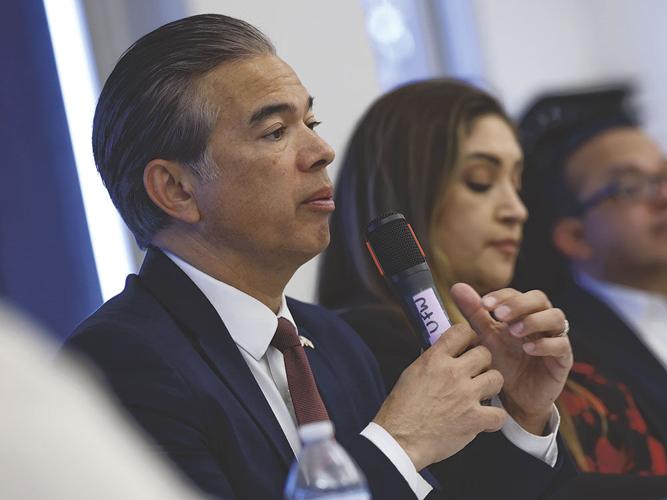
He visited the UFW hall in Salinas on Friday, Jan. 10, for a meeting focused on immigration policy.

California Attorney General Rob Bonta speaks during a town hall meeting on immigration in Salinas on Friday, Jan. 10. “In Trump 1.0 we were very successful as a state in pushing back,” Bonta said. “If and when Trump 2.0 steps outside of the law, we will be there to stop him.”
“This moment requires us to come together, to be unified, to fight for our shared values,” Bonta said. “I am here with my team in person in Salinas to make that known. We look forward to fighting side by side with you. I wish we were not in this position, but we are in it. I am grateful to be in it with you.”
He noted specific courtroom victories from the first Trump administration – on DACA, a policy protecting people who immigrated illegally as children; on California’s sanctuary state status; on a “public charge” rule that would have broadened the definition of who would not be eligible for status if they sought benefits. (Bonta’s team also sued successfully over health issues, environmental issues and more.)
Where locally elected lawmakers serving in Washington might find themselves unable to take action, state-level officials in a Democratic supermajority may find themselves more readily able to organize.
For example, state lawmakers are looking to allocate $50 million for legal resources to push back against the Trump administration, with $25 million set aside for Bonta’s DOJ to sue.
Lofgren and Panetta are both in safely blue districts – in 2024, she was reelected for a 16th term with 65 percent of the vote, and Panetta to his fifth with 69 percent of the vote – but still, it might be at the state level where officials are best positioned to fight back.
“United, there’s nothing we can’t do,” Bonta told the group in Salinas. “This is a moment that will test us. It’s a moment of uncertainty and pain and challenge, but I also believe we can rise to the occasion.”
ON DEC. 18, about 30 or so political progressives met at the Center For Peace in Seaside to discuss the issues they want to focus on in the next two to four years.
The organizer of the meeting, Carmel Valley resident Murtaza Mogri, who moved up from Southern California about a year-and-a-half ago, revived a local but dormant Indivisible Facebook page. He notes the group, a national nonprofit, is nonpartisan.
“The goal is to help communities represent folks better, and influence what goes on locally and nationally,” Mogri says, adding that during the Biden Administration the group became a lot less active.
The group’s goal now, in the advent of Trump’s second term, he says, is deciding “Where are we going to focus? Who are we going to help?”
And while this time around, unlike at the beginning of Trump’s first term, there haven’t been any notable protests nationwide, Mogri is hoping to change that locally. “I think we’ll figure out more in the upcoming year,” he adds.
In his view, “[Attendees] came out of that meeting with some optimism.”
But the vibes are distinctly different on the left than they were eight years ago. In 2016, there were at least a dozen Indivisible chapters registered in the area.
The weekend after Trump was elected in 2016, the Monterey County Democratic Central Committee hosted a post-mortem that drew about 130 people for an event called “Moving From Grief to Strategy.” Since the 2024 election, the organization has not yet hosted any similar public event. (The organizers of a local Women’s March chapter in 2016 will return with a People’s March at Window on the Bay in Monterey on Saturday, Jan. 18. “It’s a demonstration of the resilience of resistance,” the organizers wrote. “We all march for different reasons, but we march for the same cause: to defend our rights and our future.”)
Yet there’s a sense of resignation among many Democratic voters, and dispiritedness.
Trump, after all, who has largely escaped accountability his entire life, is a serial liar, a convicted felon, an adjudicated sexual assaulter, but the federal charges against him in two separate cases are now being dropped that he’s been reelected.
And while he was scheduled to be sentenced on Jan. 10 for his felony conviction in New York, a judge unconditionally discharged Trump’s sentence. That means no jail time, despite a conviction last year by a jury of his peers on 34 counts of falsifying business records in connection to efforts to cover up a sex scandal with Stormy Daniels. In his remarks in court, Trump continued to deny responsibility and dismissed the case against him as a “witch hunt.”
Yet Democrats seem exhausted. As Steve Bannon, who served as Trump’s campaign manager in 2016, and later as his chief strategist in the White House for the first seven months of his term in 2017 – and who’s now a bomb-throwing podcast host – famously told author Michael Lewis in a 2018 interview, “The Democrats don’t matter. The real opposition is the media. And the way to deal with them is to flood the zone with shit.”
Mission accomplished.
No one yet knows how the next term will play out, but if it’s anything like the last eight years with Trump at the center of our politics, it’s sure to be chaotic.
(1) comment
I suspect Trump's deportations will not exceed Bill Clinton's. I commented on how we should proceed while commenting on the article Sara Rubin wrote about this.
https://infographicsite.com/infographic/deportations-under-us-presidents-statistics/
Welcome to the discussion.
Log In
Keep it Clean. Please avoid obscene, vulgar, lewd, racist or sexually-oriented language.
PLEASE TURN OFF YOUR CAPS LOCK.
Don't Threaten. Threats of harming another person will not be tolerated.
Be Truthful. Don't knowingly lie about anyone or anything.
Be Nice. No racism, sexism or any sort of -ism that is degrading to another person.
Be Proactive. Use the 'Report' link on each comment to let us know of abusive posts.
Share with Us. We'd love to hear eyewitness accounts, the history behind an article.