

MONDAY, NOV. 11, 1991 WAS A HOLIDAY, VETERANS DAY. But for those close to the Smith family, it was a day that would be painfully etched in memory, and one that would remain a mystery for 33 years.
Their restaurant, Smith’s on El Camino Real North in Prunedale, was ordinarily closed on Mondays, a fact that employees and regulars at the restaurant knew well. The owners of the restaurant, Anna Smith, then 63, and George Smith, 67, would run errands and get the books in order. While Anna went grocery shopping, George did payroll and remained with his wife’s bedridden mother, Eva Thompson, 79, in the shared building – half restaurant, half home.
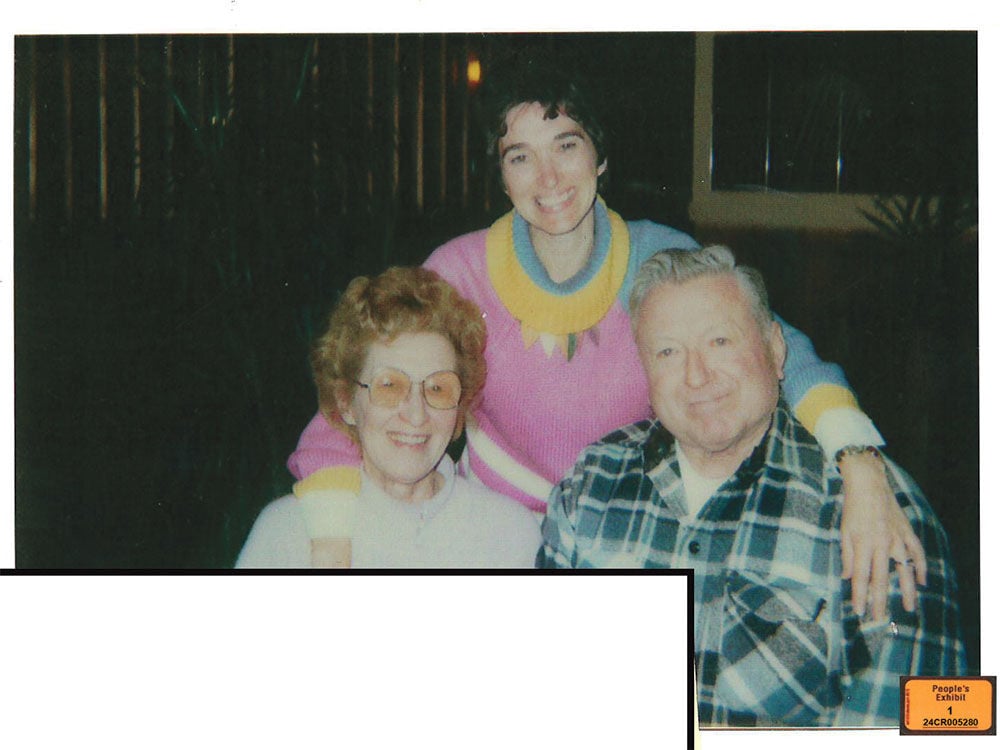
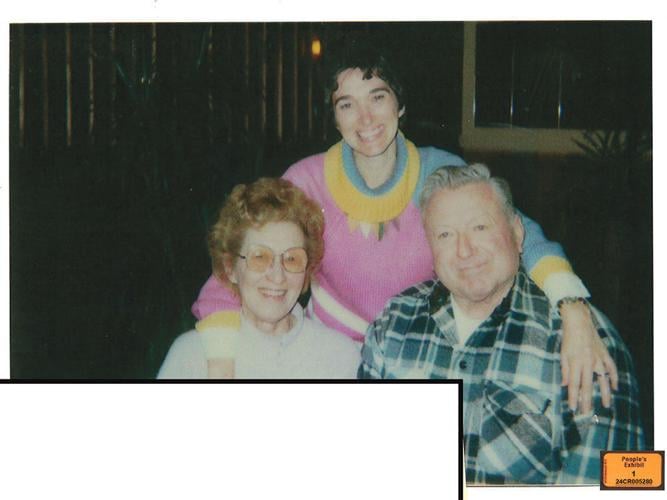
Exhibit 1, a photo of George and Anna Smith, with daughter JoAnn Holland. Image provided to Monterey County Sheriff’s investigators by JoAnn Holland, Anna Smith’s daughter (now deceased).
By 7:30 that night, Anna had returned to find her mother in her hospital-style bed covered in blood. Her husband was across the hall in their room, lying on the floor on his back. She fetched her neighbors, Ron and Jeri Rader, for help. Jeri called 911 and Ron joined Anna in returning to the premises, assessing the scene and checking for George’s pulse with no success.
An investigation later found that Eva Thompson had been beaten, strangled and her throat had been slashed. Her sternum and all of the ribs on her right side were fractured. The telephone cord next to her bed had been pulled out, with the receiver tossed across the room.
George Smith had been stabbed 11 times in their bedroom, which also served as the business office for the restaurant. The room had been ransacked with drawers left open, the mattress moved and items strewn about.
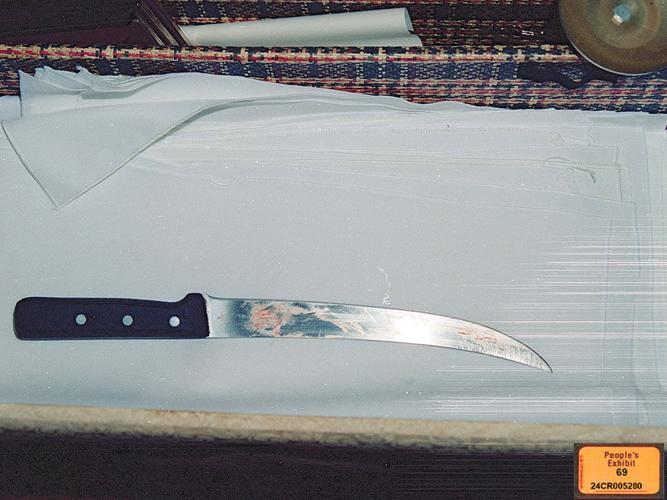
Although extensive evidence was recovered at the crime scene – a kitchen knife, parts of Thompson’s nightshirt, and shoe impressions left by the back door, among other items – it was not sufficient in proving, beyond a reasonable doubt, who the killer was. This was in 1991 – long before forensic DNA analysis became one of the most powerful tools in modern criminal investigations, helping solve cases like these.
Thirty-three years passed.
Then in 2024, the Monterey County District Attorney’s Office charged a suspect with the murders.
A year later, on Aug. 26, 2025, a jury convicted a former employee of the restaurant, Ira Bastian, now 86 years old, of two counts of first-degree murder for Smith and Thompson. The jury also found the special-circumstance allegations to be true: that Bastian murdered Smith and Thompson during a burglary, and that he personally used a knife to kill both victims.
It’s estimated that there are over 340,000 unsolved homicides in the United States, along with 40,000 unidentified human remains cases. In Monterey County, the District Attorney’s Office Cold Case Task Force (CCTF) has identified over 600 unsolved homicide cases across the county, and with the support of a grant and the Cold Case Project – a nonprofit funding arm established this year – they have begun to make a significant leap in bringing justice to these families today.
After decades of waiting, some families are beginning to get answers.

Exhibit 69 used in the People v. Ira Bastian case depicting the knife found at from the crime scene.
IN A SALINAS COURTROOM ON MONDAY, AUG. 11, 2025 a dozen jurors listen as attorneys deliver their opening statements in case no. 24CR005280, The People of the State of California vs. Ira Bastian, describing the crime scene on the day of the murder. They outline the details of the case, the evidence the jury would consider, and the witnesses slated to take the stand in the coming days.
Prosecutors display graphic photo evidence from the scene; images faded with age, the colors of the photos indicative of the era. In the courtroom audience, George Smith’s daughter looks away – the images too horrific, the memories too painful.
For those close to the victims in cases like this, memories of the event, and of their loved ones, remain salient. Yet as time passes, answers – and justice – drift further out of reach.
In July 2020, the Monterey County District Attorney’s Office launched the Cold Case Task Force, the county’s most comprehensive effort to revisit unsolved cases. Prosecutors and investigators had long sought to establish a more structured approach to handling cold cases. While not driven solely by advancements in DNA technology, those tools played a role – and the slowdown in court activities during the pandemic finally gave them the opportunity.
The task force involves seasoned investigators from local law enforcement agencies, the District Attorney’s Office, and a dedicated prosecutor, in collaboration with the state Department of Justice, Bureau of Forensic Services, private laboratories and specialist teams. They focus on revisiting homicides, cases where someone went missing and there was suspected foul play, unsolved sexual assaults and cases involving unidentified human remains.
In the months after Thompson and Smith were murdered in 1991, investigators spoke with witnesses and painted a picture of the family members’ daily lives as best they could. Assistant District Attorney Matthew L’Heureux, the lead prosecutor in the Bastian case, brought pieces of this story to the jurors, explaining Bastian’s history working for the family, and that he had two completely different explanations for what he was doing the day of the crime. His girlfriend at the time, who Bastian was living with, also provided shoes that matched the prints left by the back door. Bastian also was confirmed to have a wad of cash when he came home one day, with no explanation of where it came from.
Back in the ’90s, Bastian claimed that although his girlfriend provided the shoes, and the prints matched those by the back door, they weren’t his. Other workers at the restaurant, who once worked with Bastian before he committed the crime, told investigators that Bastian thought “the restaurant would be an easy place to rob.”
While he couldn’t provide an explanation for where he got the cash, prosecutors did not think all of this information would be enough to prove to a jury, beyond a reasonable doubt, that he was the killer.
For murder, the statute of limitations does not apply. In the case of the double homicide of George Smith and Eva Thompson, years passed, leads were exhausted, the restaurant shut down – yet the case remained open, ready to be revisited if new evidence emerged.
JUDGE ANDREW G. LIU, WHO PRESIDED OVER THE TRIAL, addressed the jurors after the attorneys gave their closing statements. He likened the trial to a Broadway show: “There is a lot going on behind the scenes to present in a smooth, efficient way,” he said. “But it’s also like an improv show, and the judge’s job is to manage that show as it unfolds.”
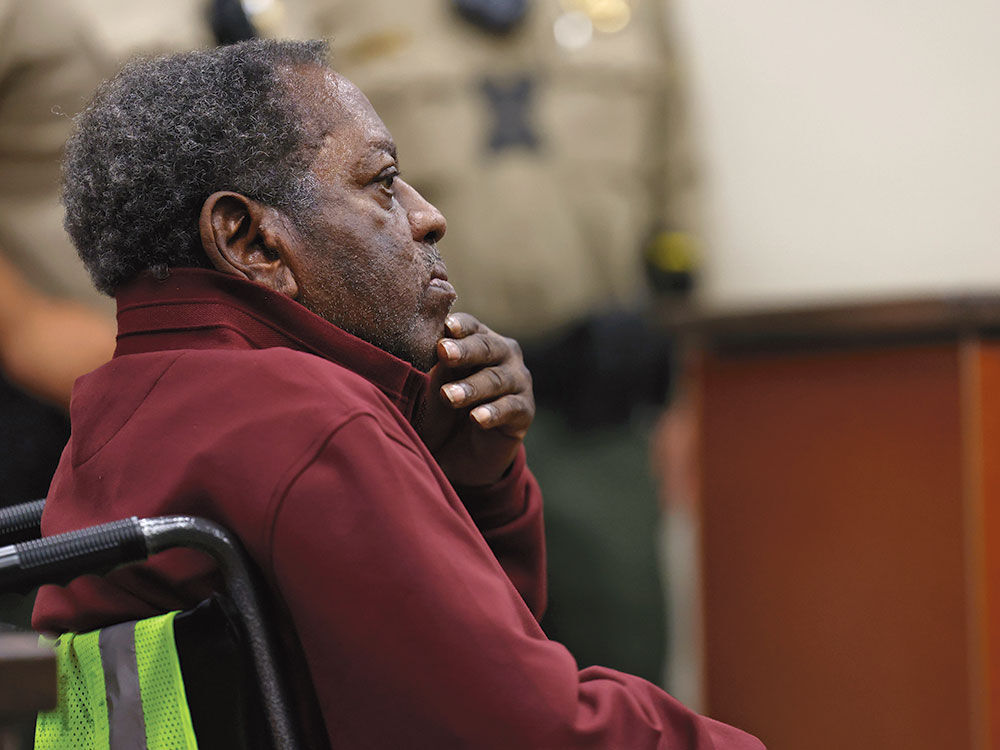
Ira Bastian, now 86, sits in a wheelchair in a Salinas courtroom for his trial. He was convicted of a double homicide on Aug. 26, over 30 years after the crime occurred.
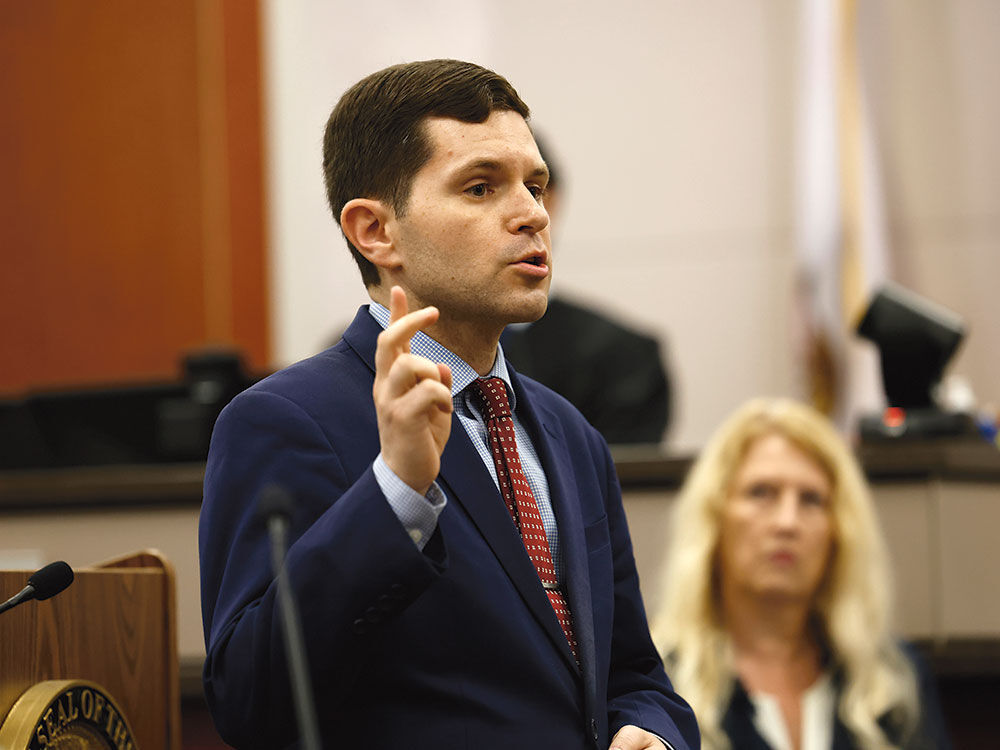
Assistant District Attorney Matthew L’Heureux, who prosecuted the Ira Bastian case, is the main prosecutor on the Cold Case Task Force.
Behind the scenes, L’Heureux, who is the main prosecutor on the Cold Case Task Force, spends much of his time outside of the courtroom deep in the paperwork, assisting investigators with reviewing cases and planning their investigative strategy. He’ll handle the review and the filing of cases that get submitted. Then, if a case is on track to go to trial, he’ll be deep in the weeds interviewing and preparing for the testimony of all the witnesses.
“I’ve learned over the time I’ve been doing this that every person who goes through this is going to view it differently, no matter how long it’s been,” L’Heureux says, reflecting on working with families of victims over the years. “They don’t all have the same desires or the same feelings toward whether the case is reopened, whether it’s prosecuted, whether they want to go to trial or not.”
Since the task force was created in 2020, they received a $535,000 federal grant from the U.S. Department of Justice and have reviewed more than 100 cases, solved 19 homicide cases, one sexual assault case, and identified 10 previously unidentified human remains. After federal support ran dry, the Cold Case Project nonprofit was established to help sustain the task force through continued funding.
“The technology has really advanced, even since 2018,” says Ann Kern, Cold Case Project president. “In regards to these cold cases, it is a new day.”
IN GENETICS, DNA IS OFTEN LIKENED TO A “COOKBOOK,” where chromosomes are the chapters and genes are the recipes. We all have the same cookbook, and the same recipes on each page. But the ingredient lists vary slightly (the reason people don’t look the same) and those differences create a unique fingerprint.
In an investigation, forensic experts analyze these “ingredients” – things like skin cells, blood, hair, semen – collected like torn scraps from someone’s cookbook. Then these recipes are compared to the suspect’s, or to a list of profiles in a DNA database like CODIS (Combined DNA Index System) which is an FBI program that links crime-scene evidence to a database of convicted offenders.
If the patterns line up, analysts may have a match.
In the courtroom, attorneys bring forward these torn pages from the cookbook: DNA samples from the nightshirt, the knife, the shoes, showing the jury that these recipes match only certain people’s cookbook – like Ira Bastian and Eva Thompson – with odds against a random match being extraordinarily low. In criminal investigations like these, investigators interpret the DNA against the probability that a random person might, by chance, match with the sample.
The lower the probability, the higher the confidence the correct suspect has been identified.
DNA can “answer questions of identity that previously had to be answered through other evidence,” L’Heureux says, “and can provide a conclusive answer as to whether someone is the source or a contributor to an item with a very high degree of certainty.”
While a powerful tool, L’Heureux adds DNA can’t be used alone, but alongside other pieces of evidence that tie that person to the crime scene. “It’s always going to require context to understand what it means. If you get a DNA result that is from someone who is known to the victim, and their DNA could have been there for innocent reasons not related to the crime, then that doesn’t necessarily prove anything.”
Before the turn of the 21st century, detectives weren’t thinking about DNA preservation when collecting evidence – at least not in the way they are today, says Gary Harmor, Chief Forensic DNA Analyst with SERI (Serological Research Institute), a private lab based in Richmond, California. Protocols that are standard now didn’t exist in the 1990s and earlier. Back then, evidence was often handled without gloves, and storing it properly – in freezers or specialized bags – wasn’t common practice, which made detecting DNA more difficult when the technology to do so did emerge.
“There were no masks or anything,” Harmor says. “[Detectives] would pass a garment around. When they put it in the paper bag, wet blood from other parts [may have] transferred to the unstained parts, which may have had the DNA from the perpetrator.”
In the early 2000s, the precision by which researchers were able to pick up DNA from older pieces of evidence started to improve, along with the ability to distinguish individuals more accurately. And around 2018, genetic genealogy – a method of using DNA test results to locate relatives – began to rise and became a game changer. Most famously, DNA profiles pulled from ancestry websites were used to identify and arrest “The Golden State Killer” who committed at least 13 murders across California in the 1970s and ’80s.
“The sensitivity has gotten a lot better. I can get DNA off stuff from the 1950s and 1960s,” Harmor says. “So we can go back many years. But of course, when you go back that far, who’s left alive?”
In the case George Smith’s wife and Eva Thompson’s daughter, Anna Smith, she died in 2008 – 17 years before an answer was found.
ON MARCH 28, 2021, a fisherman pulled up partial skeletal human remains in a net just outside the boundaries of Monterey Bay. The remains were wrapped up inside a one-piece fleece garment that resembled the inner lining of a dry suit or an emergency survival suit, along with five keys and two coins.

A photo of Jeffrey Hulliger, right, who disappeared in 1997 out at sea. His remains were found and identified 24 years later. Photo courtesy of John Hulliger, Jeffrey’s nephew.
Researchers, after searching the California Missing and Unidentified Persons System for a match and coming up empty, turned over the case to the county’s Cold Case Task Force, which then partnered with the forensics company Othram to extract DNA and see if they could identify the individual.
In 2024, using the extracted DNA in combination with forensic genetic genealogy to identify potential relatives, officials confirmed that the remains belonged to Jeffrey Hulliger, who went missing in 1997 while fishing with a friend near a Monterey Bay Aquarium Research Institute buoy off Moss Landing. Hulliger, 36 at the time, had sent a distress signal to the Coast Guard when their boat began taking on water.
Despite a days-long search involving helicopters and an aircraft, he was never found – until 24 years later, when his remains were finally recovered.
Over the years, some of Hulliger’s family held out hope that he was still alive. Hulliger, who had been in the military for nearly 20 years, had returned home following a deadly incident in Beirut, Lebanon, and after contracting malaria from his deployments. “He would have still been in there if he could, he loved the service,” Terry Kiskaddon, Hulliger’s sister, says.
With more time at home after his return, he had a chance to get to know his family better, picking up odd jobs and adjusting to civilian life.
Kiskaddon, now 68, remembers the last time she saw him. “He had a girlfriend with him, and we had dinner,” she says. “We had a blast. My husband and I were talking about how we wished that we had known him [better] all those years. He was a great guy.”
When he went missing, he had been trying to earn a living fishing, at the time for black cod, recalls John Hulliger, Jeffrey’s nephew, who was 14 then. John and his father were part of the Moss Landing fishing community, and found out quickly the day Jeffrey disappeared. He remembers hundreds of boats out in the water, the whole community out searching.
“We felt like he was still alive until he was found,” Kiskaddon says. “I was always looking for him, and I’d see people I thought looked like him and I thought it was him. I thought he had actually faked it, because he was in the military.”
For the Hulliger family, getting the call from the detectives that the remains were identified as Jeffrey’s years later was not only a surprise, but to them, it meant closure.
“Finding the bones and the identification, it was a healing thing,” says John Kiskaddon, Jeffrey’s brother-in-law. “We were just like: wow. It’s the weirdest feeling. All these years there was hope, but then, this actually helps to put the hope into another place. Now, it’s closure.”
FOR SOME FAMILIES LIKE HULLIGER’S, DNA technology and genetic genealogy provide answers that offer closure. For others, the answers might mean a step forward towards some semblance of a resolution, or at the very least, justice.
Anne Pham was a 5-year-old girl who disappeared on Jan. 21, 1982 while walking to kindergarten at Highland Elementary School in Seaside. Her school was just a few blocks from her home, but two days later, her body was discovered near a shooting range at the former Fort Ord Army base by military investigators.
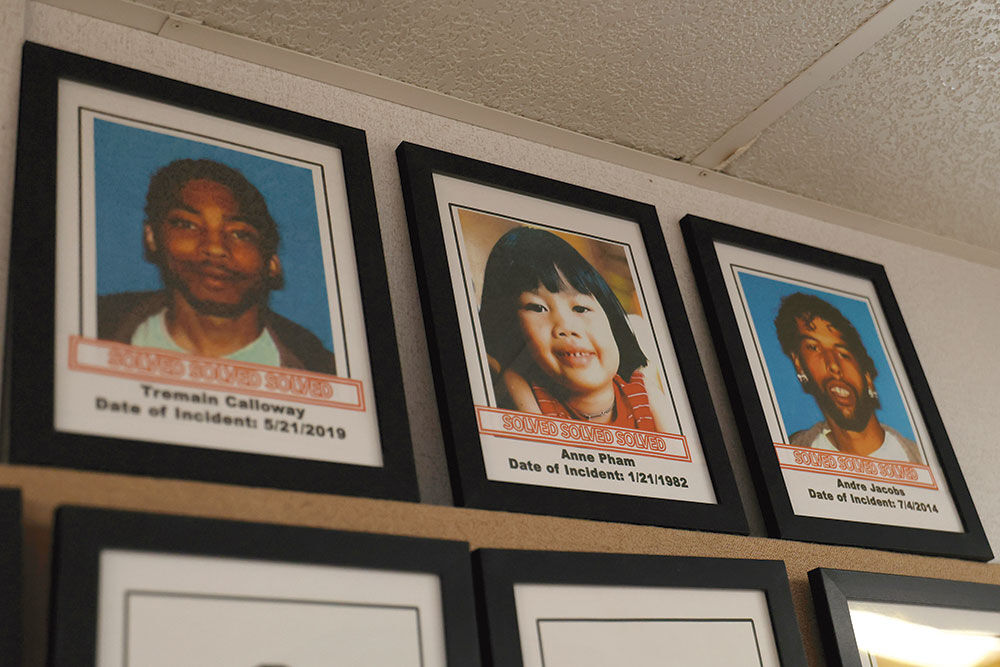
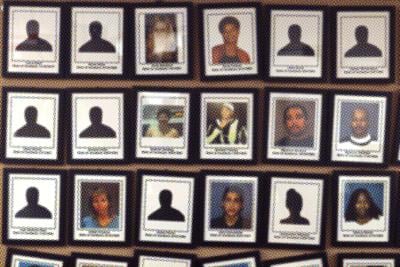
Photos of murder victims whose cases once went cold but have since been solved hang on the wall of the Seaside Police Department. In the center above is Anne Pham who was murdered at 5 years old in 1982. Her killer was sentenced in March 2025.
Forty-three years later, all it took was one hair to identify and arrest the perpetrator, a Nevada resident named Robert John Lanoue who was 29 at the time of the murder, stationed at Fort Ord. DNA testing of a rootless pubic hair found on the remains of Pham was sent to a forensics lab in Santa Cruz to perform whole-genome sequencing (a newer technology which is able to look at a person’s entire “cookbook”) which was then searched on genetic genealogical databases.
A forensic genetic genealogist was able to identify “Lanoue” as a possible last name for the suspect, which CCTF members then used to identify his full name. They discovered that Lanoue lived on Luzern Street in Seaside, 0.1 miles away from the Pham family residence at the time. According to the District Attorney’s Office, he admitted to CCTF members that he had a history of sexually assaulting young girls.
Seaside Police Chief Nick Borges says getting to zero unsolved homicides is the goal: “These cases take time, money and a lot of effort, but that is the goal.”
Lanoue, at age 72, was sentenced to 25 years to life in prison on March 20, 2025.
It can get expensive to do this work; genetic genealogy testing costs around $15,000 per case, which the Cold Case Project helps to fund as the half-million dollar grant to the task force is set to expire in the next month or two.
The nonprofit, run entirely by volunteers, many of them former investigators and detectives, aims to ease the burden on local agencies by handling grant writing and working with law enforcement to connect cases with labs that can generate new leads.
There are a number of cases in the queue, some of which may not yield enough evidence to bring them to trial. The Cold Case Task Force and the nonprofit work in collaboration to select and support the cases that go to trial. The task force identifies potential cases to investigate, evaluating them based on available evidence, the surviving witnesses and the potential to generate new leads with advanced testing.
The nonprofit helps support these efforts in a number of ways: by assisting with grant writing on behalf of law enforcement agencies, advising on which evidence may be most promising to test, and offering guidance on which testing strategies might be more effective, depending on the case.
“We don’t know where things lead us until the science gives us the answers,” Kern says. “But we’re advocating for justice. We’re taking the steps to do the work.”
(0) comments
Welcome to the discussion.
Log In
Keep it Clean. Please avoid obscene, vulgar, lewd, racist or sexually-oriented language.
PLEASE TURN OFF YOUR CAPS LOCK.
Don't Threaten. Threats of harming another person will not be tolerated.
Be Truthful. Don't knowingly lie about anyone or anything.
Be Nice. No racism, sexism or any sort of -ism that is degrading to another person.
Be Proactive. Use the 'Report' link on each comment to let us know of abusive posts.
Share with Us. We'd love to hear eyewitness accounts, the history behind an article.