


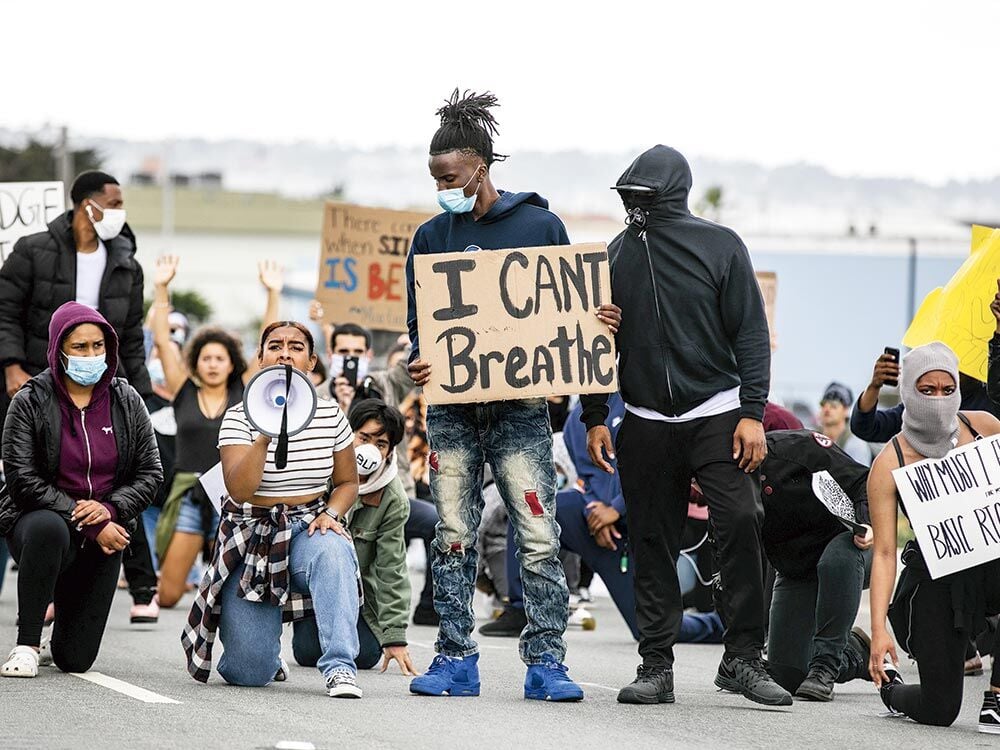
Following the murder of George Floyd on May 25, 2020, thousands of protesters flooded the streets across the country and around the world to demand justice and call for an end to racism. Locally, on May 30, 2020, hundreds gathered on Broadway Avenue in Seaside.
THINK BACK TO THE SUMMER OF 2020. Months into an international pandemic lockdown, with the promise of vaccines still off on the horizon, we lived stratified, isolated lives. So-called “essential workers” shouldered the brunt of the risk while others were lucky enough to continue working from home. On May 28, 2020, the Centers for Disease Control announced that the U.S. Covid-19 death toll had surpassed 100,000 people.
That same week, on May 25, 2020, a Black man named George Floyd was murdered by a white police officer in Minneapolis, Minnesota. It wasn’t the first example of systemic police brutality against a person of color, nor, unfortunately, would it be the last. But the tragedy sparked a global protest movement that raged that summer – by some counts becoming the largest such movement in U.S. history.
In addition to in-person protests, race relations and racism dominated conversations, headlines and social media posts that summer. There was urgency – understandable urgency – around unraveling an issue that has defined this nation since 1619, the year the first 20-30 enslaved African people arrived in Virginia. There were books to read, documentaries to watch and more equitable interpretations of history to be internalized. For many white allies or would-be allies, there was a sense of needing to do more, which sometimes wound its way into diluted ends. On June 2, 2020, a social media action originated by two Black women in the music industry – as a way to hold the industry accountable for profiting off the work of Black people – became a prime example of this, when multitudes of Instagram users posted a simple black square to their feed, ostensibly as a way to show support for the Black Lives Matter movement.
It’s easy to deride these squares for what they are – a display of performative allyship that ultimately means little to nothing. But perhaps there’s another lesson to be learned from the black squares. The fact that this country was built on the backs of enslaved people is a heavy fact, made only more so by the hundreds of years of abuse, violence and marginalization that has followed. Truly contemplating this legacy brings a host of uncomfortable emotions – guilt, shame, anger, fear, sadness – and knowing how to identify, process and ultimately use these emotions for good takes training.
THE FIRST FEW WEEKS OF “RACE RELATIONS BOOT CAMP” ARE A ROLLERCOASTER RIDE OF EMOTIONS. If you were educated in a classroom that teaches this history (and not all do – in recent years many states have adopted legislation that limits how teachers can discuss issues like race, politics and gender identity), you’ve been taught how the institution of slavery shaped the foundation of America, how white slave owners brutally treated the people they viewed as property, and how traces of this dynamic still persist, despite incredible progress made. But when was the last time someone asked how this history makes you feel? Or, for that matter, how the murder of George Floyd or Philando Castile or Breonna Taylor made you feel?
Dirrick Williams will do just that.
The Pacific Grove native and founder of the Black Leaders and Allies Collaborative teaches Euro-Centric Cultural Reflectionism (ECCR), an anti-racist curriculum of his own creation that centers on students’ emotional responses to racism – and aims to teach students how to channel those emotions toward creating change.
(In the course of reporting this story, I participated in a cohort of ECCR. In order to honor the confidentiality of the course, this story does not discuss specific conversations that took place during the course.)
Williams is adamant that ECCR is not a traditional diversity training. It’s not only about learning the history and the facts of racism, though there is some of that. Over the course of 14 weeks, small cohorts meet for two hours each week via Zoom to have real, honest conversations about the ways in which racism shapes our society and what it takes to be a good ally – a classroom dynamic that feels a bit like a cross between a Socratic seminar and group therapy. It all begins with self-examination, with an exploration of the emotional toll of racism, whether this often-invisible force is something you think about regularly or something you are privileged enough to avoid thinking about.
Like any Socratic seminar, the direction the conversation takes is to a large extent dependent on who is part of the conversation. “What I do is I drop something [a question, a polemic] in the middle of the room and then… it tends to go,” Williams says of his facilitation style.
“The goal is not to change your mind. The goal is to change your heart so that you will change your mind.”
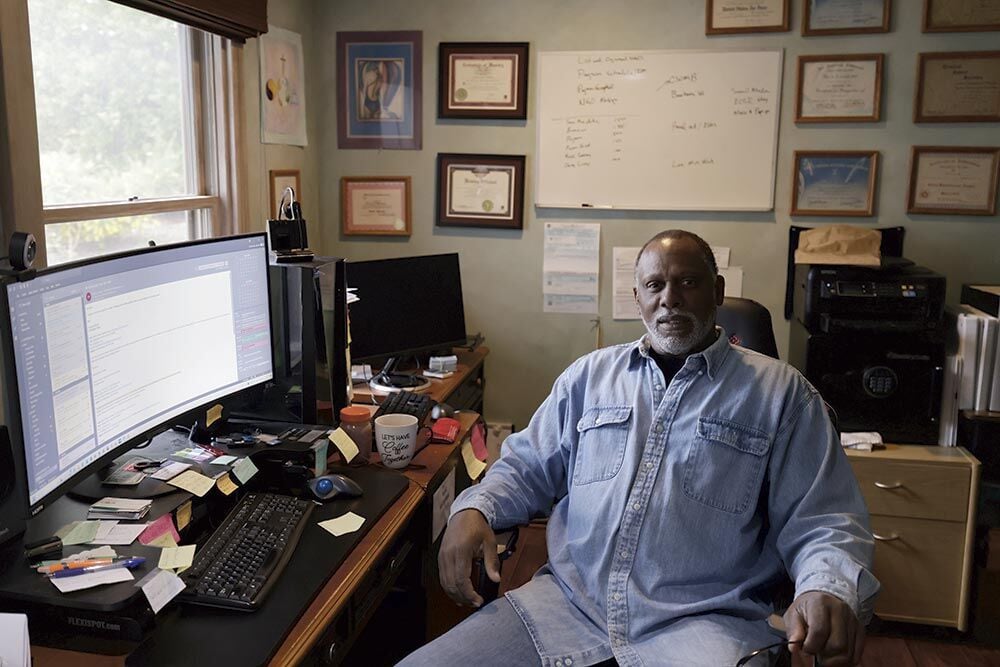
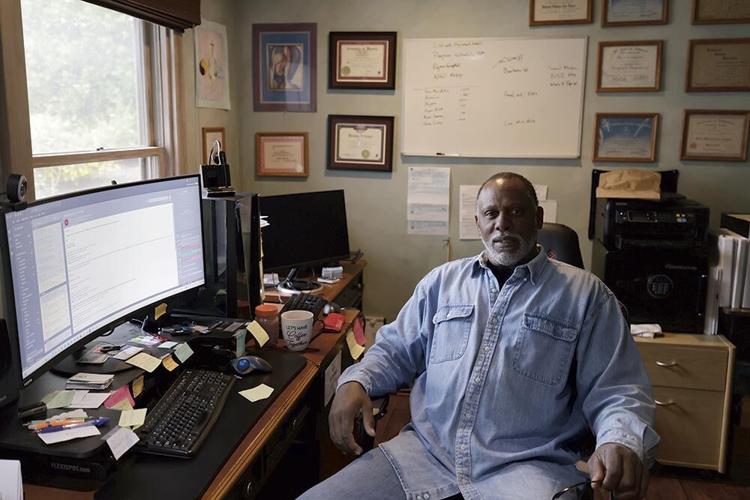
Dirrick Williams, seen here in the home office from which he facilitates cohorts of his anti-racist education program Euro-Centric Cultural Reflectionism. The classes take place on Zoom.
BACK IN THE SUMMER OF 2020, WILLIAMS WATCHED THE BLACK LIVES MATTER PROTESTS WITH A CERTAIN CONCERN. “A decentralized movement will end up with many issues,” he says. “There’s too much room for infighting and ambiguity.” At the time, he worried primarily that the wave of energy seen in the streets would fade, as the attention and energy it takes to produce protest movements tend to do, and that once it did people – white people especially – would return to a sense of complacency. “I thought there should be a way to hold on to that,” Williams says.
A Black man born and raised in Pacific Grove, a town with an overwhelming 80-percent white majority, per recent census data, Williams is intimately familiar with the realities of racism – from regular microaggressions to full-on violence. On July 6, 2018, while at Monterey Lanes bowling alley to collect entry forms and fees for an annual golf and bowling tournament he ran to benefit the youth services nonprofit The Village Project, Williams was the victim of a violent, racist attack. Outside the bowling alley, he encountered Noah and Tricia Boewer, who called Williams the N-word while Tricia falsely claimed Williams had deliberately grabbed her as he walked past. After this, Noah punched Williams in the face, breaking his jaw in three places, and Tricia jumped on his back. In December 2020, a jury found Noah Boewer guilty of felony assault and Tricia Boewer guilty of misdemeanor battery – but found both not guilty of a hate crime.
At the Boewers’ sentencing, Williams spoke to Monterey County Superior Court Judge Andrew Liu and those present in the courtroom, delivering a poetic history of how this one moment fits into the larger experience of being a Black man in America.
“The lie Tricia Boewer told to the police and this court when she said I physically accosted her is more than a lie, more than an insult. It was a direct and deliberate attack on my life,” Williams said. “The court wants to know the impact she has in my life? Well, after calling me a nigger several times, she employed the oldest trick in the book when it comes to interactions between white women and Black men.
“A white woman lies,” he said, “and by the thousands, Black lives are devastated.”
Judge Liu replied that Williams had been heard, and noted that the jury’s failure to find a hate crime was perhaps not surprising, as proving a hate crime is a high legal hurdle.
“I cannot say I personally understand the experiences you describe, but they are also not foreign to me,” Liu said. “The phrase that has repeatedly come to mind as I thought about this case… is that the march toward justice does not move in a straight line, but it does move forward.
“I think perhaps too often we think of racism in stark terms. It is not simply or merely a hatred of people of color or other groups. Everyday racism takes on varying forms with varying degrees of subtlety.”
IT WAS IN THIS CONTEXT THAT WILLIAMS, AN AIR FORCE VETERAN, MINISTER AND COMMUNITY ACTIVIST, founded the Black Leaders and Allies Collaborative (BLAAC). The organization, which gained nonprofit status in May 2021, holds a mission to “[help] leaders and change-makers achieve racial equity through dialogue, unity and shared values.”
Toward that end, BLAAC hosts movie nights, pop-up community conversations and, of course, facilitates Euro-Centric Cultural Reflectionism, known in shorthand as ECCR.
Williams initially began developing ECCR thinking it might apply most readily in a college context – in December 2020 the California State University system updated the CSU General Education Breadth policy to include an ethnic studies requirement. Starting with students who began their degrees in the fall of 2021, all CSU students now complete at least one ethnic studies course. Locally at CSU Monterey Bay, there are dozens of courses on offer to fulfill this requirement – from a class on slavery and race in the Americas to “Art of the Aztec Empire” and “Multicultural Poetry.”
Williams has a specific vision for the progression of the course. The first few weeks are devoted to “learning of self” – students practice identifying their emotions and using certain tools to go deeper, like a pyramid method for breaking down thoughts and feelings into their component parts. Starting with emotions is important, Williams says, “because that’s where the problem exists.” As Williams sees it, all of the corporeal facts of racism, from outright violence to discrimination, are a result of the way people process (or fail to process) their guilt, fear and shame. Next, students “learn of the problem,” discussing things like the wealth gap between white and Black Americans (the median white family had $184,000 in wealth in 2019 compared to just $23,000 for the median Black family, according to researchers at the Federal Reserve Bank of St. Louis) the school-to-prison pipeline, or the ways in which religion has upheld white supremacy. Finally, students “learn of others” – and conduct research into Black history and the cultural, political and technological contributions of Black Americans. The course also features extensive discussions on white saviorism (a pop culture trope where a white person rescues people of color from some perceived plight) and the importance of curiosity and compassion in being a good ally.
After creating the ECCR curriculum, Williams decided to pilot it with community members outside the college context, and that’s where it has remained – Williams is not currently looking to bring ECCR into any formal education system. Instead, he is focused on developing additional courses – ECCR 2 will focus on the Constitution of the United States, and the inequality written right into it; ECCR 3 will explore questions around reconciliation and reparations.

Founded in 2013, Black Lives Matter is a decentralized social movement that seeks to draw attention to racial discrimination against Black Americans. Above, Black Lives Matter protesters in Seaside in 2020.
ECCR WAS NOT CREATED EXCLUSIVELY FOR WHITE PEOPLE. But it does contain a distinct goal for white participants: “ECCR was written from a Black perspective… that would have white people reflect on issues they never talk about,” Williams says. “The goal for white people is to see themselves as a racialized group – everything else comes out of that.”
Colleen Ingram chose to participate in ECCR as a way to deal with the emotional turmoil of 2020. During and after the Black Lives Matter protests, the 15-year P.G. resident says she noticed a distinct “hostility” to diversity in her town. This hostility became even more apparent once Ingram started attending meetings of P.G.’s Diversity, Equity and Inclusion Task Force – the task force, created in 2021, has done significant work including writing the city’s officially approved apology for the 1906 burning of the Chinese fishing village at Point Alones. It has also faced continuous criticism, including from recent Task Force candidate Marie Hunter, who acknowledged in her application that she doubted the usefulness of the DEI Task Force and said it was wrong “to point fingers at a particular race dominating and suppressing another.” (In spite of this, Mayor Bill Peake recommended appointing Hunter to the task force following the 2022 election – her appointment was ultimately not approved by City Council.)
“You need education to be able to counter that,” says Ingram, who is white.
Both the information presented in the class – data on income and wealth disparities between Black Americans and white Americans, the Black-white homeownership divide, the school-to-prison pipeline, etc. – and the conversations have been eye-opening, Ingram says. “It was really the first time I looked from the ground up at how our country was founded and what it was based on,” she says.
Other students come in with more of a foundation in racial justice concepts. Cynthia Ainsworth, a student services librarian at Hartnell College in Salinas, joined a cohort of ECCR a year-and-a-half ago. Ainsworth, who is white, has long been involved with the local activist organization Whites for Racial Equity and works on racial equity initiatives at Hartnell.
“Most everything was not new to me,” Ainsworth says, of the content of the course. “It was more of a relationship-building experience.”
The same could be said for Mari Adams, who identifies as white and mixed race, and who quickly began attending DEI Task Force meetings after moving to P.G. a year-and-a-half ago. For her, ECCR was a way to meet other people in her community who share her perspective – or at least her commitment to having the conversation. “I wasn’t taking it as much for education as community – and I got that,” Adams says.
Ainsworth, and others, talk about anti-racism as a journey, a spectrum from relatively less awareness to relatively more awareness. “When you get a group of white folk together, we’re all on a different place on the continuum,” Ainsworth says.
For at least one Black ECCR participant, firsthand observation of this continuum has proven a main takeaway experience from the class. Shira Crawford met Williams during a Black History Month movie night hosted by BLAAC, and was impressed by the conversation he facilitated after the movie ended. When she heard about ECCR she was curious enough to check it out – “it felt like an attempt to have conversations that were not superficial,” she says. For the mother, realtor and grad student, the content of the course is deeply familiar. But engaging in conversation about racism in a mixed-race group – that’s unusual. “I feel like there’s a bridge that’s being created in me,” Crawford says.
Over the past two years, Williams says close to 80 people have participated in ECCR, ranging from a 17-year-old high school student to an 80-year-old retired CEO. He says the class demographics roughly track with the demographics of the area – 50 percent of participants are men, 50 percent women; most are white.
ECCR IS NOT THE FIRST OR ONLY ATTEMPT to develop a curriculum that can help educate people to change. In Monterey County, the group Whites for Racial Equity hosts discussions, book clubs and trainings with the goal of “cultivating greater racial competency” among white people. Founded in 2015, Whites for Racial Equity is an affiliate of Showing Up for Racial Justice, a national activist group founded in 2009 amid the racist backlash to former president Barack Obama’s election.
Following George Floyd’s murder and the rise of Black Lives Matter in 2020, corporations, schools and other organizations rushed to provide diversity, equity and inclusion (often abbreviated as DEI) or bias training for workers. Some companies even created new leadership positions tasked with increasing diversity, often by focusing on hiring practices.
These efforts toward change have attracted a backlash. Many of the companies that rushed to hire more diverse workers have since conducted layoffs – and some data suggests that these layoffs have disproportionately impacted people of color.
There has also been a political backlash from conservative Republican lawmakers across the county. Republican Texas Gov. Greg Abbott, for example, released a memo in February warning state agencies and public universities to stop considering diversity in hiring decisions. In April, Republican Florida Gov. Ron DeSantis (also a presidential candidate) signed into law guidelines that limit discussion about race in Florida businesses and schools. In May, he signed a bill banning DEI initiatives in the state’s public colleges.
Despite these headline-grabbing instances, polling by Pew Research Center reveals that, while there are notable partisan differences, a majority of Americans (56 percent) believe that increasing diversity, equity and inclusion in the workplace is a good thing.
ECCR’s methodology and individual approach sets it apart from other diversity or bias trainings, but it fits into this ecosystem – bolstered on the one side by those who believe change is necessary, and weathered on the other by those who do not.
WHAT UNITES THE PEOPLE WHO CHOSE TO PARTICIPATE IN ECCR, no matter their race or background, is a commitment to showing up – missing family dinners or forgoing other work responsibilities in order to invest time and energy in self-reflection. It’s work – both for participants and for the facilitator. “It takes a lot of humility to do this work,” Ainsworth says.
ECCR is open to anyone willing to show up and do that work. It’s designed for participants who are actively seeking to learn, and willing to change their hearts so they can change their minds. Personal buy-in is the starting point.
For those who do buy in, Williams’ intention is that, through practice, students will develop a certain emotional resilience in the face of what are often fraught, charged conversations or situations. The goal, he says, is for students to get past the place where emotion controls their actions (whether that looks like using a racist epithet or posting a black square on Instagram), to a place where they are able to use those powerful emotions as a motivation for making change.
At the very least, Williams hopes students graduate with an ability to understand how racism has affected them – whatever that impact might be.
“Nobody in this country is exempt [from the impacts of racism],” he says, “and nobody can say it’s been a positive experience.”
To learn more about the BLACK LEADERS AND ALLIES COLLABORATIVE and get information about an upcoming session of Euro-Centric Cultural Reflectionism, visit blaac.org.
READING LIST
Are you curious about anti-racism and racial justice, or interested in learning more about the history of race in America? There are a plethora of resources available, including, but not limited to, the books on the short reading list below. Some of these books are part of the course material for ECCR – other title suggestions came out of interviews for this story. A special thank you to Hartnell College student services librarian Cynthia Ainsworth (also an ECCR student) for her help compiling this list.
White Fragility by Robin DiAngelo
Me and White Supremacy by Layla F. Saad
So You Want to Talk About Race by Ijeoma Oluo
How to be an Antiracist by Ibram X. Kendi
The Color of Law: A Forgotten History of How Our Government Segregated America by Richard Rothstein
I’m Still Here by Austin Channing Brown
Stamped from the Beginning by Ibram X. Kendi
The History of White People by Nell Irvin Painter
(1) comment
A couple of more books to add to the reading list, "The New Jim Crow" by Michelle Alexander and "White Rage" by Carol Anderson. Both books explore deeply how both state and federal legislatures, Presidents of both parties and the Supreme Court have been major influences in institutionalizing racism in our country and culture.
Welcome to the discussion.
Log In
Keep it Clean. Please avoid obscene, vulgar, lewd, racist or sexually-oriented language.
PLEASE TURN OFF YOUR CAPS LOCK.
Don't Threaten. Threats of harming another person will not be tolerated.
Be Truthful. Don't knowingly lie about anyone or anything.
Be Nice. No racism, sexism or any sort of -ism that is degrading to another person.
Be Proactive. Use the 'Report' link on each comment to let us know of abusive posts.
Share with Us. We'd love to hear eyewitness accounts, the history behind an article.