

Frequently, in the evenings, hundreds of crows, sometimes thousands, alight to the eucalyptus trees in Laguna Grande Park.
On the street outside the Weekly’s office, which is just a block away, the cacophony can be both haunting and astonishing, and when the crows take back to the air, there are often so many they nearly blot out the sky.
Wordsmiths tell us a flock of crows is called a murder, but the word doesn’t seem to capture the raw power and sheer number of crows at Laguna Grande Park.
They are not a murder – they are a legion. A nation, even.
Blake Matheson, president of the Monterey Audubon Society, says the behavior is not uncommon for crows, who forage in the day and, at night, like to sleep in big groups.
“They’re a highly gregarious species, they’re extremely social and they’re extremely intelligent,” Matheson says, adding that species like crows thrive amid humanity. “Human civilization is basically a landfill wherever we go, and if [species] have a generalist background, they have the capacity to exploit us.”
But Laguna Grande also attracts many other types of birds, both migratory and residents, that are not generalists. That’s because it’s a biodiverse wetland with varied habitats, a 35-acre pocket of wilderness, nestled between two cities, that stubbornly teems with life.
And while many locals might drive by it without ever thinking about it much, the park is one of the top birding destinations on the Central Coast, and it’s not uncommon to see birders circling the path around the park’s lake, their binoculars hanging from their necks.
But the shelter provided by the park’s forest is also favored by people, who make camps in the dense thickets – usually hidden from the outside world – to sleep and do whatever else they need to do to get by.

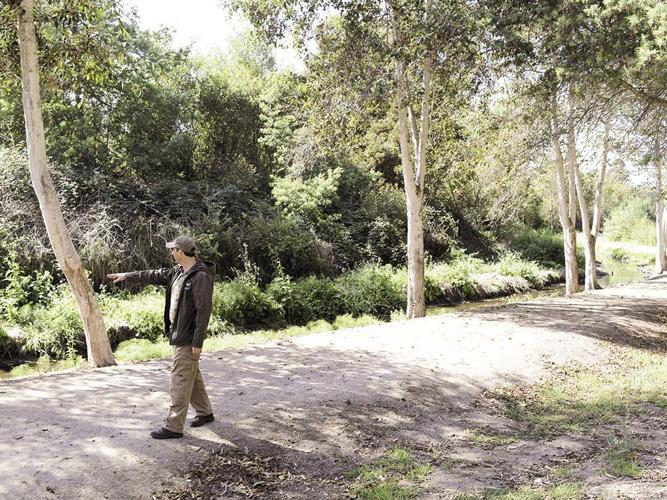
Chris Hartzell, former vice president of the Monterey Audubon Society, walks along the park’s creek in 2014, describing his vision for a trail network.
In late 2014, these two worlds – that of the birders and the homeless camps – intersected when Chris Hartzell, then-vice president of the Monterey Audubon Society, brought forward a plan to clear trails in the forest to both make it more accessible, and – presuming foot traffic and public trails would be a deterrent to encampments – safer as well.
That was four-and-a-half years ago, just weeks after two dead bodies turned up in the park within two months. Within another year, a third dead body was discovered, and in a completely separate incident, a transient was charged with attempted murder after setting two other transients on fire in the park’s forest.
At that time, there appeared to be momentum in both Seaside and Monterey to take action. Hartzell, who’d been thinking about how to turn around the park for years, was among those who were hopeful, even if his hopes were measured.
“There’s no way to keep that park 100-percent free of illegal activity,” Hartzell told the Weeklyin 2015. “What we’re looking at is mitigation of the most dangerous activities, to people and the environment.”
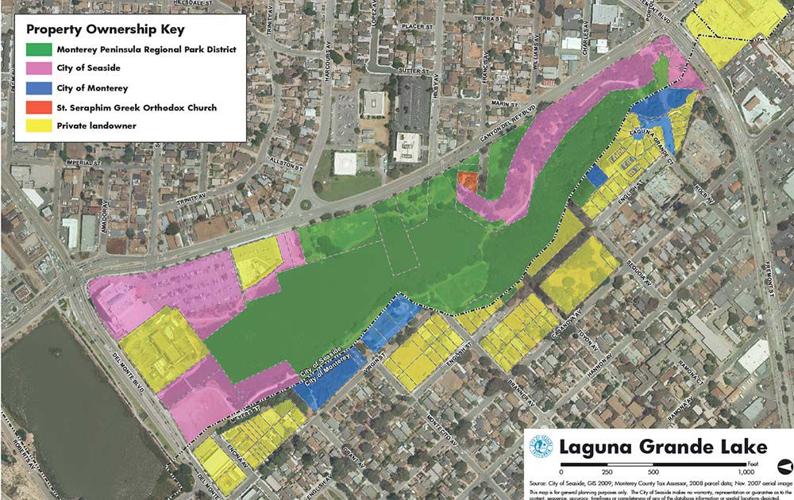
Yet years later, neither Seaside, Monterey, nor the Monterey Peninsula Regional Park District – which owns all the land that encompasses the forest – have a plan.
Encampments continue to regularly crop up, and the park feels no safer than it did in 2014, when then-Seaside city engineer Tim O’Halloran told the Weekly his public works staff wouldn’t even enter the park’s forest without a police escort.
“I don’t think they’re going in there,” O’Halloran said. “I don’t think they feel safe.”
Some Monterey residents who live next to the park share a similar unease, as the forest, while technically in Seaside city limits, abuts several Monterey homes.
For this reason, the city of Monterey is now taking the lead to try to address some of the park’s systemic challenges, but substantive progress has remained elusive.
That reality is surprising when considering the history of the place. The park, which officially opened to the public in 1982, was then the product of a four-decade-long effort led by scores of residents and public officials to turn the spot into a local gem.
Yet here we are, in 2019, and it’s not even safe to walk through parts of the park in midday without a police escort, and the only plan to change that is a plan to make a plan.
ON A RECENT FRIDAY AFTERNOON IN LAGUNA GRANDE PARK IN SEASIDE, sunshine dapples the hillside lawn beneath a canopy of eucalyptus trees. Two men sit on the grass swapping stories and passing a Mickey’s tall boy between them.

Source: City of Seaside, GIS 2009; Monterey County Tax Assessor, 2008 parcel data; Nov. 2007 aerial image
About 40 feet away, toward the footbridge over the southern edge of the park’s lake, a man and woman are also reclined on the grass, chatting. Various bags – more than a dozen – are sprawled out on the lawn around them, appearing to contain their earthly belongings.
The air is crisp and clear, and alongside the park’s dirt footpath a creek flows, steady but calm, after several weeks of rain.
Following that footpath to its endpoint, at a culvert near the border of Seaside and Monterey, an upside-down shopping cart is half-submerged in the creek. Just beyond it is a plastic shipping pallet, also partially submerged. On the other side of the creek is a trail that disappears into a thicket of vegetation, mostly willows, and next to it is a sign that reads: “Habitat Protection Area – Do Not Enter.”
About 50 feet back down the path, a man is seated at the foot of a stairway that climbs up to the corner of Canyon Del Rey and North Fremont Street. A medium-sized backpack, which appears full, rests at his side.
After this reporter pulls out a phone to take a picture of the shopping cart, the man yells out, “Don’t take a picture of it! Get it out of there!”
He then starts cursing under his breath.
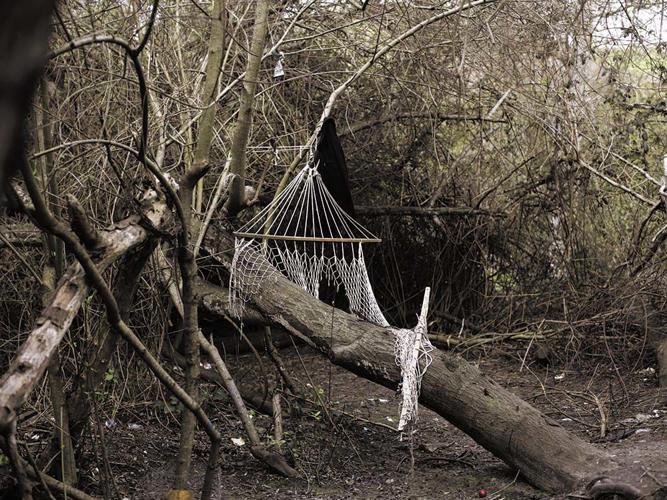
Across the creek, into the dense, overgrown forest that covers about 7-8 acres of the park, detritus of human habitation – blankets, plastic trash, liquor bottles, a torn hammock – presents itself in clearings scattered throughout the trees.
While pushing deeper into the woods, further exploring the trails and encampments, a sound comes from behind: The man who had been sitting on the stairs – he appears to be in his early 30s, and is wearing a clean set of clothes – walks by, shouldering his backpack, and mutters, “Don’t take pictures back here,” and keeps on walking.
Crossing back through the creek a few minutes later, the shopping cart has been removed, and put right-side up on the forest side of the shore. The pallet, too, has been dislodged, and now rests in the water about 20 feet downstream.
Walking back down the footpath moments later, another trailhead across the creek invites exploration, though it too is accompanied by a “Do Not Enter” sign. After sloshing through the water, another sign is visible by the trail, this one nailed to a sapling, that reads, “72 hour notice – Remove your belongings OR they WILL BE removed on 01/06/2019.” An insignia indicates it was posted by the Seaside Police Department.
The quiet is momentarily broken by the warble of birdsong carrying through the willows.
About a minute later, as this reporter approaches the heart of the forest, the man from the stairs suddenly appears again, silently watching from one of the paths.
“You should be careful back here,” he says. “There are tweakers hiding out in these woods. They don’t mess with me, because they know me, but you should be careful.”
He walks away, and disappears into the trees.
THE DREAM OF LAGUNA GRANDE PARK STARTED AT LEAST AS EARLY AS 1942, MORE THAN 75 YEARS AGO, when the city of Monterey, in cooperation with the Army at Fort Ord, began developing a plan.

A torn hammock is all that’s left in one deserted encampment.
A coherent vision didn’t gain traction until the early 1950s, when Seaside businessman Sam De Mello, who later went on to become mayor of Del Rey Oaks, started persistently advocating for the park, and who, according to a story in the Monterey Peninsula Herald from 1962, said that if a park wasn’t developed at the site, “future generations are going to look back and say, ‘Why didn’t we?’”
On file in the Monterey Public Library is an undated pamphlet from the Seaside Chamber of Commerce titled: “Laguna Grande as a Recreation and Entertainment Project.” It appears to have been published in the ’50s or early ’60s, and it speaks to the high-minded dreams the region once had for the park.
“It will beautify and make more attractive the city of Seaside and the entrance to the Monterey Peninsula. It should, from this standpoint, be of interest to every Peninsula community and individual,” it reads.
It also promised “out-of-the-ordinary amusements,” and that it would “attract many thousands of new visitors and part-time residents to the Peninsula each year.”
But making the dream happen was complicated. The land, and the lake, were almost entirely privately owned, and acquiring it required either negotiation or condemnation, i.e., eminent domain. At the time, 25 of the envisioned 35 acres for the park – including the entire lake – were owned by Phil Calabrese, a prominent builder on the Peninsula and the first mayor of Sand City.
Calabrese, initially at least, wasn’t too keen on the idea, and according to what he told theHerald in 1962, he’d already been making the place a park “at his own expense” by dumping construction debris from a project in Seaside on the lake’s shoreline in Monterey.
“He said he has been able to save several thousand feet of shoreline,” the Herald story reads.
But in 1963, the state officially endorsed the idea of the park, and Calabrese changed his tune. At that same time, there were auto-wrecking yards where Del Monte Avenue borders the lake in Seaside, and officials moved to ban those yards, as well as to prohibit dumping in the lake.
Yet not much was reported until the mid-1970s, when Seaside, Monterey and the Monterey Peninsula Regional Park District formed the Laguna Grande Regional Park Joint Powers Agency in 1976, with the express purpose of developing and maintaining the park “for the use and benefit” of the region’s residents.
The park finally opened in 1982, after the park district, reportedly, spent about $1 million to acquire much of the land. By 1984, Seaside had also spent about $2 million on the park, but millions more were needed to dredge and clean up the lake.
The 1978 master plan and environmental impact report for the park indicates that the thickly forested area in Seaside, in what is now park district land, was intended to be a part of the lake. In fact, the plan suggests, it already was part of a lake. Now, after decades of sediment buildup, it is solid ground, dense with vegetation and strewn with an ever-replenishing supply of trash.
The plan also states there was intended to be a trail encircling the entire park, not just the lake as it exists today. It’s as if, after four decades of hard work – and a considerable amount of treasure – to make the park a reality, the community lost interest and moved on the next thing, leaving the plan unfinished.
That’s not to say no work has been done: Both Seaside and Monterey, in recent years, have invested in improvements on the edges of the park that include new play structures and an artificial turf soccer field, respectively – upgrades that have proven popular.
And in 2014, Monterey cut back the overgrown vegetation on its shoreline property near Virgin Avenue, and cleared pathways where camps were starting to take hold.
But the latter only happened after dead bodies started turning up in the forest. That got people’s attention, for awhile.
STEPHEN AND MICHELLE CRY BOUGHT THEIR HOUSE ON LAGUNA GRANDE COURT IN MONTEREY IN 1995. Like every other house on the street, it was new at the time. They still live there now, as do most of their original neighbors, they say, but things have started to change over the past decade. In the forest down the hill from their backyard, they say homeless encampments have increasingly taken a foothold.

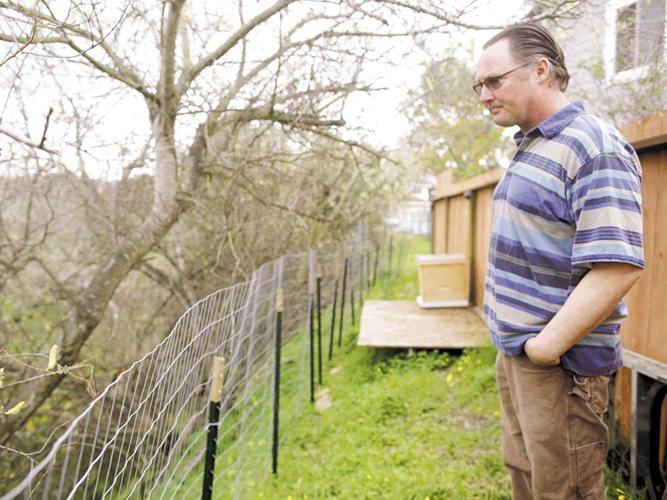
From Stephen Cry’s fenceline on Laguna Grande Court in Monterey, encampments are visible down the hillside, just a stone’s throw away.
It started to become more apparent, Stephen says, when the Great Recession hit, and then came the yearslong drought, when the often-muddy floor of the forest – it’s a wetland – dried up, and became more hospitable to human habitation.
They started to notice campfire smoke sometimes rising from the forest. If they left their bedroom window open at night, they would sometimes hear a person taking a hatchet to the trees to make a camp, or other times, people having sex. More disturbingly, they sometimes woke to screaming from the forest, and one time, a baby screaming.
In moments like those, it’s not clear to the Crys what to do: They don’t want to call the cops all the time, as it’s often not clear if a crime is even taking place. So instead, they sleep with the windows shut.
But the continuing inaction to come up with a long-term solution – especially in light of the dead bodies turning up in the park – became too much, and in early 2015, Stephen sent some emails to the Seaside Police Department to complain. (The Crys’ fenceline is essentially the border between Monterey and Seaside.)
“As I am writing to you at this hour,” Stephen wrote on April 30, 2015, just after 8pm, “I am listening to profanities being screamed back and forth along with what sounds like trees being chopped down for shelters or what not.
“Where does it all end?”
In October 2017, a transient trespassed into the house of the Crys’ neighbors, Rich and Kathie Buaya, after jumping their back fence and entering the back door during the daytime. According to accounts from neighbors, Rich was able to get the man, who was agitated and screaming, to go out the front door, where Rich also offered to help him. When the police arrived, it took multiple officers to restrain the man, who was taken away in an ambulance. (The Buayas retained legal counsel following the incident, and declined to comment for this story.)
Both Stephen and Michelle make it clear they’re not out to villainize the homeless – they understand it’s a systemic, complex problem with no easy solutions – but they just want to feel safe in their own home, their own backyard.
“Our biggest concern, to be honest, especially in the summer, is fires,” Michelle says.
Looking down the hill from their backyard on a recent weekday, two encampments are visible at the hill’s base. When told that the park’s original plans called for a path encircling the entire park, they both agree that would go a long way toward changing the closed-off nature of the forest.
When told that the forest used to be – or at least was envisioned to be – part of the lake, Michelle notes that the forest’s trees were a lot younger when they bought the house.
“When we moved in, we had an ocean view here,” Michelle says. “When we moved in, we heard birds.”
ON WHAT FEELS LIKE A WARM AFTERNOON ON FEB. 27, SEASIDE POLICE OFFICERS MANNY FERNANDEZ AND GABE SUAREZ walk down the park’s footpath alongside the creek, scoping out the best place to cross into the forest.

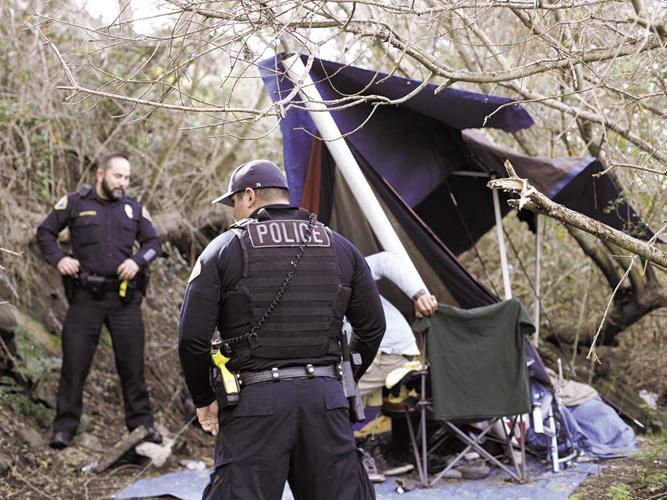
Seaside police officers Manny Fernandez (left) and Gabe Suarez speak to a man camping out in the park Feb. 27, and tell him he has to clear out.
Seaside officers do occasional patrols through the park, Fernandez says – depending on whether the number of calls for service permit it – and that the last time he was here was a couple of weeks ago.
But the patrols aren’t so much solving a problem as mitigating one, because even when encampments are cleared out, Fernandez says, “within literally days, the stuff comes back.”
Rounding a turn in the path as it begins to run parallel to North Fremont Street, the shopping cart this reporter saw just days earlier is again partly submerged in the creek. Next to it is a small log, and both Fernandez and Suarez agree it’s the best place to cross.
A few minutes later, after stepping through the trails carefully to avoid blackberry brambles, they duck under some branches toward a clearing at the bottom of the hill, just below the houses on Laguna Grande Court in Monterey.
They soon spot a makeshift shelter at the base of the hill, covered by a brown tarp, and find a young man inside it, his belongings stacked around the edges.
Fernandez tells him he needs to clear out, but the man says there’s nowhere else safe for him to go. When asked whom he needs to be safe from, the man says, “other homeless people.” Fernandez tells him there are programs that can help, but the man isn’t interested.
The man says he doesn’t mind program rules, but he doesn’t want to be a burden on society. Fernandez encourages him, telling him getting help is not being a burden, and adds that living in the park was “not sanitary.”
“It’s bad for you, it’s bad for the environment,” Fernandez says, then politely asks the man to gather his belongings and go elsewhere. He also tells the man that being homeless “doesn’t make you any less of a man.”
The man pleads to have 24 hours to comply, citing a forecast for rain. Fernandez grants him 24 hours, so long as he doesn’t sleep in the park and that he leaves by dusk the next day.
“Thank you, sir,” the man says.
(As the Weekly went to press, Stephen Cry says the man’s shelter is still there.)
Heading back into the trails, Fernandez points out where some are blocked by branches that have been sawed, hatcheted or broken off of trees, then dragged across the trails to block access. The barriers they’ve created are just as impenetrable as going off-trail, and Fernandez says this has segregated what used to be a network of trails into discrete pockets.
As to Hartzell’s plan – to create wide trails that would create access for the public throughout the forested area – would work as a deterrent to encampments and change the status quo, Fernandez says, “It’s kind of a toss-up.”
He adds it would also make access easier for the homeless, and that if it were to work, the trails would need a steady flow of visitors, like at the Frog Pond Preserve in Del Rey Oaks.
A few minutes later, back on the path and heading toward the lake, Fernandez notes other trailheads across the creek, some of which are now blocked off.
“People don’t realize how big this park is,” he says.
THE MOST RECENTLY SCHEDULED MEETING ABOUT LAGUNA PARK WAS FEB. 14, between the city of Monterey and the Monterey Peninsula Regional Park District, but due to a pressing personal matter for a key participant, it was canceled.

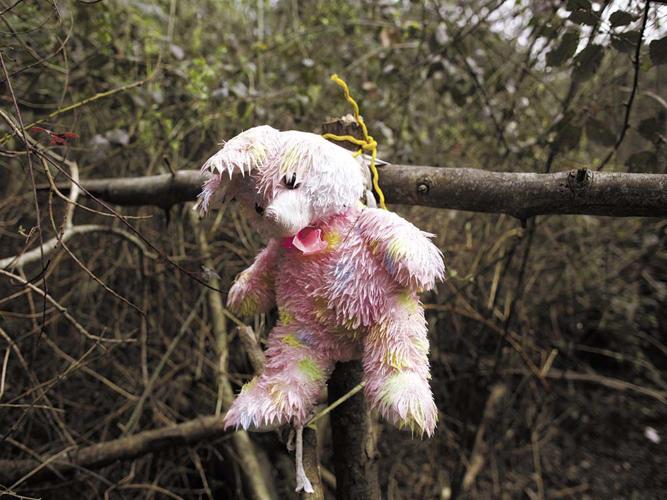
An abandoned teddy bear is strung to an entrance of an abandoned encampment.
Hartzell, from the Monterey Audubon Society, has grown frustrated by canceled meetings for years, and that his vision to create pathways through the forest remains ever out of sight.
He thinks nothing will change until somebody files a lawsuit against Seaside, or all three agencies in the JPA.
But no matter what happens, he won’t be here to see it: Hartzell, a firefighter with Cal Fire, is entering retirement, and moved to Montana last fall. He will remain engaged in the issue, but says he’s no longer in a position to apply pressure.
What’s now in the works isn’t much: The park district has allocated $60,000 to the city of Monterey to make a plan for the future vision for the park, and conduct whatever environmental review is necessary. Perhaps, Monterey planner Kim Cole says, it will be an approximation of Hartzell’s plan, or perhaps not.
That process has yet to begin, in part because of the canceled meeting.
Where things seem to be headed, MPRPD General Manager Rafael Payan says, is that the park district is going to offload its property in Laguna Grande to the two cities, but he hedges that it’s still only “one possibility.”
However the plan shakes out, it seems clear any lasting solution has to address a local homelessness crisis. At a meeting Feb. 27, Seaside City Council took a small step to that end, and agreed to endorse nonprofits Gathering for Women and Community Human Services to apply for state grant funding that could be used toward a potential homeless shelter in the city in a vacant county building on Broadway and Noche Buena Street.
Time will tell how that pans out, just like the plan for the park.
Despite everything else going on at Laguna Grande, the birds still seem to be thriving.
Matheson, from the Audubon Society, notes that a sage thrasher is wintering in the one toyon bush between the In-N-Out and M&S Building Supply on Del Monte Boulevard, in the northwest corner of the park.
“Birders are coming from all over Northern California to see it,” he says.
Thrashers, at least, aren’t put off by tweakers.
(3) comments
I had an idea that could work for he homeless problem if it was done correctly. I've submitted it to both Salinas City and Monterey County, but I guess they didn't like it or it would be too easy . It's a bit lengthy but if this comment section will let me, I will post it to you.
A great number of the homeless do have a little money, some even have jobs they just don't have enough to pay for the high deposits and 1st & last months rent to get into a regular home or apartment. , utilities and such. but they could pay a small camping fee per week or month. They have snap food cards, cell phones, and Medi-cal .
Here is my Proposed solution to the Homeless situation:
We need a "Rest Stop or KOA type of camp ground with restrooms and showers for the homeless.
There is no housing. Housing has been exhausted.
Officials are working on that? Well, it’s taking too long. Meanwhile….
Most of the homeless have tents. If they don’t then Social Services should provide them with a tent. Also, most homeless people do have some money. Just not enough to pay high deposits, or first and last months rent, utilities and such. but they could pay a small camping fee per week or month. They have snap food cards, cell phones, and Medi-cal .
Major problems caused by the homeless situation:
• Hygiene
• Sanitation
• Clutter/trash
• Fires
• Drugs / crime
• Pet litter
Keep in mind this Camp would need to be monitored and managed But so do shelters and shelters are costly to build plus they don't work.
Proposed solution:
• Sanitation and Hygiene- The camp would need restrooms with showers built like those at a rest stop or KOA camp with large floor drains so that the area could be spray cleaned daily with a hose. People need to be able to use the restroom, brush their teeth and bath . It is the most basic of needs. A person cannot go to a job interview or any public place ( supermarket, social services, Doctor) without basic hygiene. Should also provide large metal or concrete wash tubs for washing of clothing and bedding and lines to hang things for drying.
• Trash/litter: Commercial dumpsters should be provided with weekly sanitation dept. pick-up.
• Fires: Each camping area should have a space for a tent, built in BBQ grill for cooking and warming . Just like public parks( such as Toro Park), This will eliminate the need for building illegal fires. People need to have a way to cook food to eat. Picnic tables would be helpful and eliminate the need for a bunch of broken furniture to sit on.
• Drugs/crime Local police and or CHP should drive through on a regular scheduled basis . Letting their presents be known, would cut down on any illegal activity and ensure the safety for all. Plus the park manager would be on site.
• Pet litter: Most Rest stops have a pet area. (This would also make it easier for the Aspca to monitor for abuse & neglect.
There would be park rules and regulations just like any Family camp grounds but if people could know that they could set up and camp safelywithout being moved about they just might be respectful and take care of their area. If not , they would have to go.
Seriously, this would work and it would help clean up the city
But I do know that we are already wasting a lot of money on law suits, round ups, and pointless meetings. Put that money to better use instead tossing the ball back and forth and wasting time while thousands of homeless suffer and get moved from one spot to another.
Here is another idea: Prisoners and people serving court ordered Community Service could do some of the maintenance. Hire homeless people as Park Supervisors or maintenance crews.
. We cant just continue to do nothing. That's not working.
i also live a short distance from the park. i see lots of people enjoying the soccer field on an almost daily basis. i enjoy walking across the bridge to the seaside side of the park and listening to the sunday blues in the park during the summer. almost every day there are mothers with their children playing in the park. but no, i do not ever venture into the "forest" area.
Thank you for this article. I have lived less than two blocks away for years and refuse to go into the park. Just look at the bushes at the corner of Canyon Del Ray and Fremont. It is disgusting. I couldn't imagine what it would be like deeper into the park. Now i have an idea. Thank you for bringing much needed attention to this. It is a problem that no city wants to take responsibility for.
Welcome to the discussion.
Log In
Keep it Clean. Please avoid obscene, vulgar, lewd, racist or sexually-oriented language.
PLEASE TURN OFF YOUR CAPS LOCK.
Don't Threaten. Threats of harming another person will not be tolerated.
Be Truthful. Don't knowingly lie about anyone or anything.
Be Nice. No racism, sexism or any sort of -ism that is degrading to another person.
Be Proactive. Use the 'Report' link on each comment to let us know of abusive posts.
Share with Us. We'd love to hear eyewitness accounts, the history behind an article.