

Dave Eggers is a writer’s writer. He’s a reader’s writer. He’s one of the most consequential cultural figures of this millennium, and a hub of remarkably creative projects that, at their core, revere writing. And he’s been furiously productive as the source of a deluge of cool content rich in literary nutrients.
Aside from writing novels (nine thus far), nonfiction books, screenplays and articles, Eggers has published a constellation of other writers and intellects through his famed publishing house, McSweeney’s. There’s the coming film adaptation of his novel A Hologram for the King starring Tom Hanks. He co-wrote the screenplay for Spike Jonze’s Where the Wild Things Are. He’s edited anthologies like the Best American Nonrequired Reading series and enlisted David Sedaris, Sufjan Stevens, Judy Blume, Guillermo Del Toro and Matt Groening to write introductions. He did a song with Beck (who headlined the First City Fest in Monterey last Saturday), and while that isn’t all that literary, it’s pretty dang cool.
There’s more. (See: Get to Know Your Dave Eggers)
But first, a word about 826 Valencia.
826 Valencia is the San Francisco address where Eggers wanted to open a nonprofit tutoring center to match up his network of literary people with kids who needed reading and writing help. But the building was zoned retail only.
Solution: they opened up a retail front selling pirate gear. (Seriously – it’s billed as San Francisco’s only independent pirate-supply store.) In the middle went the tutoring center, in the rear,McSweeney’s Quarterly. He spoke at the 2008 TED conference in Monterey about this work and about enlisting others in tutoring public school kids in an effort called Once Upon a School. The tutoring center model has been replicated in eight cities as 826 National. Eggers won a 2008 TED prize.
He’s been back to Monterey County. His new novel, released June 17, is evidence. It’s called Your Fathers, Where Are They? And the Prophets, Do They Live Forever? The title is a verse from the Bible, but the novel uses Fort Ord as a setting, as a landscape and as an overarching metaphor.
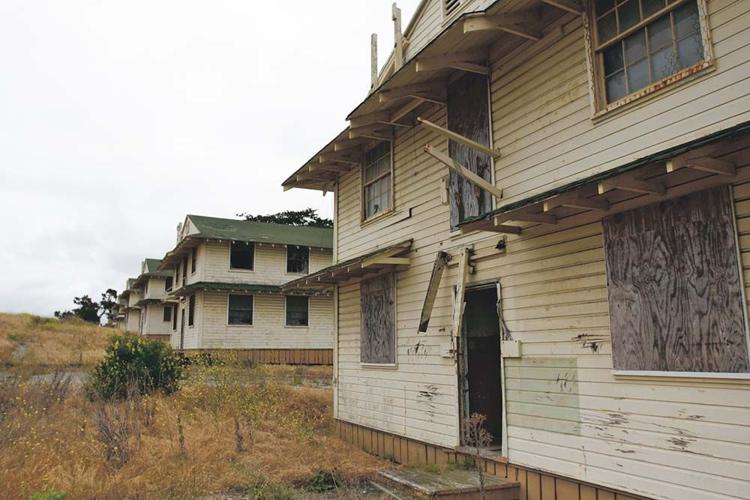
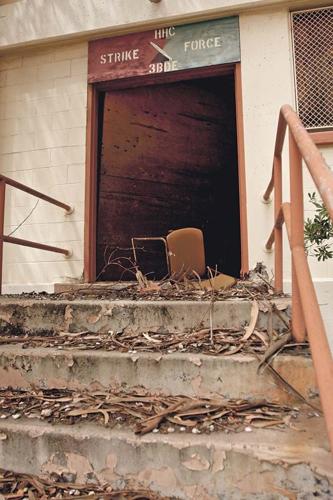
Your Fathers drops the reader right into conflict. A 34-year-old man named Thomas has kidnapped another man, an astronaut named Kevin, tied him to a post in an abandoned barrack on the former Fort Ord (though in the book, the barracks are nearer to the beach), and wants to have a deposition-of-sorts on how peers like Kevin and Thomas were cheated out of something approximating the American Dream.
It uses only dialogue and is leaner than a play, which can include cues to orient readers to movement, voice, time or location. Here, the dialogue does all the work.
Thomas is angry, disturbed, determined and earnest. He wants answers. Kevin cannot provide them all, so he kidnaps another person, a wheelchair-bound congressman, and questions him, too:
“I’m pretty sure that I would have turned out better, and everyone I know would have turned out better, if we’d been part of some universal struggle, some cause greater than ourselves,” Thomas says. He’s beseeching the congressman, a tough vet who lost a leg and arm in Vietnam, and who is trying to understand Thomas’ unrest.
He means that he seems to have found no higher purpose to spend his talents, his energy, his life. He’s so zealous to get at the root of all his life’s ailments, he keeps kidnapping more people he thinks can reveal the sources. Eggers uses a minimalist approach in these Socratic exchanges to explore the nature of how and why things turn out the way they do.
(Read an excerpt from the book.)
One reviewer noted that Your Fathers seems to form a triad of fiction novels – along with 2012’s A Hologram for the King (about the recession’s effect on family) and 2013’s The Circle (about technology’s effect on individuals) – that are urgently questioning fundamental precepts about the world.
“You have to go back to Steinbeck and Vonnegut to find a popular American novelist so willing to deploy his talents to such deliberately political ends” writes Mark Athitakis in The Washington Post.
Eggers paused from a well-earned vacation to field questions about Fort Ord, writing the novel, the nonprofit tutoring center and other things. (But first, a disclosure: Eggers spoke to my wife, Enid Baxter Ryce, and me about Fort Ord and Seaside prior to the book’s publication; she also set to work with Eggers cohort Brent Hoff on a film version of Fathers/Prophets.)
“You have to go back to Steinbeck and Vonnegut to find a popular American novelist so willing to deploy his talents to such
deliberately political ends”

Ft Ord, The Metaphor
What first tipped you off that you might want to set the book in Fort Ord? What was it about Fort Ord?
I’d been fascinated by Fort Ord for many years. My great-great-great grandfather, TS Hawkins, helped found the town of Hollister, so I’ve spent time there over the years. Fort Ord had loomed in my imagination for a while. Then, a few years ago at a flea market in Alameda, I found one of the yearbooks from the base’s active period, and it rekindled my interest. When I was writingFathers/Prophets, then, it seemed to be the obvious place where a troubled man like Thomas would focus much of his attention and confusion. He’s in a period of transition in his mind, and has dreams of past glories, past violence, and Fort Ord is a symbolic corollary for a man like this.
Do you see Fort Ord as a microcosm of something happening to the country?
I grew up near another decommissioned base, Fort Sheridan, on the coast of Lake Michigan. As kids, we spent a lot of time exploring it while it was active and then after it was decommissioned. I also lived on the cusp of the Presidio of San Francisco for a few years, so I’ve had a lot of experience watching these bases evolve from active sites to their various uses afterward. But Fort Ord is really unusual, in just how vast it is, and how unused it is. On the coast of California, on priceless land, we have this vast crumbling symbol of past U.S. military build-up and preparation, and just what to do with the site now is an interesting question. Should it be a museum to honor the soldiers stationed there? Should it be converted to affordable housing to honor the legacy of Seaside and its dream of a truly diverse and accessible American Dream? There are so many ways to think about it, but in the meantime the base slowly returns to nature.
When was the first time you came to and explored Fort Ord? Where did you go? What did you see? What was your impression?
Though I’d driven through many times, and read about the base in various articles, I didn’t explore it fully until I was writing the book these last few years. I brought my bike and spent a few days riding around, stopping, exploring, taking pictures and imagining various areas of the base as settings for the book. It is really one of the more incredible places in California. The setting is so dramatic, and the coastline so beautiful, that to have this crumbling, enormous base in the middle of this landscape is utterly fascinating. I’ve also grown to know the towns nearby, and I benefited from the hospitality of a lot of good people.
How did you decide on what specific issues you wanted to explore through Thomas and his interrogations?
The book took all kinds of turns during the writing of it. I initially had a list of interviewees Thomas would bring to the base, but most of them I didn’t end up writing about. This book actually did something that rarely happens to me, in that it took on its own life, and its path was determined by a certain internal propulsion that I hadn’t anticipated, and was largely out of my control. The character of Thomas’s friend, who died young and under dubious circumstances, I hadn’t planned on at all, but suddenly he appeared, and much was determined by his presence. At a certain point, Thomas’s efforts to try to find some explanation for his death become the driving force behind his actions and fate.
What was the process of writing the book?
Unlike some books, this one was a caterwauling joy to write. Even though it’s heavy in subject matter, the all-dialogue form does lend itself to a certain speed in its creation. It doesn’t mean I didn’t do a dozen drafts, and at one point I set it aside for a year, but overall it did come together more quickly than is often the case.
Why did you decide to use all dialogue? Was it freeing or confining?
Like many constraints, it was ultimately liberating. I was writing the book at the same time I was painting a lot, and in both cases the constraints helped a lot. With this series of paintings, I had three colors and two brushes, and that was enormously freeing. When I had written the first section of Fathers/Prophets in all-dialogue, it seemed wrong to break from that. The constraint helped keep it tight, and helped it move at the pace of Thomas’s mind. He’s in a desperate state, so the pace had to match.
What project (yours and others) are you excited about now?
A friend of mine, Brent Hoff, is hoping to film Fathers/Prophets at Fort Ord. It would be a small production, with a small crew, sometime in the next 12 months. We would love to be able to do it if the necessary agencies would be up for it. The setting is so dramatic that I feel like to do it anywhere but Fort Ord wouldn’t be quite right.
How is 826 Valencia doing? What are alum from the program up to?
The center is really thriving. This year we’ll open a second full location in the Tenderloin neighborhood, a district that has a lot of students, a lot of need and not enough services. We’ve gotten incredible support from the city of San Francisco and lots of partner agencies and companies. There’s been this wonderful pulling-together that happens every so often, even in a big city like San Francisco.
In terms of alumni, I taught a high school class for 11 years at 826 called The Best American Nonrequired Reading, and it’s surreal now that so many of my former students have finished college, and gone out into the world. I have three former students who are already teaching at the college level! And one former student, Daniel Gumbiner, now works at McSweeney’s and runs the class. He took over from me this year. So I’m sure any teachers out there can relate – it’s strange how fast it goes, and how soon your teenage students are out running the world.
Have any plans on coming to Monterey County again?
My ancestor, TS Hawkins, wrote an autobiography called Some Recollections of a Busy Life, published in 1913, and in it he talks about leaving Missouri as a young man and leading a wagon train across the plains, across the Rockies, and settling in what’s now Hollister. He and some other farmers bought the land from Colonel Hollister, who then moved down to Santa Barbara. Then Hawkins and the others incorporated the town, and Hollister was for years part of Monterey County. But Hawkins got tired of the trip 50 miles west, having to travel over the Gabilans, to get to the county seat. (This was before cars.) So he began to agitate to create a new county, and eventually, in 1874, San Benito County was created. I guess this is a very long way of saying… it’s a part of the state I love dearly and to which I feel a long and profound connection.

(0) comments
Welcome to the discussion.
Log In
Keep it Clean. Please avoid obscene, vulgar, lewd, racist or sexually-oriented language.
PLEASE TURN OFF YOUR CAPS LOCK.
Don't Threaten. Threats of harming another person will not be tolerated.
Be Truthful. Don't knowingly lie about anyone or anything.
Be Nice. No racism, sexism or any sort of -ism that is degrading to another person.
Be Proactive. Use the 'Report' link on each comment to let us know of abusive posts.
Share with Us. We'd love to hear eyewitness accounts, the history behind an article.