
When it came time for Emily Maceira to pick a high school to attend, she and her mother, Enid Maceira, took the decision very seriously. They went on tours and sat in on classes at charter schools, private schools and public schools. They took notes on the curriculum, spoke to teachers and compared costs.


On a visit to Monte Vista Christian School, a private co-ed school in Watsonville, Emily sat quietly in a freshman classroom. In a crowd of white faces, the teacher asked Emily a question: “Oh, what ethnicity are you?” She was stunned. Suddenly, all kinds of questions about her racial background sprang from the students.
The situation was “uncomfortable,” says Emily, who’s half-white and half-Latina. The questions were enough to put her off the school. “I was just there to see what they were learning,” Emily says.
Nearing the end of their search, Enid and Emily gravitated toward Notre Dame, an all-girls private school in Salinas.
But instead, Emily chose Seaside High School, the same high school her mother attended from 1985-87.
“It was closer,” Emily says, “and I wanted to do something different.”
Different, as in public. Since the time she was in kindergarten and until seventh grade, Emily attended Monterey Bay Charter School in Pacific Grove. In seventh grade, she tried a type of home-schooling at the Monterey Bay Educational Center. But Emily had never attended a classic public school.
Her lack of public school experience ultimately presented some challenges. She was unprepared for a nightly homework routine, and after two years at Seaside High, she needed to catch up on English, math and geography. Now a 16-year-old junior, she is enrolled in Central Coast High School, a continuation school a mile down the road from Seaside High.
Despite her struggle to catch up academically, Emily doesn’t regret her choice. She plans to return to Seaside to graduate in 2017 with her class. She likes that being in a diverse public school has allowed her to make a diverse group of friends and, when outside of school, she notices when someone is feeling left out.
“I hang out with a lot of black people, some white people and Mexicans,” Emily says, “and when I see someone doesn’t fit in, I approach them. I know that feeling. It’s a weird feeling.”
“She has some troubles, but she has all kinds of friends,” Enid says. “Black friends, white friends, gay friends, transgender friends.”
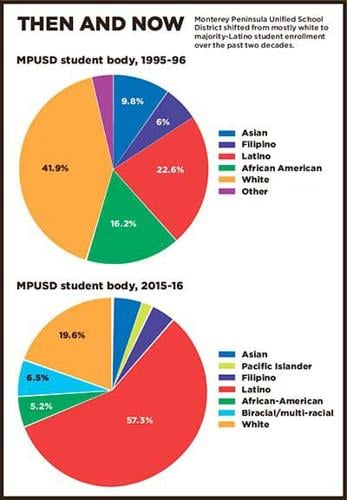
Social diversity is something both mother and daughter shared in their experience at Seaside High, even though their time there came decades apart. Demographic trends show the relative diversity of their peers is something Monterey Peninsula Unified schools have more or less sustained.

MPUSD student body
Editor's note: The keys in the above charts have been updated to reflect the following correction: An earlier version inverted the labels for white and African-American students; 16.2 percent of MPUSD students in 1995-96 were African-American and 41.9 percent were white, not the other way around, and 5.2 percent of MPUSD students in 2015-16 were African-American and 19.6 percent were white, not the other way around.
But there are big shifts happening in other local districts, consistent with changes in Monterey County’s population – which is majority Latino – as a whole. From 1995 to 2015, MPUSD went from having a majority of white students to a majority of Latino students. In Salinas schools, the shift is even more radical. A look at demographic data shows why diversity in public schools may be harder and harder to find.
:: ~ ::
The face of the United States is changing rapidly. To look at the face of the future, look no further than public schools. Like Emily, kids and teens have fewer hang-ups about the identities of their peers. Yet, there is a troubling national trend at hand. While the U.S. is growing more diverse as a whole, its schools are becoming resegregated. Children from different racial, ethnic and income groups are now less likely to find themselves in a classroom with each other than they were two decades ago.
In Monterey County, the changing demographics of schools are more nuanced than the national picture, with schools in the Salinas Valley becoming almost exclusively Latino and Monterey Peninsula schools growing more diverse.
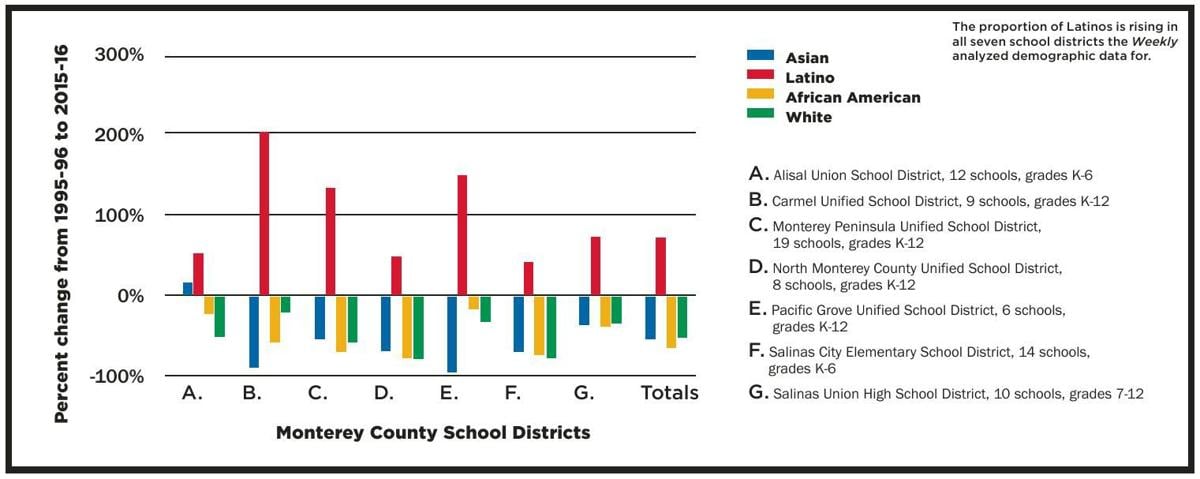
To see how local schools have changed in the past two decades, the Weekly collected and analyzed data from California Department of Education for the 1995-96 and the 2015-16 school years, as well as U.S. Census data from 2000 and 2015 for seven county school districts (see graph, p. 22) that account for the majority of students countywide.
After compiling spreadsheets and crunching numbers, three main trends emerge: White populations are aging faster in comparison to other ethnic grooups, in part because their adult children no longer live in the area; many African-American families have left for other regions; and the Latino population continues to increase across the board.
School districts in the Salinas Valley, which have been predominantly Latino for decades, are now becoming almost exclusively so. The Alisal Union School District increased from 91.5-percent Latino in 1995-96 to 96.1-percent Latino in 2015-16. The Salinas Union High School District went from 69.6-percent Latino to 85-percent over the same period.
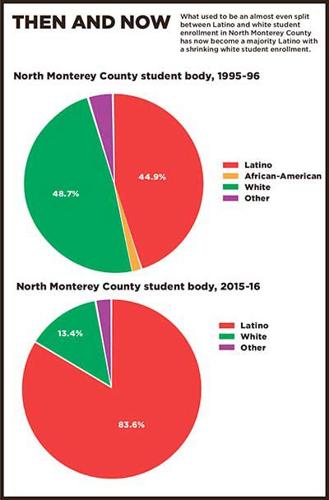
Other local districts are becoming increasingly Latino, consistent with larger demographic shifts. The North Monterey County Unified School District went from 48.7-percent white and 44.9-percent Latino in the 1995-96 school year to 13.4-percent white and 83.6-percent Latino in the 2015-16 school year.
Census data for the three zip codes that make up NMCUSD, including Castroville and Prunedale, show that white people comprised 46 percent of the population in 2000, then 28 percent in 2015. Over that 15-year period, the number of white people went from 14,661 to 9,612 – a drop of more than 5,000 people.
“The aging of the white population and their kids following jobs outside of the region is a trend,” says Jose Luis Alvarado, dean of the College of Education at CSU Monterey Bay. “There’s a brain drain that has taken place.”
The changing demographics of schools and communities doesn’t look the same in Monterey County as it does in the San Francisco Bay Area and other urban centers across the country. But it is this “brain drain” that’s a contributing factor to the gentrification of cities like San Francisco and Oakland and, in turn, resegregation – the consolidation of race, ethnicity and family wealth along geographic lines.
“School resegregation is more than just an educational problem, it’s a societal problem,” Alvarado says. “When you compare this trend to property values, incomes and test scores, they’re in line.”
While both the Carmel Union School District and the Pacific Grove Unified School District are more than 60-percent white, enrollment of Latino students in the districts have increased by 202 percent and 148.7 percent, respectively, over the past two decades.
Monterey Peninsula Unified School District, meanwhile, includes the mostly white (68-percent) city of Monterey, but also the two most diverse cities in Monterey County: Marina and Seaside.
Since 1995, there have also been major shifts in the makeup of the student body. The population of white students in MPUSD fell from 41.9 percent of the student body to 19.6 percent in 20 years. The percentage of Latinos in the district doubled in that same time period, from 22.6 percent to 57.3 percent.
The most notable change in demographics of the district is the sharp decline in African-American students. In the 1995-96 school year, black children and teens made up 16.2 percent of the student body at MPUSD; by the 2015-16 school year, the number dropped to 5.2 percent.

North County student body
The proportion of African-American student enrollment fell even more than that of white students, decreasing by 70.7 percent (compared to 57.1 percent for white students). Yet, the rates of change in population at large in the zip codes that make up MPUSD tell a larger story: From 2000 to 2015 the African-American population decreased by 44 percent as opposed to the total population of whites, which decreased by 8 percent.
The data shows that black families have moved out of the county. Seaside once boasted one of the largest population of African-Americans in California between San Francisco and Los Angeles; the drop in Seaside’s African American population is largely attributed to the closure of Fort Ord in 1994.
Carol Lynn McKibben, a historian and a lecturer at Stanford University, describes this change in her 2012 book on the history of Seaside, Racial Beachhead: Diversity and Democracy in a Military Town. “By 2000, [Seaside] was quickly losing its population of military families of all races, as middle-class blacks and others were able to make huge profits on their homes as many returned to the south to spend their final years in their hometowns,” McKibben writes.
A discussion of race, ethnicity, incomes and test scores is not without its traps and temptation to oversimplify. The terms black, white, Latino and Asian are broad brush strokes that lack detail and historical context.
Ta-Nehisi Coates, national correspondent for The Atlantic, captures this dilemma in his 2015 book Between the World and Me, where he only refers to white people as “people that believe they are white.”
Even within the past 100 years, the classifications and terminology of race and ethnicity have changed. It was a little more than a half-century ago that the Italian families who help build the Monterey fishing industry weren’t seen as white, but rather as Sicilian.
Yet, race still matters. In 2005, white men in the U.S. workforce earned, on average, $21 an hour as opposed to African-American men earning $15 and Latino $14, according to a 2016 Pew Research Center Report. Women earned less than their male counterparts in every demographic, the same study also found.
In 2013, the median household wealth – home equity, savings, retirement, etc. – for white families was $141,900, according to a 2014 report by the Pew Research Center. The figure is 13 times higher than the $11,000 in median wealth held by black families. Latino families had a median household wealth of $13,700. Both reports found the Great Recession only increased the disparities.
The effects of these disparities can be seen in the schools of Monterey County. The Carmel Unified and the Pacific Grove Unified school districts both have the whitest population and the highest median income for school districts in the county. CUSD and PGUSD districts also spend nearly $2,000 more per student than the average ($11,914 per student per year) in the districts the Weekly analyzed. Students in Carmel and Pacific Grove also report the highest standardized test scores in Monterey County.
Only 20 percent of students met or exceeded the standard for English language literacy and 13 percent for math in the Alisal Union School District in 2015. On the other side of the Lettuce Curtain, 80 percent of students attending Carmel Unified schools met or exceeded literacy standards, and 69 percent did so for math.
(While Alisal Union serves students in grades K-6 and Carmel Unified serves K-12, the test score trend holds true across Salinas high schools as well. In 2015, 31 percent of high school students met or exceeded English language standards, and 14 percent met or exceeded standards in math.)
“I would love to see more equitable funding for school districts where real estate values where children live don’t determine the amount of resources available to them,” Alvarado says. “There are some great students coming out of the Salinas Valley, but their schools are forced to do more with less.”
:: ~ ::
Sitting in a small office on Stanford University’s pristine campus, Ignacio Ornelas has come a long way from his humble beginnings as an undocumented child of farm workers in East Salinas. Ornelas is a Ph.D. candidate at UC Santa Cruz and a researcher at Stanford’s Special Collections and University Archives. He is currently finishing his dissertation on how immigration and the Chicano and farmworker movements shaped the politics and culture of the Monterey Bay area in the 20th century.

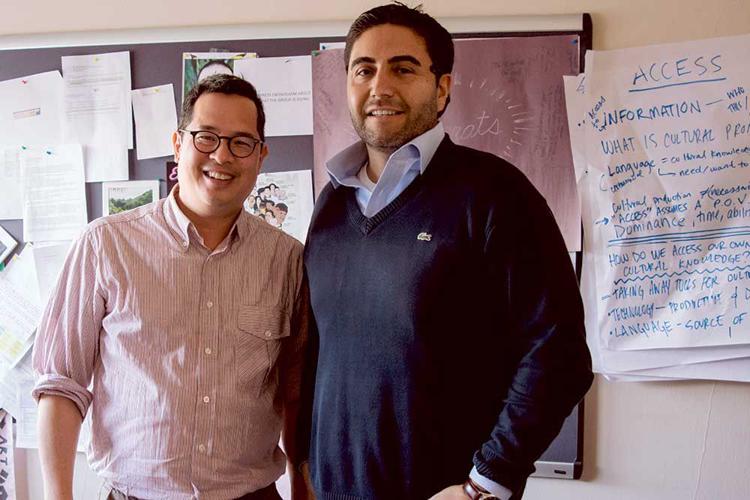
Jeff Chang, left, and Ignacio Ornelas, right, work in the same Stanford University office.
For Ornelas, who graduated from Salinas High in 1996 and then taught history and social studies at both Alisal and Alvarez high schools, the problem is not that schools in his hometown are becoming almost exclusively Latino, but that the diversity he found at Salinas High in the 1990s gave him more tools for life that many students today may not experience.
Salinas is full of Mexican-Americans and Latinos who are well-educated and earning good incomes, he continues, but there are many children of recent immigrants living in extreme poverty.
“For me, it’s all about zip code. From zip codes you can tell the income and education levels of parents,” he says, “which can have more influence on a child’s success than teachers have.”
The zip code 93905 covers the Alisal, or East Salinas. In 2015, only 38.6 percent of adults in 93905 had a high school diploma or higher educational attainment. The median household income for the year stood at $42,754, more than $16,000 below the county average.
After leaving Alisal High, Ornelas took a job at a high school in Silicon Valley. The differences were shocking.
“I don’t know how we can punish teachers in Salinas for low test scores while praising teachers in Silicon Valley for their students’ high test scores,” Ornelas says. “Kids from low-income areas have to work a lot harder to succeed.”
Across the Stanford office, Jeff Chang sits behind his cluttered desk. While Ornelas has taken a historian’s eye to population changes and Latino movements in the Salinas Valley, Chang has set his sights on the intersection of hip-hop, social justice and politics.
Chang is the executive director of the Institute for Diversity in the Arts at Stanford. His most recent book, published in 2016, is We Gon’ Be Alright: Notes on Race and Resegregation.
Chang titles the first chapter of We Gon’ Be Alright as a question: “Is Diversity for White People?” In it, he outlines how the Civil Rights Act of 1964 sought to integrate African-Americans, Latinos and Asians with white America through affirmative action. While images of angry white parents protesting young black students still haunt the U.S. psyche, the nation’s schools and universities did become less segregated.
Then came the 1978 decision in Regents of the University of California v. Bakke. The U.S. Supreme Court ruled race-based quotas under affirmative action were unconstitutional, at the same time praising “diversity” as being “an essential ingredient to the education process.”
It was at this time, says Chang, that “diversity” became the catch-all phrase for racial inclusion – integration be damned.
Integration is intended to bring students of different racial, ethnic and economic backgrounds together – with equal access to resources. Diversity, on the other hand, can be reflected in numbers alone. Schools started to enroll just enough high-achieving students of color to confirm the high ideals of education – but not enough to change the racial makeup of the institution, Chang says.
He cites a study by Kendra Bischoff of Cornell University and Sean Reardon of Stanford, who found that in 1970, 17 percent of people in the U.S. lived in the highest-income and 19 percent in lowest-income neighborhoods.
In 2012, 30 percent lived in the highest-income and 30 percent in the lowest-income neighborhoods, evidence of neighborhoods forming around income level – the opposite of integration.
While the choices of individual parents can’t stem the flow of history, the choices of millions of parents have shaped the resegregation of schools. Parents with money, transportation and the time to navigate bureaucracy can send their kids to high-performing schools, whether they be public, charter or private, Chang says.
Low-income parents don’t often have those luxuries, so their kids are more likely to go to underfunded and under-performing schools in the neighborhood, widening the achievement gap further. (Chang sent his own kid to Berkeley public schools, which bucks the national trend, remaining racially and economically integrated.)
“I’m not going to judge parents on doing what they think is best for their children,” Chang says. “But I do think we should all be very uncomfortable about that choice. We shouldn’t minimize the discomfort.”
:: ~ ::
It’s a rainy Sunday afternoon on Jan. 22. Despite the bad weather, a slow swell of parents and educators settle around lunch tables inside the cafeteria of Marina Del Mar Elementary School in Marina to talk about education. Specifically, they’re there to brainstorm where they should send their kids to school, and on what terms should they be basing their decisions.
Vanessa Diffenbaugh – the mother of two biological white children, two adopted black children, wife of MPUSD’s superintendent and a best-selling author – prefaces the workshop with a story. She recounts sending her daughter to a well-funded public school in Newport Beach, where at the bottom of the slide her daughter would “land on a pillow of white sand.” She remembers engraved personalized pencil boxes.
Then in 2014, the Diffenbaughs moved to Monterey, where they struggled with the decision on where to send their daughter to school.
They ultimately decided on Del Rey Woods Elementary School in Seaside, even though their neighborhood school enjoys more resources.
Her daughter has adjusted well – despite being in the minority racially. In 2015-16, 400 of 459 Del Rey Woods students identified as Latino. As Diffenbaugh described it, her daughter was a “white girl in a sea of brown faces.”
It shows that despite data showing MPUSD is the most diverse school district in the county, it doesn’t mean students are integrated on a classroom-to-classroom level.
Diffenbaugh saw Del Rey Oaks as an opportunity to change that at least a little.
“Our kids spend the majority of their day in schools,” she said at Marina Del Mar. “If they aren’t together in our schools, how are they going to interact with each other as adults?”
A similar instinct took Emily Maceira to Seaside High. But families choosing diversity and poorer public schools over other options is very rare. That integration is not happening naturally.
As Chang notes, these decisions for families are – and should be – challenging. They can bring personal priorities of family to odds with the more diffuse needs of public schools and communities.
Current policy options may intensify resegregation trends further. The Trump administration has proposed scrapping traditional models of funding and giving parents $12,000 per year for them to send their children to the public or private school of their choice. This “school choice” means of educational funding has been championed by Department of Education Secretary Betsy DeVos, despite its questionable success in her home state of Michigan.
For Alvarado and Chang, a scheme like this becomes a subsidy for the middle and upper classes to take their kids – and funding – out of public schools, exacerbating current trends.
“Even in the best circumstances, it took us decades to get here,” Chang says. “It will take us decades to get out of it.”
(3) comments
The DeVos Pyramid Cartel bought ALL the Republican Legislators in Michigan, so they could impose their "Make our Public Schools serve the Savior" agenda. Yes, she said that, literally. It was White Supremacy on steroids. In less than a decade, the Michigan Public Schools PLUNGED from the top ten of performance, test scores and graduation rates all the way to the bottom with Mississippi. That was the DeVos Cartel intention.....to maim, then kill Public Education. Why?
White Christian Dominionists were sick and tired that their lovely white children had to sit next to.......Those Kind of kids (black, Latino, gay, different) So DeVos played all the White Christian Fear and Bigotry Cards in Michigan. It worked! Michigan Public schools are now starved to destruction, blacks and minorities are back in their places, white majority, unregulated, Private, Parochial and Charter Schools took all the taxpayer money away from Public Schools. The end result? Blaming the victims. Instead of investing in Public School Education, it was targeted for demonization, assault and abandonment. The White Christians in Michigan are doing fine now, re-segregated in their OWN schools, safely away from the unwashed, unSaved minorities.
Blame this ongoing National Disaster squarely on Betsy DeVos, the New George Wallace of the Christian Right.
Isn't it time to add some new categories to the pie chart? It's obvious to me because my 3 year old son is White (Irish, Norwegian) and Latino (Mexican). There was a white woman at Seaside McDonalds the other day with 4 "Latino" kids. White women are marrying the men who are available here and so the population is becoming more diverse. We need new categories and if we did that then maybe we'd see more of a rainbow.
The law should not make distinctions on the basis of race or ethnicity, and people should not either. That's true whether the distinctions are made for old-fashioned, politically incorrect reasons, or now-fashionable, politically correct reasons. Racial essentialism is a bad thing, and using race as a proxy for how people think or what experiences they have had is a bad thing, too. Treat people as individuals, and quite obsessing over skin color. It's not that complicated or difficult, and it's the only way forward as America becomes increasingly multiracial and multiethnic.
Welcome to the discussion.
Log In
Keep it Clean. Please avoid obscene, vulgar, lewd, racist or sexually-oriented language.
PLEASE TURN OFF YOUR CAPS LOCK.
Don't Threaten. Threats of harming another person will not be tolerated.
Be Truthful. Don't knowingly lie about anyone or anything.
Be Nice. No racism, sexism or any sort of -ism that is degrading to another person.
Be Proactive. Use the 'Report' link on each comment to let us know of abusive posts.
Share with Us. We'd love to hear eyewitness accounts, the history behind an article.