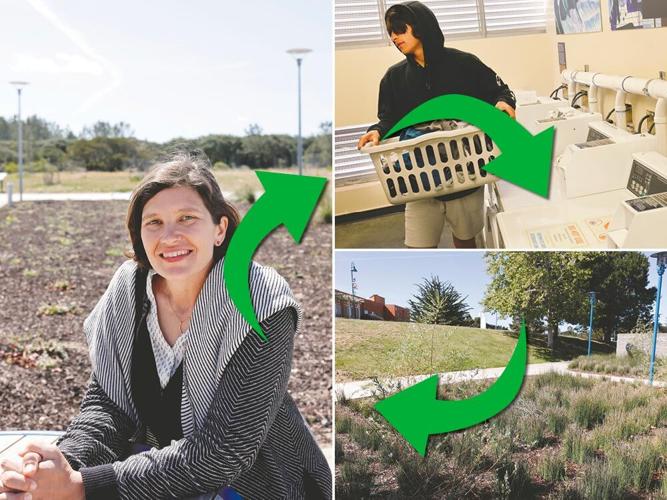


(left): CSUMB Sustainability Director Lacey Raak sits in the area behind the university library where coast live oak seedlings and native plants are replenishing the oak woodland. Raak says she’s certain they’ll meet a goal of planting 2,030 trees by 2030. Carbon neutrality and 90-percent waste reduction will be tougher goals to achieve. (above): A student gets set to do laundry inside the Pinnacles Suites laundry room where a CSU grant paid for a system that diverts graywater into two holding tanks outside for watering the surrounding landscape. (below): Over 400 grass plants and a few willow trees are supported by the system.
LACEY RAAK, DIRECTOR OF SUSTAINABILITY AT CSU MONTEREY BAY, IS NOT AFRAID OF PURSUING WHAT SOME MIGHT CONSIDER THE IMPOSSIBLE. She oversees the implementation of 30 goals contained within the CSUMB Inclusive Sustainability Plan designed to combat the Earth’s greatest threat, climate change. The deadline for meeting those goals is the year 2030, just eight years away.
Most of the effort is in pursuit of three main priorities, and they are huge: 1) Reduce greenhouse gasses to the point of achieving carbon neutrality; 2) Plant 2,030 trees; 3) Divert 90 percent of CSUMB’s waste from reaching the landfill.
“They are very big goals, and that’s what we wanted. We wanted them to be ambitious,” Raak says.
At the same time, CSUMB is also actively planning to expand by 2035. A draft environmental impact report for its master plan projects a doubling of the full-time equivalent students from 6,250 last year to 12,700 by 2035. The number of faculty and staff could also more than double, from just over 750 to more than 1,775 full-time equivalent employees. The plan also calls for adding 2.6 million square feet of new building space. The draft EIR will be up for approval by the CSU Board of Trustees at the end of May.
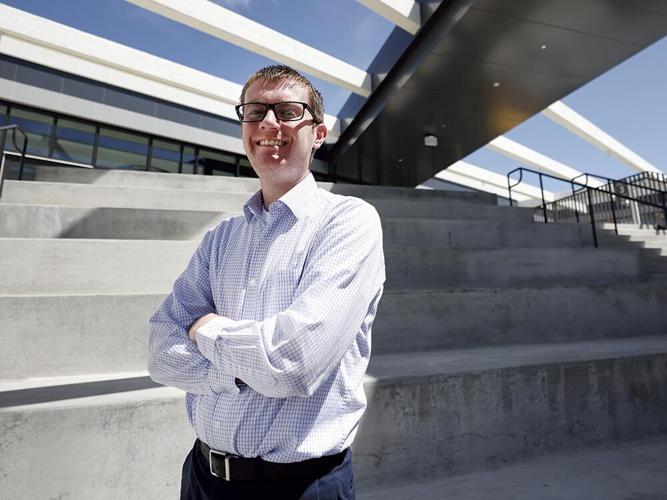
“It’s tricky to accomplish when CSUMB wants to grow a lot in the future,” says CSUMB Senior Ethan Quaranta, who participated in crafting the Inclusive Sustainability Plan from 2019 to 2020. But he is similarly hopeful about meeting the targets: “I think we’ll get there, we have a good track record.”
The clock is now ticking for CSUMB to meet its self-imposed 2030 deadline, not an inconsequential date for sustainability goals. It’s the same year the Intergovernmental Panel on Climate Change said greenhouse gas emissions must be cut in half throughout the world to limit the devastating effects of the global warming.
The Inclusive Sustainability Plan went quietly into effect in 2020 – public fanfare for its launch was tabled due to the Covid-19 pandemic, and the university reintroduced it at a “State of Sustainability” event on May 4, after the Weekly’s deadline. Since the plan was approved in 2020, 300 trees have made it into the ground. Raak is “100-percent” not worried CSUMB will meet its goal of 2,030 trees.
The other two core goals – achieving carbon neutrality and reducing waste by 90 percent – “will require serious campus commitment and dedicated collaboration with our partners” beyond CSUMB’s borders, Raak says.

Senior Ethan Quaranta is capping off a busy four years as an environmental and community activist. Last year he led an effort that convinced the CSU Board of Trustees to vote to divest from fossil fuel companies.
A MAJORITY OF CSUMB STUDENTS HAD ALREADY SIGNALED THEIR SUPPORT FOR SUSTAINABILITY long before the most recent plan was created in 2020. A 2019 survey found that 60 percent of students who responded said CSUMB’s pursuit of those principles before the adoption of the recent plan factored into their decision to apply to and attend the university. For underrepresented students, the percentage was 66.
The university has a long history of commitment to sustainability: In 2007 then-president Dianne Harrison signed the Presidents’ Leadership Climate Commitment organized by the group Second Nature; the university’s first Climate Action Plan was approved in 2013; its first sustainability director was hired in 2016; in 2018 CSUMB became the first university in the world to develop an approved vision plan with the Living Community Challenge, created by the Seattle-based International Living Future Institute, an organization that promotes sustainability. Over the years CSUMB has increased its offering of environment-focused courses and programs, including the College of Business’ Sustainable Hospitality Program.
A “larger campus culture of caring about sustainability” is one of the primary reasons that Quaranta chose to enroll at CSUMB. “It was definitely a pretty big factor for me, and all the opportunities in the [community] to get involved. I didn’t want to just learn in the classroom,” he says.
“I’m obviously very worried about the climate crisis. The IPCC report is terrifying,” Quaranta adds. Working as an activist keeps him from falling into despair. One of his biggest accomplishments while he’s been at CSUMB is successfully leading a movement to convince the CSU Board of Trustees – which oversees the whole CSU system statewide – to divest from fossil fuel companies last October.
Quaranta draws a direct line between climate change and an unequal impact on communities of color. “It’s all a complicated web of why I study what I do and why I advocate for what I do,” he says.
As the Associated Students’ sustainability ambassador, Quaranta took part in discussions to create the Inclusive Sustainability Plan. A collaboration of students, faculty and staff worked to develop the plan. Quaranta says they made sure student voices were heard. (He’s an environmental studies major with a concentration in sustainable communities and a minor in environmental health policy.)
“Something that is really special about the [plan] is the overarching concept is environmental justice,” he says, something other institutions with sustainability plans overlook. “The younger generation that makes up the majority of the campus population cares about social justice a lot. It felt like they were listening to us younger folks.”
At the heart of CSUMB’s 40-page Inclusive Sustainability Plan is environmental justice and inclusion. For a university designated as a federal Hispanic Serving Institution that is 80-percent non-white, it’s imperitave to view sustainability through a lens of environmental justice, says Brian Corpening, associate vice president for the Office of Inclusive Excellence and Sustainability. People of color are more likely to suffer the impacts of pollution and climate change.
“Diversity, equity and inclusion work is not just for people of color, it’s for everybody,” Corpening says.
All 23 CSU campuses have sustainability plans in addition to a system-wide policy approved by the Board of Trustees in 2014, which was recently updated in March. Campuses also participate in the national Sustainability, Tracking, Assessment and Rating System known as STARS, which rates campuses across the country for their progress in pursuing sustainability. Campuses can earn green, bronze, silver, gold or platinum ratings – CSUMB currently has a silver rating.
CSUMB is one of the few universities in the system that focuses on inclusiveness, along with UC Santa Cruz, where the term “inclusive sustainability” was coined in 2015 by the People of Color Sustainability Collective (and where Raak worked prior).
That focus on social justice is also an educational imperative, Corpening says. Regardless of major, CSUMB is preparing students to be citizens of the world. “Everyone has a role as stewards of the planet, everyone has a role in respecting and valuing each other and making sure the planet is here for future generations,” he says.
Raak believes CSUMB also has a responsibility to lead on a global scale as an institution. “The two biggest challenges facing the world are climate sustainability and injustice. When you’re a higher education institution you have an obligation to push farther because that’s what moves society toward that goal,” she says.
HANGING ON THE WALL OF MIKE LERCH’S OFFICE in the facilities management building on campus is an aerial view of the former Fort Ord Army base before it was decommissioned. Now CSUMB’s director of energy and utilities, Lerch was a teenager when his dad paid the Army $17 for the opportunity to take apart one of the wooden barracks plank by plank for the lumber. Lerch, a graduate of Carmel High School, says as they were struggling to pull apart the building he wondered if all that effort was really worth it.
Today Lerch oversees not just existing energy and utility infrastructure but is also involved in planning for CSUMB’s expansion – and how to temper that expansion with carbon-cutting efforts.
Past strategies included a small field of solar panels located across the street from Lerch’s office building. CSUMB does not own them; they were constructed by a private firm under an agreement that commits the university to purchase all the energy the panels generate. Overall, solar and conservation measures have already helped reduce building energy use on site by 51 percent from 2010 to 2018, according to the sustainability plan. Total energy usage has not increased over that same time period, despite having added 50-percent more building square footage to the campus and doubling the student population to over 7,500.
Constructing more solar panels is less of an emphasis today, Lerch says, as the state’s grid uses more and more electricity from clean sources like wind and large solar fields. Spending money on constructing panels for a single institution makes less sense, since the electricity it’s purchasing is cleaner already, Lerch says.
Instead, CSUMB is placing a greater focus on manufacturing its own heating and cooling systems through the use of industrial water. In the case of industrial hot water, the water is heated in a central plant in a large boiler, then pumped to specific buildings plumbed for the purpose. The water loops back to the plant, where it’s treated in such a way as to not corrode the pipes and heated again. (Another type of system that does not use water is incorporated into residence halls.)
The university also uses industrial chilled water, which actually makes electricity while cooling academic buildings. In that system, energy as heat is absorbed by the chilled water. For every two units of heat rejected by the system, they use one unit of electricity, Lerch says. That system was built for the library and last year the new Otter Student Union was hooked up to the system, but it will have to be replaced in the future. “We are running the ragged edge of the library chiller plant,” he says.
All of CSUMB’s efforts to use renewable energy mean that renewable accounts for 17 percent of total energy used, as reported by the sustainability plan. The goal is to add more. As Lerch prepared data for the master plan’s draft environmental impact report, he could see that the goal of achieving carbon neutrality – reached when “the net amount of carbon dioxide or other carbon compounds emitted into the atmosphere is reduced to zero because it is balanced by actions to reduce or offset these emissions,” according to the plan – would be a huge challenge. “Natural gas is always going to be a problem,” Lerch says. “Our takeaway was that we need to deal with the natural gas.”
One answer is to build a heat chiller recovery plant on site – similar to the idea currently used for just two buildings – that will keep more buildings cool while creating energy at the same time. Once constructed, the plant will also give them the capacity to take heat from the recovery plant and inject it into a heating system. “Any heat we reject into the heating system is less natural gas we have to burn,” says Lerch.
The heat chiller recovery plant, estimated to cost $3 million, is set to break ground this year, with a 12-month construction timeline. According to the master plan, CSUMB will need to construct two more heat chiller recovery plants on campus to accommodate more buildings and replace the aging library system.
In the meantime, Lerch and his colleagues are on the hunt for more ways to get CSUMB closer to carbon neutrality as the university grows. One way will be to convert more campus lighting to LED lights. To meet the goal, Lerch continues to search for other avenues. “We’re actively looking for other sources of heat in the area,” he says.
That includes partnering with surrounding communities, which Raak says will be necessary to be successful. “Carbon neutrality is dependent on other factors outside of campus,” she says.

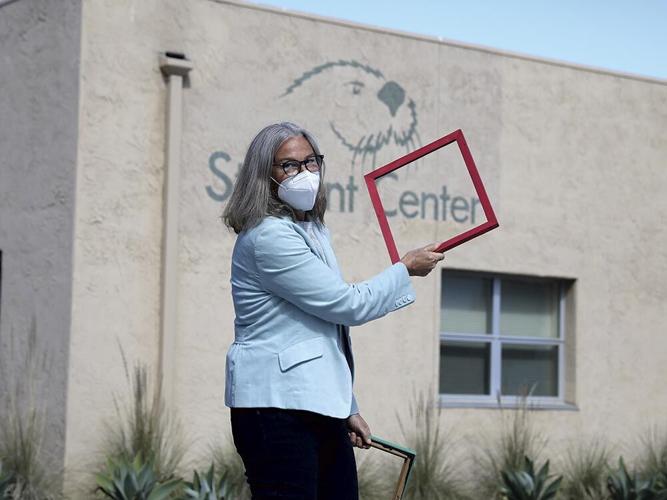
Applied Environmental Science Associate Professor Victoria Derr demonstrates a class exercise called photovoice on a recent tour for faculty and staff about using the campus as a living laboratory. For the exercise students hold up frames to enable them see the campus’ built and natural environments and how they interact in different ways.
PLANTING TREES MAY BE THE EASIEST SUSTAINABILITY PLAN GOAL TO CONQUER. Along with increasing the amount of native plantings, removal of invasive species and protection of rare species, it’s also one of the ways the university is increasing learning opportunities in a very hands-on way, while restoring habitat from what the Army’s presence stripped away.
“At the most basic level, we’re planting trees,” says Professor Fred Watson of the Applied Environmental Science Department. “You could just plant trees or you can create habitat and restore the land, and that’s the approach we’ve taken.”
The trees they are planting are coast live oaks, the same trees that would have grown there before the Army arrived. Volunteers with Return of the Natives, a nonprofit founded by a group of Salinas educators and Moss Landing Marine Lab scientists on the CSUMB campus in the 1990s, provide the seedlings grown from acorns in a greenhouse. The season for planting seedlings runs January through March, with monthly planting days involving students and other volunteers. The rest of the year is for pulling out invasive species like ice plant and French broom.
Most of the tree plantings take place close to the campus core which makes for easier care in the early years of growth. “I’m optimistic we’ll be able to give them the attention they need,” he says. “It won’t be a ‘plant it and forget it’ exercise.”
To determine where to plant, a student studied aerial images taken before the Army’s arrival to see where the oak woodland used to be, to avoid planting in areas that used to be other habitat, like meadows, Watson says. “That enabled us to create these patches of restoration that will become oak woodland again, that restores parts of the landscape to its natural condition.” The mapping exercise also pointed out where future buildings are planned, water availability and other factors.
For Watson, one of the key components of the inclusive sustainability plan is that it’s intertwined with policies that will support initiatives like restoration and protection. “These can be important things when you look at all of the pressures on a budget,” he says. “If it’s not in the policy and not in the plan, it’s hard to get those things taken care of.”

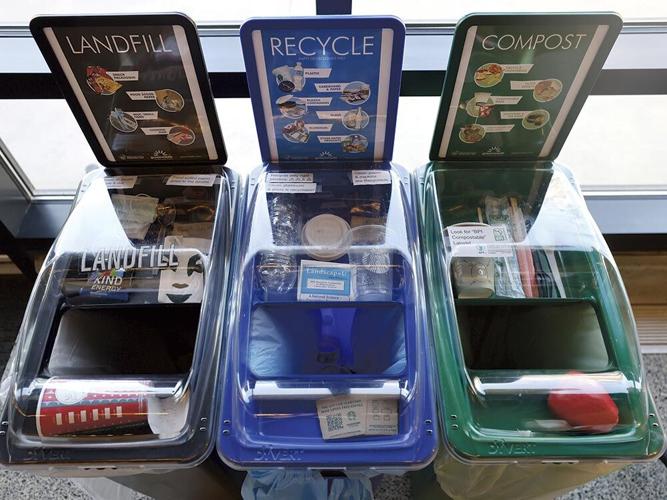
CSUMB is testing out sets of waste diversion bins that use displays under plexiglass that show actual examples of what goes into the landfill, what can be recycled or composted. The displays allow for changing out items as the availability of what can be recycled or composted changes.
IF TREES ARE EASY, reducing the carbon footprint and diverting waste are going to be equally challenging, Raak says, although she believes CSUMB will have more control over its waste output. There is no designated waste diversion manager, leaving different groups on campus to work toward the goal.
“That’s great to support collaboration and breaking down silos and working together – that’s if it works well – but it doesn’t work well if you wind up reinventing the wheel every year,” Raak says. (She’s optimistic the management position will be filled.)
The university already met the state mandate to reduce waste by 75 percent by the year 2020, in large part because it has consistently diverted construction and demolition waste – up to 90 percent – according to the sustainability plan. Between 2016 and 2018, there was a 33-percent reduction in per-person waste, thanks to efforts to increase food composting, e-waste recycling and other measures.
Food composting efforts got a boost after a former student, Carolyn Hinman, created an initiative as part of her capstone project. When she entered CSUMB in 2016 as an older transfer student, she was surprised when she moved into East Campus housing that there was no food waste composting. Hinman contacted waste hauling company Greenwaste, which helped her get food waste containers on campus. That led to an internship with the company as CSUMB’s recycling liaison. She now works for Greenwaste as an environmental outreach coordinator working with the cities of Capitola and Scotts Valley, a career she’s passionate about.
Two of the biggest targets for waste diversion are residence halls and dining services. The residence halls have been actively working on waste diversion for several years by partnering with Goodwill Central Coast, says Robyn DoCanto, coordinator of Housing Operations. Goodwill bins are located in each of the residence halls where students can drop off unwanted items.
Moveouts at the end of each year were once a major source of waste, but a major push toward donating items has helped. Ahead of this year’s May moveout, the residence halls are doing a larger drive May 2-6 with Goodwill, Dorothy’s Place, the Thomas Carman Food Pantry in Marina, as well as a few on-campus organizations.
Last fall, CSUMB contracted with a new dining company, Chartwells Higher Education, operating as Otter Kitchens, which focuses on sustainability. One of its initiatives is a proprietary system called Waste Not 2.0, which tracks food waste in the kitchen and on the plate. Employees enter data about the food waste they find in compost bins, which in turn informs them on what needs to be done to curb waste, whether it be training kitchen staff on cutting skills or educating students on portion sizes. Recently, Otter Kitchens announced a limited relaunch of a reusable to-go box, with plans to expand in the fall.
Raak sees opportunity in further reducing single-use containers.
“I would love to rethink that system and have the whole campus be a pilot for reusables,” she says.
THE CSU BOARD OF TRUSTEES is expected to consider the draft EIR for CSUMB’s proposed master plan when the trustees meet in Long Beach on May 24-25. If approved, it will map out how the campus will expand built spaces to house more of the estimated 6,000 additional students and 750 more faculty.
The master plan includes infill building to create a more compact and walkable campus core. On-campus housing would ideally accommodate 60 percent of students and 65 percent of staff – that means adding 3,800 additional student beds and 750 converted residential units.
In the near term, the plan calls for two phases of student housing totaling 1,000 beds; two phases of classroom construction totaling 171,700 square feet; and the addition of a 70,000-square-foot student recreation center.
While adding more people and buildings could be seen as a challenge to meeting CSUMB’s already-approved sustainability goals, Applied Environmental Science Professor Dan Fernandez sees it in a more philosophical light. He’s been on staff since almost the beginning of the university in 1995, and has been involved in pursuing sustainability ever since.
“Yes and no,” he says when asked if growth will pose a challenge. “Yes it will be more challenging for CSUMB to grapple with more people coming to campus. We’re also going to have to grapple with it as a society. If we cannot do it as a campus, who else will do it?”
In other words, with more population growth expected, the people will wind up somewhere else if CSUMB cannot accommodate them. Welcoming more people into a place that is actively seeking to minimize its footprint – and traveling a shorter distance between home and school or work – can contribute to solving the global problem.
“It’s really about the infrastructure and the behavior change,” Raak says. The biggest challenge toward reaching the core goals, she says, will be educating the new crop of students who enter CSUMB every year. “We have to do that if it’s five new students or 100 new students.”
(1) comment
I strongly recommend CUSMB update it's sustainability plan and vision to now include the not new but recently divulged particulars of the many decades long heritage Fort Ord Toxic Plume ground water commons tragedy and related Vet Cancer Epidemic so well run down by prior local/now AP local journalist Martha Mendoza, et al @ (hope it's ok, MC Weekly?) https://apnews.com/article/business-health-travel-environment-and-nature-lifestyle-c1078dd520322f2a4130e2f7077b7892 & https://twitter.com/DouglasDeitch/status/1496412124691972101 ?
Welcome to the discussion.
Log In
Keep it Clean. Please avoid obscene, vulgar, lewd, racist or sexually-oriented language.
PLEASE TURN OFF YOUR CAPS LOCK.
Don't Threaten. Threats of harming another person will not be tolerated.
Be Truthful. Don't knowingly lie about anyone or anything.
Be Nice. No racism, sexism or any sort of -ism that is degrading to another person.
Be Proactive. Use the 'Report' link on each comment to let us know of abusive posts.
Share with Us. We'd love to hear eyewitness accounts, the history behind an article.