
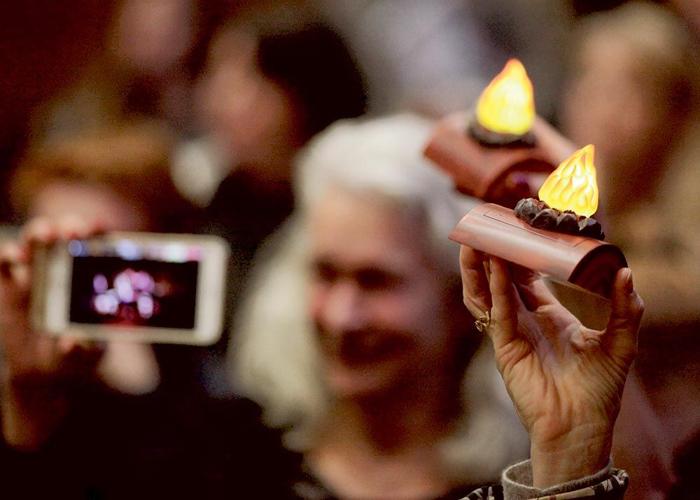

After Jeanne McCulloch approached the podium to address Carmel City Council on Feb. 2, she reached to the top of her head and flicked a switch: A small toy flame lit up, affixed to the top of her head with a headband. When she did her Christmas shopping six weeks earlier, she’d bought out all of the available handheld, light-up campfire toys at Tessuti Zoo, a toy store in Pacific Grove.

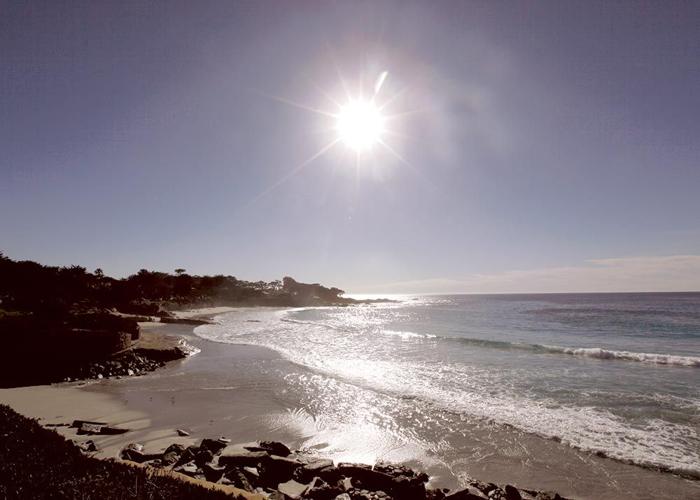
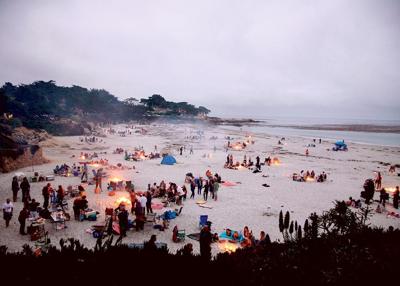
A view of the same area with no fires.
It was gimmicky, sure, but McCulloch wanted to make a splash. She announced she’d gathered 297 signatures on a petition (it was up to 440 as of the time this story went to press), asking the city to restore a long-time tradition of allowing people to burn wood fires on Carmel Beach, in portable baskets that would allow them to remove the coals afterward.
“City Hall is about to move forward with a plan that would only allow propane fire rings and fire pits,” McCulloch said. “This is not in keeping with the soul of Carmel.”
Behind McCulloch, dozens of supporters lit up their own campfire toys, or brought up images of fires on their smartphone screens and waved them like lighters at a concert. Speaker after speaker got up and urged City Council to reinstate fires. One man came to the podium and said if residents who live on Scenic Drive along the beach were bothered by smoke, they should move.
A few minutes later, Barbara Livingston, a former council member and current president of the Carmel Residents Association, went to the mic. “The Carmel Residents Association has publicly invited everybody concerned about trash on the beach to help us pick up trash on the beach the fourth Saturday of the month,” she said. “None of these people have ever shown up to help us.”
The debate over how to regulate beach fires – and the science behind those regulations – have become bitterly divisive issues in Carmel, and a test for the democratic process. Fire policy stands to be a defining election issue when five contenders vie for two open city council seats, and two current council members challenge each other for mayor April 12.
City officials have been deliberating over what exactly the issues are – graying sand? smoke? crowds and litter? – since at least 2009. It’s a singular Carmel story, but it’s also a bigger story about public policy in California: How do we preserve coastal access and recreation, and who, exactly, are we protecting access for?
In this 1-square-mile city of 4,000, there are dozens of people who have immersed themselves in the civic process to weigh in on beach fires. McCulloch, 52, spoke at public meetings for the first time in her life. Even after citizens have dedicated hundreds of collective hours of effort to solving the problem, tensions still run high.
After she spoke at the Feb. 2 City Council meeting, McCulloch gave her fire-adorned headband to Mayor Jason Burnett, as something like a crown.
He never put it on.
..§..
On July 6, a drone with a camera whirred high above Carmel Beach, capturing imagery of turquoise water gently lapping against white sand. The drone zooms in, revealing chunks of charcoal and soot mixed in with the sand, darkening it to a grayish tone.
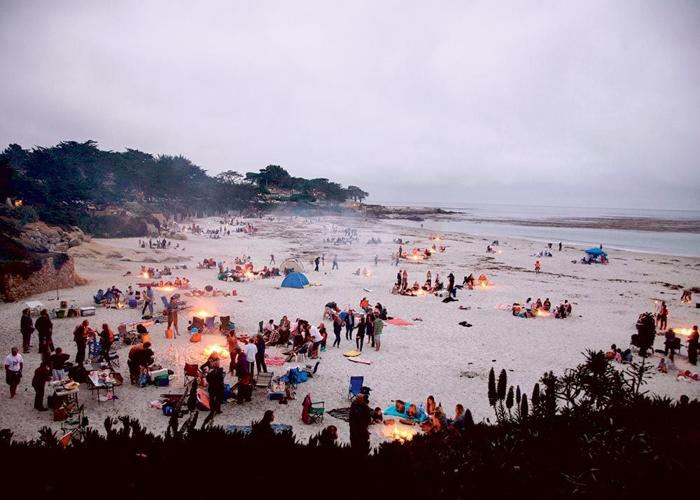
Kathy Bang hired Monterey Drone to record the aftermath of the Fourth of July, when city officials counted 135 beach fires burning at once. It was the third and final time she brought the drone company on to document what she viewed as an untenable situation: a once-pristine beach, now overrun with the detritus of so many beach fires.

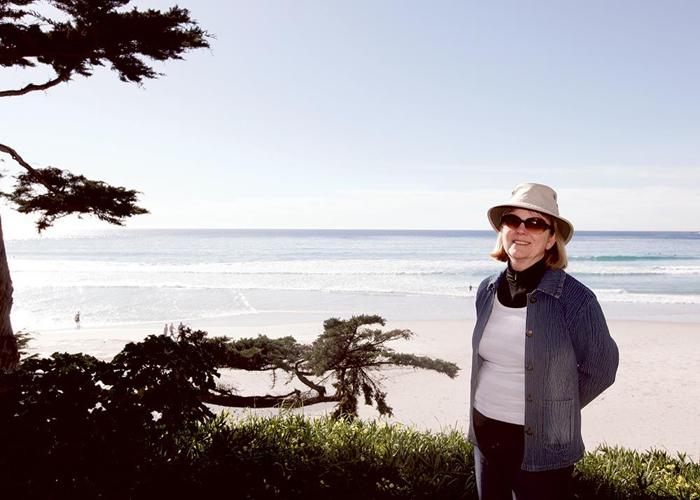
Kathy Bang lives on Scenic Drive and walks Carmel Beach daily. She disputes the claim that banning fires is a tool to keep the public away: “It’s just untrue. We love the hustle and bustle of the beach.”
Bang begins most days by walking her West Highland terrier, Duffy, on Carmel Beach, starting immediately across the street from her geometric 1,950-square-foot house, which was featured in Architectural Digest in 2010. And she’s been meticulously documenting the degradation of Carmel Beach since 2009.
This isn’t where Bang imagined she’d be, or what she thought she’d be doing. The retired hospital executive, who was raised in Ohio and built her career in Chicago, planned to retire in North Carolina. She and her late husband bought property in the Blue Ridge Mountains, envisioning their dream home in the woods, before he was hit and killed in a bus collision.
She returned to Chicago, still planning to retire to North Carolina – “I had this dream of being the eccentric little old lady on the top of the mountain, where I’d write books and do yoga,” she says.
She got together with her second husband, Gary Bang, who had a little place in Carmel on Scenic Drive. They each sold their other homes, and moved to the home they’ve named An Tearmann – Irish for sanctuary.
Since then, Bang has become something of a folk hero to Carmelites who’ve been trying to limit beach fires for years.
She made her first presentation in 2009 on deteriorating beach conditions, focusing mostly on the white sand turning gray from charcoal remnants, to a group of Scenic Road homeowners.
Back then, her goal was to get city officials to seriously enforce the rules on the books at the time: Don’t allow fires north of Tenth Avenue, and burn at least 25 feet from the bluffs, to ensure that wave action would wash away any fire remains. (That distance has since been extended to 100 feet.)
“I had no idea what a process this was going to be,” she says. “It felt like the beach was begging us to help it.”
The process lasted for five-plus years and through dozens of meetings (Bang counts 22 – so far). Bang, who also serves on the Carmel Forest and Beach Commission, supported a pilot program to limit the number of simultaneous beach fires. The commission recommended the city try out fire rings, and last April, City Council voted to pilot having 26 fire rings on the beach.
On May 27, Carmel resident Alexis Delehanty made an appeal to the California Coastal Commission, responsible for preserving public access to the state’s coastline.
Last May, Delehanty argued the fire rings were too draconian a solution, likely to cause a tripping hazard or diminish the beach’s wild beauty. “Scarring the beach with fire pits should not be the first line of action,” Delehanty wrote.
But by the time her appeal actually made it onto a Coastal Commission meeting agenda on Dec. 11, Delehanty found herself arguing in favor of fire rings.
That’s because between May and December, a lot had changed.
..§..
Faced with dozens of complaints about smoke from Scenic Drive residents, the Monterey Bay Unified Air Pollution Control District installed an air quality monitor in the backyard of a private home. (They’d looked at public property, but were concerned the controversial issue would make the $10,000 instrument a target of vandalism.)
The air district is responsible for enforcing air quality standards in Monterey, Santa Cruz and San Benito counties, and maintains constant monitors at certain sites including the Salinas airport and at Pinnacles National Park.
Starting at 10am on May 21, an air quality monitor – a shoebox-sized contraption perched on top of a tripod about 5 feet tall – started collecting data on particulate matter in the air next to Carmel Beach.
On July 4, when city officials counted all those fires burning on Carmel Beach, the monitor spiked. For four hours, particulate matter – the invisible toxic stuff that burns off of wood, very similar to what comes from cigarettes – exceeded a threshold for safe exposure set by the U.S. Environmental Protection Agency.
Levels reached the point that EPA would advise an evacuation, if it was a wildfire burning. The spike marked a turning point for Carmel.
Right after the holiday, City Council decided they had to act, and fast. They approved a temporary moratorium on beach fires on holidays and weekends (that moratorium, still in effect, expires in August).

People who signed a petition supporting wood-burning beach fires protested City Council Feb. 2 with light-up fire toys and cell phone photos of fires.
After enacting the moratorium, City Council members started hearing from residents that they could breathe easier. But with Delehanty’s pending Coastal Commission appeal, city officials wanted to offer up an alternative. The Coastal Commission has long celebrated beach fires as a form of equal-opportunity beach recreation, an affordable way for California residents of all economic strata to be outdoors and enjoy the coast.
So city officials came up with a new pilot plan: Instead of the 26 fire rings originally proposed, they would nix wood-burning fires altogether and allow propane-burning fires only, using a cleaner-burning fuel. The city would install a few seasonal propane fire pits on the beach, and beachgoers would be allowed to bring their own propane-burning devices in unlimited numbers.
In a 3-2 vote on Dec. 1, City Council voted to declare beach fires a public nuisance – effectively a ban – and declared their intention to adopt a propane pilot program. When the Coastal Commission met 10 days later, commissioners defied their staff’s recommendation, and voted down the wood-burning fire ring plan.
They too were divided, sinking the 26 fire rings with a 5-6 vote.
Monterey Bay Unified Air Pollution Control Officer Richard Stedman spoke: “I just want to say that this is no longer a recreation or an access issue. It’s a public health issue, that’s why I’m here,” he said.
That was reflected in many of the comments by the public, and by commissioners.
“The science is in, the debate’s over. Wood smoke is a carcinogen,” said Commissioner Mary Shallenberger. “It’s an unhealthy recreation. We, the commission, need to find healthy ways to allow people access to the coast.”
It was a victory for Bang and her allies, who’d made T-shirts to wear to the Coastal Commission hearing that said, “Clean Air / Clean Beach / Clean Ocean / Clean Up.”
Bang had started out on a mission to keep the white sand white, but over time shifted her thinking. “We started to learn more about the harmful effects of wood smoke,” she says. “We cannot un-see this data.”
Only, some people say the data is all wrong.
..§..
Last summer, Tricia Dally was checking smoke levels daily. She and her husband, John, own a lodge in the Sierras, just outside Kings Canyon and Sequoia National Parks, near where the Rough Fire burned more than 150,000 acres from July 31 to Nov. 9.

Tricia Dally devoted four weeks to compiling and studying the data in detail. “This whole thing has been completely overblown,” she says. “They created an emergency when one didn’t exist.”
After Dally read in the Weekly that officials warned Carmel residents about the July 4 air quality – that levels exceeded the wildfire evacuation standard – she set out on a mission to understand what was really happening in the air.
“Having been through that several times, that made no sense to me,” Dally says.
She wanted to see the data for herself, and got the Air District’s spreadsheets. Then she devoted the next four weeks to number-crunching, neglecting her marketing duties for the lodge, and ordering takeout for her family instead of making dinner. (“She was obsessive,” John says.)
“You look at the data and realize, they’re misleading people,” Tricia says.
She’s not a scientist, but she is trained on how to analyze data: She spent a decade working for ad agencies in New York, where her job was to scrutinize the claims they were making on air to be sure they were legit. (If you’re going to claim you make the safest car compared to other carmakers, for example, you need data to back it up.)
Dally would review those claims with the ad agency’s lawyers, the client’s lawyers and the network’s lawyers.
“When I saw the data I was shocked, because there was no way that would have passed those three sets of attorneys,” Dally says.
She and John became citizen scientists, analyzing the air quality monitoring data and looking for spikes. Their biggest critique is that hour-by-hour readings aren’t very helpful; they’d rather study the 24-hour averages to see if Carmel has a real air quality problem.
In the 1,871 hours monitored prior to the moratorium taking effect last August, particulate matter exceeded the EPA’s safe threshold eight times, for an hour each. Four of those occasions were on July 4. (Once, while the Tassajara Fire burned wildlands in nearby Carmel Valley, the 24-hour average exceeded EPA’s recommended level.)
Even the hourly readings don’t show that the moratorium made much of a difference. Particulate matter spiked on Dec. 27, Jan. 2 and Jan. 7 – months after the moratorium took effect. The air monitor came down Jan. 8, after about six months.
Even Richard Stedman, the air pollution control officer, is skeptical of the data, despite his comments to the Coastal Commission.
“We never had a perfect season of monitoring, and we didn’t have a great place to monitor,” Stedman says. “The whole thing is fraught. I’ve never really been hanging my hat on the public health issue.”
Instead, he says the critical issue is a public nuisance – something that disrupts basic quality of life – due to smoke. “The smoke is an impact to the neighbors,” Stedman says. “You can stand there and watch the smoke hit people’s houses.
“I know they own million-dollar homes,” he adds. “Whether you’re rich or poor, you have a right to breathe clean air.”
The Dallys raised their kids in Carmel-by-the-Sea, when they used to frequent beach fires with other families with young children. Now they live in Carmel Valley, but after immersing themselves in the data and stuffing a 3-inch binder with charts, graphs and EPA informational packets, they’ve connected with McCulloch and others who say they have a right to burn fires on the beach.
They’re going to wait and see how the April 12 election plays out, but if they’re still left with a propane-only option, a referendum effort might be coming next.
..§..
Jason Burnett is not seeking re-election. Instead, two of his colleagues, council members Ken Talmage and Steve Dallas are running for mayor. (Dallas was one of the minority votes against declaring fires a public nuisance; Burnett has endorsed Talmage, who serves on the board of the Air District.)
Talmage and Dallas will battle out their difference over beach fires on the campaign trail, but Burnett will leave office with unfinished business, or a chance to cement his legacy. His vision is to make Carmel a model for California beaches, which are all struggling with how to limit fires and keep beaches clean.
His legacy, he hopes, is the addition of data – faulty as it is – to the policy debate. Burnett himself worked on setting air quality standards in the EPA and resigned when officials wouldn’t tighten them enough.
The Carmel air monitor data persuaded him there was a health crisis. And the moratorium gave him a chance to compare Carmel Beach before and after: “We really like our beach experience without smelling smoke,” he says.
The idea of zero fires, as compared to 26 – or any other pilot program number – started to look enticing.
“Any number is always going to get into pitting one value against another, access vs. health,” Burnett says. “I wanted to try to get out of that zero-sum game.”
But to people who used to go to beach fires, the propane alternative looks like a loss.
When Roy Thomas, a former forest and beach commissioner, spoke at the Coastal Commission hearing in December, he was one of the few to speak in favor of preserving wood-burning fires. “I should be dead, because I’ve been around fire all my life,” he said. “I have fires in my fireplace, I have fires at the beach. I think part of the problem here is the big houses overlooking the beach. The big houses overlooking the beach don’t want trees, don’t want dogs, don’t want fires, don’t want groups, don’t want noise, don’t want people, don’t want parking and don’t want traffic.”
The fire dilemma is one manifestation of a larger Carmel conflict: Does it serve the residents, or the visitors? As the village celebrates its centennial, events recall the bohemian days of starving artists partying in town. Scenic Drive residents oppose fires, but they’re a cheap way for out-of-towners – the overwhelming majority of users – to enjoy a public beach.
After Carmel City Council voted in December to declare beach fires a public nuisance – meaning they’d be banned entirely – the matter went to the Coastal Commission for a final verdict. (The propane proposal will also require Coastal Commission approval, and there’s still a vigorous debate about whether propane should be allowed on the beach at all.)
But the nuisance ordinance never became law. For the ordinance to take effect, City Council is required to do a second reading. They haven’t done that, and Burnett says there’s no plan to. They’re focused on launching a propane test program this spring, before tourist season picks up. (For more on propane concepts, visit www.mcweekly.com.)
Since the nuisance ordinance never got final approval, the previous policy – the moratorium on weekends and holidays – is still in effect, which means people can still make old-fashioned wood fires Mondays through Thursdays.
Even that leaves the pro-fire camp frustrated. If the city wanted to declare beach fires a public nuisance, they would’ve; instead, McCulloch sees an end-run around fair, measured process.
“The nuisance ordinance was a chess move,” McCulloch says. “It was a pawn, a ploy – it was bullshit. They did it to put leverage on the Coastal Commission so they got what they wanted.”
She’s right; that’s exactly what Burnett had in mind with the nuisance ordinance, showing the Coastal Commission that Carmel was prepared for an all-out ban.
Early in the process, Stedman supported the 26-fire-ring proposal, thinking any reduction to wood smoke would be an improvement for health: “They took the precautionary principle to the extreme.”

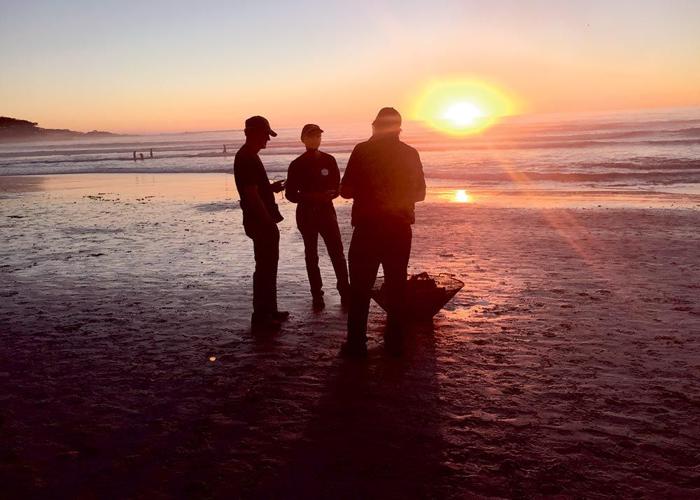
A group of fire supporters, including Councilman Steve Dallas (who is running for mayor) and Forest & Beach Commissioner David Refuerzo, gather regularly for fires in portable baskets in an effort to prove they can avoid leaving charcoal behind.
As far as applying the precautionary principle, at least they’re being consistent. When the Carmel Planning Commission next meets March 9, they will consider an ordinance requiring new and renovated homes to convert from wood-burning fireplaces to gas.
Clarification: This story has been updated to reflect that a petition specifically asks for wood fires to be permitted on Carmel Beach only in portable containers.
(6) comments
I would like to emphasize the petition's salient point is a limited # of Woodburning Portable Pits, so the beach & air will not be fouled by too much smoke or charcoal. I would also like to apologize for the curse word at the end of the article, that I specifically remember asking Sara to omit. I am not in favor of war & have tried throughout to offer a positive & equitable compromise to the problem.
Funny my comment gets deleted/censored when it followed ALL the guidelines listed below. So much for open discussions on the weekly. . .
First off the title of this article should be "First world, rich white people problems" - (More than a quarter of children in Monterey County live in poverty) and these people spend 5 years on this issue because a select privileged few (most of which are not permanent residents, none of which actually grew up here) with multi million dollar 2nd,3rd, 10th homes have to deal with smoke on the 4th of July. . . Guess what - Welcome to living near a beach in America on the 4th of July. Beach fires have been a part of the culture in Carmel since the beginning. The fact that a select few ultra rich have relocated here or are only here a couple weeks a year are able to change public policy and culture represent a larger problem with the political process and a shift away from preserving what has made this town so special and unique to fit their privileged standards of living. The only usable data to back up their argument came from 1 DAY - the 4th of july. That is not a usable statistic nor support the move to scar a beautifully natural beach with UGLY cement rings resembling beaches in southern california. I also noticed since this debate began the city stopped cleaning the beach with their ATV's and drag nets etc. Carmel has the budget and resources to keep it clean as always and they stopped. WHY? They can afford to put an officer on duty to police the beach at $110k/year so it obviously wasn't a budget issue. Maybe next they can rally to line ocean ave with Tesla chargers for their brand new cars so they can pat themselves on the back for "saving the beach" and being environmentally unconscious. I grew up having the freedom to have family bonfires and toast marshmallows without the need for ugly cement rings all over one of the most pristine beaches in the world without the need for police presence. Maybe they should focus on all the break ins happening in Carmel that no one seems to be reporting on...
When I saw the picture of all the fires on the front of the paper, my first thought was this picture had to be taken on a Holiday! My family and I have had and enjoyed bonfires on Carmel beach and I would really hate to lose just about the only beach in the area where bonfires are welcomed. One solution to the problem that I think all sides might agree to is to ban bonfires on the beach on Holidays.
I live in a beach town and I can relate. The propane alternative is a really great compromise. It addresses the toxic smoke issue and the litter issue. Besides a propane fire ring fits much better with the vibe of Carmel Beach than a messy smokey poor person's fire. Maybe decorate the fire rings with a nice mosaic? No, but seriously the propane fire ring is the BEST solution. The tourists don't realize that the smoke is a constant nuisance, not just a once in a while thing. Good job Carmel.
Observers have come to expect opportunistic, expedient shenanigans from Carmel Mayor Jason Burnett - "The nuisance ordinance was a chess move,” McCulloch says. “It was a pawn, a ploy – it was bullshit. They did it to put leverage on the Coastal Commission so they got what they wanted.” She’s right; that’s exactly what Burnett had in mind with the nuisance ordinance, showing the Coastal Commission that Carmel was prepared for an all-out ban.
But, for Richard Stedman, Monterey Bay Unified Air Pollution Control Officer, to say “I just want to say that this is no longer a recreation or an access issue. It’s a public health issue, that’s why I’m here” before the Coastal Commissioners and later say “I’ve never really been hanging my hat on the public health issue” destroys Stedman’s and the MBUAPCD’s credibility.
Welcome to the discussion.
Log In
Keep it Clean. Please avoid obscene, vulgar, lewd, racist or sexually-oriented language.
PLEASE TURN OFF YOUR CAPS LOCK.
Don't Threaten. Threats of harming another person will not be tolerated.
Be Truthful. Don't knowingly lie about anyone or anything.
Be Nice. No racism, sexism or any sort of -ism that is degrading to another person.
Be Proactive. Use the 'Report' link on each comment to let us know of abusive posts.
Share with Us. We'd love to hear eyewitness accounts, the history behind an article.