


IT’S NOT THE FIRST TIME CARMEL-BASED WRITER AND ARTIST BELLE YANG IS SHOWING HER WORK TO THE WORLD. Her previous show at the Monterey Museum of Art took place in 1996, almost 30 years ago, around the time she started experiencing the first symptoms of HIV/AIDS. She lived quietly with the disease, and the stigma surrounding it, for the last 30 years. Now, she has decided to share her story, the story of a straight woman who never drinks or does drugs, who contracted AIDS – and has survived. Yang has previously shared intimate stories of herself and her family, revealed through her art – now she is sharing those stories in the context of her health.
The diagnosis provides for an experience that couldn’t be without influence on her life as an artist. Bringing back her work from various times of her life, including before AIDS, and bringing her father’s artwork into the MMA exhibit, titled Imagining China: The Art of Belle Yang and Joseph Yang, is revisiting her story as an artist and a person, this time with everything laid bare.
Maybe she has the type of personality that needs to tell the truth, Yang wonders. Then she adds: “I tend to open my mouth if that can help other people.”
She hopes to remove both stigma and trauma. She sees the current exhibit as a way to talk about trauma, both in the context of what happened to her, but also what happened to her family – ancestral trauma.
But how and when does this story start? Maybe with the Japanese occupation of Manchuria (from 1931-1932), before China regained control of that land, considered wild and nomadic even by the Chinese. It was around that time Yang’s grandfather’s family got united, just to experience more poverty and governmental abuse.
Because of the hardship, Yang’s father, Joseph Yang, traveled through China and settled in Taiwan, where he got married and where Yang was born. But there was yet another big family move, decisive in Yang’s life. This one was permanent – to California, eventually to Carmel. Her father didn’t want to get in trouble for just living and reading what he wanted.
“I don’t belong anywhere, really,” Yang says. “Everything feels kind of like home, but not quite.”

Artist and AIDS survivor Belle Yang in her family house in Carmel, posing with her parrot, Ruby.
DURING HER SCHOOL YEARS, Yang was not interested in her roots; she was more interested in rooting herself in American culture. Her attitude toward the latter changed after an 18-year-old Yang experienced an abusive relationship with a Western man with whom she lived in Los Angeles, where she also had a chance to experience cultures of the world, broadening her interest in art. When it comes to relationships, she still has nightmares, decades later.
Looking for safety, Yang came home, a 25-year-old moving back into her parents’ house for rescue. The time of big ancestral stories began; she spent weeks and months listening to stories told by her father and mother. Soon, those stories started to populate her art, which is unique in content and also coloristically, combining California culture with a migrant experience. “Populate” is the word that comes to mind when looking at her pieces, most of them untitled, full of people and animals with human facial expressions.
“It gave me a platform,” she says about her art and her books. “An artist is one who takes his own life and makes it into art. Now when I’m in the final chapters in my life, I want to clean things out.”
It’s not a coincidence that, all together, Yang wrote and illustrated nine picture books for children and three adult books, to date. Her children’s books have titles such as Hannah Is My Name, A Young Immigrant’s Story about a girl waiting for a green card to arrive, or Angel in Beijing, a story about a girl and a white cat united in their hatred of fireworks.
“Publishing is stressful,” Yang says. “It kills you. After I finished writing, I spent the next two years drumming up a contract. I was very lucky.”
Her first adult nonfiction book, which took 14 years of work, was Baba: A Return to China Upon My Father’s Shoulders, a collection of short stories and illustrations based on Joseph Yang’s tales, which came in 1996. The book was followed by The Odyssey of a Manchurian, and finally Forget Sorrow: An Ancestral Tale in 2010, this time a graphic novel retelling her father’s family’s story of displacement and also internal strife, alongside Yang as a mid-20s character probing her parents for her past, and grappling with the continued trauma of a violent ex-boyfriend and her own isolation as friends withdrew, afraid for their own safety.
“Baba named me Xuan,” she wrote in the caption on one of the opening images. “It means ‘forget sorrow.’” We are looking at a girl with dark, medium-length hair drawing on a meadow. She shows us an image that demonstrates how to write Xuan in Mandarin. Yang’s drawings express big emotions, for example a sense of being cornered and persecuted portrayed as an actual corner in the house that is being shaken by a bald giant, the Big Abusive Boyfriend. Yang, her parents and their parrot are huddled inside.
YANG IS WALKING THROUGH HER FAMILY HOUSE, where she spent most of 64 years of her life, excluding international travels between 1986 and 1989. The house is almost exactly how her parents left it, a prolonged rectangle with a living room in the middle. There are soft armchairs in light colors, contrasting with bold-colored art, flowers and a splendid view of greenery behind the house. The space feels cosmopolitan, yet many conventions of 19th-century Western tradition are preserved: an impressive wooden magazine holder, a few writing stations, each a combination of a desk and a chair. At the east end of the living room lives Ruby, a large black-and-red parrot. Family treasures are placed comfortably around.
Yang is moving among the objects carefully, as if she is meditating, slowly, because she is blind in one eye. She looks very delicate, slim, porcelain doll-like, which makes her appear much younger. That said, Yang is quite fragile and not sure when she will have strength to paint again, even though she no longer has to spend time taking care of her parents. But even if she is not creating new artwork, she is telling her story anew. “Now, without a single person left to worry or embarrass, I can be honest to the bone,” she wrote in the catalog accompanying the Imagining China exhibit.
“I was a terrible child,” Yang says, taking a seat in a dark chair covered with soft materials, not fully realizing that her art proves that’s just not true.
This is the same house she returned to from Los Angeles seeking safety in her 20s, then again from China, after the violence against protesters in Tiananmen Square in 1989. This is where she listened to stories told by her father and Taiwanese mother, and then illustrated them. Finally this is a place where her father, when he retired, painted many pieces and hid them – left as a gift to his daughter after his death, as Yang is convinced.
“He would never show us what he was working on, on his tiny desk,” she says.
But it turned out that coming home to Carmel didn’t bring full safety. The abusive ex-partner followed her, going as far as to rummage through the family garbage for information about her. He shot up an attorney friend’s office. In search of safety, Joseph Yang sent his daughter to China to study art in a prestigious school, one of many institutes of higher education she attended. “I studied under Chinese contemporary masters, which was like a dream,” she says.
She studied under president Xi Jinping’s daughter, an art instructor who sent Yang to travel, for example to the Gobi desert and to the Mogao Caves, also known as the Thousand Buddha Grottoes. In that period, Yang went to Manchuria and met her father’s relatives, who survived among broken windows. She traveled through Manchurian villages that foreigners rarely come to, bypassing big cities, staying in little inns with her traveling companion. Both were landscape painters. Many of her works from that period are included in the current exhibit.
Soon, after Tiananmen, things got difficult and Yang decided to leave China forever. She couldn’t stand the tanks and the authoritarian regime. Even if there are only two people waiting for the bus, they will still shove each other to get in, fighting for a seat, she recalls. “When I go back there, I feel connected but there’s still a political fear, maybe less now than then,” Yang says. “But I remember a policeman going through our stuff, checking for contraband books. I wanted to bite him from under the table. I know the language, but the aggression of the country that lived with so little for so long is still there.”
She settled down in Carmel again, in a garage with Chairman Mao, a cat who appeared exactly 100 days after the Tiananmen massacre, and gave herself to a deep practice in calligraphy. That era resulted in the publication in 2010 of Forget Sorrow, a black-and-white graphic novel. “I like fine art, but ink work forces you to roll up your sleeves and get dirty,” Yang says.
Forget Sorrow confronts many of her inner thoughts, puts them out in the open – her abusive relationship, her anxiety in the years after it, her frustrating relationship with her parents living back under their roof.
But there was still this one big challenge in her life that had not shared until 2024, when this exhibit went up in September. With it, she publicly announced her HIV/AIDS diagnosis for the first time in the exhibit catalog.
Back in California, Yang, an only child, once again discovered that her parents were the most important part of her life. “Dad’s dragon, mom’s monkey and I’m a rat,” she says, using Chinese astrology. “They are all companionable animals. We get along.”
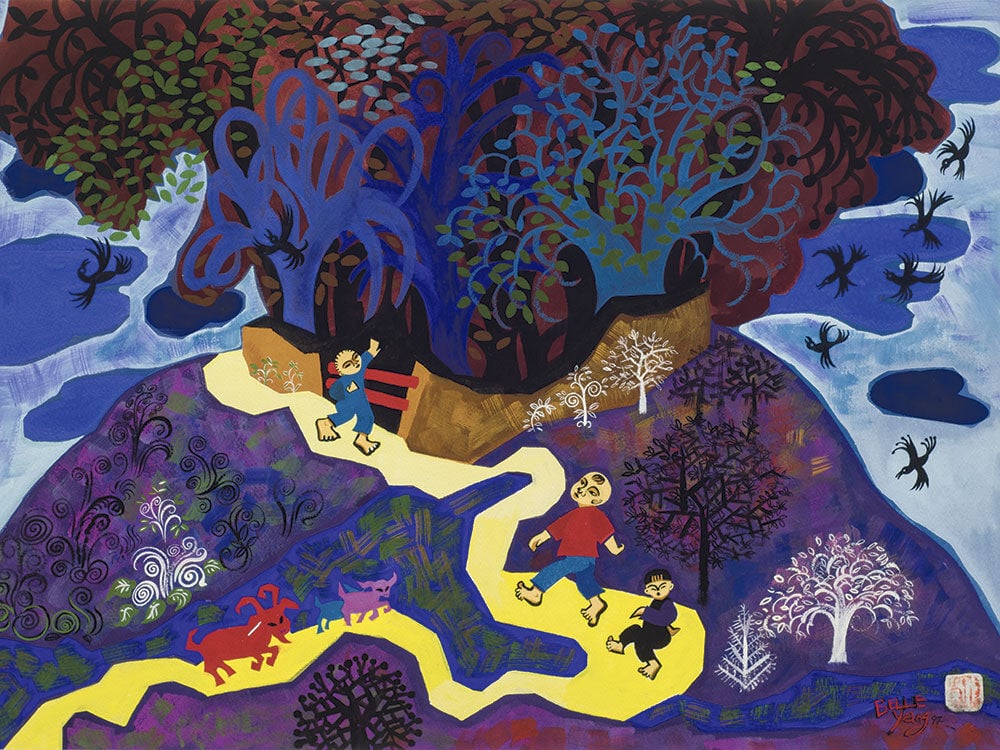
This 1997 gouache and pencil piece, “Untitled (Granddaddy Hill),” is included in the current exhibit Imagining China. Granddaddy Hill refers to place in Manchuria where some of Belle Yang’s ancestors were buried.
IT’S DINNERTIME. Yang is sitting in a warm and crowded Sur restaurant in The Barnyard, eating fish, rice and steamed vegetables. She wears a fluffy white vest that makes her immediate environment softer. “I didn’t want to stick with the identity of an AIDS victim,” she says. “There’s life after AIDS; now it’s a matter of a shot every two months. When a viral load of the carrier is undetectable, you can’t contract it even via sex.”
Yang contracted AIDS from her boyfriend in the ’80s, but did not know it until she was diagnosed 12 years later, in 1999. Only now, she has decided to disclose it. “AIDS is a hard subject,” she continues. “Stigma is terrible. Some people are afraid to take the test to find out if they have it.”
It was late June 1999 and her parents took her to the ER. She was down to 80 pounds and looked deathly ill. She had slowly lost weight until her parents finally awakened to the fact she may be dying. A husband-wife team, Dr. Allen Radner and Dr. Dawn Mudge, saw her. It took three days for the test result to come back, showing that Yang had full-blown AIDS.
Two years would pass until she learned how she’d contracted the virus – it was from an ex-boyfriend. “Only after I had gotten well did I learn, on Sept. 11, 2001 that Carlos had died,” she says. The news was delivered by a mutual friend.
According to Yang, people should both fear and understand. She is an example of a straight woman having AIDS. She never really followed the epidemic, not fitting the profile of a probable victim. But it turns out that AIDS was not only for people engaged in risky gay sex or who were using drugs; if you are a human being, it’s possible for you to catch it. According to Yang, the health care community knows how treating and living with AIDS has changed, but the larger community still doesn’t. She wants them to know, so she is now sharing her story.
After her first exhibit at the Monterey Museum of Art, between her first and second book, Yang started getting blisters, shingles and infections. She partially lost her eyesight, and had a rash all over her body. Still, she wasn’t diagnosed until her weight dropped to below 80 pounds.
How to remain calm? As Confucius teaches, there are many layers of peace. Meditate and achieve. Radner is hesitant to talk (due to patient confidentiality, but he agrees to a brief interview per Yang’s request). “She was as sick as one can be,” he recalls. “It took two years to get her where she is.”
Radner says treating Yang was a challenge because she was diagnosed so late. Today, HIV tests offer quick results; there are self-tests, blood tests and oral fluid tests. These tests can be done readily at most clinics or labs. (Today, there are two clinics that treat HIV/AIDS in Monterey County, one in Monterey and one in Salinas. They assist about 200-300 patients. “Now, medications are easier,” Radner says. “There are less side effects, and we have more choices to treat patients.”)
It was not obvious to the medical team at first that Yang would survive. “But I never thought I would die,” she writes. “I had work to do.”
After a period of serious infections and not responding to a certain treatment, she was offered another cocktail that worked. “The approach was the same, we treated the infections,” Radner says. “We treated it aggressively.”
Yang showed a lot of will, says Radner, who is now the CEO of Salinas Valley Health. “He is a wonderful doctor,” she remembers. “He would even come to my house when I was not able to get up or even put my socks on.”
How did the experience of being sick influence her life? “It made me feel the unconditional love of my parents,” she says. “They are gone and I feel they are still with me. Sometimes there is a flash in the house, an electrical shock, that one of them is here.”
After Yang’s health stabilized, it was her time to take care of her aging parents. “We are Chinese and we have our own ways,” she says. “I don’t know where I found the energy to lift my father and bathe my mother every day. Anyway, they glowed when they died in their bed. That’s the biggest achievement in my life.”
HER FATHER IS HERE, Yang says, as she walks through the Monterey Museum of Art gallery where his and her images are hanging. “It’s so weird,” she adds.
Joseph Yang’s paintings are landscapes, California landscapes shaped by Chinese art, by bold lines that represent movement, a flow of energy, an important concept in traditional Chinese art.
A woman and her mother who happen to be visiting the museum join Yang’s spontaneous tour. “Before my father was born, China went through 200 years of wars, followed by Communism,” Yang says, standing in between two of his untitled pieces that show gray rocks and mountains, curiously never people, whose absence offers peace to the eyes. “People disappeared in the chaos of war. The stories he told me were giving voice to very small lives, people who made fertilizer, people who made pancakes.”
After Tiananmen, Joseph Yang closed his art and jewelry store in Carmel. Then, he devoted himself to painting in secret. Would he be surprised to see his work in the Monterey Museum of Art? Yang laughs and says he would be surprised, and pleased. “He was quite in awe of the museum,” she says, recalling the times of her first MMA exhibit in the 1990s, where she presented images from her first book, Baba: A Return to China Upon My Father’s Shoulders. They include maps of her father’s journey from Manchuria to China and what he experienced along the way – people, animals, cities, hospitality, hostility, mountains and many working people.
In the current exhibit, her work can be divided between two categories: enlarged pages from her graphic novel that, by the way, also has hilarious dialogues. The second category is extremely colorful – dark red, vivid blue, unapologetically bright yellow – pieces. Some of them are so packed with the content that everything has to be in miniature – the inside of a whole town, such as “A Dream” from the Odyssey Of Manchuria.
“In China, I learned a new style that combines old traditions of painting,” Yang says. “But my subject matter is more Western.”
One thing not to be found in Western pieces is the Chinese perspective of the bird’s eye, looking down into the subject matter, as in “The Big White Celebration,” a piece that comes from Baba: Return to China Upon My Father’s Shoulders. It shows a red devil chasing after terrified people.
“I want to remove the trauma,” Yang says about the exhibit. “The ancestral trauma we brought with us [from China], but also the trauma of AIDS. We are here to study in a school of life. And life is never done with you. I love the world, but I’m ready to go tomorrow.”
(0) comments
Welcome to the discussion.
Log In
Keep it Clean. Please avoid obscene, vulgar, lewd, racist or sexually-oriented language.
PLEASE TURN OFF YOUR CAPS LOCK.
Don't Threaten. Threats of harming another person will not be tolerated.
Be Truthful. Don't knowingly lie about anyone or anything.
Be Nice. No racism, sexism or any sort of -ism that is degrading to another person.
Be Proactive. Use the 'Report' link on each comment to let us know of abusive posts.
Share with Us. We'd love to hear eyewitness accounts, the history behind an article.