If you can’t count on youth to make a fuss when a fuss is required, call up the old warriors– and stand back. Upon the occasion of its birthday, the Carl Cherry Center for the Arts is throwing itself a veritable orgy of relevant, irreverent and repercussive artworks of all media in the tradition within which it was founded 60 years ago.
“Art gives us a way to understand our lives, address our concerns, provide expression to them,” says director Robert Reese. “Carl Cherry Center’s role is to investigate this expression, examine our concerns and express our values, not just paint pretty pictures. That’s the role of art in a democracy.”
Sixty years ago this kind of role for the arts was very much in question.
In 1948, when the center was founded as the Carl Cherry Foundation, the United States was in the midst of one of the most shameful periods of its history. During World War II, the House of Representatives had established a committee to investigate German-American involvement in Nazi and Ku Klux Klan activity. After the war, the House Un-American Activities Committee (HUAC) moved on to investigate the threat of communism, and in 1947 began a series of hearings on alleged communist influence in the film industry.
These hearings by the House preceded the wider Senate “witch hunt” famously conducted by Republican Sen. Joseph McCarthy of Wisconsin in the 1950s that coined the phrase “McCarthyism.” The era inspired Arthur Miller to write his masterpiece The Crucible about a metaphoric witch hunt and the lives ruined by unfounded accusation. (Miller subsequently was summoned to appear before HUAC on suspicion of communist sympathies.)
As the center planned its 60th anniversary and a month-long celebration of artistic freedom, board member Malcolm Weintraub felt it would be appropriate to include a play written in or about 1948, the year the center was founded. He proposed production of one he had seen in New York that, in Weintraub’s words, “exemplifies what the Cherry Center has represented over the years as a guardian of artistic freedom.”
That play is Trumbo: Red, White and Blacklisted, written by Christopher Trumbo and based on the letters of his father, Dalton Trumbo, a film writer (Spartacus, Roman Holiday, Exodus, and many more films under his own name and pseudonyms after being blacklisted). The elder Trumbo was one of the “Hollywood Ten” jailed in 1947 for contempt of Congress for standing up to HUAC. He refused to name or answer questions about colleagues in the film and theater industry who might have had any affiliation with the Communist Party.
The 10 refused to testify based on First Amendment rights of freedom of speech and assembly. All were jailed for contempt of Congress. Most of their careers ended summarily, because the then-powerful Hollywood studio system, in a rush to “clean its own house,” established a blacklist that included these 10 and eventually more than 300 actors, directors, writers and producers. Each had been named by colleagues– many without evidence and often for spurious reasons– as potential “sympathizers” who might then or at some time have had a connection with the Communist Party.
Found guilty of contempt of Congress for not responding to lawmakers’ questions, Dalton Trumbo admitted, “I was judged guilty of contempt. It was a completely just verdict. I had contempt for that Congress.” Jailed for almost a year in federal prison, then barred from working in Hollywood for more than a decade, he lost his home, lived in Mexico working under other names, stayed with his wife and children in hotel rooms in the United States and continued working under assumed names. Under the name Robert Rich, for instance, Trumbo penned The Brave One, which won an Academy Award for screenwriting in 1957 and was the only Oscar in history never to have been claimed.
The letters upon which the play, and the film Trumbo that opened in New York two weeks ago (starring an A-list of actors including Liam Neeson, Nathan Lane, Michael Douglas, Donald Sutherland, Danny Glover, Kirk Douglas, Brian Dennehy, Dustin Hoffman, Joan Allen and Paul Giamatti) is based, were written in exile. They often are scathing, always witty and polished so impeccably that one could imagine he expected them to be performed.
Even those who loved him admitted that Trumbo was a contrarian who enjoyed nothing more than a good argument. But he also believed strongly in the Constitution and the Bill of Rights, and for such a fight he was willing to pay the cost.
“Today, we are faced with similar threats,” says Weintraub, an attorney. “We’ve seen a great deal of impingement on our fundamental rights… through the [Bush] administration and court decisions… censorship, Guantanamo, and the compulsion to remain silent or not express yourself for fear of potential harm that may be endowed on you. In the ’40s, the United States government didn’t invoke the blacklist. The Hollywood industry did, silencing these men and women by not taking their scripts, stories, giving them acting jobs– and through that economic coercion, caused them to starve.We should be always alert to those things. There’s a lot of resonance today.”
The Cherry decided to celebrate its founding with Blacklisted, a month of theater, film, discussion and visual arts that deal with the subject of freedom of expression. The month begins July 10 with Trumbo, featuring a succession of respected local actors, one playing Dalton Trumbo, and the other in the multi-role of the Narrator, the Committee and Christopher Trumbo. Skip Kadish, Len Perry, Mark Shilstone and Michael Lojkovic switch between both parts. Christopher Anderson and Thomas Burks join the cast playing the multi-role in several productions.
“We thought it would be interesting to see how these characters are interpreted by different people,” Reese says. When Weintraub saw the production in New York, the Trumbo character was played by Lane. But it also had been played by Paul Newman, Liam Neeson, Chris Cooper, Ed Harris, Tim Robbins and other actors taking turns in the lead role.
Every performance of Trumbo will be followed by a moderated discussion between the audience and a local individual associated with the blacklist. Barbara James, the daughter of Dan and Lillith James, both blacklisted screenwriters, speaks at the Cherry Center after the July 10 and 11 productions (see story, next page). Jerry Ludwig, a screen and television writer and producer working on a book about that period, follows on July 19 and 20. Alan Marcus, a writer and former Guggenheim fellow, who worked in Hollywood for a blacklisted director, appears on July 24 and 25. Linda Grant, the daughter of a blacklisted writer whose family essentially hid out from the blacklist in Big Sur, speaks on Aug. 2 and 3; and Weintraub, the board member who brought Trumbo to the Cherry’s attention, on Aug. 7 and 8.
Trumbo plays on a rotating schedule with an edgy duo of monologues: Thom Pain (based on nothing), a Pulitzer Prize finalist written by Will Eno (hailed by the New York Times as the “Samuel Beckett for the Jon Stewart generation”) and “Thief of Tears,” excerpted from Jeffery Hatcher’s play, Three Viewings. All three productions are directed by Nina Capriola, a seasoned theater director much in demand throughout the state and loved locally for her work with the Actors Collective.
“The first thing that struck me was how beautifully [Trumbo] wrote,” Capriola says. “Then I was dazzled by how smart the guy was and what happened to him. He never knuckled under, and it cost him dearly. It’s very easy to sit around and moan about what’s happening, but another entirely to stand up to it.
“The other two pieces are both solo shows; each exhibits a dark humor. We thought they would really complement the Trumbo piece, because they each in their own way take free expression to the edge. Patrice Parks doing “Thief of Tears,” very creepy but really great, and Thom Pain, another goodie that Malcolm found, with Peter Reynolds, another very good local actor. It’s one of the wildest pieces I’ve ever seen, like being inside of somebody’s head.
“The current political climate is really scary. I think it’s very easy to celebrate all the freedoms we have, but we definitely reap the benefits of Dalton Trumbo and all the people who threw themselves in front of that particular train. It’s very easy to slip back.”
On Wednesday evenings throughout the month, the Cherry presents four films associated with the Hollywood Ten: The Front, featuring Woody Allen and Zero Mostel (who was himself on the blacklist) on July 16; Hollywood On Trial, a documentary, on July 23; Guilty By Suspicion with Robert DeNiro on July 30; and on Aug. 6, Lonely Are the Brave starring Kirk Douglas and written by Dalton Trumbo.
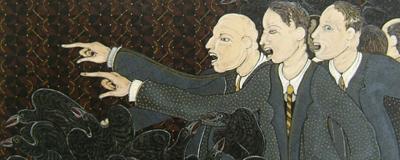
Throughout the month, the center’s galleries feature works by 19 western states artists in Blacklisted: the Exhibit, dealing with the subject of suppression of ideas. “We asked them to investigate, explore, examine and imagine, in whatever ways they wished, the ethical concerns and ideas raised by the idea of a blacklist. This resulted in some 30 pieces that show a wide range of approaches and perspectives,” Reese says.
It’s quite certain that the founders of the Carl Cherry Center for the Arts would applaud.
The address at Fourth and Guadalupe, in one of Carmel’s lovely wooded enclaves, was once the home of the Cherrys. Carl Cherry was an inventor, whose Cherry Blind Rivet revolutionized the shipbuilding and aircraft industries during WWII. His wife, born in England as Lena Yates but who assumed the name Jeanne D’Orge, was a poet, painter and noted eccentric who, according to a fascinating Carmel history by Connie Wright, often was seen around Carmel wearing full-length Chinese robes, a bright-pink hat and paint-splattered tennis shoes. An iconoclast of some note, she had read her poems at the famous Armory show in New York in 1913– the show that introduced “avant-garde” impressionist, fauvist and cubist works from Europe and the United States to the tender New York public– and created quite a ruckus. Offended, outraged and scandalized, the media and the critics at the time declared the art obscene, insane and immoral. Later, the show was enshrined by reverent historians as the birth of modern art in the United States. By all accounts, Jeanne D’Orge probably loved the outrage and was deeply amused by the later reversal.
In New York she had been part of a group of poets called “The Others,” which included such luminaries as William Carlos Williams, Wallace Stevens and Marianne Moore. She moved to Carmel in the 1920s as the wife of Dr. Alfred E. Burton, who had been dean of the Massachusetts Institute of Technology. In Carmel D’Orge met Carl Cherry, 24 years (or 22; she provided several versions of her birth date, as well as her given name) her junior, and left her husband and three children to live with, then marry, the inventor.
They lived in poverty at first until Cherry’s rivet invention made them rich. She took up painting and the couple eventually moved to a two-story, Victorian cottage that housed their creative lives together– his inventions and her paintings– and sawed off the second story to have better light. This home/workshop in 1948 became the Carl Cherry Foundation, dedicated to supporting experimental fine artists and scientists, and then became the Carl Cherry Center for the Arts.
“A lot of Mrs. Cherry’s art and a lot of her thinking, essentially during the ’30s and ’40s, was reacting very strongly to the fascist movement in Europe. You can see that in her poetry and plays,” says Reese. “The presiding spirit of her work was the investigation of literary, artistic and personal freedom. There’s a clear link between her ideas and those expressed and exposed in Blacklisted.”
(0) comments
Welcome to the discussion.
Log In
Keep it Clean. Please avoid obscene, vulgar, lewd, racist or sexually-oriented language.
PLEASE TURN OFF YOUR CAPS LOCK.
Don't Threaten. Threats of harming another person will not be tolerated.
Be Truthful. Don't knowingly lie about anyone or anything.
Be Nice. No racism, sexism or any sort of -ism that is degrading to another person.
Be Proactive. Use the 'Report' link on each comment to let us know of abusive posts.
Share with Us. We'd love to hear eyewitness accounts, the history behind an article.