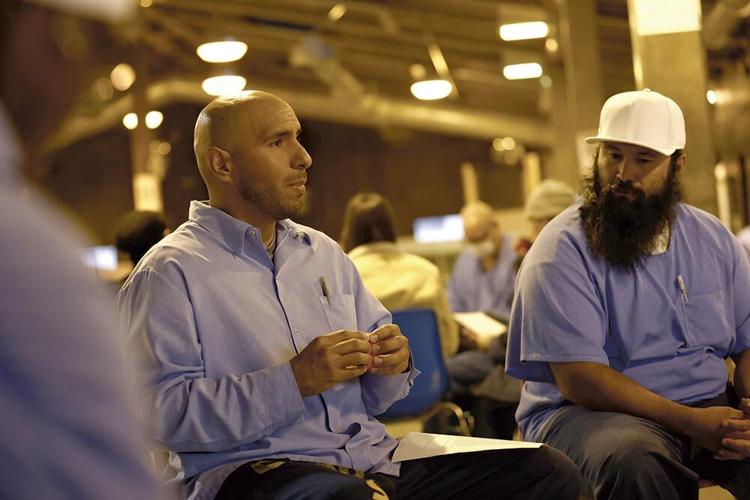


SERGIO ZARAZUA IS 37 NOW, AND HE HAS BEEN LOCKED UP SINCE HE WAS 15. He keeps his head and face clean-shaven, which makes his already large eyes look even bigger and deeper. When asked to write down his name, he adds his prison number. He wants to be helpful.
It was a second-degree murder and attempted voluntary manslaughter conviction in Sacramento over two decades ago. Then another conviction arrived, for the same incident – shooting at an occupied vehicle and after, some years later, it was confirmed the crime was gang-related.
The first story he shares in the circle – just a few chairs, some inmates, some civilians – is about getting to where he is at the moment, the Facility’s B Level II Sensitive Needs Yard in the Correctional Training Facility, Soledad. Before that transfer five years ago, he spent 10 years in other prisons, including adjacent Salinas Valley State Prison.
“The sergeant asked me about my name,” Zarazua says, glowing with every sentence even though the smiling is done mostly with his eyes.
“She asked me: ‘What’s your name?’” he says. “And I told her. And she said: ‘No, your first name. What is your first name?’”
Zarazua says he was speechless: “She asked for it as if it was a normal thing, you know?”
For a few seconds, he didn’t know what to answer, he says. At that moment, he realized that his actual first name was not in use for the last 10 years. And then, when the name arrived in his memory, should he say it in Spanish or English?
Zarazua says he went with the American pronunciation. He also says that that moment five years ago was crucial in his own healing process. “It was the first time I felt I’m not a number,” he says.
Other inmates in the circle are nodding.
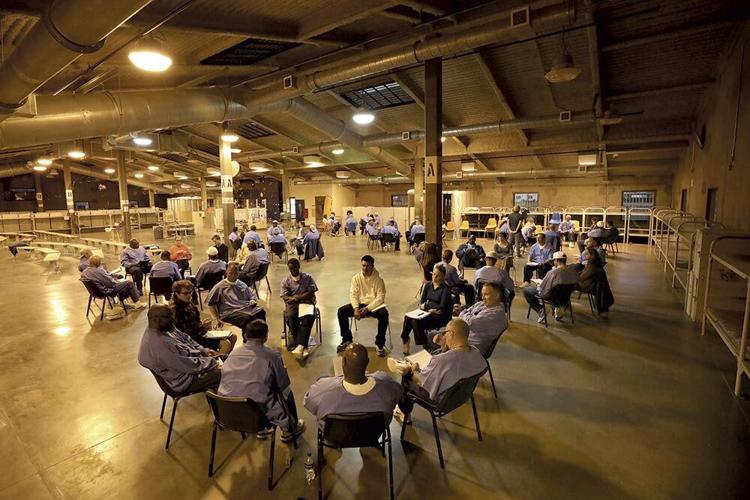
THERE ARE CLOSE TO 7,000 INCARCERATED MALES IN THE CORRECTIONAL TRAINING FACILITY COMMONLY REFERRED TO AS CTF, or Soledad State Prison. When a small group of civilians – mostly college students, led by Hartnell College Adjunct Sociology Professor Megan McDrew and her team, breathing instructor Spencer Smith and former inmate Carlos Aceves – cross the big yard surrounded by Pentagon-like walls, a few inmates on the way to make a phone call stop and ask how they can join. They likely saw a poster for Exercises in Empathy: A Transformative Justice Initiative on the wall and maybe ignored it. Only now it occurs to them that sitting down with a bunch of civilians can be a reality, and something they would be interested in.
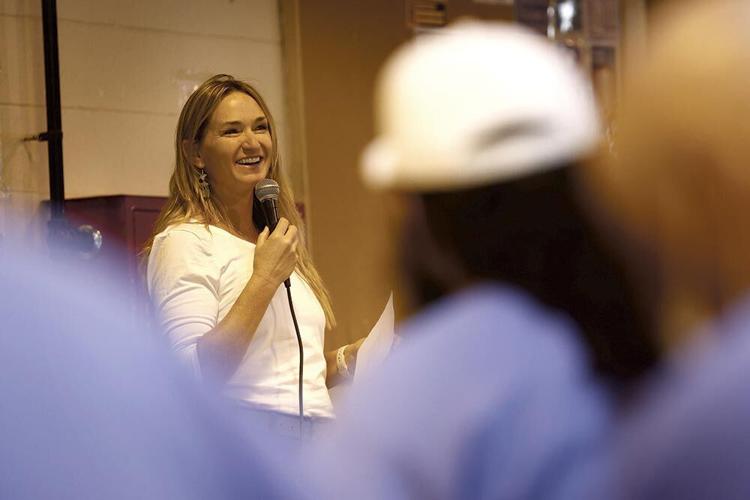
McDrew turns to tell them that while only 80 inmates can participate in the eight-week program at once, her team will be back in January 2023, with another iteration. She has to keep strands of her long hair in her hands and is squinting in the big sunshine of an open, windy space. Then she turns back to the group of “civilians” she leads and shares that she would like the program to spill from the university environment into the broader community.
“I would like more people to come, not only students,” she says, adding that one or two sessions would be sufficient to open people’s minds and hearts.

Sergio Zarazua sits among his fellow inmates during an Exercises in Empathy session.
PROBABLY MOST MONTEREY COUNTY RESIDENTS HAVE PASSED EXIT 306 ON HIGHWAY 101 Between Gonzales and Soledad. But unless you have business with CTF, the exit could as well lead to another dimension.
Program participants from the outside commit to two hours weekly, for eight weeks. Most of them know only that they will be talking about empathy with the inmates, but McDrew is selective and quickly weeds out spectators who will come only once to be able to tell people they’ve been to prison.
Before reaching the yard and getting into the low dayroom building, a lilliput among giants towering above it, everybody’s ID is checked three times. There will be a couple of more checks on the way back and the obligatory trunk opening at the exit gate, operated by young guards, males and females. There’s a strict dress code. No spaghetti straps, no denim, no gray denim or gray shirts that would resemble inmates’ attire. No hugging, no trading anything – items, drugs, information.
The inmates, even those who did sign up, don’t know that it’s a two-way-street miracle. They are not the only ones who benefit from this “educational exchange,” as the official description of the program reads. An “emotional exchange” would be as accurate of a description.
WHEN THE EINE GROUP FINALLY GETS INTO THE BUILDING, BROTHERS IN BLUE, AS THE 80 INMATES WHO WILL PARTICIPATE IN THE PROGRAM are referred to, are already inside, lined up around the dayroom. Most of them wear blue shirts on white T-shirts and darker pants with the name of the prison in big, yellow letters.
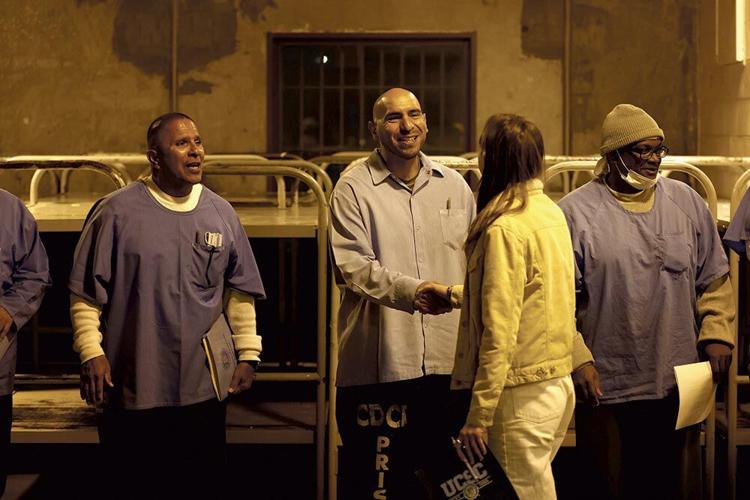
Shaking hands with each of them will take a few minutes, but it’s hard to overstate its importance. Done twice, before and after each session, it cements the new bonds in an invisible but palpable way.
“There are 80 lessons in empathy here, 80 teachers.”
While the program is open to any inmate in this yard – and for the first time in its history it offers an exchange for their participation credits into a few days off from their years-long sentences – Sensitive Needs Yard is not a typical CTF population.
“This is not the main population yard,” McDrew explains. “This yard is under protective custody.” Eighty percent of inmates are there because they had to be taken from the main yard for either their own, or someone else’s, safety. That means that all special needs inmates will be here for a range of reasons – military veterans requiring assistance, and also serious sex offenders. Some are here because their life is at risk – they are escaping homophobia, drugs or gang life omnipresent in the main yard.
“I find it more peaceful,” McDrew says, even though she eventually plans to offer the program to any inmate population. She would be happy to go anywhere with EinE. What she requires from all participants, incarcerated and not, is showing up on time and commitment.
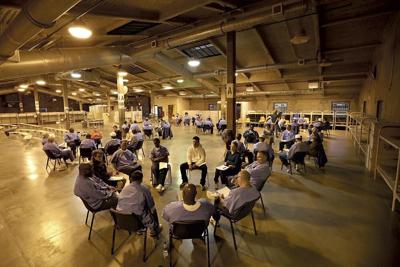
EACH TWO-HOUR SESSION HAS TWO ELEMENTS. Before dispersing into circles or families where more intimate conversations take place, all participants sit together on benches arranged as audience seating. The civilians and the inmates are encouraged to sit together. This simple action immediately transforms the prison into an institution of higher education. More importantly, all participants are now one student body.
That’s the time when one of McDrew’s assistants, Smith, leads breathing exercises. Most inmates close their eyes and lean upward on the benches. They exhale loudly, some are swinging; others lose patience with the exercise and look around. “You can use this technique every day, anytime, throughout your life,” Smith says, promising that the effect of the clear head and the sense of relaxation can be achieved anywhere – even in prison.
Each week of EinE is devoted to a different issue. The fifth week is for societal trauma, the sixth is for gender, seventh for race. Participants do readings on their own each week. One of the first readings assigned is the first chapter from the 2014 book by Roman Krznaric, Empathy: Why It Matters, and How to Get It, followed by The Little Book of Race and Restorative Justice by Fania E. Davis from 2019. There are dark green UC Santa Cruz folders that some inmates use to arrange their readings in order.
The names of thinkers they read vary from activist and philosopher Angela Davis to contemporary vulnerability guru Brené Brown to the late actress Audrey Hepburn. There are quotes to reflect on. In addition to a strong feminist core, Martin Luther King Jr. returns several times, including a lively discussion about what would have happened if he had a chance to carry on with his Dream. EinE doesn’t shy away from issues such as mass incarceration in the U.S., systemic trauma, the trauma caused by prison itself, and a need for racial reconciliation.
The “lecture part” is brief and interactive, and serves as a prompt to more engaging activities in smaller circles. McDrew called them families. Each family has about five to seven inmates and a couple of the outside participants. The work in circles takes a solid hour – then all families are called back to sit at the audience. There, two representatives from each family share “sparks from the fire,” which can be pretty much anything they want to share. In that part of the session, personalities show up. Some inmates enjoy speaking in front of the audience, others are clearly uncomfortable.
“Wait until the last session,” McDrew says. She is referring to the final, eighth week of the program, when a ceremony will be held. She calls it the Performance Night. Then, all participants are asked to prepare something, if they feel like it. It can be spoken word, poetry, a letter, a speech, a song, whatever. “At the last session, at the very last minute, everybody wants to speak.”

Sociology professor Megan McDrew inherited the program from Jim Micheletti, a former teacher at Palma School in Salinas.
THE IDEA THAT PRISON AS PUNISHMENT DOESN’T WORK AND MAKES A SERIOUS CRIMINAL FROM A PETTY THIEF IS NOT NEW. It was proclaimed by French philosopher and historian of ideas Michel Foucault in his breakthrough analysis of Western penal systems Discipline and Punish: The Birth of the Prison (1975).
Along with society, prison changes too. When in 1968, the name “Soledad State Prison” was officially changed to “The Correctional Training Facility” it was due to the extensive educational and vocational training available to the inmate population.
“This is not the only system that needs revamping,” says Carlos Aceves, McDrew’s other assistant. His function is different from Smith’s; he is not an expert on mindfulness. But he was incarcerated for 21 years, including in CTF.
Aceves flies in from San Diego every week and takes an Uber from San Jose Airport to Soledad. One night, on his way back, he couldn’t find an Uber but started to pray and he soon met a guy who gave him a ride, he says. “Now I call him every week and pay him cash,” he says.
Aceves is outgoing and friendly, and wears a black leather jacket over a dark sweater. He has been coming to prisons as a speaker since before EinE started; McDrew found him through CROP (Creative Restorative Opportunity), a nonprofit dedicated to reforming California’s criminal justice landscape.
Aceves is also the only one who mentions the other immense cost of mass incarceration in the U.S. – in dollars.
“It costs an average of about $106,000 per year to incarcerate an inmate in prison in California,” he says. “Do you make this money?” he asks civilians in the circle. No one does. “Come on, we can fix this. Aren’t we the greatest country in the world?”
McDrew wants to contribute to a transformation from punishment to healing, but says her main motivation in leading Exercises in Empathy is to provide for more safety in the prison system – not only for the inmates, but also for the guards, who work long hours and are prone to depression working in a challenging and stressful environment.
“Yes I want a change,” McDrew says. “I want the change to happen from the inside.”

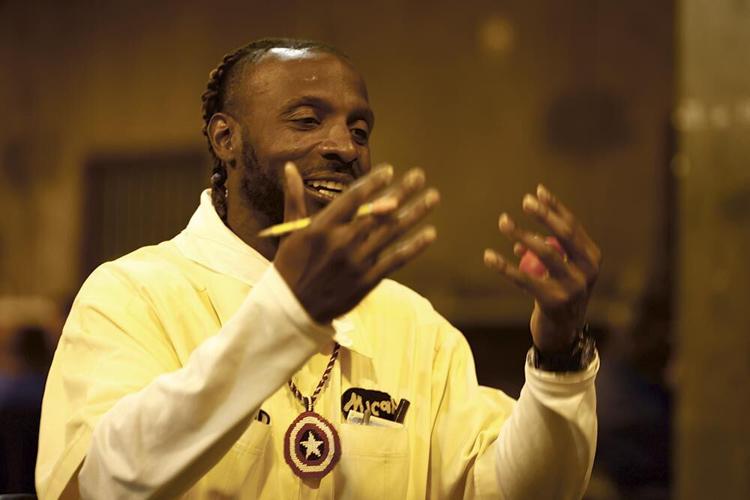
Micah Harris, a former college football player who was training for track for the Olympics when he was sentenced to prison. After he is released, he would like to open his own sports facility and train others.
THERE ARE NO SIDES IN A CIRCLE. Everybody sits eye to eye, face to face. First introductions are shy and rather simple, eye contact interrupted. Fortunately, McDrew hands each group a talking piece – pretty much a stress ball. It’s incredible how much it helps and how comforting it is to squeeze it and talk.
“I go by Ricco.”
“I’m a former Marine.”
“My name is Micah. I’ve been incarcerated for 16 years.”
“I’ve been down for 20 years.”
“I like football and I love Jesus. I’ve been down for 20 years.”
One of the first exercises in the circle starts with showing a cartoon drawing, an image of people sitting on a tree. The tree seems to represent the society, some of the people shown sitting with others, some sitting alone. There is a person sitting with a turned back; there is someone with an extended hand at the trunk of the tree. Everybody in the circle is asked to find himself or herself on the tree. Maybe because it’s a cartoon, it’s easy and fun to admit how you perceive yourself in society – a user, a pushover, a loser, a loner?
“Being in prison teaches you to love yourself. And if you don’t love yourself, you are not living.”
But not every confession is fun or easy. Soon, the inmates talk about their childhood, gang dads and uncles who learned that lying and cheating is the way to be a man.
There are so many things to share. One inmate says it took him years and years to admit that he killed his wife. Another says only now he realizes how much he loves his mother.
A former Navy member discusses his drug problems at work, people from Mexico and Honduras talk about the racism and racial segregation they learned in prison.
An inmate who goes by the name Chicago talks about Alaska Daily on ABC and how he loves that the TV series brings up missing Indigenous girls. George talks about critical race theory and how important it is to start teaching African-American history in schools.
They also touch on relations within prison. “It’s not easy to share,” one of them says. “You will go, but we see each other every day.”
There are some surprising shares. “Being in prison teaches you to love yourself,” says Tony. “And if you don’t love yourself, you are not living.”
Christian was involved in a gang and was sentenced for second-degree murder. He thinks it’s unfair he got 25 years because others “got 15 for the same thing.”
Micah Harris has been incarcerated for 16 years. He is easy to spot due to his athlete height and the yellow ADA shirt he wears, signaling his role assisting disabled inmates. Harris has a bachelor’s degree in sociology and used to play football for the University of Oregon. He was found guilty of torture and sexual assault in San Diego in 2006, and sentenced to life in prison. He will see the parole board again in 2023. At the time of his crime, Harris was training in track with his eyes on competing in the 2008 Olympics.
“Empathy was a… struggle for me,” he says. “I guess one could say I lacked empathy. It’s a new concept for me.”
Harris talks about a dysfunctional, violent household and the emotional trauma that was never addressed. He talks about relying on alcohol in the years before the crime. Only this year, he started to be the yard’s ADA worker. He takes veterans to their appointments, or wherever they need to go, in accordance with the Rehabilitation Act of 1973 and the Americans with Disabilities Act of 1990.
“It all came through this year,” he says, referring both to his new responsibilities and the EinE program.

Micah Harris works on a writing exercise on the topic of race.
McDREW’S FIRST EXPOSURE TO THE PRISON SYSTEM WAS IN SAN QUENTIN STATE PRISION CIRCA 2013. “There was a big focus on rehabilitation in San Quentin,” she says. Because it really does matter who is in charge of the facility, she says, praising Luis Martinez, the CTF warden since 2021.
Wardens’ efforts in providing their inmates with higher education was what got McDrew – a sociology professor at Hartnell College and UC Santa Cruz, who lives in Monterey – into the prison system in the first place. Before the first session of Exercises in Empathy starts, the civilians are welcomed by a team who runs CTF, and Martinez talks with pride about “replacing the culture of violence” by treating inmates like human beings. Because of the access to higher education, prisoners are being “sent home with a skill set,” he says.
McDrew first started in CTF in 2016, offering one sociology class per semester via Hartnell, as a volunteer. Inside, she developed relationships and rapport not only with the guards, but also with other volunteers from the outside world, among them Jim Micheletti and Mia Mirassou from Palma School, a Catholic boys school in Salinas. Their program was the precursor of EinE. Micheletti came up with the name.
“Most of the groups in the prison system are limited to prisoners themselves and whoever facilitates the program,” McDrew says. But EinE, originally offered as a literature class where Micheletti would read everything from Steinbeck to Shakespeare with the inmates, would additionally bring in some high school students from Palma to join.
McDrew suggested bringing college students too. They led one cohort together, but soon both Micheletti and Mirassou parted ways with the school. (“Palma is still active in the institution,” writes CTF spokesperson Wilbert Landrum. Representatives of the school visited the prison on Jan. 11 to discuss resuming their program in Facility C.)
“I didn’t want the program to get disintegrated,” McDrew says. “I saw real-life benefits in it.” She revamped it, extended the original title to incorporate the “Transformative Justice Initiative” component, and applied for (and received) a California Reentry and Enrichment (CARE) grant from California Department of Corrections and Rehabilitation. That enabled her to offer the program, supported by a research intern and two facilitators, Smith and Aceves.

Before and after each session, the inmates and the visitors shake hands. It takes a few minutes but it’s worth every second.
THE PERFORMANCE NIGHT SURPRISES ALL. First, it comes too soon. Second, it is exactly like McDrew says. It’s showtime and everybody is nervous again, but also pretty excited, like before a class performance. There are poems and really good songs, both a capella and with a guitar. There are also dream catchers and other handmade art prepared by the inmates.
Kevin talks about how he spoke on the phone with his wife after the first EinE session and told her: “They came. Those people really showed up.” Many thanks for “making me feel human” and for “walking in my shoes” are being given. Kevin prepared a rap song on empathy in action and praises God; another inmate reads a poem that he wrote to his dead daughter.
Sergio Zarazua is performing as well. He shares a story he heard on the radio about a fancy lady who picks up a homeless old man and takes him for lunch. She turns out to be the CEO of a bank, whom he once helped when she herself was in a desperate situation, years earlier. As with each story, he is brimming with hope, but he has every right to be hopeful – Zarazua will be out in three years. By now even the prosecutor who led the case against him is curious and well-wishing for his upcoming future. They are in touch by mail.
McDrew is not surprised by the quality of the performances, she understands the potential – artistic, intellectual and societal that is locked up behind those bars. “I believe in neuroplasticity,” she says.
She believes that developing empathy is the best use of human imagination; she sees it as a skill to interrupt the pipeline of mass misery with mass incarceration.
When reflecting on Exercises in Empathy, McDrew looks around and counts the inmate participants: “There are 80 lessons in empathy here, 80 teachers,’’ she says.
(0) comments
Welcome to the discussion.
Log In
Keep it Clean. Please avoid obscene, vulgar, lewd, racist or sexually-oriented language.
PLEASE TURN OFF YOUR CAPS LOCK.
Don't Threaten. Threats of harming another person will not be tolerated.
Be Truthful. Don't knowingly lie about anyone or anything.
Be Nice. No racism, sexism or any sort of -ism that is degrading to another person.
Be Proactive. Use the 'Report' link on each comment to let us know of abusive posts.
Share with Us. We'd love to hear eyewitness accounts, the history behind an article.