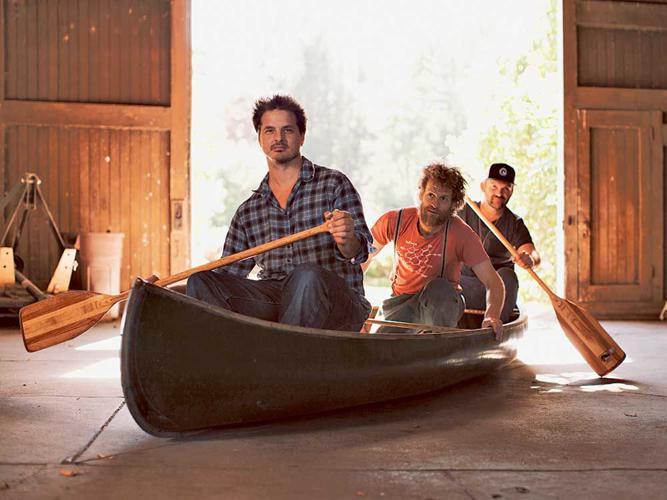
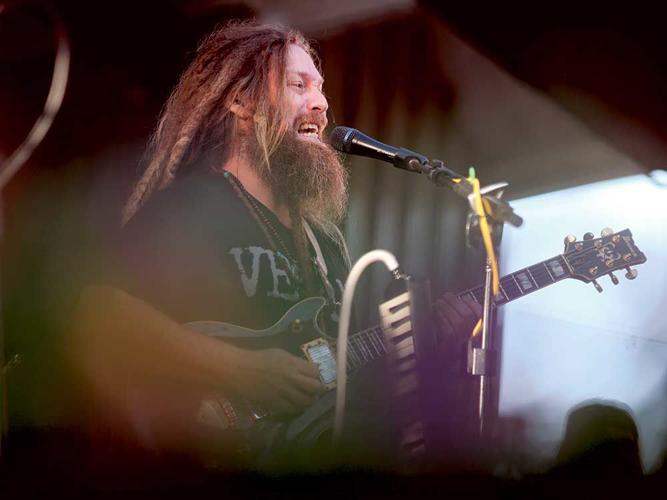

IN JULY 2004, INDIE ROCK TRIO DISPATCH drew over 110,000 people from all 50 U.S. states and 20 different countries for a free concert in Boston. At the time, it was billed as the group’s final show, but it also proved to the music industry just how big a band could go without ever signing with a record label. The outfit’s multi-instrumental members Chad Urmston, Pete Heimbold and Brad Corrigan leaned on the support of a fan-powered, grassroots network largely fueled by word-of-mouth, a growing adoration for genre pioneers Sublime, and a major internet hit, the catchy upbeat blue-eyed reggae anthem, “The General.” Dispatch did indeed disband for nearly a decade, but they picked up exactly where they left off, continuing to redefine independent music history.

Rumor has it that Dispatch is readying to release about 10 new songs recorded during the America, Location 12 sessions at the serene coastal Stinson Studio in Northern California.
When the group got back together, their grassroots strategy remained intact: Dispatch sold 58,000 tickets to shows at Madison Square Garden without spending any money on marketing. They simply created a special Facebook fan page to spread the word.
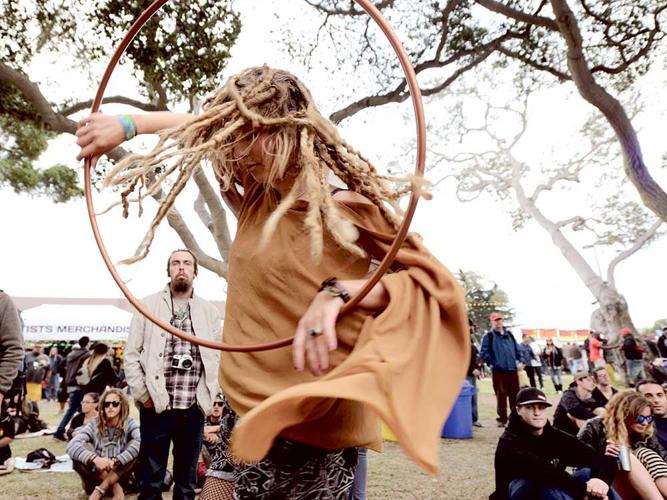
It’s fitting that the part-time New England and part-time Colorado-based collective is one of the headliners of the 2018 iteration of Cali Roots, a music gathering that has redefined the reggae-rock festival and grown into the largest event of its kind in the world, according to organizers.
Since Cali Roots’ daylong 2010 debut on a patch of grass at the Monterey County Fairgrounds, it has exponentially morphed into a three-day phenomenon that fills the entire expanse of the fairgrounds with nearly 12,000 attendees per day and deep, versatile lineups that have included Philly hip-hop favorite The Roots, ganja-flavored rap crew Cypress Hill, hip-hop guru Nas and even the wonderfully uncategorizable Fishbone.
And it began with one man, Jeff Monser’s vision – a vision without a blueprint or even a simple outline.
“There was no master plan,” Monser told to the Weekly a few weeks before Cali Roots expanded into a three-day jaunt. With the assistance of Dan Sheehan, brought on as a co-producer, marketer, talent buyer and go-to guy for everything else in between, the lineups sizzled with everyone from Matisyahu and Pepper to SOJA in the past, and Rebelution, who will close Saturday night this year in The Bowl.
The 2018 lineup (see schedule sidebar) also includes Alpha Blondy, E-40, Atmosphere, Stephen Marley, and The Original Wailers.
Dispatch, meanwhile, makes their Cali Roots debut Saturday after recently finishing their first all-acoustic tour in winter 2018. The string of shows primarily focused on material from their 2017 LP America, Location 12.
“It’s really good to have the full instrumental arrangements and whittle them back to acoustic where you really can’t hide anything.”
“It’s really good to have the full instrumental arrangements and whittle them back to acoustic where you really can’t hide anything,” says Corrigan (vocals, guitar, percussion and harmonica), speaking from a buddy’s house in Evergreen, Colorado. “Most of the new material has been tattooed into ourselves.”
Corrigan notes that the group recorded several tunes that don’t appear on America, Location 12, but they’ll begin busting some of those out – in small doses – on the road, starting in Monterey. He says that fans can look forward to one or two of the previously unreleased tracks as well as the three songs from the record that they have yet to perform live. More than any of their previous work, America, Location 12 represents a monumental period for the trio.
It’s also vastly different from any other album in their catalog.

Mike Love – not to be mistaken for the co-founding Beach Boy – regularly inserts politically-charged ideas into his music: “Bring the troops back home,” he sings in “No More War.”
“Painted Yellow Lines” glides by with a mellow beach-soaked refrain and potent prose: “America on my face… ” The accompanying black and white video is its own story: “I love how unlikely it is, but as soon as you see the black and white footage and that character, it really works,” Corrigan says. There’s a strong sense of wandering, searching for something just out of reach in this mini-masterpiece that pulls its aesthetic from a mixture of The Last Picture Show andParis, Texas.
Those who are interested in checking out the 35-minute film in its entirety can send an aluminum-can tab and a one-dollar bill with a return address to the filmmaker, whose info is available through Dispatch’s website.
Corrigan quickly digresses back to the experience behind recording America, Location 12, and Dispatch’s creative process.
“I’m so inspired by the way Chad writes,” he says. “I think my biggest strength is not trying to compete on the writing front, but arranging and singing harmonies and helping refine and distill all the material that comes out of him. Pete has this funny, left-field ingredient with the sound that he hears in the midst of it. I think all three of us really leaned on our strengths forAmerica, Location 12 and we depersonalized it. We made it about what songs serve the band best, opposed to is it a Brad song, a Chad song or a Pete song?”
After more than two decades, the band trusts its team to pick the best and most cohesive material for the record. It ended up with 11 tracks culled from a solid batch of around 30 newly recorded pieces.
“It’s a record that has a beginning, middle and end,” Corrigan says. “Instead of feeling like it’s a collage, it’s one of our strongest records. It really has continuity to it and unique production and all of us standing on our strengths.”

With recreational cannabis legal for people ages 21 and up in California as of Jan. 1 thanks to the Adult Use of Marijuana Act, you might expect more pot at this year’s festival.
All three agree that one of the main ingredients that contributed to the record’s beauty was recording at a “magical” studio at Stinson Beach in Northern California, overlooking the vast Pacific Ocean and endless forest.
“It’s the most beautiful place to create anything,” Corrigan insists. “Sitting up on a mountainside, overlooking the water… it’s incredible.”
Also, Corrigan says there’s magic in the way they get along in the studio after so many years making music together. The band is really in sync as far as trusting each other and trusting the process and looking at the songs that serve Dispatch best.
“It’s so fun when you can trust and respect each other so much that you can totally disagree,” Corrigan says. “We’ve been doing this for 22 years. We love each other. We’ve been a band, we’ve broken up, we’ve been a band – the one thing that we know is that we’re brothers, and we should allow ourselves to be passionate but be able to laugh and say, ‘Hey, thanks for giving me room there.’”
Laughter is another important ingredient that brings Dispatch back together again and again. Recording in a place that was in the middle of forest and full of trails inspired the band to regularly go for hikes, which is what they did anytime they needed to vent, whenever there was too much intensity.
“Someone’s going to climb a tree or someone’s going to strip down naked or someone’s going to jump out or start talking in a different accent,”
“Someone’s going to climb a tree or someone’s going to strip down naked or someone’s going to jump out or start talking in a different accent,” Corrigan says. “The excitement about a power trio is there’s sometimes unstable energy. Sometimes two people are connecting and one isn’t, but there’s a constant exchange of energy and ideas.”

Now in their mid-40s, the group faces life situations that are much different from their salad years, but they’re trying to hang onto the spark that ignited them in their 20s.
“We’re trying to be crazy creative kids, hanging onto our youth and all the ways we write and create and believe,” Corrigan says. “Chad and Pete are married with kids and we’ve all got a little more adult stuff that we’re trying to keep an eye on. We’re sharing a lot of heavy stuff together about our parents, our wives and kids.”
Something about Dispatch that has never changed over the years: Their commitment to helping those in need and involving themselves in an assortment of charitable work. They’ve even launched their own charities and nonprofits, including Amplifying Education and The Dispatch Foundation, which focuses its attention and resources on Zimbabwe.
Corrigan says the three of them give back for various reasons, but speaking for himself, it all began in church with his grandfather.
“My grandpa said that there’s a time to pray for people and then you’re hoping things for them, and then there’s a time when you become the answer to their prayers,” he says. “You actively go work for [people who are marginalized], serve them, fix something, walk with them and share life with them. I remember thinking how powerful that is and how life is completely spiritual and it is completely physical. If you’re not willing to meet someone in their struggle or their brokenness, that’s not the full deal.
“All of us experienced so much love and were given so much love, and our fans have given us the gifts of gifts.”
“All of us experienced so much love and were given so much love, and our fans have given us the gifts of gifts,” Corrigan continues. “We’re able to make music and ask questions and invite our fans along for our artistic ride. Our fans keep showing up when we ask, ‘If we do a show for Zimbabwe will you guys come? If we do a show on a reservation in South Dakota, will you come and do a service day?’”
Most recently, following a mass shooting in a high school in Parkland, Florida, the band tackled gun reform and gun violence in U.S. schools.
“It’s the first time we ever brought something up that has the potential to be polarizing,” Corrigan says.
Dispatch’s response to the cowardly act that tragically claimed the lives of 17 kids at Marjory Stoneman Douglas High School was “Dear Congress, (17),” which the band penned while touring.
“We want to humanize the subject and say, ‘This song is from the perspective of a parent losing a child to gun violence,’” Corrigan says.
Bandmate Chad Stokes channels a grieving parent: “It’s not enough, your thoughts and prayers.”
“People need to be able to dialogue and listen to each other’s perspective,” Corrigan continues. “Even if they don’t agree, it’s important to hear everyone out. That became the [mantra] on the winter tour: ‘No one here has to agree, but we have to be able to talk about this.’”
In the weeks following their Cali Roots debut, Dispatch will crisscross the country on a monster summer tour. And they’ll probably come out the other side with more socially relevant material to share with the world.
CALIFORNIA ROOTS FESTIVAL music begins 11am Friday, Saturday and Sunday, May 25-27. Monterey County Fair and Event Center, 2004 Fairgrounds Road, Monterey. $230 (plus $36.18 fees)/three-day pass; $110 (plus $17.82 fees)/single-day pass; VIP sold out.
(0) comments
Welcome to the discussion.
Log In
Keep it Clean. Please avoid obscene, vulgar, lewd, racist or sexually-oriented language.
PLEASE TURN OFF YOUR CAPS LOCK.
Don't Threaten. Threats of harming another person will not be tolerated.
Be Truthful. Don't knowingly lie about anyone or anything.
Be Nice. No racism, sexism or any sort of -ism that is degrading to another person.
Be Proactive. Use the 'Report' link on each comment to let us know of abusive posts.
Share with Us. We'd love to hear eyewitness accounts, the history behind an article.