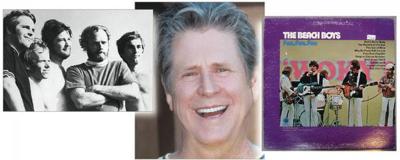
Interviewing Brian Wilson, I felt like I was talking to a very simple man. He answered my questions with a directness that was not exactly blunt— he was friendly, just not very talkative. It was as though he sees things in such straightforward terms that he can hardly say more than a few words.
He didn’t seem to want to talk much about his remarkable comeback, or about why he is still touring after being gone for so long. I asked him why he is featuring old Beach Boys material on this tour, rather than playing the newer stuff that he’s been performing for the past three years or so. “Because I like the songs,” he said. “And I sing ‘em well.” I asked him how he felt about taking the stage in Monterey with his long-time bandmate, Al Jardine. “Great,” he said. I waited. “He’s a wonderful man and a good singer. He’s a Beach Boy.”
Wilson didn’t have a lot to say about Smile, the critically acclaimed 2004 album he’d been working on since 1967. When I asked him how it was that he got back together with Van Dyke Parks, the brilliant songwriter and arranger that he’d worked with in a collaboration that spanned four decades, he said, “I called him up.” Simple as that.
I’ve read several recent interviews, and none of them go into much depth. So I don’t think it’s that he was in a quiet mood. He’s just not much of a talker.
If he wanted to talk, he’d have a great story to tell.
GOOD VIBRATIONS
It’s been eight years since Brian Wilson’s reincarnation. For three decades before that, he’d been pretty much gone. At some point in the early 1970s, he vanished, became some kind of a hermit. He was a man ruined by drugs and booze, we were told, haunted by paranoia and depression. He stayed in his room; he would not leave his bed. He weighed 300 pounds and did not talk. Later reports told an even weirder story: He’d been rescued by some kind of psychiatrist-guru who’d saved his life but stolen his soul. He quit drugs and got healthy, but mostly kept to his seclusion.
All the while, his myth lived on. His accomplishments and the power of his genius were recognized by succeeding generations of musicians and fans. He was gone, but he had become a legend— California’s own Elvis.
Slowly, eventually, he began to reemerge. He got married. He started to make occasional appearances on stage. But by then he was thought about in the past tense. People spoke of him as one of the ’60s icons who’d succumbed to self-destruction— like Jimi and Janis and Jim Morrison. It was almost like he was dead.
In the summer of 1999, he really reappeared. In fine voice, backed by a tight band, he sang the old hits and even unveiled some pretty good new songs. The audience was stunned by the beauty of his music, which had survived intact.
The LA Times’ Richard Cromelin published a review that was typical of many that would follow: “At the end of the evening, Wilson stood triumphant on stage, a man who has emerged from his darkest, most paralyzing blue period to again celebrate his music— and the human spirit— with his fans.”
Several accounts of that show contain wonder verging on awe, but not hope. Clearly this was a one-time miracle, some kind of fluke, maybe even a swan song. Brian Wilson had reappeared— but he couldn’t really be back for good.
Over the next three years, the miracle repeated itself. Wilson went on tour, and everywhere, audiences sang along until the end of the show and then jumped to their feet— practically every performance concluded with a long standing ovation. Critics continued to deliver raves A San Francisco Chronicle reviewer wrote: “The Brian Wilson concert was one of the most moving and inspirational events in recent memory.”
Still, the true proof of the resurrection was yet to come. At home in Los Angeles between tour dates, he was back in the studio, working with his old friend Van Dyke Parks. In 2004, Smile, a project that the two had begun working on in 1969, was finally released.
For old Beach Boys fans and many other pop-music aficionados, Smile was a major event. This was the legendary lost masterpiece, maybe the most famous unrecorded album in history, conceived at the peak of the Beach Boys’ career, and abandoned amid the tumult that ultimately led to the breakup of the band and the shattering of Wilson’s life. More than 30 years later, it could have easily been a disappointment.
I remember feeling some fear when I saw the CD on the shelf of a record store in Santa Cruz. I was only vaguely familiar with the story of Wilson’s return, but I knew what Smile was. For a while when I was a kid, I loved the Beach Boys more than anything. They were my first favorite band— All Summer Long was the first album I ever bought, when I was 9 years old, a few days after it came out in 1964. I loved the band right up until Brian quit, in 1974.
I picked up Smile the minute I saw it but I didn’t expect too much. I listened to it on the drive down Highway 1 and was blown away, transported by those old Beach Boys harmonies and stunned by the album’s pleasantly strange composition and its sublime beauty.
I thought maybe it was just me. Over the years I have developed broad tastes in music— I love pretty pop songs and also all kinds of borderline-bizarre avant garde artsy music, and to my ears, Smile contained both. I was embarrassed that I liked it so much— and relieved to find out that smart music critics liked it too.
Smile was not an enormous commercial success, but it was showered with critical acclaim. It landed at the top of dozens of critics best-of-the-year list. Tom Smucker’s review in the Village Voice was effusive, but not outlandish: “Whatever it was supposed to achieve originally, right now Smile sounds like a beautifully modulated, funny, sometimes unintentional meditation on a failed United States and counterculture, and the lost paradise, real or imagined, of Southern California.”
Over the past couple of years, Brian Wilson has continued touring, and continued to bring crowds to their feet. He arrives in Monterey this week riding a wave of adulation. This is not mere nostalgia— these days, when the old Beach Boy takes the stage, bearing the marks of a wounded man, the music he brings inspires something like love.
PET SOUNDS
Sgt. Peppers Lonely Hearts Club Band, which came out in 1967, is often given credit for revolutionizing popular music. But ask Paul McCartney and he’ll tell you it was the 1966 Beach Boys album Pet Sounds that showed The Beatles what was possible.
People who take popular culture seriously have long held Brian Wilson in the highest regard. He is widely considered to be one of the most important pioneers in the history of pop music— credited with fundamentally changing the way records sound by finding a new way to work a recording studio.
Pet Sounds was a monumental breakthrough. The lush vocal harmonies that had been the Beach Boys’ trademark floated above a densely layered instrumental web; its sonic complexity and depth were utterly unique in 1966.
Using then-newly invented recording devices, Wilson had learned to play the recording studio like it was an instrument. Today we are familiar with the experience of hearing an album that is expansively produced; at the time it was something brand new, and it came as a revelation.
Pet Sounds was as much of a musical breakthrough as it was a technological advance— a re-imagining of what music could be. With its complex arrangements (not to mention its weird instrumentation, which included, famously, clips of barking dogs) it was a singular invention. Then as now, it’s hard to even know what to call it; the Beach Boys were some variety of rock ’n’ roll band, but it’s a stretch to call this music rock ’n’ roll.
In 2003, Rolling Stone magazine selected Pet Sounds as the number two album of all time— behind Sgt. Peppers. In a retrospective review, the magazine described it as “the first rock record that can be considered a ‘concept album.’ ”
“From first cut to last we were treated to an intense, linear personal vision of the vagaries of a love affair and the painful, introverted anxieties that are the wrenching precipitates of the unstable chemistry of any love relationship.”
In 1965, it would have been hard to imagine that kind of statement being made about the work of any rock ’n’ roll band— maybe least of all the Beach Boys. Rock ’n’ roll didn’t deal in concepts— rock ’n’ roll was for kids. And from everything we heard and saw, it seemed like the Beach Boys themselves were kids. This band was about fun. They didn’t sing about “the vagaries of a love affair,” they sang about surfing, hotrods and girls.
The first two lines on track one of Pet Sounds move from the teenaged innocence of early-Beach Boys records to another kind of innocence. “Wouldn’t it be nice if we were older, and we wouldn’t have to wait so long?” Then, “Wouldn’t it be nice to live together in the kind of world where we belong?”
The album is suffused with an optimistic glow— it captures the feeling of an era that was just dawning. (The band had already recorded Good Vibrations, one of the anthems of that era, but Wilson had decided not to include it on Pet Sounds.) In 1966, a year before Sgt. Peppers and the Summer of Love, Brian Wilson brought his band and his fans into a new world, a new California.
SURFIN’ USA
Prior to Pet Sounds, the Beach Boys were already huge stars. They’d had four top-ten hits in 1963 and three in 1964. That success sprung from its own brand of innovation.
Even on their earliest hits, “Surfin’ Safari,” “Surfin’ USA,” “Fun, Fun, Fun,” etc., the band had a sound that was unmistakable, built around tight, high harmonies, uniquely gorgeous to this day. Their marvel can be attributed to two things: genetics and practice.
The Beach Boys were a family band. Brian, Carl and Dennis Wilson grew up singing together around the family piano— both of their parents were amateur musicians. They were often joined by their cousin, Mike Love, and a friend from down the street, Al Jardine. When they appeared on the music scene, the Beach Boys had already been singing together for years.
Of course, in addition to their well-rehearsed act, the Beach Boys brought something else to the scene: an exciting and exotic image— California youth.
Pop music had been geared toward young people for years by the time they showed up, but this was something different. This was surfing, hot-rods, and California girls— and it all came wrapped in an irresistibly sunny sweetness. It may be hard to imagine now, but the Beach Boys were a new kind of cool.
Listening to them in New Jersey when I was 9, I liked everything about this band. The pre-teen rebel in me lusted after the cars and girls; the little boy in me was probably comforted by the lullaby of the California dream.
This resonated with a lot of other kids, too. I can remember a summer weekend— probably 1964— when New York’s WMCA radio held a call-in battle-of-the-bands between the Beach Boys and The Beatles. For a short while, the Beach Boys were the biggest band in the country.
Their fame has survived, but their popularity was short lived. I don’t recall who won the contest that weekend in 1964, but we know that The Beatles rose to such heights that they are now almost universally celebrated as the greatest band of all time, while the Beach Boys are largely viewed as an artifact.
That might have something to do with the fact that Brian Wilson refused to change with the times. In their songs and in their sound, the Beach Boys clung to the beauty and innocence that marked the early ‘60s, continuing to create music marked by a sweetness that seemed a bit out of place as the culture moved in a darker direction. But there’s a simpler explanation as to why the Beach Boys did not achieve the kind of success promised by Pet Sounds: At the peak of their popularity, the band imploded.
HEROES AND VILLAINS
As a 12-year-old in 1967, I was still listening to “I Get Around,” shamelessly dancing around my mom’s kitchen and singing into an egg-beater microphone.
As a 15-year-old in 1970, I was sitting in the back seat of my buddy Giles’s primer-gray Fairlane, listening to Jethro Tull and The Doors and smoking lots of dope. So was everyone else.
According to the oft-told story chronicling the demise of the original Beach Boys, the Wilson brothers all discovered drugs in the late ‘60s. Big time. Brian, in particular, experimented for a while, and then began to self-medicate heavily (or party like a rock star, depending on who’s telling the story). His little brothers followed in his footsteps.
Brian Wilson’s musical tastes evolved, reflecting changes in the culture and his life. While he still favored pretty pop, he attempted to steer the band further along the path blazed by Pet Sounds, toward a vision that can fairly be called psychedelic. He wanted to make Smile. But his band wouldn’t let him.
Apparently, bandmates Al Jardine and Mike Love declined to embrace Wilson’s druggy lifestyle or his new experimental artistic bent. Love was open about his disdain for the strange, artsy new songs Wilson was bringing to the band— he wanted to make “Kokomo.”
(When I spoke with Wilson, he did not want to talk about any of this. “It’s too painful for me,” he said. I tried to reach Jardine, who lives in Big Sur, to confirm this version of events, but was unable to get to him through his manager.)
Drugs, personal gripes and artistic differences slowly wrenched the band apart over the next six or seven years. Meanwhile, the Beach Boys continued to make records, and they even had some monster hits (“Good Vibrations,” “California Girls,” “Let’s Do It Again,” etc.), but they were no longer spoken of in the same breath as The Beatles.
To my ears, some of the Beach Boys’ best work can be found on a couple of never-heard records from the period in which the original band was in disarray and Brian Wilson was headed toward the depths of depression and addiction.
Surf’s Up, from 1971, is as beautiful as Pet Sounds, and as rewarding, even though there is nothing like a hit on it. The cover features a dark-hued painting of a defeated-looking Indian on a slumping horse, his head bowed in what looks like exhaustion or sorrow, his spear pointed ominously downward. The image plays against the title, and everything that the Beach Boys had ever meant. The album is not nearly as dark as the cover might suggest— it includes the wonderfully optimistic “Long Promised Road” and the gorgeously trippy “Feel Flows,” both by Carl Wilson; but the title track, which was meant for Smile and showed up again on the 2004 version, is a study in melancholic beauty.
Holland, recorded the following year, was made without much help from Brian Wilson. According to the legend, he was barely functioning. It features a gorgeous trilogy, “The California Saga”— one song by Mike Love and two by Al Jardine (one of which includes a poem by the Bard of Big Sur, Robinson Jeffers). The best thing on the album, though, is Brian Wilson’s one contribution— the triumphant “Sail On Sailor.”
When those albums were new, and I was a high school kid trying to fit in and be cool, they were my secret pleasure. I remember that once or twice I broke them out to play for a trusted friend, as a break from Led Zep and David Bowie. I don’t know if any of my buddies liked the Beach Boys at all. Mostly, though, they were ignored and then forgotten.
Not long after Holland was released, Brian Wilson left the band and disappeared. He came back again for a few minutes in the late ‘70s, then disappeared again. Dennis died in 1983, Carl in 1998. The Beach Boys, fronted by Mike Love and longtime sixth-member Bruce Johnston, continued to tour and make records, but that was a different band.
SMILE
The thing Brian Wilson seemed most excited about, when I interviewed him last week, was a new studio project— another concept album. He has been working over the past year with Van Dyke Parks on what he called a “narrative album” based on the classic children’s book The Little Prince.
“I’m doing the narration,” he said. “It’ll be a bunch of songs interrupted by a narrator who tells the story— the idea is to present a complete narrative.”
He explained that the narrator is named “Lucky Old Sun,” and asked if I remembered the old song. He sang a few bars: “That lucky old sun, he’s got nothin’ to do, but roll around heaven all day.”
Wilson reminded me that he had released a children’s album along with Holland in 1973. I replied that it seemed to me that much of his work has a childlike quality to it; Smile, for instance, has both lyrical and musical references to children’s songs. “Yeah,” he said.
I asked: What’s that about? Where does that come from?
“From my heart,” he said. Simple.
BRAIN WILSON plays the Golden State Theatre on Saturday, June 9, at 8pm. 372-4555 or goldenstatetheatre.com
(0) comments
Welcome to the discussion.
Log In
Keep it Clean. Please avoid obscene, vulgar, lewd, racist or sexually-oriented language.
PLEASE TURN OFF YOUR CAPS LOCK.
Don't Threaten. Threats of harming another person will not be tolerated.
Be Truthful. Don't knowingly lie about anyone or anything.
Be Nice. No racism, sexism or any sort of -ism that is degrading to another person.
Be Proactive. Use the 'Report' link on each comment to let us know of abusive posts.
Share with Us. We'd love to hear eyewitness accounts, the history behind an article.