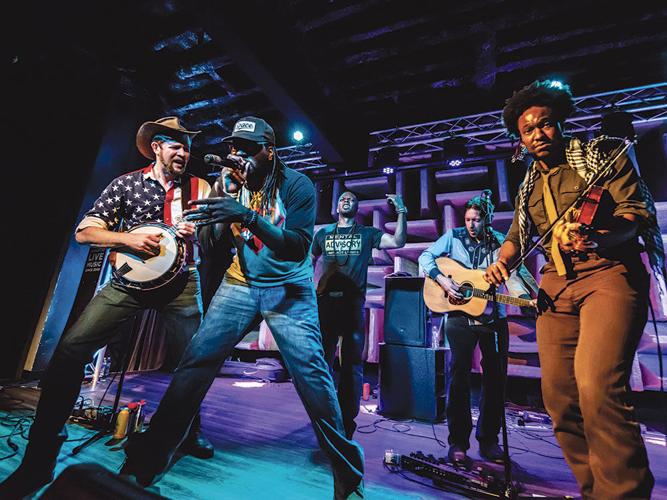
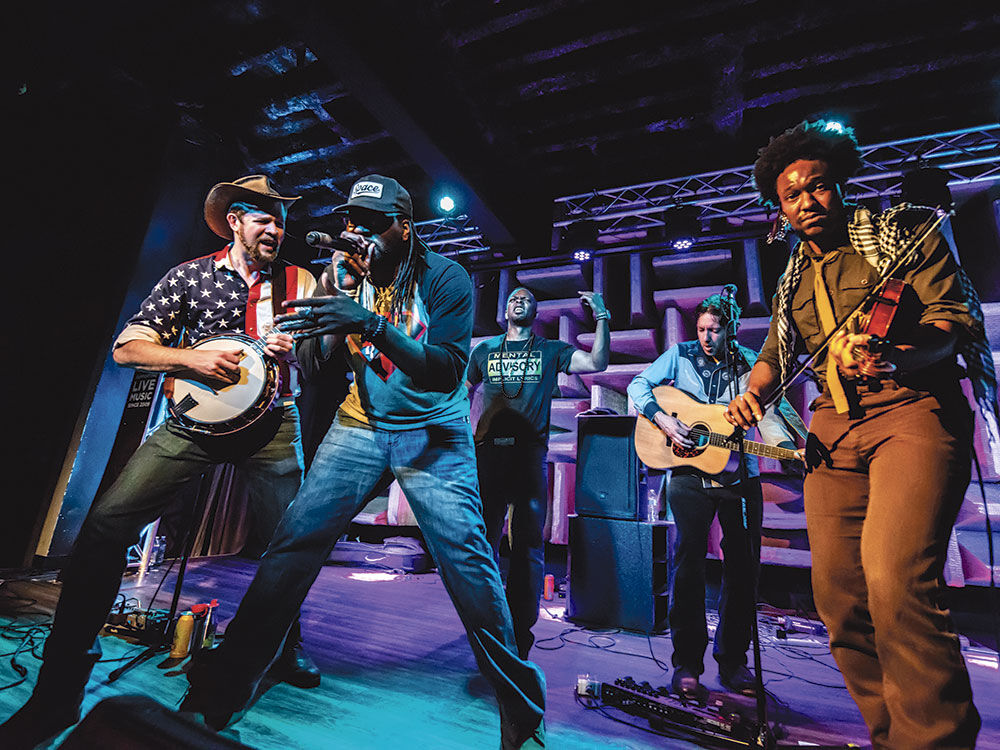
The band Gangstagrass brings together hip-hop artists and bluegrass pickers. The fusion band helped pilot a workshop for songwriters and musicians at the Braver Angels convention, guiding people who hold divergent political views to create and perform music together.
There are plenty of cues that signal people’s political affiliations. Some are obvious – hats or T-shirts advocating a cause or candidate, for example. Many are subtle, and may not come up until deep into a conversation.
But to flag ourselves as red or blue, right or left, feels extreme. So when I was handed a name tag on a blue lanyard at a conference to signify my left-leaning political identity, I was at first uncomfortable. Did I really want to advertise my views at-a-glance to a contentious, divided world?
And besides, we were there – from July 5-8, at the Braver Angels National Convention in Gettysburg, Pennsylvania – for the purpose of crossing over the red/blue divide. I was one of roughly 700 delegates from around the country, equally divided between red and blue. We had come together to challenge political polarization and engage in robust civic debate.
“Lots of feelings going into this event,” I wrote in my journal on the plane ride to Gettysburg. “Hopeful, high expectations, nervous… Flickers of doubtful. How can anything be a panacea in this day and age? But maybe just a glimpse of progress, a bit of illumination on the path ahead, is enough. So I go back to hopeful.”
Hope felt especially important for this journey – and especially personal.
I had first heard of Braver Angels in 2020, when then-president, now-candidate Donald Trump was dominating the media, George Floyd was murdered, Covid ran rampant, masks became politicized, and QAnon conspiracies were going viral. When my sister, an evangelical Christian, began sending me videos about the “Plandemic” and the stolen election, I stopped responding to many of them. Our mother tried uncomfortably to straddle the widening divide between us, as we all learned to tread lightly and avoid speaking about many topics. We still loved each other, but as our shared sense of truth dissolved, it also felt like we no longer really knew – or trusted – each other.
I searched online for ideas on how to communicate across the gulf and stay connected despite ideological disagreements. I took three of Braver Angels’ workshops via Zoom. Their “Families and Politics” offering was helpful, but I still craved more guidance on how to bridge the gap in my own family. So in 2023, I applied, along with my husband, Kevin Smith (director of digital media at the Weekly), to attend the nonprofit’s third national convention. We were accepted.
Stepping into that sea of red and blue convention delegates in Gettysburg, I knew I had a lot riding personally on this event, and suspected that others did, too.
AS WE THREADED OUR WAY TO THE DINING HALL FOR BREAKFAST THAT FIRST MORNING, through waves of red lanyard wearers, we couldn’t help but wonder if they were as wary of us as we were of them. Did they perceive us as coastal-elite-bleeding-heart-immoral-California-liberals? Were they Trump-voting-anti-immigrant-gun-toting fascists?
Across from me at the breakfast table was an atheist from Utah with long brown hair and a blue lanyard. He was engaged in conversation with a soft-spoken man with a white collar and red lanyard, who I soon learned was a Catholic priest from the tiny Glenmary missionary sect in Ohio. Though they had met only five minutes before, they were talking intently about birth control – and they seemed to be bonding over it.
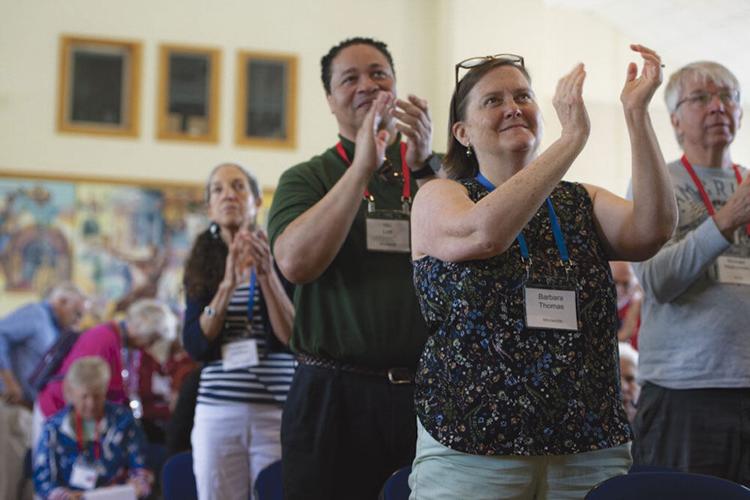
The theme of that morning’s opening session was “Why Are We Here?,” co-chaired by Erica Manuel (blue), CEO and executive director of the Institute for Local Government, and Wilk Wilkinson (red), champion of the working class and host of the podcast Derate the Hate. As hundreds of heads nodded over their red and blue lanyards, I saw that this sprawling group of Americans was united in support of Braver Angels’ mission: “To bring Americans together to bridge the partisan divide and strengthen our democratic republic.”
And what I experienced over the following three days was a profound renewal of hope and a tantalizing taste of what America – in all its passionate diversity – could be.

Below: Attendees at the Braver Angels convention in July wear red and blue lanyards to signal their political leanings.
BRAVER ANGELS WAS ESTABLISHED AS A NONPROFIT ORGANIZATION BY TWO FRIENDS, David Blankenhorn and David Lapp, shortly after the divisive 2016 presidential election. Along with family therapist Bill Doherty, they held a workshop for 21 residents of South Lebanon, Ohio (10 Trump supporters and 11 Clinton supporters), with the goal of disagreeing respectfully and – perhaps – finding common ground. They filmed this first inspiring event (you can still view it on the Braver Angels website) and followed it up with two bus tours through the Midwest and East Coast, training over 100 moderators as they went.
There are now 700 workshop moderators and 100 local alliances throughout the U.S. and 71 types of Braver Angels events. In 2022, over 24,000 people attended more than 1,200 Braver Angels programs, and the numbers show real impact: 86 percent of participants feel they better understand “the other side,” and 81 percent feel better prepared to apply the new skills in their real life.
A small sampling of their programs includes the College Debates and Discourse Alliance, a framework for teaching students how to express their views, form persuasive arguments, listen deeply and engage respectfully around the challenging political and social issues dividing our nation.
There’s Braver Politics, an initiative aimed at empowering politicians to work with their colleagues and constituents across the aisle. This includes Deliberative Town Halls, in which citizens and their elected officials find common ground and work toward shared solutions to pressing community issues, rather than digging in on their differences.
And a variety of flagship workshops continue to be offered in-person and online, such as 1:1 Conversations, a way for Americans with different backgrounds to connect as people who are concerned for their country. Depolarizing Within helps de-normalize the dismissing and ridiculing of people with different opinions. And Red/Blue Workshops are intensive events that help participants clarify disagreements, reduce stereotyped thinking and discover common values.
“Never before in our history have Red, Blue, and Independent Americans come together in such numbers, determined to heal our divisions and protect America’s promise,” Blankenhorn said in a post-convention press release on July 13.
That determination played a pivotal role in dozens of workshops in Gettysburg and also – perhaps most importantly – over meals and in conversation with each other.
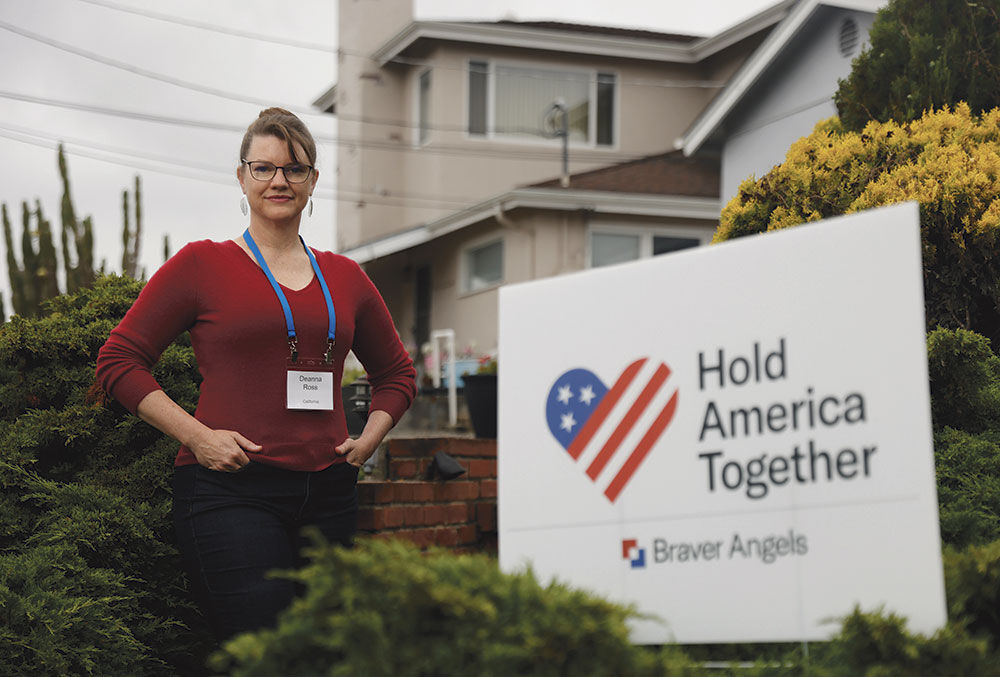
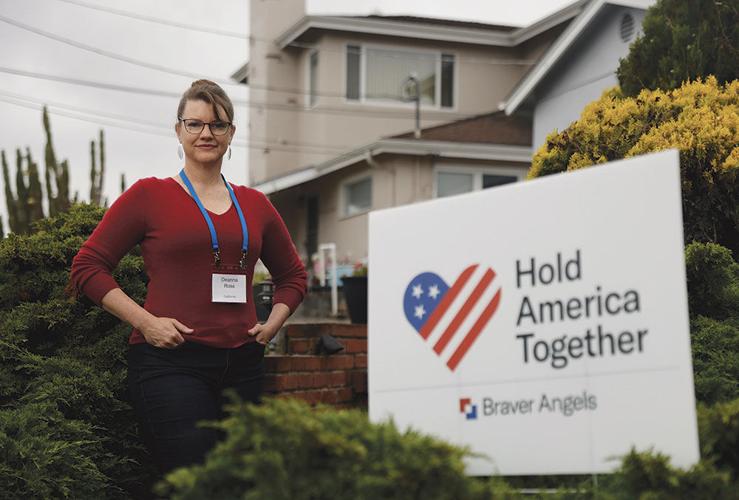
Deanna Ross lives in Del Rey Oaks and works at Monterey Peninsula College and Hidden Valley Music Seminars. She now keeps this Braver Angels sign in her front yard.
DURING MY FIRST BREAKOUT SESSION, “Braver Lens: Amateur Photography to Heal American Divides,” reds and blues passed around our phones in small groups, sharing photos in response to the prompt “bridges and barriers to flourishing.” It was an intimate exercise, a candid look through strangers’ eyes. My group bonded over the discovery of a shared love of travel, traditions and capturing unique moments with our cameras. Some of us even shed a few tears, understanding that we were in the middle of something unique ourselves.
Lunch that day included surprisingly good tater tots and an impromptu conversation on big government with two municipal workers from Idaho (red lanyards), who were surprised by my husband’s stance that bureaucracy often leads to inefficiency. In turn, we picked their brains about what it takes to establish a local Braver Angels alliance (spoiler alerts: it requires red and blue co-chairs, and we want one in Monterey County). Refreshed, we shook hands before heading off to our various afternoon sessions.
Kevin attended an event called “Red and Blue Takes on Tech: From Fueling Polarization to Building Bridges,” led by Braver Angels Chief Technology Officer Andrew Stillman and Lisa Schirch, author of the 2021 book Social Media Impacts on Conflict and Democracy: The Techtonic Shift. Schirch presented compelling new research on the ways that “conflict entrepreneurs” are intentionally weaponizing the media for their own financial gain, using the blunt tools of exaggeration and stereotyping to misinform the American public – and how citizens are playing a part in their success by consuming toxic media indiscriminately.
Meanwhile, I participated in a faculty gathering in which we debated the effects of social media on democracy using parliamentary procedure in a mock classroom setting. I was humbled and proud to represent Monterey Peninsula College, where I’ve taught in the Dance Department since 2005, among a varied group of educators from UC Berkeley, Princeton and other major academic institutions. I was inspired by the exercise – the debate format engendered honest self-expression and transparent reasoning.
In the evening, Kevin and I had a pleasant exchange with a former Republican member of the New Mexico State Senate regarding Capitola’s recovery from last winter’s floods (his family has a house in the area), before attending a theatrical event created for the convention. Four Score: A Memory Play, written by Braver Angels Administrative Director Mark Metzger, featured local red and blue delegates sharing family artifacts harkening back to the Civil War. Through personal stories and live music, it highlighted the fact that we were gathered on ground that had been the backdrop, 160 years earlier, for a decisive battle and Abraham Lincoln’s Gettysburg Address.
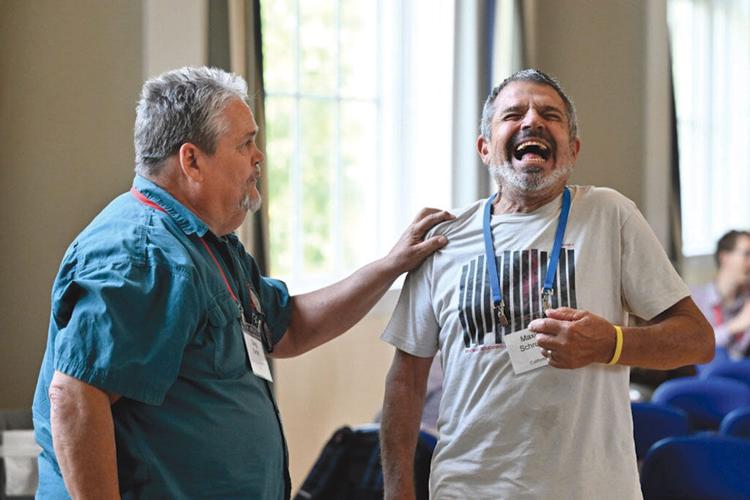
Throughout the convention, it was not uncommon to bump into guest speakers and elected officials in the crowded hallways or in line at the salad bar. There was a talk-to-everyone atmosphere that permeated the humid summer air and elicited conversation. As the hours passed, and initial chats deepened into the sharing of ideas and became human connections, I found myself forgetting to fear the color-coded lanyards. By the end of that first night, Kevin and I walked back to our dorm room feeling a little starry-eyed, as hundreds of fireflies punctuated the lush, green darkness.
Hans Christian Andersen, the 19-century author of fairy tales such as “The Little Mermaid” and “The Emperor’s New Clothes,” famously wrote: “Where words fail, music speaks.” Beyond its many programs that emphasize talking, Braver Angels has assembled a dedicated team to explore the role of music in communicating ideas and bringing people together. Recognizing the convention as fertile ground for a musical experiment, the team brought in the genre-bending, genre-blending band Gangstagrass as artists-in-residence to help pilot a new program called Common Ground Songwriting. Kevin (a guitarist/vocalist/songwriter) and I (a vocalist/songwriter) gathered our courage and signed up.
The Common Ground Songwriting program began on day two of the convention with 15 intrepid songwriters, six artists-in-residence from Gangstagrass, and five Braver Angels music team staff members.
But before we wrote any music, we did more talking. Separated into three smaller songwriting groups, each group was focused on a different policy topic: health, education (myself) or voting rights (Kevin). Our discussions began with “fishbowl” exercises, in which like-lanyarded participants spoke freely about their beliefs regarding these policy areas, while the other participants listened without interruption. Then the roles were reversed, giving folks with the opposite political leanings the floor.
Afterwards, each songwriting group reflected on common concerns and overlapping ideas. In my group, we discovered differing views on affirmative action, private versus public education, and more. We all agreed that an education absent of values would not be a complete education.
That afternoon, each policy group jumped into the daunting task of writing an original song based on the morning’s discussions. In my education-focused cohort, we grappled with lyrics for nearly three hours. While all of us agreed on the importance of values in education, we repeatedly got hung up over the thorny question, “Whose values?” At one point, this generated a heated exchange between our group’s religious and non-religious songwriters, with pulses quickening and voices rising. But none of us gave up, filibustered or walked out of the room. We regrouped around the task at hand: to finish our song for a concert the following night. We stayed in the creative maelstrom, together.
By the next morning, we were scrambling to nail down that pesky second verse, dial in our vocal harmonies and ward off performance anxiety.
While I’m no stranger to making music, I had never tried to write a song about a controversial policy issue with six politically diverse strangers in less than eight hours, then perform it for hundreds of people before the scribbled ink had dried on the page. It was hectic, and surprisingly fun.
Meanwhile, Kevin’s group was undergoing similarly frantic preparations for its voting rights song. After contributing a rousing guitar part and hooky whistling riff the day before, Kevin was now feeling butterflies of his own. His group included three Gangstagrass band members and New York Times journalist Farah Stockman observing, and he really didn’t want to screw anything up. (He did great!)
Meanwhile the third songwriting group, focused on health policy, was tucked away in another classroom, shrouded in mystery – except for the soaring vocals and violin occasionally seeping through the walls.
While we rehearsed, other convention delegates were attending sessions with titles such as “Libertarian Perspectives on Depolarization” and “Can We Find Common Ground on Ensuring Trustworthy Elections?” or touring the local battlefield. StoryCorps was recording pop-up conversations between reds and blues for the Library of Congress, and Utah’s Republican governor, Spencer Cox, was announcing his new “Disagree Better” initiative.
On day three, the convention came to a close with the delegates voting in a new Braver Angels platform. After a final dinner, we premiered our new songs and Gangstagrass brought the house down with their unique mash-up of hip-hop and bluegrass.
In the semi-darkness of the crowded, pulsating ballroom that night, I found myself noticing red lanyards again – and how good it felt to be dancing beside them.
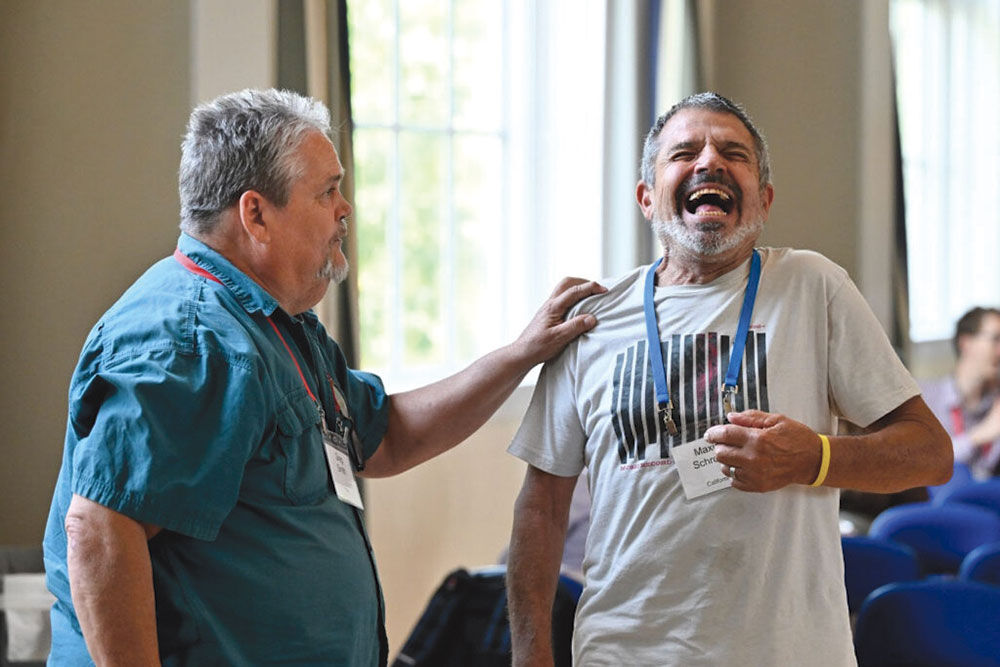
The Braver Angels convention brought together 700 politically minded delegates for workshops and conversations. The convention is an incubator for how to talk to each other, starting by not avoiding the difficult, polarizing topics.
WHICH BRINGS ME BACK HOME, to the most personal outcome of this experience.
Three weeks after attending the Braver Angels convention, I drove to Sonoma County to celebrate my birthday with my sister and mother, in the region where I grew up and where our mom still resides. As the date approached, I considered whether to talk with them about the elephants in the room – hurts I had held onto over the years but never addressed. Assumptions and fears about my sister’s faith. Sadness over our slow estrangement. And the growing sense that I had been making it worse by tiptoeing around the difficult issues, selling us short of a more authentic and durable relationship.
So, I took a deep breath and talked, then listened while my sister talked. Then we talked some more, late into the night. It was wrenching and vulnerable, and even felt a little dangerous at times, speaking about what had long gone unsaid. But we rallied around what we shared: a desire to be real with each other.
We clarified our ideological differences, agreeing to vehemently disagree on some of them. But freed from the need to change each others’ belief systems, the closeness we’d had as children began to resurface. Facebook posts and stereotypes faded away. Instead, I saw her as my sister, a passionate woman with a strong spiritual practice. And I recognized myself as her kid sister again, someone who laughs loud, cries hard, and is deeply connected to her via blood, history and heart.
I believe that Braver Angels and other movements working to depolarize America are crucial right now. With our culture at an inflection point of divisiveness, can we afford to write off so many of our relationships? We all need each other to envision and enact broad-consensus solutions to challenges facing our communities and our planet.
The convention also taught me not merely to withstand opposing political viewpoints, but to welcome them. It seems clear to me now that, in order to thrive in a democratic society, I would do better to invite different perspectives into my life, rather than to avoid and fear them.
As we move into the next presidential election cycle, I wish each of us the courage to state our views freely, listen with a curious mind, experience delight within diversity, and continue to believe not just in the abstract promise of democracy, but to actively participate in creating it. If you have any questions, I’d be glad to talk with you – over tater tots, if possible.
(0) comments
Welcome to the discussion.
Log In
Keep it Clean. Please avoid obscene, vulgar, lewd, racist or sexually-oriented language.
PLEASE TURN OFF YOUR CAPS LOCK.
Don't Threaten. Threats of harming another person will not be tolerated.
Be Truthful. Don't knowingly lie about anyone or anything.
Be Nice. No racism, sexism or any sort of -ism that is degrading to another person.
Be Proactive. Use the 'Report' link on each comment to let us know of abusive posts.
Share with Us. We'd love to hear eyewitness accounts, the history behind an article.