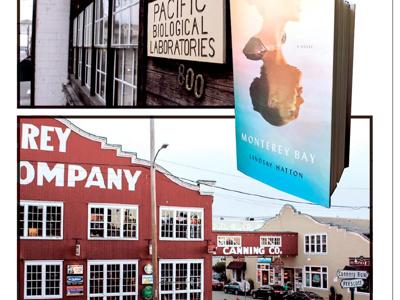

John Steinbeck had his obsessions: the tricky textures of humanity, under-told stories, working-class charisma.
So too did his muse and best mate Ed Ricketts. “Doc” tended toward tidepools, octopuses, anemones.
But less famous obsessions linger in the pages of Steinbeck’s work. To hear him tell it, Ricketts was obsessed with younger women. And it seems Steinbeck was obsessed with Ricketts’ love life.
When Monterey native and neophyte novelist Lindsay Hatton made that discovery, something clicked. Suddenly she had a mechanism to reimagine the history of Cannery Row: through the eyes of a young lover who falls for Ricketts – and the sea creatures he adores.
While Hatton knew revising revered historic characters was risky, her daring went deeper. As her narrative unfolds, leaping from Ricketts’ 1940s to modern-day Cannery Row with vivid imagery and layered characters, that young woman, Margot Fiske, goes on to create the Monterey Bay Aquarium.
While there’s no word on how MBA’s longtime chief Julie Packard feels about that plotline – Aquarium spokesperson Ken Peterson says he’s not privy to Packard’s summer reading list – the conceit worked well enough for Penguin Press to buy the book. Monterey Bay debuted this week.
The Weekly tracked down Hatton in her Cambridge home before it did. She says she still aches for her home state; she’s a Monterey native who attended All Saints in Carmel Valley before matriculating to Williams College and New York University before settling outside Boston with her husband and two kids. Her dad continues to work as a dentist in Carmel. The Carol Hatton Breast Care Center at Community Hospital of the Monterey Peninsula is named for her late mother.
~ ~ ~
What was the first little seed that grew into a big elaborate book?
It started in high school working at the Aquarium. I spent three different summers and a winter term in college there, experiencing a lot of super fun and exciting things, and a lot of behind-the-scenes stuff that’s boring, repetitive, meditative work, when the mind wanders and invents stories.
I don’t know how you feel when you go down to Cannery Row – and I know it better now from research – but even before, I always felt something was lurking beneath the surface.
My research for the book started seven years ago for real, but the tiny descriptive [passages] started a lot earlier than that. In looking into the actual lives of Ricketts and Steinbeck, there were so many interesting bits. At the end of The Log From the Sea of Cortez, there’s a eulogy to Ricketts that’s fascinating in so many ways. The part that’s most amazing is a dissection of Ricketts’ sex life.
Steinbeck was obsessed with everyone Ricketts slept with, writing, “When I first met him he was engaged in a scholarly and persistent way in the process of deflowering a young girl.” I wondered, “Who might that girl have been?”
Working at the Aquarium, I knew how foundational his studies were on the layout of the building – it’s arranged by habitat instead of species, for instance. It seemed he had more influence than he was given credit for, and that there existed an alternate legend that might include a relationship with a younger woman.
It’s great if people buy the book. What’s the ideal outcome from there?
Oh man. There’s the personal goal, then the universal goal. I want a career as a writer, and part and parcel of that is connecting with the audience. I know it sounds cheesy, but if I can connect with one reader, I’ll be happy.
Your ambitions must be greater than one reader.
Well, yes. Writing is a borderline compulsive activity for me, so to make it into a career would be great.
You went to Williams College then earned an MFA in creative writing from New York University. What was your less formal training like?
The most important thing: reading. I’m voracious – and I let it come to me rather than diving into canons of the greats. One thing that’s good and bad: Up until this past December, I hadn’t been hooked up into Twitter or social media as far as the book world, so I was living under a rock, reading and writing – not tapping into trends or getting in with a writerly crew – so I was ignorant and following personal taste. I don’t think that ever does a person wrong, in the long run, because it’s completely organic. I’m a great admirer of contemporary writers, but I’ve been dipping back into [Vladimir] Nabokov. His work is evergreen – whenever my prose feels stale and lazy, I’ll read the master to brush up.
You are literate in many subjects in here – marine life, Doc, his lab, foreign lands (Philippines! Bolivia!) how would you describe your process for studying up on them? And how much of a creative leash did you give yourself to revise facts? The details about unsolved murders and suicides at the Hotel Del Monte come to mind.
Hotel Del Monte does have sordid history of arson and very strange things. All of Monterey does – the forcible re-evaluation of the landscape, depending on who’s in charge.
I read a lot of historical fiction. My taste as a reader is that those stories can come off dusty. Writers who are brave enough, who have clearly done their research, can take that foundation and go off the rails.
People who read it will recognize Doc Ricketts as historically accurate. Anyone who knows Julie Packard knows Margot bears no resemblance. I exist very comfortably in that place; I don’t mind uncertainty over what’s real or what’s not That’s the magic of a novel.
How did you construct Margot?
The protagonist is entirely invented. There was inspiration from Carol Steinbeck, a very ferocious artist and activist. And [1930s Pacific Grove] Mayor Julia Platt. I’m totally down with her. She has very Margot tendencies: I love the story of private landowners putting up a fence around a public [Lovers Point] beach, and every time they put it up she’d walk down in the middle of the night and tear it down.
What is most dangerous/scary about co-opting heroes?
I mean, everything. You never want to disabuse [readers] of people they admire. I am very forgiving of people’s weaknesses. That includes heroes, and Ricketts was one of my heroes, and that’s not diminished by some of the details.
He’s human.
Absolutely. There’s a benefit to recognizing that. As far as Steinbeck, it’s fascinating how much the perspective has changed on him. When he wrote Cannery Row, he was run out of town. He tried to rent office space on Lighthouse [Avenue] but locals hated him for portraying them as hookers and drunks. He was so upset he moved to New York. He was exiled for the vehicle from which we gain so much tourism revenue. I took encouragement in that. If he can ruffle feathers, so can I. I became less worried about painting him in a negative light. The book happens at a time of his life when he was very unhappy and vindictive. He was coming off the wild success of Grapes of Wrath, his marriage was crumbling, his friendship with Ed Ricketts was crumbling.
Spoiler alert! How’d you construct the sex scene with Doc Ricketts?
That was the most fun thing to write. The goal was to make the attraction believable. Their banter was something I worked very hard on. If people don’t buy into the relationship, the bigger narrative is never going to happen. I enjoyed the prospect of re-creating what it must have been like inside his lab, to reveal a side of him that’s not discussed. He was an essayist in addition to a biologist. His essays are great but nuts – stream of consciousness and bizarre.
How do you think the outside world perceives Cannery Row – many people know the book, but little else, or the Aquarium and little else – what are they are missing?
I’m obsessed with authenticity of that place, especially as it’s frequented by so many tourists. Joan Didion’s Where I Am From? is poignant for me as a Californian in self-imposed exile. I cannot get over my nostalgia about California. Her book digs into the whole question: What is real about California in particular? The Cannery Row we grew up with, especially after the Aquarium was popular, is a hallucination of Steinbeck. He had a very interesting quote after the sardine industry collapsed and warehouses burned down. They asked him, probably in the ’60s, “What should we do?” He said, “Oh, you know, pump in the smell of fish meal and hire actresses to play prostitutes and turn it into a tourist attraction.” He was tongue-in-cheek, but that’s kind of what it’s become in a sanitized way.
How has your relationship to Monterey changed?
I love coming back but always have the anxiety, “Am I a tourist?” My dad is a very mild-mannered dude. He never gets cranky, but he reserves his strongest epithets for tourists. Am I the dumb tourist?
What’s been the most dramatic feedback on either side of the spectrum?
For better or worse, people are very protective of that landscape. I knew from the outset that setting it there would be an opportunity and a minefield. If I didn’t represent it the way they wanted, they’d be pissed. But I can’t do anything about that. It’s true to my experience and imagination.
My main character is proving to be controversial. The question of likeability, for female characters, is something the literary world has been talking about. I think she’s profoundly likeable. Also ambitious. Some people have taken issue with her. That’s heartening – if I’m pissing people off in that way, they’re reacting and thinking about it.
I have some passages I want to run by you and have you riff on them. And here, in the weeds and the ice plants, in the rusty metal that smells salty in the sun and bloody in the fog, she dreams of everything that has slipped away, everything that will never come back.
That is me being homesick.
Keep steady, keep calm, notice things beyond yourself and let them distract you, let them stretch you back into a workable shape. Notice the tide pools, notice the fog. Notice the biologist picking through the water. Notice how he swings the bucket as he walks, how he whistles out of the corner of his mouth, out of key.
Have you ever had a panic attack? I think it is also something else that passage is meant to do: foreshadow what she does with her life, the curation of noticing – notice it, label it, put it in a tank. How she processes her darker feelings.
Monterey was out to destroy her the same way it destroyed itself.
The book is set at the height of sardine boom. The more research I did into 1940 the more it was: Go to the beach and you’re tripping over sardine heads and guts and the smell was so bad people were trying to take legal action. Monterey was trying to uphold its rep as tourist mecca with Hotel Del Monte. People have an idealized version of what Monterey is now. It wasn’t always that way.
There she is. Younger, angrier, smarter. Nothing in front, nothing behind, and for the first time in her life since before [Ricketts’] death, she’s balanced on the edge of his fast-melting world.
When she’s gutting the squid. Interesting you chose that one. Beheading and deboweling squid is the first thing I wrote in the book, three or four years before I started really writing. It’s the most autobiographical. I spent hours gutting those squid and making those rings [to feed bat rays]. The way my mind would wander, a simple activity had profound consequences. Margot does that.

OK. Speed round. When writing: Silence or music?
Silence. Complete. I write out of my home so I have noise-cancelling headphones with white noise.
How do you describe the voice in your head?
Demanding.
Favorite children’s book?
Frog and Toad. Because they don’t pander to kids. And they usually end on a weird note, with total lack of resolution that I think kids find comforting. That’s exactly what it feels like in real life: a bizarre, confusing mess.
Sea creature?
So hard. S***. Probably some cephalopod, because they’re so smart. And sea hares are kind of my jam.
Steinbeck work?
Sea of Cortez. I think that’s his weirdest – most successfully weird – because of Ricketts [co-writing], but Ricketts doesn’t get that credit.
Thing you’d like your kids to know about the ocean?
It’s so fragile.
Free association! Margot.
Fierce.
Book tour.
Yikes.
Steinbeck.
Lovely.
From your Twitter feed: “Pre-launch stress dream.”
(Laughs.) Children’s Benadryl. I’ve been having a lot of them. But they’re hilarious. Maybe my subconscious is making jokes out of them.
Calamari.
Abalonetti’s. That was our go-to growing up.
Julie Packard.
Genius.
Doc Ricketts.
Stone-cold fox. I have a crush on him, in case you couldn’t notice.
Monterey Bay author Lindsay Hatton speaks and reads at 7pm Friday, Aug. 5, at Pilgrim’s Way, Dolores between Fifth and Sixth, Carmel, www.pilgrimsway.com
A nonfiction note on the author, this writer and Monterey Bay.
The thick rope swing hung from a wire strung between two towering Monterey pines, 70 feet long at least. To mount it we had to drag the rope up the steep slope and up the even steeper wooden platform, stand on its highest edge and leap, trusting the unreachable seat would drop into place as we did.
“How the hell did they ever let us do that?” Lindsay Hatton asked me the other day. “I’m surprised none of us died. That was so fun.”
We shared more than a swing: We co-directed goofy home video skits, raced wagons down the hill in front of our homes, made up radio shows and collaborated on neighborhood supergroup Mark and the Weirdos.
But we went to different schools, grew apart, and moved to different parts of the world. Now, years later, writing brings us back together, however briefly.
It was surreal enough reading about one of my most sacred places (Monterey) and two of my most sacred historical figures (John Steinbeck and Ed Ricketts) in a novel that at times echoes one of my favorites (Cannery Row). It just got more surreal knowing she wrote it, from faraway Massachusetts.
I told her I appreciate the sense of place that comes through in her prose, and that even if she no longer knows Monterey Bay as I might after 10 years of reporting and scouring its corners, she taught me a lot about it with a work of fiction.
“Thanks for not thinking I’m a sellout,” she said. “My heart’s still there.”
(0) comments
Welcome to the discussion.
Log In
Keep it Clean. Please avoid obscene, vulgar, lewd, racist or sexually-oriented language.
PLEASE TURN OFF YOUR CAPS LOCK.
Don't Threaten. Threats of harming another person will not be tolerated.
Be Truthful. Don't knowingly lie about anyone or anything.
Be Nice. No racism, sexism or any sort of -ism that is degrading to another person.
Be Proactive. Use the 'Report' link on each comment to let us know of abusive posts.
Share with Us. We'd love to hear eyewitness accounts, the history behind an article.