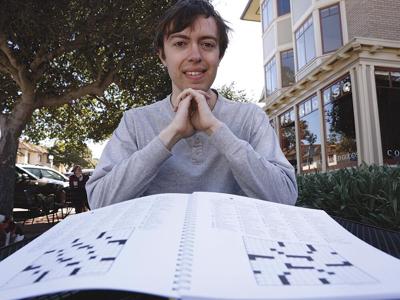

As with many folk heroes, David Steinberg’s arc begins with rejection and, perhaps, a dose of unrequited love.
The credits were not yet done rolling on the 2006 documentary Wordplay when Steinberg, 12 years old and brimming with inspiration, holed up in his bedroom to try his hand at constructing a crossword puzzle. Already a solver, and a Scrabble savant, Steinberg was taken by the crosswording community depicted in the award-winning film, and the wizardry of Merl Reagle, the craft’s preeminent constructor whose puzzles were often published in the New York Times.
All great crosswords have a theme. The seventh-grader scanned his bedroom for a muse. His eyes landed on a corner stack of board games and zeroed in on the classic “Clue.” Bingo. He would build the crossword grid around a murder mystery, with a suspect, a weapon and a scene of the crime.
Handdrawn in about a day, Steinberg sealed his 15x15 creation and placed it in the mailbox, hoping the U.S. Postal Service would deliver the envelope from his Seattle suburb to the New York office of Will Shortz, the longtime and legendary editor of the New York Times crossword.
“I was a pretty brazen 12-year-old,” Steinberg, now 25, says from Bookworks Cafe in Pacific Grove, the city where he has lived with his parents since the onset of the pandemic.
A few months later, Steinberg received an email from Will Shortz’s address.
“Hi David. This is Paula Gamache writing, helping Will with correspondence. Will says thanks, but must send regrets on your ‘Clue’ 15x, whose theme didn’t excite him quite enough,” the email read. “Sorry about that. Will did appreciate seeing this, tho. Best regards.”
Never mind the rejection or that Shortz didn’t respond himself, Steinberg was hooked. Over the next 18 months, he sent 15 more crosswords to Shortz, and Shortz’s office sent back 15 rejection letters. Up-and-coming crossword constructors have more than a few outlets where they can submit their work. Yet, Steinberg was hellbent on the Times. He wanted his first summit to be Everest.
As spring 2011 rolled around, the steadfast teenager shot off puzzle number 17. Then, after a couple of months on June 2, Steinberg, still in eighth grade, received an email. This time it was from Shortz himself.
“Hi David. Finally, the news you’ve been waiting for: Your revised CODE puzzle is a yes. The theme is ingenious, and the construction is very solid,” Shortz wrote. “Tentatively, I’m scheduling this for Thursday, June 16, so it can appear while you’re as young as possible… Thanks a lot… and welcome aboard!”
On June 16, 2011, Steinberg, at 14 years and 6 months old, became the youngest constructor Shortz had ever published in his then 18-year tenure at the Times.
“We don’t give any slack to anyone because of their age, so to be published he had to meet the regular standards,” Shortz says by telephone from his Pleasantville, New York home. “He has always had the highest quality: quality vocabulary, interesting, juicy, colorful answers with as little crosswordese and stupid obscurity as possible.”
One ascent was not enough. As of today, Shortz has published 101 of Steinberg’s crosswords, which Shortz says makes him “far and away the most prolific crossword constructor [25 years or younger] the New York Times has ever had.”
Today, Steinberg is the editor of the Andrews McMeel Universal Crossword Puzzle, which prints daily in publications such as the Philadelphia Inquirer, Boston Globe, San Francisco Examiner and Dallas Morning News. Puzzles offer a narrow career path, but Steinberg’s meteoric rise over the last 13 years has placed him among the rare few who decide which crossword puzzles millions of American solvers see every day.
Simply put, crosswords have dominated Steinberg’s life – there is no other way to reach the heights he has so quickly reached without giving everything to his craft. Many refer to him as a prodigy, and the lore that surrounds him is well known among solvers, constructors and editors.
For Steinberg, the opportunities afforded by puzzles have been plenty; however, the last two years of the pandemic have made him begin to think. With a mountain of achievement in his wake, he is beginning to reflect on what he might have missed out on, as a kid and a young adult, because of crosswords; he is, for the first time, beginning to wonder about what he wants outside of puzzles. A girlfriend, eventually a family. Perhaps a community of people his age who are into the same things he is. Friends. His own life.
“A LOT OF PEOPLE KIND OF FORGET THAT THERE ARE ACTUALLY PEOPLE WHO ARE MAKING THE CROSSWORDS,” Steinberg says, seated inside a humming Pacific Grove coffee shop on a Wednesday afternoon in early March. He pulls down his double face mask to sip a large hot chocolate, topped with a healthy dollop of whipped cream that tags his upper lip.
Picking up the day’s Los Angeles Times crossword puzzle for the first time, he immediately points out the author. “This is a Stella Zawistowski puzzle, she’s great,” Steinberg says as he straps his masks back on. He begins describing the blank puzzle like a familiar face coming into focus. He sees four 15-letter answers across. “Those are probably the theme answers,” he says. Then, he picks up an inky black ballpoint pen and begins from the top left.
A three-letter word for “medium ability.” “Normally I would think that is referring to skill, but I’ve done enough crosswords to know they mean psychic ability,” Steinberg says, writing in ESP. Five letters for “a component of the spice blend za’atar.” “That’s a tough one, maybe SUMAC.” A four-letter word for “tennis immortal.” “That’s easy, there’s only one tennis name you ever see in crosswords,” Steinberg says as he writes in ASHE.
He arrives at a four-letter word for “tinseled fabric,” and writes LAME, (spelled lamé).
“You might think that it would be clued to signal ‘lame’ in the typical way, but there is a push for more inclusivity in crosswords,” Steinberg explains. “People who are not able-bodied don’t like that word, so now you see it clued as the fabric.”
The 15x15, 124-clue crossword puzzle is complete in less than six minutes. There are no mistakes. Steinberg is quick to compliment Zawistowski – he is always quick to compliment – pointing out her idiosyncratic clues that deal with exercise, theater and pop culture.
“I think I’ve learned a lot of useless information from crosswords,” Steinberg says. “People say, ‘You must have done really well on the SAT.’ Not really, because the SAT asks you about vocabulary words that are longer than five letters. How am I supposed to know those?”
STEINBERG WAS BORN IN PHILADELPHIA ON NOV. 24, 1996. An only child, he and his parents moved around quite a bit during his younger years. His father, who received a PhD in linguistics from UC Berkeley, worked as a communications analyst for the RAND Corporation; his mother earned a PhD in psychology from the University of Pennsylvania and stayed home to raise her son. From Philadelphia, the family transplanted to Seattle and then to Irvine.
By the time Steinberg was in Southern California, he’d already had several puzzles published in the New York Times, and his crossword expertise was attracting attention. In an interview on his work with the Orange County Register, a reporter asked the 15-year-old Steinberg what his dream job would be. He said he would love to edit his own crosswords one day. A few months later, he received a call from the newspaper’s editors.
“They told me they were starting a new crossword section in their community papers and asked if I wanted to be the editor,” Steinberg says. Not yet old enough to drive, Steinberg secured a full-time job – his dream job – editing crosswords for one of the country’s better-known newspapers.
When it came time to apply for college, Steinberg’s SAT scores took a backseat to his crossword career. He received an acceptance letter from every school he applied to – Harvard, Yale, Princeton, Pomona, and his eventual choice, Stanford.
Throughout high school and college, Steinberg put much of his energy into crosswords. He was constructing and editing as well as competing in and winning tournaments. Somehow, he made time on the side to become a founder of the Pre-Shortzian Puzzle Project, an effort that gathered about 60 crossword connoisseurs from across the world to digitize the 16,200 New York Times crossword puzzles published before the paper hired Shortz as editor in 1993.
Shortz, probably the most famous name in the 110-year history of crossword puzzles, took notice. While studying computer science at Stanford, Steinberg received an invitation to join Shortz in New York for a summer internship, where he would help his idol sort through submissions and decide which puzzles would earn a place under the vaunted New York Times crossword banner.
Shortz’s effort to find a host family failed, so he let Steinberg sleep on his couch, where he would spend the next six weeks surrounded by crossword submissions from across the world. Shortz slept on his screened-in porch, while a second guest – a young table tennis phenom from Beijing who was a visiting player at Shortz’s nationally renowned table tennis club – slept upstairs.
At the time, Shortz only accepted submissions by mail, and Steinberg took on the role of screening those submissions, slowly learning from the best as to what makes a quality crossword and, perhaps more importantly, how to spot a bad puzzle.
“I probably wrote 1,000 rejection letters during those six weeks,” Steinberg says. “It was great training because in my job now, that is a lot of what I do.”
AS THE CLOCK HITS 9AM ON A WEDNESDAY IN EARLY APRIL, Steinberg checks his email inbox from the same Pacific Grove coffee shop, sipping his hot chocolate through a pile of whipped cream.
He sorts through a barrage of submissions at different points in the editing process, and pulls up a grid he is working through with a constructor from Los Angeles. Steinberg wants his solvers to finish the puzzles, but he also wants them to feel challenged. He sees his job, in some ways, as deciding what answers people should know, and what answers they should be able to figure out. That responsibility makes him uncomfortable.
“In some ways I feel like I don’t deserve to make that call, but at the same time, I’ve seen enough puzzles that I have a good idea of what people do know,” Steinberg says. “But do I really deserve the authority to decide which puzzles are best? I don’t know.”
Steinberg turns to his laptop screen and scans the clues proposed by the constructor.
Five-letter word for “cultural dish:” PETRI. “Here’s the thing, is petri a dish or is it a petri-dish? That’s something you have to determine as an editor,” Steinberg says as he does a quick Google search. His suspicions are correct, and he changes the clue to “Cultural dish variety.”
Next clue: Instrument played by Julia Roberts and Jennifer Lawrence. Answer: OBOE. Steinberg does some Googling to confirm the clue’s accuracy. However, he decides to keep only Roberts’ name because of space restrictions in newspapers. “Sorry J-Law,” Steinberg says. Thinking about his solvers, he clarifies the clue to say “wind” instrument.
Steinberg says he saw a recent New Yorker crossword that crossed the esoteric words FRISSON and FROWSY.
“Those puzzles have a very New Yorker bent to them. Like, ‘Oh, yes, you have a PhD, we get it,’” Steinberg says. “For me, I like to think of myself as trying to make puzzles for the people. I might include the word FROWSY, but I’m not going to cross it with FRISSON.”
As an editor, Steinberg doesn’t have time for much else, though he still stands as a formidable constructor. His most recent construction printed in the New York Times on Sunday, Feb. 13, for which he received the standard Sunday puzzle pay of $2,250. Titled “Change of Heart,” the puzzle included nine starred answers, in which the middle letter could be swapped to create a new word. For instance, UNLIKABLE could be changed to UNLIVABLE. UNINHIBITED could be changed to UNINHABITED. The new letter in each of the answers combined to spell their own word, the answer to the puzzle: VALENTINE.
Shortz, upon receiving it, was blown away.
“As far as constructing goes, there are three different skills: coming up with fresh ideas for a theme; doing quality construction with interesting, colorful, lively vocabulary; and writing clues,” Shortz says. “Many people have one or two of those. David is one of those rare people who have all three.”
Steinberg understands the criticism that comes with the territory of occupying a public-facing editor position. He gets the occasional, “Your crossword puzzles suck!” messages from solvers who maybe don’t understand the theme. Sometimes they zero in on his age. “Somebody made a big mistake a few years ago by not giving this brat a baseball glove or a skateboard,” one especially irate solver wrote. “As Don Rickles once suggested, ‘Hey kid, why don’t you go out and play in traffic?’”
But the love has been strong as well.
“I got this email out of the blue from this high school kid in Kansas, and he wanted to ask his girlfriend out to prom through a crossword puzzle,” Steinberg says. “He asked if I could put some special words in one of the Universal crosswords I edit.”
The ask was simple enough in theory but Steinberg works way ahead of schedule, and a new crossword couldn’t appear until after prom. Instead, Steinberg made a custom 9x9 grid with the special answers, which included the girlfriend’s name, Evie. The high schooler wrote the clues and sent them back to Steinberg for a final expert edit.
“It’s always cool to see people like this guy who are young and into crosswords. That’s what keeps the art form going from generation to generation,” Steinberg says with the demeanor of an elder. “I just sent it back to him last night and wished him luck.”
STEINBERG KNEW EARLY on that his obsession with crosswords might be a lonely pursuit.
“In the early 2010s, I had a sense I was getting into something that was dying,” he says. He didn’t know anyone his age interested in crosswords, which he admits felt alienating.
“The main reason I was so excited to get my first puzzle in the New York Times was because there was this girl I liked in middle school, and I thought she would be really impressed if I got a puzzle published in the Times,” Steinberg says. “That did not work. It worked out for me because I got a puzzle in the Times, but it did not impress her. My friends weren’t interested in them. Girls weren’t interested in them.”
That was when Steinberg began to understand he might have to go at this alone.
“I’m happy to do this for a living, but even back then I realized I have to find other things to do,” he says.
When asked what his first crush is doing now, Steinberg stumbles. “Oh my gosh, I don’t know, I haven’t really kept up with her. I want to say she’s a doctor? Something more intelligent than what I’m doing.”
Steinberg sees he has become somewhat of a one-trick pony, which was never the plan. When he was using the dating app Tinder, he would offer his matches a trade: a personalized crossword with their name in it for their phone number.
“Obviously I would not swipe right on any girl with a name longer than nine letters because that would take too much work,” Steinberg jokes. The gimmick was cute and sometimes worked, but nothing stuck. “I don’t have a girlfriend, but I do have a pile of mini custom crosswords.”
As Steinberg embarks on the second half of his 20s, it’s clear puzzles aren’t going to give him the social life he so deeply desires, despite his determined attempts.
“Knowing all of this stuff, this information from crosswords, it’s a good party trick,” Steinberg says. “But is it really that useful? Probably not.”
THE FORCED ISOLATION OF THE LAST TWO YEARS has only emphasized this burning inside Steinberg to build an identity beyond puzzles.
In late 2019, Steinberg, who has always been close to his parents, moved to Kansas City, Missouri, where his new employer, Andrews McMeel Publishing, was headquartered. As a young man in his early 20s, he viewed the move as his first real opportunity to begin carving his own path and pursuing the life outside of puzzles he desired. However, after only a few months on his own, the pandemic took hold and the world around him began to fall apart.
Like many other companies, Andrews McMeel shut down its offices and went remote. Steinberg held out for a few months, but the loneliness of an apartment-bound existence in a new city crept in and mixed with the grave uncertainty that now marked the future. Steinberg assessed the cards dealt to him and, by the fall, decided to pack up his first apartment and move back to Pacific Grove to be with his parents.
Today, Steinberg says the line between pandemic frustration and life frustration is blurry. He knows he’s happy to have a career in crosswords; but he also understands success in his job is not enough to fill all voids.
“I feel like I got so wrapped up in my crossword career that there were other things people were doing that I never got to do,” Steinberg says. “I still love crosswords, but maybe now that I’m older I’m wanting to branch out a bit more. Maybe I’m not quite as obsessed with them as I once was.”
To find himself with one toe out of the crossword world for the first time, at this moment, strikes Steinberg as ironic. The pandemic has created a resurgence in crossword puzzles among young people. Magazines like The Atlantic and websites like Vulture have their own puzzles tilted toward a younger crowd, and the online indie crossword scene has taken off. Shortz says the median age for constructors over the years has fallen dramatically, from the mid-50s when he began at the Times to somewhere in the mid-30s today.
However, Steinberg has been, by any account, a successful crossworder for 13 years – now more than half of his life. He talks about them in the learned tone of an elder – a perspective he has earned, though at the sacrifice of much else.
When the pandemic loosens up he wants to travel – to see Europe, specifically France. Partially because of the food, and partially to finally see the River Seine in person – a too common answer used by crossword constructors.
“I’m 25 now, I feel like I ought to be trying to find a girlfriend more seriously and start a family and do the things that everyone else does in life instead of just focusing on crosswords,” Steinberg says. “I think there is more to life than just puzzles.”
(0) comments
Welcome to the discussion.
Log In
Keep it Clean. Please avoid obscene, vulgar, lewd, racist or sexually-oriented language.
PLEASE TURN OFF YOUR CAPS LOCK.
Don't Threaten. Threats of harming another person will not be tolerated.
Be Truthful. Don't knowingly lie about anyone or anything.
Be Nice. No racism, sexism or any sort of -ism that is degrading to another person.
Be Proactive. Use the 'Report' link on each comment to let us know of abusive posts.
Share with Us. We'd love to hear eyewitness accounts, the history behind an article.