


Perhaps the most immaculate road in Monterey County – a 1.7-mile-long stretch of Eucalyptus Road in Seaside – has no auto traffic.
While the sun’s up, one might see a few cyclists and the occasional pedestrian out to get some exercise, but the road, which slices through chaparral-covered hills in the former Fort Ord, the largest swath of coastal chaparral in America, is otherwise deserted.
That’s because it’s been closed off with barriers at its intersection with General Jim Moore Boulevard ever since upgrades to both roads were completed in 2010. But even if Eucalyptus was open, it wouldn’t lead to anywhere except wildlands. It’s a road to a beautiful nowhere.
The board of the Fort Ord Reuse Authority chose to build it with the idea it would one day link up with the proposed Eastside Parkway, a road that would connect to Inter-Garrison Road and theoretically reduce traffic along Highway 1 and Highway 68 for commuters going to and from Salinas and the Monterey Peninsula.
But FORA, along with Monterey County, lost a lawsuit a year ago related to Eastside Parkway. FORA and the county were both ordered by Monterey County Superior Court to pay the activist group that brought the lawsuit, Keep Fort Ord Wild, $255,000, or $510,000 total. The crux of the legal decision was that FORA had spent considerable funds on engineering plans for a preferred route – one that would have razed about 10,000 oak trees – before completing a required environmental review of potentially lower-impact options.
That means this serene stretch of Eucalyptus Road will remain just that, indefinitely: car-free, with views of rolling, green hills that stretch for miles.
The street, in some ways, is a metaphor for FORA: Ostensibly, it was paved with intentions to alleviate traffic, but because the plans weren’t yet complete, it is currently heading toward an uncertain destination.
The most striking thing about Eucalyptus Road – other than its existence – is that it has a sidewalk, as if a jackrabbit, perhaps, might want to safely scoot to town to grab carrots.
Welcome to the former Fort Ord.
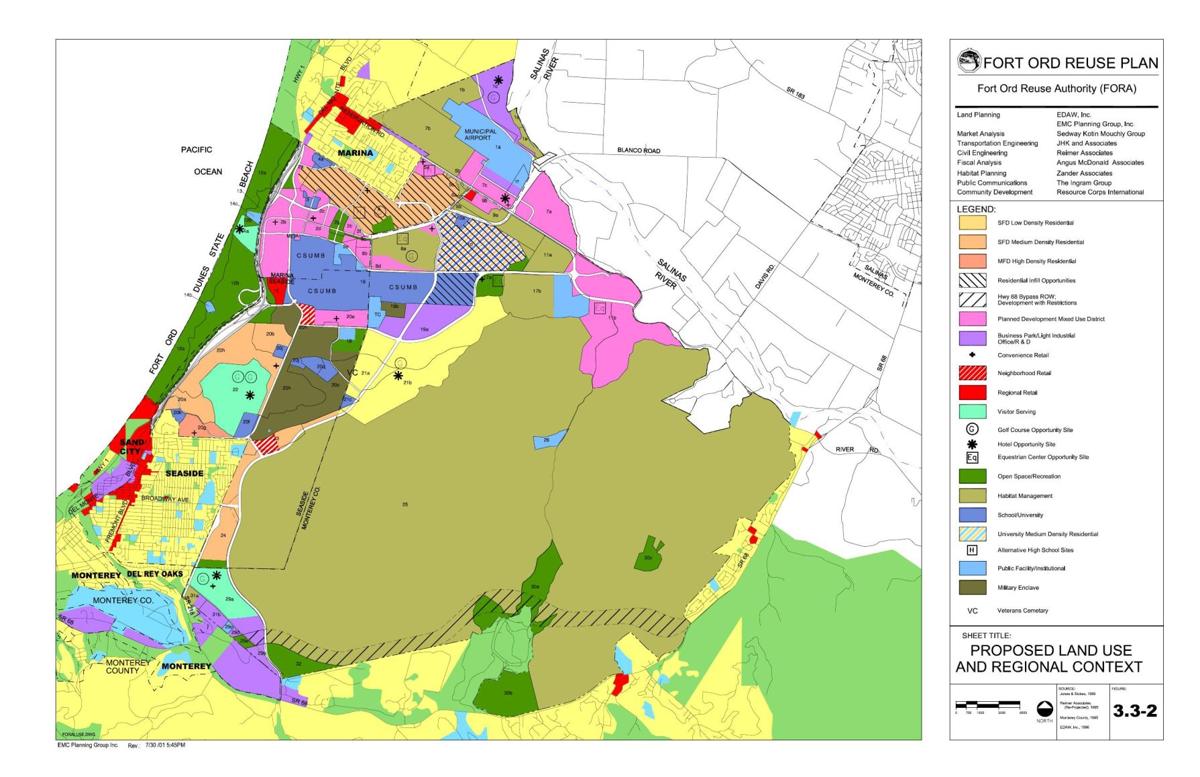
At 28,000 acres of prime real estate, about 7,300 acres of which can be developed – or is already developed – Ford Ord presents the biggest opportunity, and challenge, the Central Coast may ever have going forward in terms of land-use decisions.
But that’s not the only concern: The Fort Ord Reuse Authority currently has an overhead of about $6 million annually. As local government officials ask questions about FORA’s future – and whether it has a future – some are wondering if that money might be put to better use.
When the closure of Fort Ord was announced in 1990, it was the biggest Monterey County story in decades.
Since the dawn of World War II, the Army base had become a critical part of the local community and economy: By 1990, there were about 14,000 soldiers at Fort Ord, along with 17,000 of their family members, and the base contributed an estimated $816 million annually to the local economy.
In the immediate years that followed, the biggest story then became how the base, and its land, would be repurposed.
That included the 1994 formation of the Fort Ord Reuse Authority, aka FORA, an agency whose board would be comprised of local elected officials, authorized by state legislation, to oversee the redevelopment of Fort Ord.
It was a time of high optimism, and the redevelopment was expected to happen quickly. It did not.
FORA was originally intended to sunset in 2014, but for a variety of reasons, that didn’t happen. Like nearly everything involving FORA, it’s complicated.
In 2012, State Sen. Bill Monning, D-Carmel, was able to rally state support for an extension of the agency to June 2020, which allowed for the continuation of FORA’s funding to help complete the remaining environmental mitigations mandated under its 1997 Base Reuse Plan, which provides parameters for land-use planning on the former base. Examples of those mitigations include things like improving roadways to improve traffic flow, or implementing protections for habitat and the wildlife that live in it.
But there’s a problem: Current projections show that when June 2020 arrives, an estimated $70 million to $179 million of those mitigations – depending on who you ask – will remain unfunded.
While just 17 percent of the remaining former Fort Ord’s buildings are now considered blight – FORA has paid roughly $29 million to remove 1,282 buildings to date, and has dedicated another $7.6 million to remove another 24 – the blight that does remain is highly visible, and expensive to deal with. It’s also at least part of why the envisioned economic recovery and creation of a new community has remained elusive – FORA Economic Development Manager Josh Metz says that blight is a major deterrent to businesses looking to locate in the region.
With the clock now ticking down again, FORA is required to present a transition plan by December 30, 2018. The plan is intended to show how FORA’s unmet environmental obligations will be met going forward.
With just a year to go, there is no draft of a potential plan.
FORA is at a crossroads. Each board member presumably wants to make the right decision for their constituents, and the region, for how best to move forward.
But the crossroads has no signs, and no directions.
Instead of being presented with the pros and cons of various approaches, the board is being presented with a single option: form a joint powers authority (JPA) that would have similar financing and regional powers as FORA. In many ways, it’s FORA 2.0.
If there are viable alternatives for FORA’s stakeholders, the board has no way of knowing them.

County Supervisor Jane Parker and Seaside Mayor Ralph Rubio, also board members;
In 2012, when Monning’s legislation to extend FORA to 2020 was passed into state law, it required FORA to come up with a transition plan that would address any of FORA’s unmet obligations – like its duty to implement its habitat conservation program or get the federal signoff on munitions removal – that FORA didn’t have time to complete.
To address that mandate, FORA convened a transition task force in April 2016 – comprised of various board members – to explore post-2020 alternatives.
FORA staff set the agendas and did the research for alternatives that would effectively eliminate their own jobs.
After a handful of meetings over the course of the year, the task force recommended extending FORA through 2030.
In order to understand FORA, it’s important to understand its board and how it does business: It comprises three county supervisors, two members each from the city councils of Marina and Seaside, and one each from the city councils of Del Rey Oaks, Monterey, Sand City, Pacific Grove, Carmel and Salinas.
The board adopted that task force recommendation in November 2016 – despite pushback from a few of its members – but Monning didn’t even present the possibility to his colleagues, he says, because it was not a transition plan. He told FORA to go back to the drawing board.
So in April 2017, FORA convened a new transition task force with a more specific charge: provide a transition plan.
After a handful of meetings, the task force decided on a recommendation to the board that resembled the recommendation from the year before: Form a joint powers authority (JPA), which would have with similar financing and regional powers as FORA. Importantly, part of those financing powers, in their current form, can only be extended by state legislation. Monning will have to decide at some point in the coming year whether or not the JPA – the details of which remain undefined – constitutes a transition plan and merits another legislative push at the state level. (Even then, it would still require Assembly and State Senate approval, plus the governor’s signature.)
On Oct. 26, the FORA board voted 8-5 to form the JPA, and will make its second and final vote on the matter Nov. 17.
Even if they vote yes, it’s not clear what that will mean, because none of the jurisdictions represented on the current board can be forced to join the JPA.
The city of Marina, one of the largest landowners in the former Fort Ord, has soured on FORA – or anything that resembles it – believing it has already achieved its necessary goals: creating the Base Reuse Plan and planning for habitat mitigations and munitions removal.
While annual membership fees to FORA are trivial – $14,000 per seat on the board – an extension of anything like FORA would mean that Marina will continue to evenly split land sales with FORA for new development on former Fort Ord land (as is the case with all of FORA’s land-owning jurisdictions), which will cost the city many millions of dollars going forward.
The Seaside City Council – despite the fact its mayor, Ralph Rubio, is chair of the FORA board and supports the JPA – may not join either, for similar reasons.
Two of the three county supervisors on the FORA board, Jane Parker and Mary Adams, also voted against forming the JPA; rather, they supported hiring a consultant to do a fiscal and legal analysis of the options ahead.
One option, for example could be forming a JPA that is only a pass-through agency that collects and distributes fees for required environmental mitigations, but wouldn’t make land-use decisions.
In essence, Adams and Parker wanted signs at the crossroads.
Yet the majority of the board felt there wasn’t enough time to hire a consultant, and wanted to move forward, despite a lack of agreement on an issue that needs unanimous buy-in to be effective.
One thing everyone can agree on is this: With or without FORA, there will need be one or more people to oversee future munitions removal and habitat protection in FORA’s jurisdiction on the former Fort Ord. Other things can be handled: The Transportation Agency for Monterey County has indicated it could take over traffic mitigations, and Marina Coast Water District will continue to handle FORA’s water supply requirements.
But what happens if Marina or Seaside don’t choose to join up?
It would surely change the JPA’s revenue structure in substantive ways, but to what extent remains unknown – FORA staff hasn’t presented that scenario to the board, and the majority of the board haven’t asked them to.
So if the FORA board votes again on Nov. 17 to form the JPA without support from Marina – or the county, for that matter – the board won’t necessarily be moving forward, or anywhere at all.
The majority, it appears, prefer to remain in the dark.
Twenty-three years after FORA was formed, history, in some ways, is repeating itself.
In 1993, before FORA was enshrined in law, Marina and Seaside wanted to self-determine what to do with the land they would inherit.
Along with the county, Del Rey Oaks, Monterey and Sand City, they formed a joint powers authority called the Fort Ord Reuse Group (FORG).
Henry Mello, who at the time was the district’s powerful state senator, had different ideas. He introduced legislation to create the state-mandated Fort Ord Reuse Authority. In 1994, he told the Monterey Herald that FORG gave “too much planning power to individual cities” and could be dissolved too easily. There were also questions about whether or not it had adequate financing powers.
In January 1994, the Marina City Council wrote an open letter to the district’s congressman at the time, Leon Panetta, who had endorsed Mello’s plan. Marina’s letter called the plan “a pre-emption of the constitutional rights of local governments.”
The letter even quoted Abraham Lincoln, who said, “No man is good enough to govern another man without his consent.”
In a February 1994 op-ed in the Weekly, Lance McClair, mayor of Seaside at the time, called Mello’s bill a “have and have not” bill that set Peninsula cities against each other. “The opulent cities and the county of Monterey would hold a ruling hand” on the FORA board, he wrote, “as an insurance policy against Seaside and Marina ever becoming economically viable as communities.”
Mello shot back against Seaside and Marina, and threatened to de-annex them altogether from Fort Ord. “I’ll be honest with you,” Mello told McClair at a meeting at the Monterey Conference Center. “We’re not playing hardball yet.”
When the dust finally settled, Mello prevailed, and FORA was born.
The Fort Ord Base Reuse Plan, adopted in June 1997, calls for “rapid redevelopment” by creating “mixed-use villages” with dense development that had commerical businesses on the first floor and residential units above. And though it was imbued with optimism, the plan also urges caution.
“The opportunity provided by this 27,879.4-acre resource is inestimable,” it reads. “The challenge, however, to not squander or abuse the special qualities of this place is substantial.”
To help address that challenge, the plan called for creating design guidelines that would ensure the consistency of best design practices in the region. It emphasized what is known in FORA lingo as the three E’s: economic development, education and the environment.
The plan envisioned adding up to 25,000 jobs in the former Fort Ord by 2015 in sectors like research and retail, and made an emphasis on affordable housing, recommending many of the homes be priced from $125,000-$300,000. (While home prices have since spiked, local wages have remained relatively flat.)
The plan is also lengthy, numbering nearly 1,000 pages, not including its environmental impact report. One can only wonder how many board members over the years – elected officials who serve on city councils and other boards, most of them as volunteers – have actually read it.
Because even the best-intended plans for smart development are only meaningful if they’re implemented, enforced and – perhaps most importantly – realistic.
In July 1997, the Sierra Club sued FORA, claiming that the Base Reuse Plan did not adequately consider constraints on water supply, or impacts that its envisioned development would have on traffic, among other things.
The case was settled in November 1998, and the result was an additional chapter – chapter 8 – of FORA’s master resolution, a legally binding document that enshrined an added environmental stringency for FORA’s future land use decisions. (More on that later.)
The Sierra Club’s skepticism of FORA appears to have been justified, because while the Base Reuse Plan is a document of dreams and ideals, the way some of those ideals played out is questionable.
One example: As part of the plan, FORA was to create design guidelines for the state’s Highway 1 Scenic Corridor – which the board adopted in 2005 – in order to protect views along the highway. Just a few months later, the board approved the University Villages Specific Plan – later rebranded as “The Dunes” – which called for the construction of, among other things, the big-box stores that now sit above the highway by Imjin Parkway.
In other words, the FORA board at the time decided that those stores qualified as scenic, and it’s hard to argue the guidelines are anything but useless.
For several years, FORA conducted its business in relative obscurity, approving several projects that have yet to be completed, and some that have yet to break ground. Land-use activists had largely stopped paying attention after the 1998 settlement. But after Monterey-Salinas Transit’s controversial Whispering Oaks project – which would have razed about 4,400 oak trees to build a bus storage lot and a business park – was proposed in 2009, watchdogs started taking notice. (The County Board of Supervisors, faced with a referendum, eventually reversed their approval of Whispering Oaks.)
FORA, as part of its Base Reuse Plan, was required to do a reassessment in 2012 to evaluate the progress made to date in realizing the plan. Around 2011, the local chapter of Sierra Club asked retired attorney Jane Haines if she would volunteer to go to FORA and make her own assessment of whether the agency was meeting the terms of the chapter 8 settlement agreement. What she found was that FORA was not upholding its end of the bargain on numerous counts, and relayed her concerns to FORA Executive Officer Michael Houlemard.
“He said, ‘This is terrible,’” Haines says, and that he would do something immediately.
One in particular jumped out to Haines: FORA had not yet created regional design guidelines – as called for in the Base Reuse Plan – which would establish best practices that would be used in all developments on the former base. (Work on the design guidelines commenced in 2015 and was completed in 2016.)
“Everything there was so loose,” Haines says.
She had little idea how loose.
In March 2010, the FORA board meeting agenda contained an item that appeared innocuous: “Fort Ord Reuse Authority Master Resolution: minor corrections.” That was mostly true, except for one major edit among the “corrections” that could have forever changed the fate of Fort Ord – illegally.
Three years later, that change came to light: Someone called County Supervisor Jane Parker’s office with a concern about wording in FORA’s Master Resolution. Kristi Markey, Parker’s chief of staff, fielded the call.
Specifically, a section – the chapter that came out of the Sierra Club settlement – where it read the FORA board “may disapprove” land use decisions that are not consistent with the Base Reuse Plan.
Markey pulled a hard-copy of the resolution off the shelf. It was from 2009, and her copy read “shall disapprove.”
“It’s a good thing I pulled the binder off the shelf rather than looking online,” Markey says.
Three months after the change from “shall” to “may” was made, would-be developer Brian Boudreau signed a contract with Seaside to begin working on the now-failed Monterey Downs project, a sprawling horse park-themed housing development that Seaside City Council approved in November 2016. (They rescinded the approval three weeks later when Boudreau backed out.)
Houlemard says that when he was made aware of the amended language, “may” was immediately changed back to “shall,” and stresses that he wasn’t aware of the change at the time, and is not aware if any board members were. He also thinks FORA’s attorney at the time, Jerry Bowden, made an honest mistake.
“Jerry did that thinking it was right,” Houlemard says. “He made a mistake.”

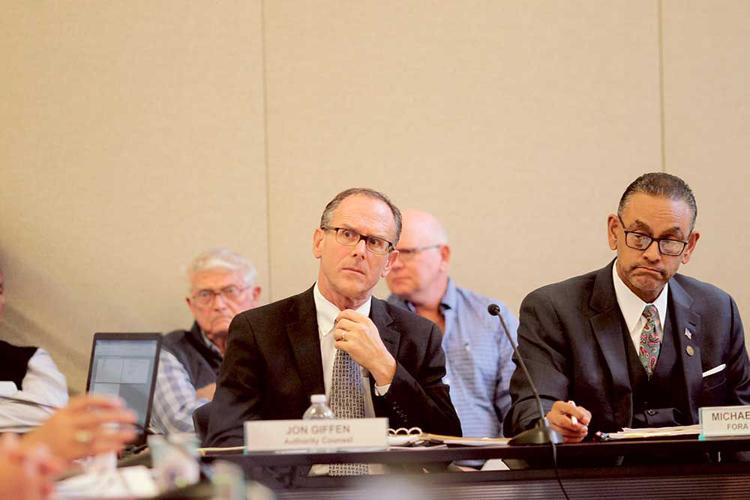
FORA Executive Officer Michael Houlemard (right) and attorney Jon Giffen.
Inside the recently opened Poké Bar in The Dunes shopping center in Marina, alongside a wall that is beautifully laminated with historic Army photos of Fort Ord, Doug Yount talks about his optimism for future development in The Dunes.
Yount was a development director for the city of Marina in 2005, when the project – then known as University Villages – received its initial approvals, and he now works for Marina Community Partners, The Dunes developer.
Yount is unapologetic about the big-box stores – he says they were a critical piece of economic development for the city when it needed it most, and adds they have created more than 1,000 jobs.
“Marina lost half of its jobs and a third of its population when the base closed,” he says. “It’s still recovering.”
But Yount is not interested in talking about the past so much as the future, and he extols the virtues of the overall project (much of which has yet to be built) citing its density and affordability compared to other major projects that have broken ground in the former Fort Ord. Around 40 percent of the housing units in The Dunes to date are affordable. “That is a significant commitment up front,” he says, and adds that MCP is working hard to break ground on the Promenade – a planned mixed-use street just south of Poké Bar – as soon as possible.
As to why development on Fort Ord has taken so long, Yount cites the usual suspects: the Great Recession, the dissolution of state redevelopment agencies – which made financing projects more difficult – and FORA-specific issues like the expense of blight removal and the requirement to pay prevailing wage on all projects.
But he reiterates MCP is committed to pushing forward, and thinks The Dunes Specific Plan will create a wonderful community.
Although he doesn’t think FORA should stick around to see it.
“FORA has run its course,” he says. “It’s been more than 20 years. All organizations go through a lifecycle.”
Yount says the challenges of financing FORA’s future required mitigations – which will cost of tens of millions of dollars, and which FORA staff have said may require state legislation – are not necessarily so complex.
He highlights an issue that LandWatch raised in a Oct. 24 letter to the FORA board: that having FORA staff working on the transition process – in which they’re trying to figure out how to eliminate their own jobs – is inappropriate.
“It is difficult for a staff of an organization to objectively evaluate their own ending,” Yount says, “particularly when [pensions are] involved.”
As for financing the required environmental mitigations of already entitled projects like The Dunes – MCP pays for mitigations in the form “impact fees” to FORA – Yount makes it sound a lot easier than developing in Fort Ord.
“These types of regional discussions, whether they’re transportation impact fees, these models are done all over, particularly throughout California,” he says, adding that MCP will continue paying for its mitigations regardless, because they’re required to under both the California Environmental Quality Act and the Base Reuse Plan.
“It doesn’t have to be unnecessarily complicated.”
At a Marina City Council meeting on Oct. 3, things took an unusual turn.
Councilwoman Gail Morton – who also is a FORA board member, and who sits on FORA’s finance committee and served on both of FORA’s transition task forces – gave a presentation.
Morton, an attorney in her day job, was both surgical and spirited as she outlined in detail, for well over an hour, why she thinks Marina should not support joining a JPA that’s anything like FORA.
Aside from the many millions of dollars of lost revenue to the city from future land sales in the former Fort Ord – which Marina presently splits evenly with FORA, like all jurisdictions – she cites the total overhead cost of FORA annually, per the 2016-17 budget: about $5.3 million. Of that, approximately $3 million goes to salaries and benefits.
Morton’s fellow councilmembers appeared to unanimously support her position – no vote was taken – that Marina should not join a FORA-like JPA.
Marina is not the only skeptical city: Seaside put out a request for proposals a few months ago to do a fiscal analysis for whether or not it is beneficial for Seaside to continue being a part of FORA. The results are expected in January. (Marina also signed on to participate in the report.)
Monning, for his part, has not yet made up his mind on the matter, and says his staff is researching the potential options. He emphasizes there’s still time, and that if legislation is needed, it could happen in 2018 or 2019. He recognizes there are a lot of stakeholders when it comes to the former Fort Ord – the entire region, essentially – and he doesn’t want to make a rash decision.
“I don’t feel the pressure of time right now,” he says. “I feel the pressure of being thorough, of doing it right.”

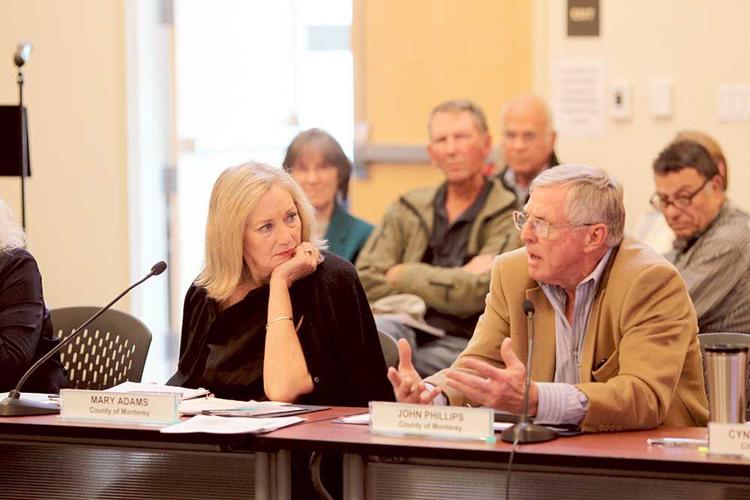
County supervisors John Phillips and Mary Adams serve on the FORA board
FORA board meetings are held once a month, on Friday afternoons, and many board members often appear like they would rather be anywhere else.
When the public offers comments, some say they don’t feel welcomed by members of the board, and it doesn’t look like it as many board members sit with hangdog, frustrated expressions.
That frustration is a good reason why a similar decision-making body – a JPA with similar powers as FORA – could be problematic, and it was on clear display at FORA’s Oct. 13 board meeting.
Several members of the public showed up to the meeting, and during a public comment period, expressed skepticism about FORA’s proposed transition plan of forming a JPA without any clear details, and criticized FORA for its lack of progress to date.
Later in the meeting, Keep Fort Ord Wild co-founder Michael Salerno read parts of a letter that KFOW attorney Molly Erickson sent to the board on Oct. 12, which outlined numerous concerns over a proposed $1.5 million engineering contract for projects on Gigling and South Boundary roads.
The key concern was that the project’s parameters had changed substantively since its first environmental documents were released, perhaps in ways that aren’t legal.
Much debate took place before Salerno’s comments – the board’s discussion about the contract took more than an hour – and Parker expressed concerns about a potential lawsuit related to matters described in Erickson’s letter.
She asked FORA attorney Jon Giffen how much Eastside Parkway has cost FORA in lawsuits; Giffen said about $300,000. Parker suggested the item be revisited in a month so it could undergo further review, but her idea lacked majority support.
As the discussion continued, County Supervisor John Phillips, a FORA board member and a retired judge, gave a piece of his mind.
“When I got on this board… I thought the same thing as a lot of these people that came [today]: Why hasn’t Fort Ord done a lot more?” he said. “Then I see the dysfunction of this board, and people playing into the delay tactics, the litigation tactics, and you can see why we haven’t gotten more done sooner.”
It was a striking comment from a former judge, because Keep Fort Ord Wild’s letter speaks to following the law, and Parker was trying to stave off a potential lawsuit – knowing that KFOW has sued FORA before, and won.
The real dysfunction on the FORA board is that discussion and public comments appear not to be welcomed by the majority.
Marina City Councilman Frank O’Connell, a FORA board member and former board chair, spoke to that during the Oct. 3 Marina City Council meeting.
He said that when Marina residents showed up to FORA meetings and expressed their views, some board members are “so frustrated that they get sarcastic, and that hurts. I’ve had negative comments expressed to me, about residents of Marina, just because they expressed an opinion that was opposite the majority of the board. That’s going to continue with a JPA. It’s a very frustrating experience.”
Marina, for one, feels it can better realize the Base Reuse Plan’s goals if it goes its own way – it could use land sale revenues to get rid of blight, among other things – and when FORA sunsets, the other cities would no longer be able to push Marina around.
How that would affect the JPA remains to be seen, because the majority of the board has not been interested in finding out.
Welcome to the former Fort Ord.
(0) comments
Welcome to the discussion.
Log In
Keep it Clean. Please avoid obscene, vulgar, lewd, racist or sexually-oriented language.
PLEASE TURN OFF YOUR CAPS LOCK.
Don't Threaten. Threats of harming another person will not be tolerated.
Be Truthful. Don't knowingly lie about anyone or anything.
Be Nice. No racism, sexism or any sort of -ism that is degrading to another person.
Be Proactive. Use the 'Report' link on each comment to let us know of abusive posts.
Share with Us. We'd love to hear eyewitness accounts, the history behind an article.