EARLY THIS YEAR, IN THE BEFORE TIMES, I was walking (maskless) through a crowded farmers market at Monterey Peninsula College when a woman handed me a recruiting flyer for the 2020 Census. Retired, I decided I could serve the country, while earning $21 per hour. I turned in my application and some weeks later, I was hired via email as an enumerator.
I believe in the mission of the census. Managed well and fully participated in, it’s a force for good. To equitably distribute billions of dollars of federal spending and correctly determine the number of congressional representatives, we are constitutionally mandated once every 10 years to accurately count the “whole number of persons in each state.” To do this, the U.S. Census Bureau trains a workforce that swells to over 600,000 in Census years – mostly enumerators, also called census-takers, like myself – hired by a bureau that normally employs about 4,300 people.
Census 2020 was originally scheduled for nationwide enumeration rollout on March 12. But on March 11, the World Health Organization declared Covid-19 an international pandemic. Any hope that door-to-door enumeration efforts could start as scheduled was dashed.
I finally started my job in mid-August. While the Census Bureau has faced off in court over the deadline for us to complete our enumeration work – Oct. 15 in the end – in the months since, I’ve met hundreds of people at their front doors, the threshold between public and private.
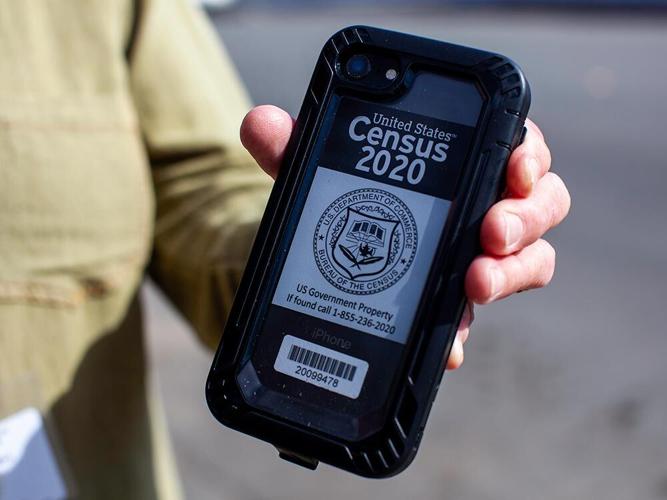
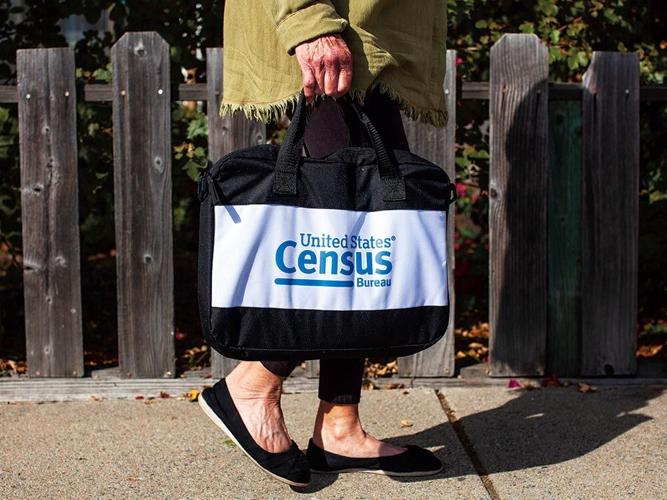
MY IN-PERSON TRAINING OCCURRED IN EARLY AUGUST. After pledging to never disclose anyone’s personally identifiable information (PII) for the rest of my life, I was given my supplies: a lanyard with my official ID; hand sanitizer and a supply of masks; a U.S. Census Bureau satchel with copies of handouts I’d need to give to households; and, most importantly, an iPhone 8 loaded up with the software needed for enumeration.
The crucial app was called the Field Data Capture (FDC), a nifty bit of mobile technology alleviating enumerators for the first time in 220 years from the burden of filling out paper forms. Using the FDC I would electronically file my available hours for the week, receive my daily caseload, submit my time worked and expenses incurred, and enter all data that I gathered at each household.
I was released and given one week to finish the remaining training online at home. On Aug. 3, the U.S. Census Bureau announced it would be cutting its enumeration effort by a month. For us on the ground in Monterey, that compressed deadline meant speeding up our training. I received a text message from my supervisor that my seven-day timeline to finish the online training was now three days.
The training consisted of recorded capsules on my laptop with text, audio, and video, sort of like online traffic school. I learned I would primarily go to homes that had not responded to census mailers back in April. These cases are called Non-Response Follow Ups or NRFUs, pronounced “nar-fu.” My FDC app contained interview scripts and data entry spots I was to follow for each case. It was designed to handle every contingency: a straightforward NRFU enumeration with a respondent at home, a no-answer at a door, a vacation home, a neighbor serving as a proxy to complete a case, a group living situation like a nursing home, or an apartment manager interview.
I was also told to expect occasional resistance to my visits. Census training encouraged the use of three A’s: Acknowledge any concerns, Answer them (say by explaining the importance of the census), and Ask for help. Additionally, I was to use a “Quick Connect,” a technique to induce a brief personal kinship – compliment the landscaping or asking about the sports team on a respondent’s sweatshirt to ease the way for a successful interview. But under no circumstance should I be drawn into a longer conversation – I was on a mission to count people and move on.
I finished my training on the accelerated timeline, but had some trouble entering my available hours into the FDC app. I called my field supervisor. He referred me to the regional office in San Jose. They passed me on to a tech support specialist at the national Decennial Support Center, who sent me back to my local supervisor.
“I need you to sit back and put on your tolerance hat, because that’s what happens when you hire hundreds of thousands of people in a couple of months based on marks on a piece of paper,” he said.
My training was done. I was told to dress professionally but not too formally. Each evening before 11 pm, I would confirm my next-day availability in the FDC. By 7am the next morning, the app sent me a list of my cases for the day. I felt a fair amount of trepidation as I was released to the streets.
Nevertheless, I began knocking on doors.
IF A CENSUS ENUMERATOR IS AT YOUR DOOR, THEORETICALLY YOU AND YOUR HOUSEHOLD ARE UNCOUNTED. And that’s why I’m there, to count your personhood, along with some semi-intrusive but completely confidential demographic data, in order to correctly and equitably reapportion congressional districts and allocate federal funding.
It may surprise you how many people don’t care about or are actively hostile to this theory. Remarkable, too, is the number of homes where annoyed people say they already sent back their completed census. While often true, they might still be a NRFU. Could I make a good enough Quick Connect and use my three A’s to break down resistance?
There is a vast spectrum of comfort levels for people when a stranger knocks on their door, from hostility and suspicion (a sign on one door read: “Don’t beware of dog, beware of the owner” written on top of an illustration of a gun pointed right at me) to open-armed friendliness (I was offered a bag of freshly cut fruit from one respondent’s garden). I honor the whole spectrum, and part of the joy of this job was making authentic human connection, whether the interaction started out well or badly. One respondent greeted me with: “How would you feel if some stranger came knocking on your door?”
I replied that I’d invite the stranger in for a cup of tea – that broke the ice.
While having conversations with nice people at their doors made my day pleasant, I took the hard cases as challenges to overcome. Among the repeat greetings: “Get lost!” “Not interested.” “Um, no thank you.” “I already did it” (as the door was closing). “Would you people stop bothering me!” “Go away!”
These accounted for roughly a third of the answers. As flippant as I’d felt during the training on “Acknowledge, Answer, Ask,” I found it in my nature to want to listen to someone’s concerns – even if I was getting yelled at – and try to find a way to resolve them.
During my second day of struggling in Carmel-by-the-Sea, where there are no street addresses but the FDC app instead refers to “the third house northwest,” I knocked on a door. A woman answered and after hearing why I was there, she grew annoyed. “I’ve already done this. I sent back my census months ago. Why are you bothering me?” I listened politely to what had become an almost universal complaint in Carmel. Maybe my sincere interest softened her. Maybe people like to unload. As she continued, her complaints grew less personally aimed at me and more generally descriptive of her challenges in life as she got older. She found a lot of daily chores difficult. She explained that getting her mail was a hassle, because she had to go to her post office box. Didn’t I know, she asked me, that no one gets home delivery in Carmel, unless it’s a special case?
A lightbulb went off in my head, as I explained that the census has no way to match a P.O. box with a physical location. So her household remained uncounted, despite her effort to respond. Upon hearing this, she shifted. After all, she wanted to be counted, understood what had happened, and happily worked with me to complete her case.
For the rest of my time enumerating in Carmel, if someone complained that they had already completed their census, I asked about the P.O. box, and annoyance often changed to cooperation.
During the first few weeks of my enumeration, before cases became further spaced apart, I was assigned a lot of houses in one neighborhood. This allowed me to park and walk for an hour or two at a time. I might spend mornings walking around knocking on apartment doors in a poor neighborhood and afternoons in gated estates in Pebble Beach.
Growing up middle-class myself, I had some preconceived notions about rich and poor, that a lot of money leads to a life of ease and entitlement, while a low income causes endless suffering. As has happened often throughout my life, children helped me learn about false assumptions.
In the courtyard of a broken-down apartment building, I approached some kids, all from different units, laughing and playing with each other. They quickly befriended me and showed off their skills on their bikes. Amid their laughter and stunts and my delighted applause, I successfully enumerated five cases in their parents’ apartments.
Later that day, I approached a mansion in Pebble Beach where a young child was sitting alone at a giant bay window overlooking acres of well-manicured garden, the nearest neighboring house a half-mile away. As I neared, the initial look on his face was one of disbelief that someone was walking up his long driveway. Then it looked to me like suspicion started battling with his loneliness and curiosity. He shyly approached the door as I interviewed his mom, but she waved him protectively away.
Who am I to judge that income correlates inversely with pain?
There are a lot of second homes in Carmel and Pebble Beach, many with no answer when I knocked on the door. To complete those cases, I would knock on neighbors’ doors until I found someone who could serve as a proxy. The process was quick if a neighbor could verify that the home was a vacation home, a second home, or a short-term-rental. I would enumerate the house as “vacant,” because it was a “seasonal, recreational or occasional use home.”
One day I enumerated a second home on the oceanfront. In this case, I was lucky enough to catch the owners on site. The woman stated she had already completed her census where they usually lived in Texas and then complained that I was bothering her. Because she had completed her forms in Texas, she had understandably thrown away the census form she received at her Monterey Peninsula address, figuring she had already been counted. But the Census Bureau has no way of knowing how one house relates to another – the goal of the census is to account for how many people live at every address, even if that number is zero. She understood, and we quickly completed the census response, counting her California house as “vacant.”
She made a point to tell me she lived part-time in California, but “never more days than necessary, so I don’t claim residency here.”
I walked away reflecting on the facts that Texas has no income tax, while California’s is among the highest, although Texas has higher property taxes than California. It made me angry to think they were cleverly gaming the system – owning a mansion in California with relatively low property taxes, and claiming all of their income in Texas, with no income tax.
I needed to speak to some children.

Prunedale-based enumerator Louise Iredell (not the author of this story) was assigned 25 to 51 NRFU cases per day, and she knocked on doors from North County to Big Sur to Salinas, ranging from apartments to gated communities. She visited 974 homes in all.
AS THE 2020 CENSUS WOUND DOWN, my caseload increasingly consisted of addresses that had been visited multiple times. I was assigned a case in Pebble Beach that had been attempted five previous times with no completion. The case notes explained that the house next door had been requested to act as a proxy. A previous enumerator wrote that the neighbor seemed to know something about the status of the house next door but had been annoyed by the visit, saying it had been an inconvenient time to talk.
Confident in my friendly demeanor, my listening skills and my ability to understand issues and resolve cases, I knocked on the neighbor’s door. A woman answered. I apologized for bothering her again and asked her to help me with her neighbor’s case, explaining how quickly we could do this together.
She grew red in the face as she started yelling at me. She said we had been in her neighborhood over and over again, and she was sick of us. Yelling “go away and never come back,” she slammed the door in my face. I took a breath and started walking back down the lane, writing in my case notes, “do not visit… ”
Three steps later, a man ripped the door open again. With his wife in the background, now on her cell phone, he berated me anew at higher volume. During a pause in his diatribe, his wife, while looking me in the eyes, said into the phone: “They’re like roaches!”
Seemingly everything is politicized today, including the 2020 Census. Many elected officials at one end of the political spectrum extoll the importance of an accurate count, despite the Trump administration’s efforts to curtail the census time-frame. (And that comes after litigating other subjects, like the administration’s effort to include a question about citizenship status. That was blocked by the U.S. Supreme Court. See sidebar, above right.)
The politics at the top were reflected in conversations I had at people’s front doors. Many people expressed gratitude to me, telling me I was doing a great and necessary job, saying, “Keep up the good work and get everyone counted!” Some even offered an enthusiastic elbow bump of encouragement.
One repeat conversation opener began with a variation of: “I just want to tell you how disappointed I am that the census removed the question about citizenship.” I’d stand politely and listen – the first of the three A’s, to acknowledge.
I didn’t take any of the negative responses personally. People have their reasons to be angry. When a door would slam, I would stop, take a deep breath and think: “I may have a future in sales.”
ONE MORNING DURING THE FIRST WEEK OF MY CENSUS ENUMERATION, I knocked on a door in a quiet, middle-class neighborhood. An older woman dressed in a bathrobe answered the door with an annoyed look on her face. I politely explained my purpose. She started complaining, and I listened. She said how busy she is, she has no time for anything, she has an accountant coming over that afternoon, there was so much paperwork to do to prepare.
I expressed my understanding, and she continued. She hadn’t had time to even clean her house. Her husband had died a couple of months ago, she’s been trying to work on his estate, and that’s why the accountant was coming over. “And you think I have time for the census? For heaven’s sake, I haven’t even had time to grieve!”
Throwing aside the Quick Connect rule mandating I never extend conversations, I said, “Well how about we make some time, right now, to grieve for your husband.”
She stopped. She took a breath. And we spent the next 15 minutes on her porch, sometimes crying, sometimes laughing, always six feet apart. She said how hard it was in this time of Covid. She missed her friends at her church, which couldn’t hold in-person services. She couldn’t hug anyone. She told me about her husband’s life, and about his death.
At the right time, we returned to the subject of the census interview, completed it, and parted ways.
This case inspires me when I knock on doors and sustains me when they’re slammed in my face. Front doors mark the beginning of one space and the end of another, a portal from private to public, a connection between the individual and the greater community. Perhaps this is fundamentally the public service Census 2020 and every census provide: a once-a-decade, face-to-face human interaction between the government and the people it serves. And how we respond to one another ultimately reflects who we are as a nation.
(0) comments
Welcome to the discussion.
Log In
Keep it Clean. Please avoid obscene, vulgar, lewd, racist or sexually-oriented language.
PLEASE TURN OFF YOUR CAPS LOCK.
Don't Threaten. Threats of harming another person will not be tolerated.
Be Truthful. Don't knowingly lie about anyone or anything.
Be Nice. No racism, sexism or any sort of -ism that is degrading to another person.
Be Proactive. Use the 'Report' link on each comment to let us know of abusive posts.
Share with Us. We'd love to hear eyewitness accounts, the history behind an article.