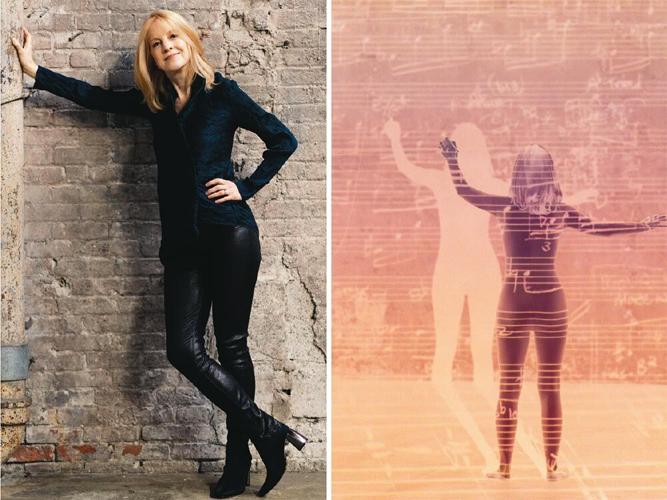


“My music brings up whatever comes up,” Maria Schneider says of the composing process. “I sit and I write and I’ll be playing something and in my mind images come up, and it’s like the images start driving the music. I follow that to finish the piece.” Above right, Schneider pictured in artwork accompanying her new album, Data Lords.
SHE HAS WON SEVEN GRAMMYS, recorded nine albums and worked with jazz icons (Gil Evans, Bob Brookmeyer) and rock artists alike (David Bowie, Sting, Phish). Music is born in Maria’s Schneider’s head, then gets expressed by her 18-member Maria Schneider Orchestra.
But Schneider is a trailblazer not only in a sense that she conducts rooms full of musicians – which she is, a tiny, youthful-looking, long-haired conductor, like her inspiration, jazz orchestra conductor Toshiko Akiyoshi, delicate but commanding, displaying a sorcerer-like power as she conjures music out of bodies and instruments. Schneider also speaks openly against publishing practices of YouTube, its parent company Alphabet (which also owns Google) and other “data lords,” who steal music profits from their creators. While making music, Schneider has also become an outspoken leader in a movement. In 2014 she testified before the U.S. Congress to help in a review of the Copyright Act. She is also involved in a class-action lawsuit against YouTube, seeking “damages and injunctive relief for copyright infringement.”
Schneider accused YouTube of mass copyright infringement, failing to suspend repeat infringers and restricting access to anti-piracy tools, among other allegations. She criticized the fact that her content can be uploaded by anyone, anytime, without much vetting on the YouTube side. On Jan. 5, 2023, both parties had a partial win in a summary judgment in the class-action case, originally filed in 2020 in federal court in the Northern District of California. The court dismissed some claims, while other infringement claims stand, and the case will continue. Specifically, the suit takes issue with YouTube’s Content ID system, which allows the largest copyright holders an easier tool by which to protect their own content, but which is not available to Schneider or other members of her class.
“The ready availability on YouTube of unauthorized copyrighted materials and the whack-a-mole approach required for creators to remove infringing material works disincentivize the creation of new works and reduce the value of all works,” the lawsuit claims.
Musically, Schneider says the Monterey Jazz Festival in 1995 was her first really big commission. “Scenes from Childhood” that she composed for the occasion was later recorded on her second album, Coming About (1996). Schneider’s fourth album, Concert in the Garden (2004) earned her her first Grammy. It was also the first award-winning album produced by ArtistShare, a fan-funded platform created to disrupt the traditional arrangement between artists and record companies.
Her seventh album, Winter Morning Walks (2014) won a Grammy for Best Contemporary Classical Composition. It is titled after a volume of poetry by Pulitzer-winning poet Ted Kooser, and equipped with haunting vocals by American soprano Dawn Upshaw.
In 2020, Schneider released the album Data Lords, where she merges the world of music and advocacy, openly challenging digital media operators, with song titles such as “Don’t Be Evil,” named for the now-discarded corporate motto of Google.
Schneider spoke with the Weekly about her music and her advocacy, from her apartment on the Upper West Side of New York City, before she is set to play on Wednesday, March 1 at the Sunset Center in Carmel.
Weekly: There are landscapes in your music, also indicated by titles, such as your 2015 album, The Thompson Fields, that refers to your former neighbors’ farm in Windom, Minnesota. Why is that?
Schneider: Most of us carry in our music something from our childhood. My childhood is maybe unusual in the jazz world because I was from a very rural area. Most kids that come up playing jazz usually are from cities that have programs that nurture that. I have other influences that are my primary influences. It’s something very rural, it has a lot of space. It’s not voluntary.
What do you miss the most from your rural childhood?
Simplicity. When I think about childhood I think about space. It has to do with [current] inundation of information and thousands of channels you can watch, and your phone always going at you. And when I was a kid, there was space. You had to think about things to do, create your own fun. It was a more creative time, and I miss the people. I went to Windom [in Minnesota] for my 40th reunion a few years ago. I was talking to one of the guys who still lives there and farms there. He said things have really changed. Kids are all in their insular world, they don’t do things together like we did.
How did your parents think about music?
My mom never pushed lessons, but we had instruments in the house. She played pretty good piano and bad violin. I also played bad violin, but we enjoyed playing anyway. But in a lot of ways, music came more from my dad. He was an engineer, very creative in building things. He noticed motivic development. He would notice when an idea connects or comes back. He thought of it more structurally.
What was your music education in Minnesota like?
I’m highly unusual because when I was 5 years old, I met this amazing woman, Evelyn Butler. She was a Dorothy Donegan-style pianist – classical and stride [jazz piano]. Extraordinary. Really, really great. So I had this unbelievable teacher in this small town. People like that don’t live in towns like that. We had a beautiful band program. It was a public school but it supported the arts. And this is something I’m really interested in. The least expensive investment this country could make is arts programs for students.
How did you end up composing?
I went to the University of Minnesota as a theory major. By Windom standards, everybody thought I was a great pianist. By standards out there in the world, I’m a lousy pianist. But Mrs. Butler taught me a lot of theory and had me writing music starting in third grade, really understanding chord structures. A teacher who heard my assignments said, “You seem like you can actually compose. You should be a composition major.” I was told there’s a big band in the school and you should go watch them rehearse, and maybe you can write for them. So I started doing that and I just loved it. I just got the bug, writing for the rhythm section, writing for improvisers. Because writing for improvisers fits and fills my social needs.
When you compose, how do you decide which instrument will play what?
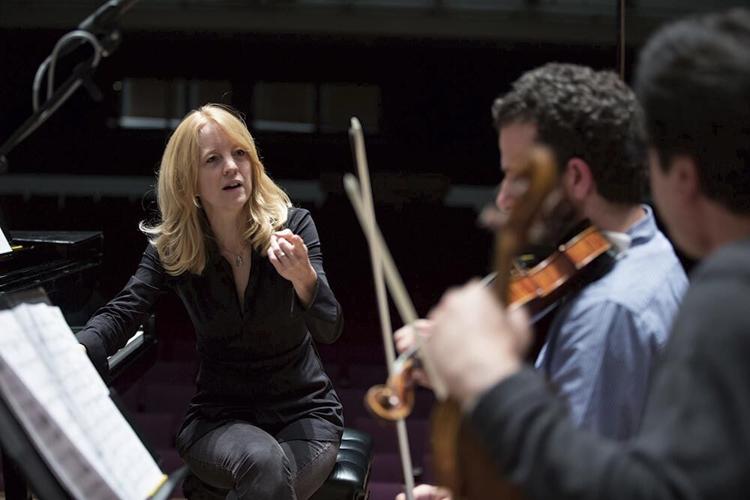
That’s the part I love the most, the thing that fascinated me when I was listening as a kid. I would hear things, and I would be like: “Aww, I would love to know how to make that color. That sound.” When I’m thinking of ideas, I’m hearing a color in my head. And I have to figure out how to get it. A lot of times it’s about mixing different instruments to come up [with a sound] that has a little edge or a little roundness to it, or something that’s just powerful and bright, or something that is very dark. Every instrument has its sweet spot. And on top of that, every player has a certain sound. In the case of my band, I know these guys, so I can think: “Who am I going to put on that, how am I going to get that sound.”

“You can see them on stage, looking at each other. You can see on their faces, the surprise and the depth of disbelief and amazement that they feel for one another in the moment,” Schneider says of the band members performing live. “Which is amazing for the audience, because they can see that this band is loving this.”
You’ve been leading a big jazz band since the ’90s. Is it still the same people you started with?
I just found my files from back in the days when we played in Visiones. [The Visiones Jazz & Supper Club was a Greenwich Village jazz music venue that operated between 1987 and 1998.] It says who can play what night, who’s subbing for who, their phone numbers are at the top. I looked at it and I got a headache because it was such an ordeal every week, putting that together, being scared that somebody wouldn’t be there, or if there was a mix-up, or double booking.
But the basic band is remarkably unchanged. Like Jay Anderson, my bassist, who played on my record that we recorded at the end of ’92. There are seven people in the band that have been there since the beginning.
What happened to Visiones?
It closed in 1998. Then right around that time the club called Jazz Standard opened, which was fantastic. And then Jazz Standard became our home. We would do week-long runs, and in 2005, I think, we started to play every year at Thanksgiving. And during Covid it closed. It was heartbreaking.
I wanted to ask you about your favorite jazz room in New York City.
There’s Birdland. We played there, and it’s a wonderful place too, and it has a big stage. Then there’s Village Vanguard, which is just a historic place, and it’s wonderful. But my band, we played there once. It’s not a good room for my band. My band needs a little bit of room to mix the sounds.
In addition to Evelyn Butler, you had two other important mentors/early employers – Gil Evans and Bob Brookmayer.
That I got to work with them and know them was really honestly kind of crazy. With Evans it was completely by luck. I worked as a music copyist in New York and met somebody there, a musician, who knew that Gil needed an assistant. I went to a rehearsal, and he had me copy some things, and I did it and I guess he liked my work and we got along. So I worked for him until he died.
And Bob Brookmeyer – he was such a great teacher. He could articulate things in such a clear way. I’ve learned so much from him and I felt so much wind in my sails, emotionally.
But you also worked with people like Sting, among other unusual collaborations.
The Sting thing was very weird. That was Gil Evans’ project, at the end of his life. He couldn’t do it. He had me write these arrangements. So that was uncomfortable. I hadn’t slept for three nights because Gil gave me this assignment three days before they were rehearsing it. And I had to copy all the music. And at the rehearsals, when everybody had questions, they had to come to me. And Sting realized that I arranged a lot of this music. I was 27 but I looked like I was 13. But I did a good job.
And the work you’ve done with Phish?
Trey Anastasio came to me and wanted to work on something together. I guess it was a string quartet arrangement; we worked on this song, “Secret Smile.” His song, but I helped develop it and orchestrate it. We went up to Vermont to the barn, where his studio is to record it. And the band basically needed me to conduct, which was really weird because I was conducting Phish. I think that was the only time when Phish was ever conducted.
David Bowie…
That thing came much later, in 2014. David contacted me through Facebook and then he called me when I was on the train to Boston.
I was really nervous about doing it. He had a beginning of this song and he said he wanted it to be really dark. And I asked what words would be? “Maybe vampires?” he said with a big smile on his face. Then we started working. It was really fun. We sat next to each other here at my place at the piano, figuring out the melody, going: “Aaaaaa,” “AaaAAa.” I guess I never thought that I would hear David Bowie in my apartment trying to figure out pitches.
I was nervous, if one of us would hate it. He said: “If I don’t like it and you don’t like it, we won’t put it out.” He said, “the great thing about music is if the plane comes down, we all walk away.” His first love was jazz. People don’t know that but he played the baritone.
You involved literature in a few of your projects.
I do like to read but my time is so limited. Octavio Paz helped me find direction in a piece that I was lost on in Concert in the Garden. I’ve done some music to the poetry of Carlos Drummond de Andrade from Brazil in an English translation of an American poet, Mark Strand, who was lovely. And I became close friends with Ted Kooser. It’s my favorite poetry in the world. I discovered I liked collaborations, even if we were not collaborating [in real time]. The poetry drives so much about the music, the rhythm – the ups and downs of the music follow the language.
Where does your activism come from?
My father was an engineer and had quite a few patents so I know the pride of ownership and authorship. I know what it means when your intellectual property is copyrighted or patented and that means that you received royalty. I recorded my first album, Evanescence, myself. I was happy Enja picked it up, but I recorded it for $30,000 and they gave me $10,000. It opened a European audience for me and I did several albums with Enja. But in the 2000s file-sharing started, with Napster and everything. A friend of mine, Brian Camelio, asked me: “What’s the one thing that nobody can fileshare?”
What is it?
My records were selling really well, but the profits were going between the record store, the distributor, and the record company. I decided I would do ArtistShare with Brian and be his first project. You sell $10,000 through the record company, and it’s nothing. You sell 10,000 [records] directly and if you are making, say, $15 on each one, that’s $150,000. We won a Grammy for that first album. It was crowdfunded. Nobody was using that word yet. We called it fan-funding. We thought that it was the best time for artists, owning your property. Until, you know what?
YouTube.
YouTube came out. These companies suddenly discovered the value of data. And the best way to collect data is to have something that keeps people glued onto their screen. And that was music, and film. So a world of pirated stuff was turned into a cash cow for them. That’s when I started becoming outspoken. When I realized that this amazing thing we built is being taken away – not by stronger technology, but by a very illegal thing.
We live in the United States of America, where in the Constitution there is something called copyright. [“To promote the progress of science and useful arts, by securing for limited times to authors and inventors the exclusive right to their respective writings and discoveries,” reads the U.S. Constitution, Article 1 Section 8 Clause 8.]
It’s not even an afterthought, it’s not an amendment. It was put there front and center to incentivize creation. If people own their work and it has value for them, they will be incentivized to create. And now musicians are like on a hamster wheel, churning out as much music as they can, to get as many listens as they can.
How deep is your resistance? How do you listen to music yourself?
When I really listen to music, it’s usually my CDs that I have, or things that I have digitally. But I did finally subscribe to Spotify not that long ago.
Spotify was supposed to legitimize things. But it doesn’t really, because now you have access to most of the music in the world for $9.99 a month. That’s never going to pay for the cost of the music. Spotify convinced the record companies to participate by giving the three biggest companies – Universal, Sony and Warner – equity in Spotify, and a lot of money.
On Spotify you can choose if your music is on there. You decide. But on YouTube, everybody can put up my music. But to take the music down, you have to sign under penalty of perjury that you are the person who owns music.
People are gorging on so much music and content, they are no longer hungry. You know when you eat at a buffet, at a certain point, you don’t even taste the food anymore? People don’t really listen and hear the music anymore. It devalued music, it hurt music – trading it for ads. David Bowie didn’t come to me because I was mainstream, but because I was niche. Niche pushes the mainstream forward.
Does activism take a lot of your time?
It’s exhausting. What I do is so many different full-time jobs. But it’s important to speak up for those who don’t have energy to speak up. Wake everybody up. They have a hard time and often don’t know how it happened and why.
A lot of musicians fell for this visibility thing – putting their stuff up for lots of plays. But are those listeners paying for your music? Because somebody is really making real dollars out of that, and it isn’t the musician.
OK, let’s wrap up with something pleasant. What will you conduct with the most pleasure in Carmel?
I’m working on a bunch of different setlists for this tour. So I will bring extra music. It’s always like a Rubik’s Cube, it’s challenging. I love playing “Sputnik” [from Data Lords]. Scott Robinson [saxophone] is so extraordinary in it. There’s another piece that he plays that I like to play and that’s “Walking by Flashlight.” It’s based on one of Ted Kooser’s poems. But sometimes I just enjoy playing “CQ CQ, IS ANYBODY THERE?” Morse Code messages, like: data, hope, power, greed.
And maybe, since we started with a small town, it seems that you have been feeling quite at home in a big town for years now.
I moved to New York in ’85 and lived in Queens, and moved to Manhattan in ’93. But New York has changed in the last few years. The bloom has gone off the rose for me, which makes me really sad. A lot of clubs not being here, and Covid, and seeing a lot of suffering people on the streets. I’m sure there are cities in California where it feels like that. Hard times.
But yes, the Upper West Side had been my little Windom. You can walk everywhere, go to the post office, grocery store, dry cleaner, drugstore. That makes it feel like a small town a little bit.
MARIA SCHNEIDER ORCHESTRA performs at 7:30pm Wednesday, March 1. Sunset Center, 9th and San Carlos, Carmel. $59-$89. 620-2048, sunsetcenter.org
(0) comments
Welcome to the discussion.
Log In
Keep it Clean. Please avoid obscene, vulgar, lewd, racist or sexually-oriented language.
PLEASE TURN OFF YOUR CAPS LOCK.
Don't Threaten. Threats of harming another person will not be tolerated.
Be Truthful. Don't knowingly lie about anyone or anything.
Be Nice. No racism, sexism or any sort of -ism that is degrading to another person.
Be Proactive. Use the 'Report' link on each comment to let us know of abusive posts.
Share with Us. We'd love to hear eyewitness accounts, the history behind an article.