




MARINA RESEMBLES A QUILT MADE OF DIFFERENT PIECES OF FABRIC, each with different patterns, stitched together, and the stitches are still visible. Two neighborhoods, The Dunes and Sea Haven, are rising up with new construction. Central Marina, where a proposed downtown area will be located per a city plan, features older homes and commercial strips. There is city-owned affordable housing at Abrams Park and Preston Park, set off from the central core, and Cypress Knolls, a 188-acre ghost neighborhood with about 400 dilapidated homes near Marina High School. Another new development, Marina Station, is expected to break ground later this year.
This patchwork reflects the old, new, in-progress and future of Marina, incorporated in 1975. Once a military city adjacent to Fort Ord, Marina today is a city in transition.
The U.S. Department of Defense closed the base in 1994. The Army kept just 876 acres of the 28,700-acre installation, and the land – roughly the size of San Francisco – was partitioned among Marina, Seaside, Monterey, Del Rey Oaks, the County of Monterey and the U.S. Bureau of Land Management. A slice became the campus of California State University Monterey Bay, making it into a college town.
Marina’s service area – where police and fire services, garbage collection, transportation, road maintenance would need to reach – roughly doubled.
Marina City Manager Layne Long says this created an unusual setting for Marina: large areas of vacant land, some with open space and others with old military buildings. “Most cities our size do not have all those vacant properties,” Long notes.
Developing those former military properties is a decades-long process still underway. It has been a patchwork process. Next will come an effort to make the stitching between the patches less visible.
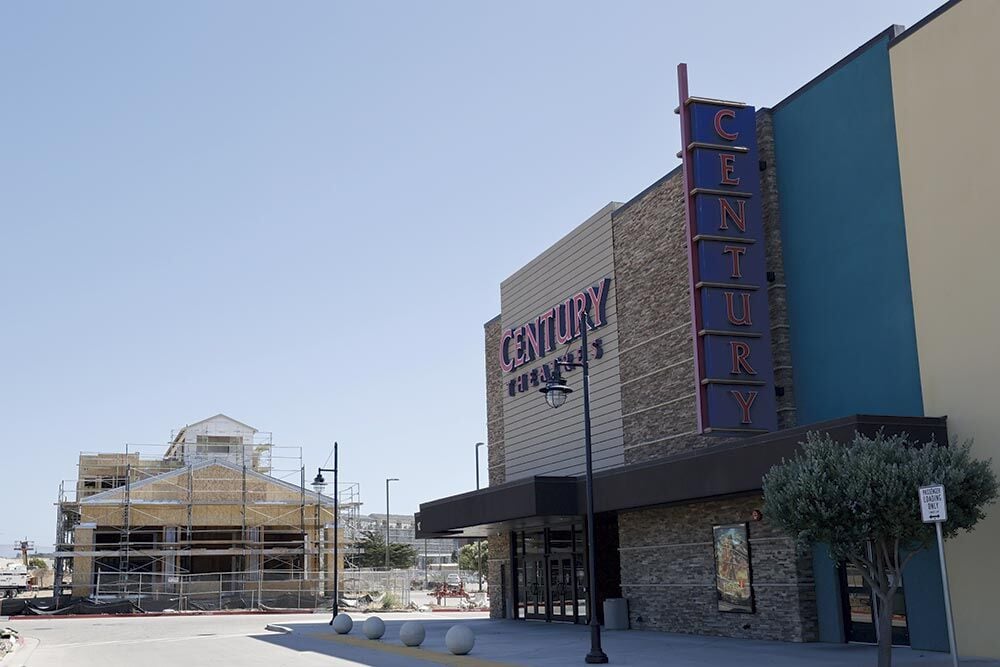
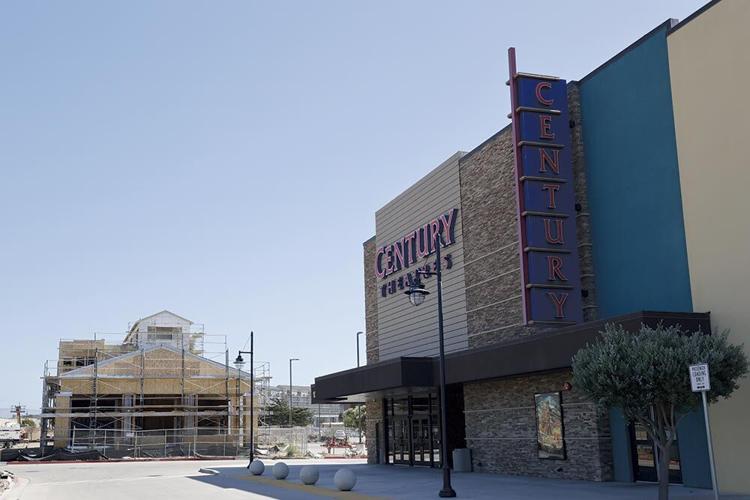
This mixed-used area is now being built around the Century movie theater
WITHIN MARINA, there are some invisible dividing lines that delineate the old city from the former Fort Ord; other lines are more obvious.
One of them is Imjin Parkway, a busy artery that feels like a mini-highway connecting Salinas and the Monterey Peninsula. A few exits connect the corridor to Central Marina and several cul-de-sacs areas along Patton Parkway; the fenced-off end of Carmel Avenue separates that part of the city from Sea Haven, a residential community still being built.
Dilapidated buildings along Imjin Parkway are now gone, and the road is currently under construction to add two additional lanes and four roundabouts along 1.7 miles.
“There’s no physical footprint anymore that would tell someone it used to be military. They have to know their history,” Mayor Bruce Delgado says.
Delgado has lived in the city since 1996. For most of those years (since 2000), he has served on council.
He says the city has worked for decades to blend old Marina with Fort Ord Marina. Much of this is through road infrastructure. Once the city opens up Second Avenue, connecting The Dunes with Del Monte Boulevard and Central Marina; Reindollar Avenue gets connected (via trails) to Imjin Parkway; and the Cypress Knolls area is developed, Delgado expects the city to be more connected and feel more like a whole.
“Cypress Knolls has to happen because we can’t have a bunch of abandoned Army houses there,” Delgado says. “Cypress Knolls is in the start [of a] planning process,” he adds.
It will be a lengthy process. Cypress Knolls is contaminated by lead and asbestos. The property is located in a key area in Marina: at its core connecting the newer, Fort Ord portion of the city with the older part to the north.
City staff estimate the cost of cleanup on the Cypress Knolls area is $20 million to $25 million. Community Development Director Guido Persicone says Marina has received $300,000 in seed funds from the U.S. Environmental Protection Agency to test the barracks for lead and asbestos, and will apply for a $5 million grant to demolish a portion of them. (In 2022, the city approved spending $4.2 million to remove 45 barracks and debris from Cypress Knolls.)
At least three development proposals on the site have fallen apart over the last 15 years, based on cost.
But after multiple projects stalled during the Great Recession, Marina is actively growing – construction is underway and people are moving into new neighborhoods at The Dunes and Sea Haven. Meanwhile, ideas are resurfacing for Cypress Knolls and Marina Station. The latter is a 320-acre development in the northern part of the city that will bring in 1,360 residential units, as well as office, retail and industrial areas.
Some city leaders, like Jon Perez, pastor at Epiphany Lutheran & Episcopal Church in Marina, see Cypress Knolls as a critical area. Perez says Marina has missed the opportunity to inter-connect its different communities and Cypress Knolls may be its last chance.
“I think it’s [the] last place to make that happen,” Perez says. “My biggest concern in Marina’s growth is that the Reservation/Del Monte corridor and the Imjin/Sea Haven/Dunes corridor are going to create two different cities and two different cultures.”
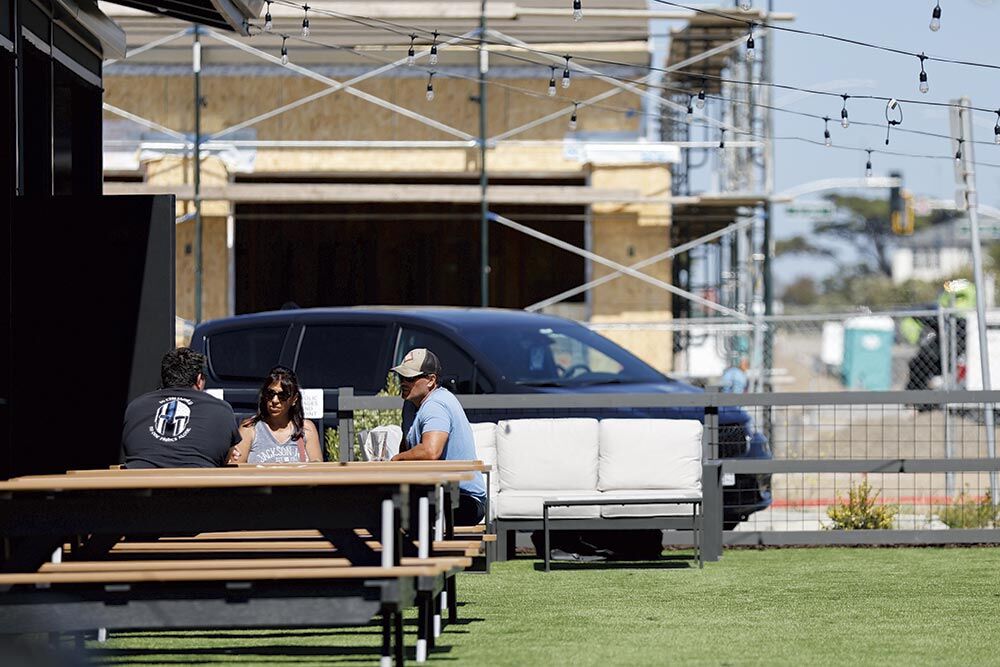
The Brass Tap opened in April, one of the first Promenade businesses; customers can witness the fast-moving changes from the outdoor seating.
DIVERSITY IS A KEY ELEMENT OF MARINA’S IDENTITY. A hint of that comes from the city’s restaurant offerings, which include Mexican, Korean, Thai, Salvadorian and more. It’s reflected on official city surveys that present questions in languages including English, Spanish and Korean. A range of events bring people of different cultures and races together to work on removing weeds and planting trees at Locke Paddon Park, or gathering at the Marina library for the Dads Read program, or explicitly celebrating diversity at the city’s Multi-Cultural Festival every year.
Many residents feel proud of the legacy of diversity, something that remains from the Army era – and, longtime residents hope, into the future. “I hope it doesn’t change that. I do feel like they heard loud and clear that is a huge area the community wants to maintain,” says Francine Rodd, a Black, longtime Marina resident who remembers when the city had just one stoplight and one fast-food restaurant (a KFC).
Allie Kim, a Sea Haven resident who grew up in Marina, notes the evolution of diversity over the years – she remembers an influx of Polynesian residents in the 1960s, and notes an increasing number of Latinos today.
(Less than 47 percent of Marina’s residents are white, the largest proportion among all ethnic groups; another 29 percent are Latino. By comparison, the proportion of Latino residents countywide is over 60 percent.)
Economic diversity is a factor that some people fear losing as new development happens. Rodd grew up in Marina when it was a diverse Army town. “My friends, we used to call ourselves the Benetton,” she says, a reference to a clothing brand that showcased people from different backgrounds, like her friend group.
She left the area to pursue higher education and after 15 years overseas, returned in 2004 with her own family. “It was affordable, and it was very diverse and that was really important to us,” Rodd notes. “We want our children to be able to grow up and still stay and live here. We want the students from CSUMB to be able to stay and live here.”
But affordability – and culture, even if that is harder to measure – can be difficult to maintain.
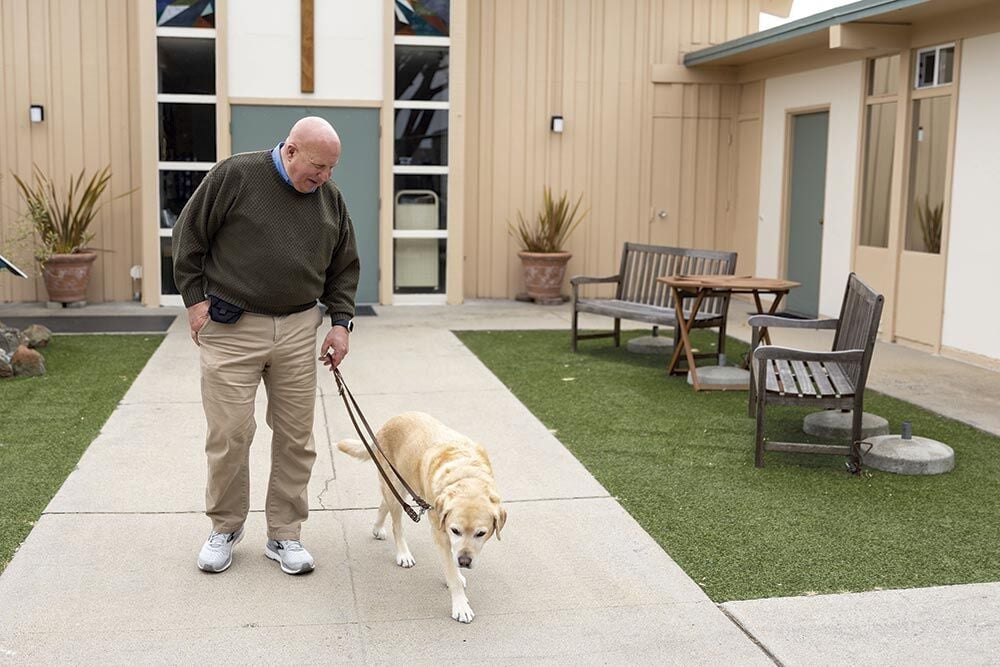
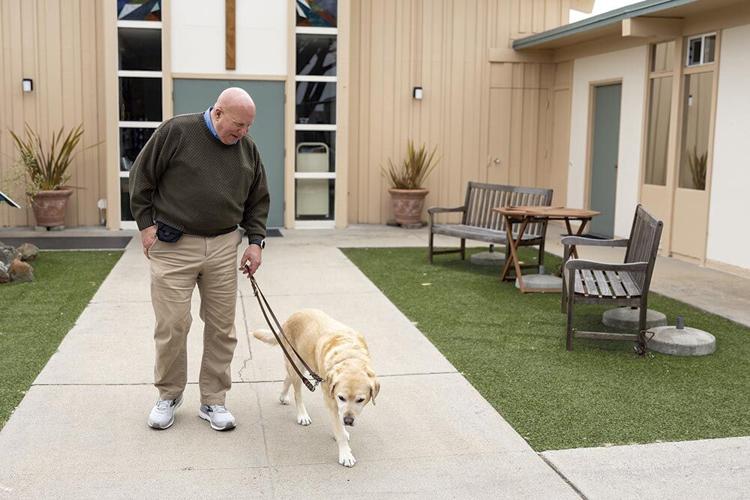
Pastor Jon Perez, who is visually impaired and walks with his guide dog Arlington, says Marina is not pedestrian-friendly. “I give Marina a fat F for pedestrian safety and pedestrian viability,” he says. “There are places where there are just not sidewalks.”
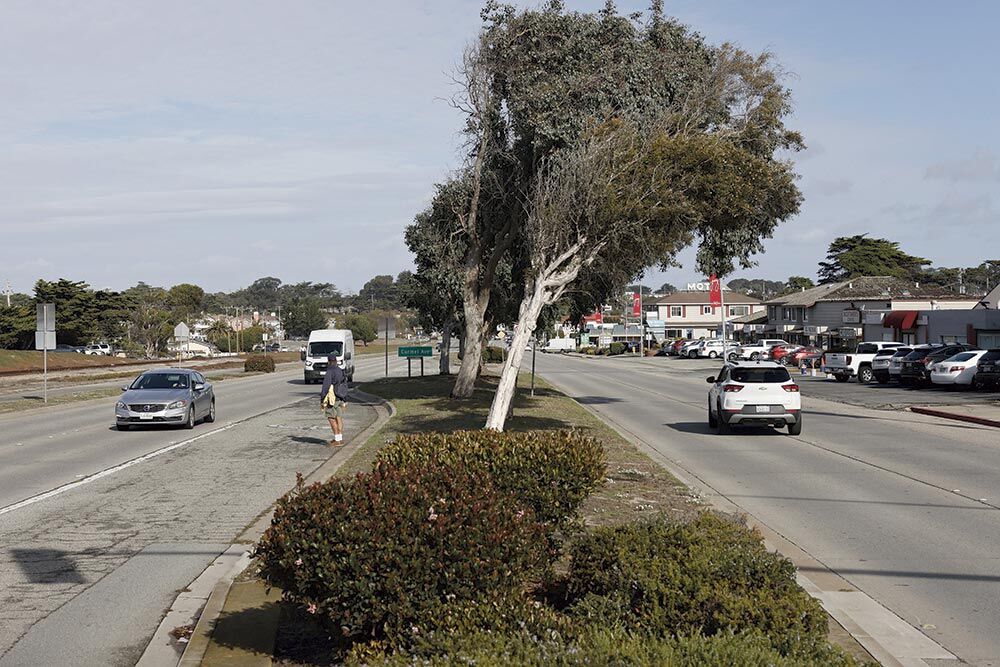
Del Monte Boulevard would transform once the Downtown Specific Plan is implemented, shrinking from four lanes to two, and would have several roundabouts instead of streetlights.
ANDY WOOLFOOT is a real estate agent who lives in Marina with his wife, Jennifer, and their three daughters Kiera, 4, and 3-year-old twins Mia and Ava. Woolfoot and his wife moved to the area 10 years ago. They initially lived in CSUMB housing, then in 2016, purchased their home. Like many Marina homeowners, they settled here because it was relatively affordable: “The affordability of Marina was a big attraction,” Woolfoot says.
But prices have skyrocketed. “I remember seeing a three-bedroom home, 1,600 square feet, in the $400s,” Woolfoot recalls. Now it is hard to find a three-bedroom house, or any house at all in Marina, under $800,000.
Woolfoot says home prices have doubled and there is a lack of inventory even with growth. For local first-time buyers, he says: “There’s just not the housing available to them, even with the new developments; they’re bigger, pricier homes.”
Kim, who returned from 35 years in San Francisco to retire in Marina, recounts seeing the prices in Sea Haven in 2021 increase by $15,000 to $25,000 – per week. There was little hope for Kim and her wife to find a home during the pandemic while inventory was selling fast. Kim called regularly and one time she “got lucky,” learning a sale fell through. She had 20 minutes to decide if she wanted to make the offer. “Everything just fell in place and it worked out,” she says.
While Kim lives in a new neighborhood, her home is close to where she grew up. “I’m right on the edge of what they consider central Marina,” she says. “There’s this line of trees that separates Sea Haven from central Marina.”
Kim loves her neighbors and they have built community, but she notes most of them aren’t local – many have moved recently from the Bay Area, enabled by remote work policies during the pandemic.
Despite the contrasting neighborhoods and an influx of newcomers from the Bay Area, Marina remains a tight-knit community.
Managing that balance is Marina’s official vision statement: “Marina will grow and mature from a small-town bedroom community to a small city which is diversified, vibrant and through positive relationships with regional agencies, self-sufficient.
“The City will develop in a way that insulates it from the negative impacts of urban sprawl to become a desirable residential and business community in a natural setting.”
MARINA IS WELL POSITIONED TO THRIVE. It’s located between Salinas and Peninsula cities, but does not face the same water constraints as the latter. (It is outside of the Cal Am service area, which is under a cease-and-desist order by state water officials.)
The city is a beachside community. It also enjoys inland recreational offerings. Much of the former Army base, some 14,000 acres, became the Fort Ord National Monument, with hiking, bicycling and equestrian trails.
Delgado is a botanist by trade, as a BLM employee, and has long been involved in habitat restoration projects. He says beautification, reforestation and environmental awareness are an integral part of Marina’s community identity. “We’re respecting our natural heritage of people, plants and animals that have been here for thousands of years,” he says.
An emphasis on conservation does not preclude recreation. Last year, the city opened a bike pump track at Glorya Jean Tate Park. It’s nearly 30,000 square feet and the first of its kind in Monterey County; it’s accessible for bicyclists of all ages, skateboarders and scooters.
Since 2021, thousands of native plants have gone in the ground at Hilltop Park, Marina’s newest park, part of the Dunes development plan.
While there is an emphasis on parks and open spaces, Marina is also hoping to grow as a tech hub. Joby Aviation, a flying car maker, has committed to an expansion at the Marina Municipal Airport, promising some 600 jobs in aero-technology manufacturing.
When Joby won a state grant for nearly $10 million in 2023 to expand in Marina, Maria Elena Manzo, director of the group Mujeres en Acción, celebrated the economic development opportunity for locals: “Joby has high-road jobs and we have an eager, able and hardworking community ready to contribute to, and benefit from, Joby’s success.”

In April, a 140-apartment affordable housing community called Terracina at The Dunes, opened its first phase with 92 apartments on Beacon Street. A second location is coming as early as July. It’s under management of Roseville-based USA Properties.
MARINA HAS APPROXIMATELY 22,500 INHABITANTS, and its population is expected to increase to over 30,000 by 2045. According to the 2020 Census, Marina was the second-fastest-growing city, just behind Greenfield, in Monterey County.
During Fort Ord’s boom years, Marina’s population grew by 28 percent from 1980 to 1990. Then it dropped by 29 percent between 1990 and 2000.
Its current population is still smaller compared to its peak in the ’90s, before Fort Ord closed, when the city had a population of about 26,500. Marina has been rebounding ever since.
“We lost a lot of buying power. Housing prices plummeted, businesses closed, it was a pretty depressing time in Marina,” Delgado says. About one-third of the population and 200 businesses vanished.
The former Army land was free, but it came with blighted barracks, munitions contamination and chemical pollution. It also came with restrictions for future developments, including affordable housing requirements, habitat protection, and setting land aside in perpetuity for conservation.
Attracting developers to the area wasn’t an easy task because it can be difficult for projects to pencil out, as seen with several failed attempts to redevelop Cypress Knolls.
Shea Homes/Marina Community Partners, based in Walnut, California started developing in Marina before California’s redevelopment agencies were dissolved in 2012. “If we didn’t have that tool in place, that development would not be happening at all,” Long says.
Marina Community Partners is the developer behind the four-phase project called The Dunes, home to a large commercial development with an REI and a Target. For years, the Cinemark movie theater stood alone, flanked by a few dilapidated Army buildings and a trailer that houses the developer’s onsite offices.
Development has been slow going thanks in part to the Great Recession, but it is moving quickly now. The central commercial strip in the shopping center, called The Promenade, is being built. There are already regulars at the Brass Tap, a pub with 60 beers on tap, sitting outdoors on a deck that is flanked on all sides by active construction sites. Just across the way, a Trader Joe’s is in the works.
New housing is coming too. Terracina at The Dunes, a 140-apartment community with two locations (one at Imjin and 4th Avenue, another at 2nd Avenue and 5th Street) opened its first phase, 92 apartments, in April.
Mixed-use buildings on 2nd Avenue and 10th Street are underway, filling in a previously desolate neighborhood around the Maj. Gen. William H. Gourley VA-Department of Defense Clinic, which opened in 2017.
This new neighborhood is filling in. But there is still more work to do.

Marina Station, expected to start grading this year, is located in northern Marina. The project includes 20-percent affordable housing. “Affordable housing isn’t our issue,” City Manager Layne Long says. He notes there are 685 affordable units at different stages of construction in the city within the next year.

Mayor Bruce Delgado explains to Marina residents about potential areas for future development at a public workshop on April 27 about Marina 2045, the city’s general plan.
WHILE MANY OF MARINA’S CHANGES are obvious as new buildings rise up out of empty lots, some change is happening just on paper for now. Through surveys, reports and community meetings, city officials and residents are planning for how the city will look 20 or 30 years in the future.
On April 27, dozens of residents showed up to get the latest updates for Marina’s 2045 general plan. They heard about proposed land-use changes in different parts of the city, including CSUMB’s 72-acre parking lot, Cypress Knolls and Preston/Abrams Park. Using colorful post-its, residents were invited to share their preferences about housing, mixed-use buildings, and Monterey-Salinas Transit’s planned SURF! busway project connecting Marina to Sand City.
According to the Marina 2045 workshop presentation, Marina lacks basic urban features such as diverse housing, local jobs, shopping areas, gathering places and entertainment. Councilmember Kathy Biala notes the city is growing, and it has to adapt; Marina is no longer a “slow-growth, small town,” she says.
A plan to remake downtown so that it feels more like a downtown core has been in the works for decades. The city planning process was revived in 2017, then stalled due to the pandemic, and now is back on track.
The vision is to turn Central Marina into a more walkable, higher-density area with four-story buildings that are mix-use (residential above, commercial below).
“Marina absolutely deserves a downtown that is enjoyable to spend time in,” says City Councilmember Brian McCarthy.
If the plan is implemented, residents and commuters will start seeing changes on Del Monte Boulevard; lanes will be reduced from four to two, and several roundabouts would replace traffic lights.
The plan would also enhance active mobility, adding walking and biking paths, increase pedestrian connectivity across the city and improve bus stops. That would come in addition to the Fort Ord Regional Trail and Greenway (FORTAG), which is set to add four miles of bicycle/pedestrian trail connecting central Marina to CSUMB and the former Fort Ord.
As far as connectivity between old Marina and new Marina, work on 2nd Avenue is now underway, new asphalt cutting through what was, for decades, decaying, unused Army buildings.
While changes are happening throughout the city, there is a space that remains unchanged: Marina City Hall.
Since 2022, the city has considered floating a bond measure to fund new facilities. This would include a senior center, a fire and police station, council chambers and city hall. Back then, the price tag was $52 million. Long says prices have increased by at least 30 percent.
In a discussion in July 2022, Long labeled these buildings as “critical facilities,” noting their upgrades are linked to the city’s growth. City Hall now occupies a group of double-wide trailers; they were meant to be a temporary solution, yet they’ve been there for nearly half a century.
“It was never intended to be here 47 years after the city was incorporated,’’ Long said.
If approved, a potential bond would run about $105 a year per $100,000 in property value. Two years ago, surveys showed voter support for a bond measure, but costs need to be recalculated since prices have increased. With new estimates in hand, the city will conduct new surveys. If there is a positive response, there is a possibility the council would discuss including it on the November 2024 ballot.
Marina voters have already weighed in on a guiding principle for development. In 2000, led by Delgado and others, they passed an urban growth boundary, trying to limit urban sprawl in the post-Fort Ord redevelopment phase. That measure required a recertification 20 years later and in 2020, Marina voters again voted in support of city-centered growth. They voted overwhelmingly, 81-percent yes, to approve Measure Q and recertify the urban growth boundary.
“The younger generation can decide if and how they want to move the city to the north, and what they want to do with that land,” Delgado says.
For now, change is happening – and fast – within the existing footprint.
(1) comment
If I recall correctly, the bond cost to homeowners of $105 a year per $100,000 in property value was based on a $50M bond at 2022 interest rates. The article does mention that the costs for the facilities have increased by 30%, but it would be more informative to the reader if the cost to homeowners could be estimated assuming a $65M-$70M bond at current interest rates.
Welcome to the discussion.
Log In
Keep it Clean. Please avoid obscene, vulgar, lewd, racist or sexually-oriented language.
PLEASE TURN OFF YOUR CAPS LOCK.
Don't Threaten. Threats of harming another person will not be tolerated.
Be Truthful. Don't knowingly lie about anyone or anything.
Be Nice. No racism, sexism or any sort of -ism that is degrading to another person.
Be Proactive. Use the 'Report' link on each comment to let us know of abusive posts.
Share with Us. We'd love to hear eyewitness accounts, the history behind an article.