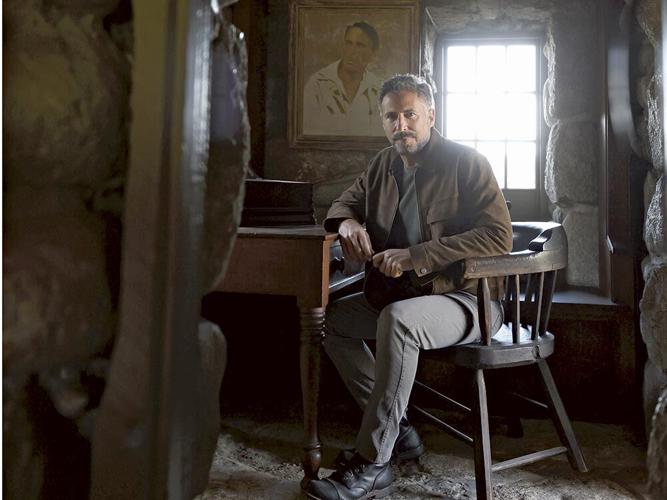


Enrique Martínez Celaya had an idea to write in Hawk Tower at Robinson Jeffers’ Tor House, at the 20th-century poet’s desk, in the poet’s old chair. Martínez Celaya first discovered Jeffers through Polish-American poet Czeslaw Milosz, whose poem “To Robinson Jeffers” ends with the line: “What have I to do with you?…”
Was it the power of the place or the power of the words that moved artist Enrique Martínez Celaya to create dozens of works for an exhibit inspired by his time at the Carmel home of poet Robinson Jeffers?
Martínez Celaya closes his eyes, taking pauses before answering questions, frozen in thought as Auguste Rodin’s sculpture “The Thinker,” with a hand touching his forehead.
“When I visited the house, it all came together,” he says. “His way of thinking, his family.”
A sculptor himself, Martínez Celaya is coming to Monterey mainly as a painter – his exhibit in Monterey Museum of Art, an “ode” and a tribute to Jeffers, consists of 28 drawings, paintings and one sculpture – but he is a writer too, and possesses all a writer’s tools and sensitivity. In addition to authoring several books and papers on art, poetry, philosophy and physics, he created a publishing house, Whale & Star Press, that specializes in releasing art, poetry and critical theory.
Martínez Celaya says he didn’t get Jeffers at first. The poetry seemed remote, “unreachable, like a stone temple in the mountains,” he says.
He kept reading though, revisiting this obscure giant among poets who was able to create poetry even for those who won’t read – meaning Tor House itself, possibly the most poetic house on the Central Coast. The stone tower on Carmel Point was built by a poet to contain his love for his family, and to feed his poetry. There, in awe of the region’s natural beauty, Jeffers wrote nearly all his major works. (He and his family first moved to the property in 1919, more than a century ago.)
Years into reading Jeffers, Martínez Celaya decided to come see the house with his own eyes. He was the first fellow of the nonprofit Robinson Jeffers Tor House Foundation in 2020. The pieces in his new exhibit, titled “The Fire of Heaven: Enrique Martínez Celaya and Robinson Jeffers,” were created during and in response to his experience.
The original stone cottage of Tor House was completed in 1919, and Hawk Tower in 1924; Jeffers lived there until his death in 1962. Now it houses the Tor House Foundation, a nonprofit started in 1978 to preserve Jeffers’ home and legacy.
Since Martínez Celaya’s fellowship in February 2021, the foundation has hosted another five fellows. “Enrique established the fellow program,” says Elliot Ruchowitz-Roberts, foundation president. “The program is open to writers, musicians; we even had a master printer.”
Martínez Celaya spent four hours writing in the tower, and returned again for five full days; his daughter filmed his time creating on the property.
“I wrote in the tower, which was inspiring and grounding, and my daughter played the piano. It was a family in the house,” Martínez Celaya says. “The house is very cold and it adds some energy to the atmosphere… We animated the house and the house animated us.”

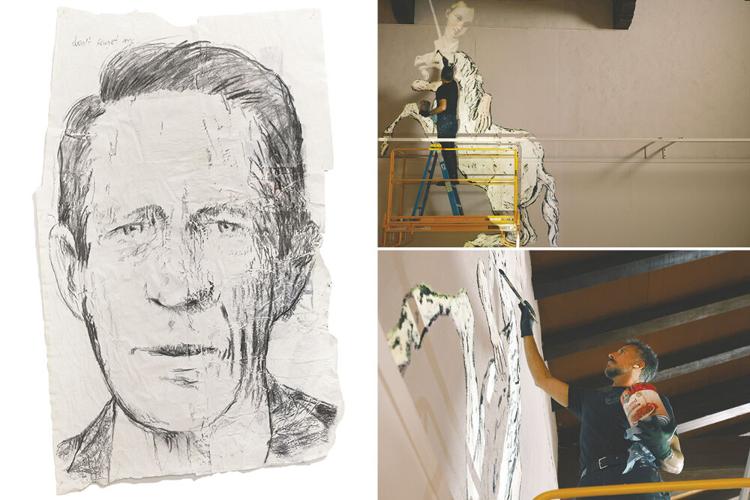
(left) This portrait of poet Robinson Jeffers, who lived in Carmel from 1914 until his death in 1962, is featured in the exhibit “The Fire of Heaven.” (right) Martínez Celaya is known for his monumental works. Here, he is in the process of recreating elements of his painting: “The Fatigue That Comes With Too Much Hoping” onto the wall of the Monterey Museum of Art.
SOME IMAGES IN THE EXHIBIT ARE STRAIGHT FROM JEFFERS’ LINES, recognizable as a hawk that revisits his poetry with brutal beauty. “The hawk represents the wild spirit of the world in us, but not contained by us,” Martínez Celaya says.
“Jeffers doesn’t come to me in sculptures,” the artist says, explaining his painting-dominated exhibit. Even the one “sculpture” on display is more of an offering than a sculpture in a traditional sense. The material is pine cone – those hearts of the forest, as he sees them – and to see the effect you will have to come see for yourself.
The exhibit, which draws its name from a line in the poem “The Summit Redwood,” is accompanied by Jeffers’ handwritten poems, notes and photographs.
“It’s an invocation of a certain spirit,” Martínez Celays says of how he worked with Jeffers’ poetry. “It opened possibilities in my work. Something in between emerged, a sort of understanding.”
MARTÍNEZ CELAYA IS NOT ONLY A READER OF LITERARY GIANTS – think Borges, Melville, Tolstoy, Bulgakov – he also writes before making art, letting the artistic process reveal whatever was relevant in the notes. This time, he went deep into Jeffers’ lines, such as the poem “The Summit Redwood” (1928) that gave the exhibit its title – with a little twist courtesy of the ancient law of licencia poetica.
“Your lightning will come,” promises Jeffers in the poem that expects divine inspiration from nature waiting in his “old tower of life.” The poem continues:
The fire from heaven; it has /felt the earth’s too /Roaring up hill in autumn, thorned oak-leaves tossing /their bright ruin to the bitter laurel-leaves, /and all /Its under-forest has died and died, and lives to be /burnt; the redwood has lived.
Martínez Celaya proposes thinking of the “fire from heaven” that Jeffers invokes – a pure, untamed force of genius that nature possesses and art imitates – as “fire of heaven,” giving the exhibit its name. This tiny grammatical change, “of” instead of “from,” suggests that the divine power doesn’t have to come from heaven as its source; it is enough that it is of that quality.
That quality comes from struggle, and Martínez Celaya cherishes artistic effort (or struggle) as a prayer to nature to become divine. That’s how he sees Jeffers’ poems too, as his “prayers to close the gap” in his “feeling irredeemable from nature.”
“The most important is ambition,” Martínez Celaya says. “The struggle is what I admire. If a son of god walks on water, they say it’s a miracle. But it’s a bigger miracle if a man walks on water and he is not a son of god.”

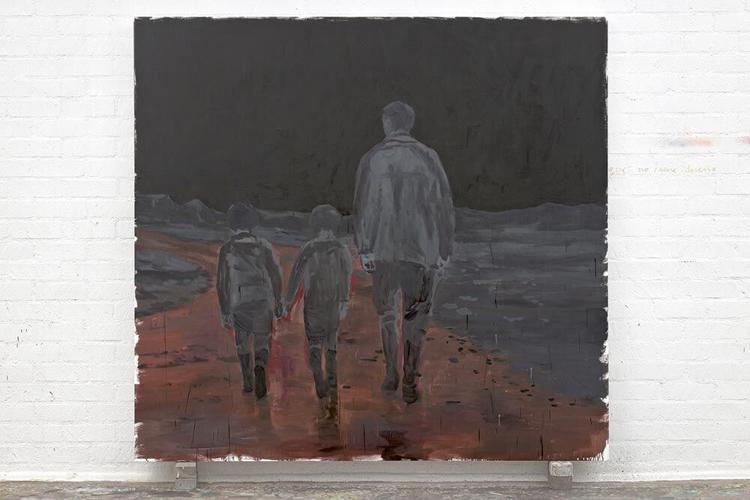
One of the paintings in the exhibit is “The Lesson.” Figures and profiles of young males fill Martínez Celaya’s works. Subjects of exile and loneliness are omnipresent.
MARTÍNEZ CELAYA HAS AN ANIMAL REVISITING HIS ART TOO. It’s a German shepherd. He uses him for a sense of safety when building imaginary or real shelters. But one of the most recognizable images of his is the sculpture “The Gambler” – a gigantic figure of a boy carrying a house on his back (another take on the same figure is titled “Tower of Snow”). Martinez Celaya knows how to carry his house on his back very well, and has been doing it all his life.
He was born in Cuba, but his parents didn’t agree with the revolution and moved the family to Madrid, later to Puerto Rico. In addition to metaphorical home-building, Martínez Celaya constructed several spaces that include houses and studios. He now works and resides in Los Angeles but understands – like Jeffers did, as someone who lived all over before settling in Carmel – the benefit of being an exile, a necessary position in a lifelong quest to crystallize and master the allusive nature of life’s meaning.
“The middle positioning is the most exciting,” he answers when asked if he is more inspired by home (belonging) or by exile (being outside). “I learned to create a home, a sense of shelter. Homes are moments in time. I can build them and make sure they embody my values but I can leave them and build another shelter. Places are possibilities.”
Tor House is one of them, a magical shelter, but Celaya Martínez says the whole world energizes him with its brilliance. He wishes he could do it all, and in a way he tried; this provost professor of humanities and arts at University of Southern California used to study applied physics, specializing in quantum electronics. He insists art is more “urgent,” literature is “urgent” – that they are not decorations, but the most important tools to examine life.
“We could live without physics,” he says with a smile, answering after one of his characteristic pauses. “But I don’t think we could live without art.”
(0) comments
Welcome to the discussion.
Log In
Keep it Clean. Please avoid obscene, vulgar, lewd, racist or sexually-oriented language.
PLEASE TURN OFF YOUR CAPS LOCK.
Don't Threaten. Threats of harming another person will not be tolerated.
Be Truthful. Don't knowingly lie about anyone or anything.
Be Nice. No racism, sexism or any sort of -ism that is degrading to another person.
Be Proactive. Use the 'Report' link on each comment to let us know of abusive posts.
Share with Us. We'd love to hear eyewitness accounts, the history behind an article.