
Deeply rooted in antiquity and ignited by its rediscovery, the Renaissance, David Ligare’s art soars above centuries, far from conventions of contemporary art.
Ligare is not a realist, he insists, because realists have to make paintings about now. His representative art lives in a different world, that of Homer (from the 8th century BCE), Plato (circa 429-347 BCE) and Polykleitos (5th century BCE), but also mythical gods and heroes like Apollo, Achilles and Penelope. It doesn’t matter which of them are historical figures and which are mythical beings; after all, Homer’s identity is also unconfirmed.
Ligare is on intimate terms with all of them, deeply familiar with their stories, forms and concepts. These are depicted in his prolific output of oil paintings produced over 40 years, featuring images of figures and objects in landscapes or suspended in space.

David Ligare is a big reader, and not only of books on art. His interest spans from ancient writers such a Vergil and Cicero to relatively new books, such as At the Existentialist Café: Freedom, Being, and Apricot Cocktails with Jean-Paul Sartre, Simone de Beauvoir, Albert Camus, Martin Heidegger, Maurice Merleau-Ponty and Others by Sarah Bakewell.
In his new exhibit, Spheres of Influence, now on display in the Monterey Museum of Art, Ligare is coming back to the form of the sphere that he started exploring in 1997, the favorite form of the universe and the best representation of the concept of infinity.
“My exhibitions are becoming more and more didactic which, like early abstraction, requires some explanation and getting used to,” Ligare says. “I do feel strongly that, for our time, art that expresses humanistic values and ideals is greatly needed. I’m hoping that my exhibition in Monterey will convey that message.”
Illinois-born Ligare moved to California as a child. He moved to Big Sur in 1968, followed by 30 years in Corral de Tierra. Now he lives in Carmel Valley, where his studio is located, but he also spends a lot of time in Florence, where he is a member of the Accademia del Disegno (“Academy of Design”), established in 1563 by the grand duke Cosimo I de’ Medici and Michelangelo himself. To Ligare, Florence is the center of humanism, his crucial interest.
“Ligare’s work is steeped in classicism,” says Patricia Junker, an art historian with a specialty in American painting. “I was always interested in California as the New Athens, the last place to realize greatness. Classical ideals have shaped California. They also have shaped Ligare’s work. It’s a literary art, superbly crafted, with poetic layers of suggestions, little messages and subtexts. It engages you to learn.”
Ligare’s thrown drapery paintings were inspired by Hellenistic sculptures, physically dismantled by age and transport. Legs and arms were often missing, and sometimes all that was left was a drapery, Ligare points out. He made several of them, named after Greek islands of Syros, Delos and others.
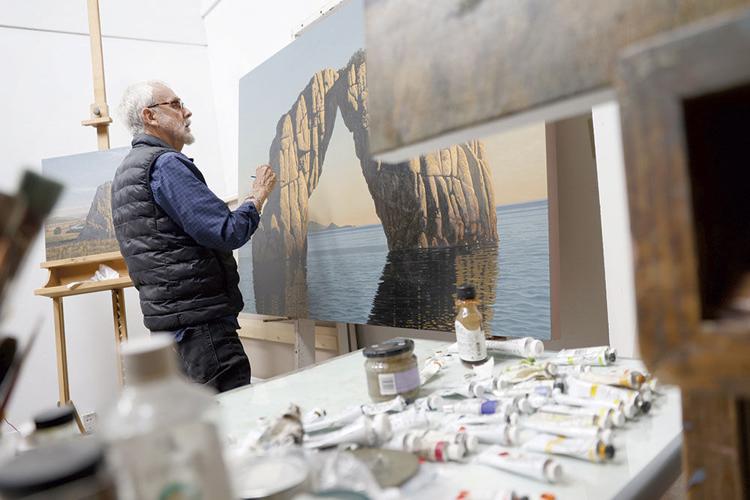
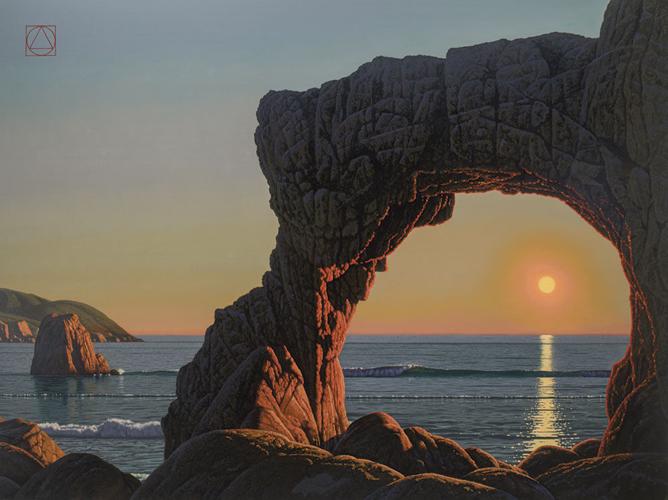
Another aspect of his work are lonely rocks and rock arches (see “Arch with Setting Sun” in the current exhibit), that symbolize the “idea of wholeness” and that “historic concepts possess valuable insights into modern problems such as the need for more humanistic thought,” he says. Numerous still lifes show pomegranates or wine and bread, commonly presented on the background of the sea, pastoral landscapes, naked male bodies, beautifully composed shrines and scenes from classic mythology, such as the desperation of Cassandra of Troy or that of Cretean princess Ariadne, abandoned by Theaseus on the island of Naxos.
Monterey County landscapes are also there, immortalized, often combined with ancient concepts. David A. Laws of Carmel Valley Manor wrote in an email that he recently updated a story, published 10 years ago, about how Ligare’s early work was influenced by John Steinbeck’s descriptions of Monterey County. He added Ligare’s recent thought: “One of my favorite exhibitions was the one at the Steinbeck Center called Paintings from the Pastures of Heaven, where my paintings were paired with quotes from John Steinbeck.” When living in the Pastures of Heaven (Corral de Tierra), he was acutely aware of being in Steinbeck’s world.
In the 1986 painting “Achilles and the Body of Patroclus,” Ligare compares the tragedy of Achilles, who lost his dearest companion and lover because of his pride, to something modern. (In the original story, Achilles, mad at the commander in chief of the Greeks, King Agamemnon, refuses to fight and so Patroclus decides to fight instead. Ligare’s painting shows a group of men despairing above Patroclus’ body, referring to deaths in the AIDS epidemic. Ligare emphasizes that the spread of AIDS had much to do with unaware or prideful partners who let down their lovers.
His most recent comment on Achilles is even more provocative, proving that Ligare lives both in the times of the Trojan War and in the 2000s. “I hesitate to compare Trump to the beautiful and brave Achilles, but he is also willing to destroy all that is moral and good to suit his overriding pride,” Ligare says. In this vision, President Joe Biden is like Priam, “an able and beneficent leader who, because of his advanced age, is unable to hold off the vicious invaders and his shining city on a hill is destroyed. Homer is, once again, a warning.”

Penelope was the wife of Odysseus from Ithaca, whose years-long wait for his return from the Trojan War is detailed in The Odyssey. She is a symbol of patience and endurance.
A VISITOR ENTERING THE CURRENT EXHIBIT sees themselves surrounded by spheres on almost every wall: white, golden or presented on altars and as part of a tomb. They correspond beautifully with a round, sphere-like window up on the wall, right below the ceiling, sending natural sunlight from above.
The sphere has no beginning and no end, has no edges or vertices, the center is everywhere. “You can’t add anything to or take away,” Ligare says.
The exhibit also shows the artist’s spheres of influence, thinkers and concepts from ancient art to the Renaissance and up to the 19th century.
Even in referencing work that holds a recognizable, even iconic place, Ligare is doing something different. “He remains very stubbornly out of the mainstream,” says David Rodes, a retired UCLA professor of drama, Renaissance and early modern studies about Ligare. “His work is full of symbols and meanings. It has unusual grace and harmony. It’s precise and very serious.”
After the white sphere of 1997, Ligare picked up the sphere again in 2002, when he created “Still Life with Polykleitan Head (Summa),” which can be seen in the current exhibit. In 2014, Ligare made a drawing of a rock formation containing a shrine set in a quiet sea and sheltered by an Italian pine. A year later he created “Still Life with Gold Sphere,” followed by “White Sphere (To the Encircling Seas)” in 2015.
In 2020, the Monterey Museum of Art purchased Ligare’s 2014 work “Magna Fide” (The Great Belief), which is the central painting in the Spheres of Influence exhibition. It shows a shrine consisting of a base with a fire and a stone sphere. The idea was to honor the Florentine artist and sphere-lover Leon Battista Alberti (1404-1472), further influenced by Arnold Bocklin’s “Isle of the Dead,” the ultimate 19th-century enigmatic work painted in Florence in 1880.
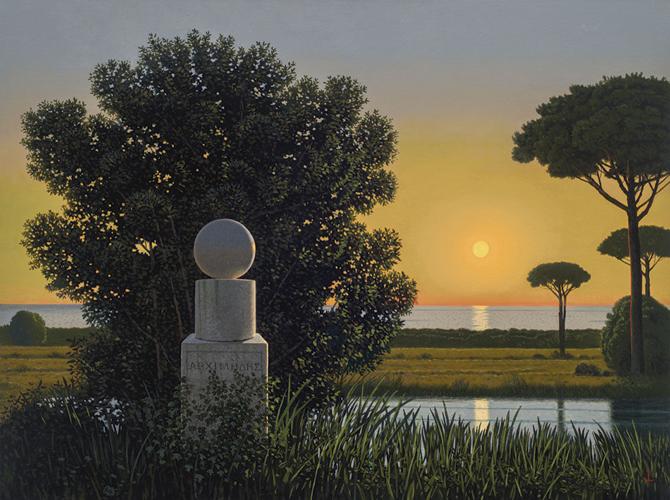
In 2022, Ligare painted an homage to mathematician and physicist Archimedes (c. 287-212 BCE), whose tomb reportedly consisted of a sphere, a cylinder and a square. This work, “The Tomb of Archimedes,” also can be currently admired in the Monterey Museum of Art.
In Ligare’s art world, everything is illuminated by clear, natural sunlight. Late afternoon light is his favorite; he chooses it for most of his paintings. No wonder his studio also has a natural but magical light. It’s where he works on the upcoming solo exhibition David Ligare: A Specific View that will be featured at Hirschl & Adler Galleries in New York, starting Sept. 5.
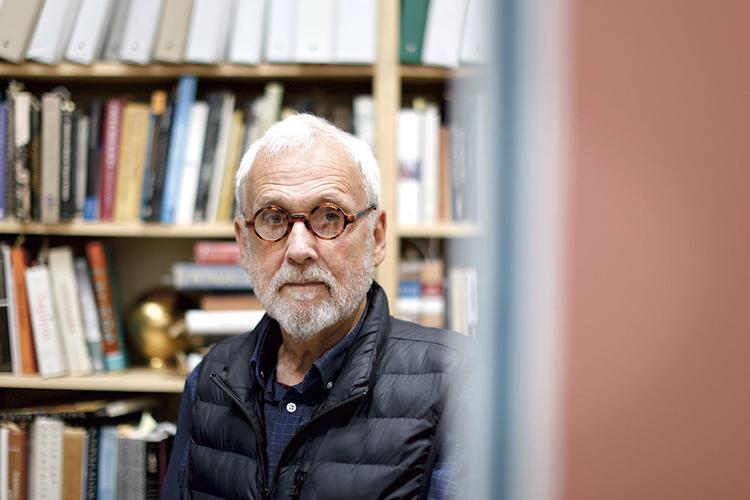
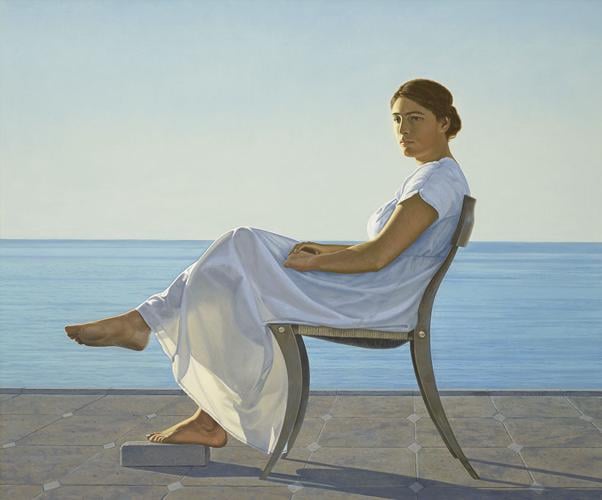
His studio, located in an unassuming building at the mouth of Carmel Valley, surprises with its size, perhaps enlarged by sunlight or the outsized spirit of the artist. There, among shelves of books (well and often used, based on a disheveled look, but seemingly still organized), sits David Ligare, working on his renewed classicism. He spends hours reading and working on his pieces. His “Penelope” hangs on the main wall, placed almost as if above an altar.
~ ~ ~
Weekly: Let’s start with the sphere.
Ligare: Years ago [1997], I made a large painting called “The White Sphere,’’ with a description: Verum Philosophiae, which means “true philosophy” in Latin. It seemed to me that the sphere represents the ideal. Renaissance architect Leon Battista Alberti, and many others, thought that the sphere is the perfect form. It’s the most ubiquitous form in the universe. The planets, the sun; there’s an unbelievable number of this form. So yes, the sphere is the main theme in the current exhibit.

“The Tomb of Archimedes,” inspired by its description by Cicero.
A human head is a sphere too. To a degree.
Yes. I never thought about it, but yes. In fact, one of my paintings from the exhibit is “Tomb Of Archimedes” which shows a tomb but is also a portrait, where the sphere is the Archemides’ head. I got the idea from Cicero, who was a pretty smart guy.
What was your first experience with Greece and Italy?
When I was out of high school, my parents allowed me to travel to Europe with a school friend who had grandparents in Paris. I don’t know what they were thinking, but they loaned us a car. We drove around Spain, Italy, Switzerland and France. Later, during the same trip, I went to Greece, by myself. I arrived in Athens at night, by train. But I opened the front door the next day and it was hot. I saw the Parthenon in the sunshine up on the hill. It stayed with me, this beautiful moment. I found some consciousness that was still waiting to come out. I walked up into the Acropolis and remember sitting with my back against one of the walls of the Parthenon, reading The King Must Die by Mary Renault. I realized that I was living in the story. It was happening all around me. I’ve returned many times to Greece and Italy since then.
Florence, especially.
Florence for me is a thinking place. The meaning of Florence is the essence of humanism, a really important concept. Quoting from Kenneth Clark’s Civilization: “I believe order is better than chaos, creation better than destruction. I prefer gentleness to violence, forgiveness to vendetta. On the whole I think that knowledge is preferable to ignorance, and I am sure that human sympathy is more valuable than ideology.” We are bombarded by political ideology but humanism is against all that. It’s for education and acceptance of diversity. And the heart of it is in Florence. One can go to the science museum there and see the Galileo telescope, the one he used. Then there’s the Duomo that Brunelleschi engineered. He and his friend, sculptor Donatello, went to Rome to study ruins. In their times, Rome went from 2 million people to 60,000 people, ruined in the medieval period, with houses falling down. They were reaching back over a thousand years, pulling out ancient ideas forward into the future.
There are elements of Antiquity and Renaissance history that apply to us. There were aspects of ancient Greece and Rome that were not so pleasant – slavery, the life of women. At the same time, there were people who were thinking brilliant thoughts, positive things.
You also draw from philosophy. You are inspired by both Plato and Aristotle, very different philosophers.
They are so different. Plato is a deist seeking perfection, while Aristotle was investigating things, looking for the meaning and the essence. For Plato, it was the gods’ business. I would say he is more of a formalist. He didn’t care for mimetic/realistic art until his later years. He believed that art was a copy of a copy – a table is first an idea of god, then the reality. And a painting of a table is even a lesser thing.
More oppositions: Apollonian and Dionysian. Where do you place yourself?
Much more an Apollonian than Dionysian. On the other hand, [philosopher] Camille Paglia – she is a crazy person – wrote the book Sexual Personae: Art and Decadence from Nefertiti to Emily Dickinson where she explores the relation between decadence or chaos and art. Pompeii is a good example; the world of chaos right beneath our feet. We can be hit by a meteor at any time and share the fate of the dinosaurs. But my kind of chaos is that of a dilettante. It’s a gentlemanly chaos.
No aggression.
I’ve written some about this. I don’t do seascapes with grand crashing waves and all that. Mine is the medium sea, calm sea that expresses anticipation, waiting. Golden mean, middle measure is important to me. The measure in all and everything, I embrace all of it – proportion as measure and measured approach to something. Gentle way. My paintings are a threshold to another world, time and space. And the threshold is the medium space.
If the alien art historians landed on the Earth at some point, could they tell that you worked in the 20th and 21st centuries?
Yes, and the reason is photography. Because I have looked at photographs all my life. So I see this way. Especially color photography; it fixed my brain. And I use it in my artistic process.
They could tell also because of the quality of light. Everything I create is in light: the landscapes, the figures, still lifes, natural sunlight. And here, Plato’s allegory of the cave comes to play. The idea that natural sun is more important than artificial light. Even when I have, let’s say, a candle in the altar [e.g. “Candles and Flowers,” 2017], the little flame is being cast as a shadow on the wall. So there’s natural sun. The sun is more preeminent, powerful sunlight is beautiful; it reflects everything.
My painting of a candle in my altar-like space makes a very subtle comment on Plato’s Allegory of the Cave, in which he presents the sun as truth. In my painting, the brightest light you see is the flame on the candle – but the sun, invisible to the right, is projecting a shadow of the flame on the left wall of the altar, meaning that the sun as truth and knowledge, is primary.

Ligare at work in his studio. His paintings are often monumental, almost always horizontal and filled with natural light.
Do you prefer Californian light or Italian light?
First of all, it’s my light. There were times in Italy when I was very disappointed. I love late afternoon light but sometimes the Italian light would be so diffused by the moisture, the air. The clear light of California works; we have very little humidity here. When the sun is setting in Italy, but also many places in the U.S, the sun is just this magenta ball; it has no strength. But California afternoon light is strong. Greek light can be just as clear. I choose to have it really strong. I choose to not have it be diffused.
There’s no night in your work.
A good example is my painting “Achilles and the Body of Patroclus,” a very tragic scene that leads to all kinds of mess in the Iliad and because Achilles caused the death of his dearest friend. [Goddess] Hera is keeping the sun up so the Trojans and the Greeks can continue the battle. I chose the moment when dead Patroclus is being taken to the beach and Achilles is confronted with his body. Achilles goes wild. And then, the Iliad says, “And now ox-eyed Queen Hera told the tireless sun to return, though unwillingly, to the Ocean’s stream.”
Late, low light is the one I love the most, the golden hour that also has the meaning of transition between day and night and life and death, in a sense. I use it in almost all of my paintings. It creates this classical balance. Light and shadow, Apollinian and Dionysian.
Your harmony and beauty is out of this world.
Except that I have chosen parts of the world to make these paintings from. They do exist in reality. For example, in my painting “In Praise of Italy,” there’s an actual rock I found between the Salinas Valley and the San Joaquin Valley, but the background is based on a landscape from Urbino, a hilltop view, used also, allegedly by Piero della Francesca for one of his paintings [“The Balconies” ]. So the Italian landscape, but also based on California. It’s what Robinson Jeffers often did, taking the landscape from this area and morphing it into classical mythology or Celtic mythology.
There’s no ugliness in your work.
For me it’s the matter of turning away from realism. I’m still doing representative art, but I’m not a realist. I practice idealism. And we are back to Plato, whose fear was that we would practice being ordinary and that would pull us away from aréte, from doing extraordinary things.
Areté is also the moral virtue. Is your art moral?
Innate excellence, what a beautiful soul is. Trying to use our abilities for a higher purpose. This is what caused the Renaissance – their interest in antiquity and applying its concepts to our time and in the process, creating the future. I used aréte in one of my works, the black figure on white horse.
I’ve been saying forever we are in the need of a renewed, diverse culture. I started to do public service to abandon aesthetics, that’s my moral side. A huge part of my life was working at [Dorothy’s Place], the soup kitchen with Franciscan workers in Salinas.
Both you and the Greeks are interested in the perfect human body, typically the male body.
Polykleitos is at the center of it. His main figure is the Doryphoros. The idea that the figure represents symetria, the harmonious integration of diversity, of part of the human body, ideal proportions of the society and nature itself. That’s an important idea – harmonious integration of diversity, we need as people. It likely came from Pythagoras and that there’s this whole thing about numbers coming into this. Very humanistic.
The idealization of the figure… those sculptures don’t look like real people, and that’s on purpose. It’s meant to be everyone. And that corresponds with the beginning of democracy. Roman historian Polybius first spoke of the system that we use, the republic. It is also the American birth, the beginning, George Washington, Jefferson. It’s a natural thing that democracies and republics go into decline and there’s nothing you can do.

“My rock arch paintings represent the idea of wholeness, my ‘specific view,’” says David Ligare. “The first, painted in 1987, had three words inscribed on the rocks: Veritas, Utilitas and Venustas meaning truth, usefulness and a kind of beauty. I had discovered that there are many whole systems defined by three words. It’s a fun game.”
How do you feel about contemporary art?
Most of our culture is focused on the contemporary period, an idea that art should be about now, a reflection about our own time. I don’t think it’s necessary. It can be about ancient times that reveals an aspect of our own period. I like contemporary artists and art that is not like mine at all. I’m inspired by Mark Rothko who I think was the greatest painter of the 20th century. Dark, but deeply profound.
If the world was ending and you could grab only one of your paintings, which one would that be?
[Looking up toward the painting] I would take Penelope.
Did you always know she was Penelope?
It is based on a real model, a person – classicized. The title came later. When it was done, I realized that is who she represented. I wanted to make a painting of a woman who had integrity such as Penelope had – the woman who outwitted all her suitors.
(0) comments
Welcome to the discussion.
Log In
Keep it Clean. Please avoid obscene, vulgar, lewd, racist or sexually-oriented language.
PLEASE TURN OFF YOUR CAPS LOCK.
Don't Threaten. Threats of harming another person will not be tolerated.
Be Truthful. Don't knowingly lie about anyone or anything.
Be Nice. No racism, sexism or any sort of -ism that is degrading to another person.
Be Proactive. Use the 'Report' link on each comment to let us know of abusive posts.
Share with Us. We'd love to hear eyewitness accounts, the history behind an article.