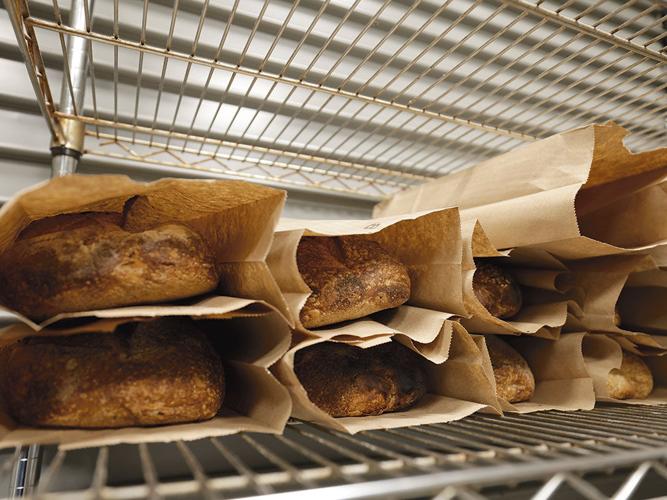


Unsold loaves of bread set aside at Ad Astra in Monterey for sale on the Too Good To Go app. The 10-15 loaves available each day sell quickly.
Not long after Ad Astra opened, the bakery began selling to groceries and restaurants. Owner Ron Mendoza knows how many loaves go where each day.
But with retail shops in Monterey and Carmel Valley, the model is different. The bakery does not take pre-orders on its retail side. Mendoza prefers the old-fashioned feel of shoppers checking out what’s available.
“Inside the shop is a guessing game,” he says, referring to the number of loaves he and his team need to bake on a given morning. “When we first opened, we were getting rid of a lot of bread.”
It’s a problem all too common. According to the U.S. Department of Agriculture, at least 30 percent of the food available to consumers goes to waste.
The numbers within that figure are equally staggering. A 2025 report by ReFed, an online center for food waste data, found that it represents enough for 120 billion meals. And because only a fraction of that is donated or put to other uses, such as livestock feed, 85 percent of food waste ends up in landfills, where it is responsible for dumping enough methane into the atmosphere to account for 10 percent of methane emissions.
But Mendoza came across a solution, at least to his excess bread problem. It came in the form of an online app.
“OUR STRONGEST SELLING POINT is that surplus is a massive opportunity,” says Esther Cohn, spokesperson for Flashfood, which partners with Lucky supermarket locations in Monterey County.
Each day, boxes of produce, pre-made salads, deli sandwiches and other items nearing expiration are placed on the Flashfood app for customers to claim at discounted prices. Another app, Too Good To Go, has partnered with some 75 restaurants, bakeries and grocers in the county, including Ad Astra.
The free apps function in a similar manner. Once installed, users select a location. Images on the screen then detail what is available at that particular time. On Too Good To Go it might be a surprise bag of pastries from Lafayette Bakery in Carmel for $4.99 or a 14-inch pie from Pizza My Heart in Monterey, regularly a $30 order for just $9.99. The app details a pick-up time (between 11am and 9pm for the pizza, in this case). The user can then select an item and complete the purchase.
To pick up an order, customers just show the ticket on the app to a clerk and walk away with lunch, dinner or produce. The app also produces a receipt.
“It’s really simple, really efficient,” Mendoza observes.
On any day, one might find pizza from a local Round Table location, bowls from Poke House, a half dozen of Danny’s Donut Shop’s treats or a dish from Camalig Filipino Cuisine. Whole Foods prepares mystery bags that sell out quickly.
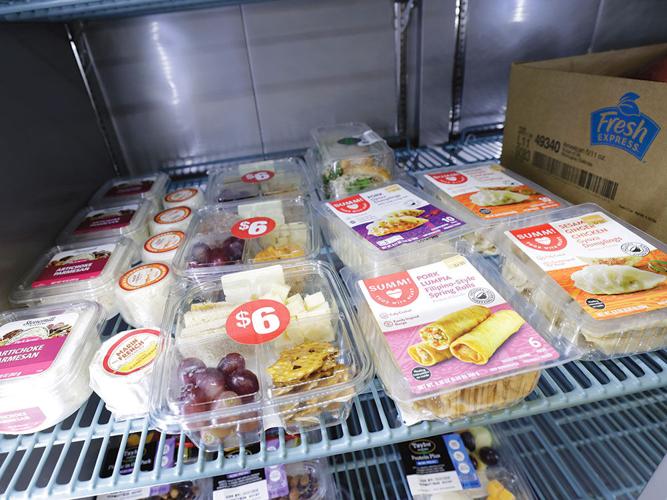
If there is a downside, it’s that app users can only select from what is available. Bread from Ad Astra might be sourdough, an olive loaf or another style. Boxes of produce and mystery bags are assembled in advance. A produce box from Lucky on one occasion included six bell peppers, a head of cauliflower, three cucumbers, an onion and a few other items. The next time it was heavy with tomatoes, onions, potatoes and oranges.
But the store uploads photos to guide your selection. The randomness involved is part of the deal. These are someone else’s leftovers, after all.
Such apps are bringing consumers into the food waste fight (and giving them access to discounted groceries or prepared food; a tray of 12 turkey sliders from Lucky priced at $15.99 in store was recently selling for $7.99 on the app).
There is also an existing pipeline moving donated foods to organizations serving those in need, and representatives from both consumer apps say there is no intention of competing with nonprofits for the surplus.
“What we find is that Flashfood is capturing shorter lifespan items,” Cohn points out. “A lot of it is ready to go that day or in two days. Food is still going to waste.”
“We provide a slightly different ‘last-mile’ solution,” explains Molly Sposato of Too Good To Go. “It is an easy way for businesses of all sizes to turn a potential loss into a win. Many Monterey Bay establishments have actually reached out to us.”
The app companies process the transactions, turning a portion of the sale back to the grocery store or restaurant. It may represent a fraction of the original price, but partner businesses receive some compensation for foods that were otherwise destined for the dump.
According to Sposato, use of the Too Good To Go app on the Monterey Peninsula and Salinas area has already saved more than 99,000 meals, or the equivalent of 268,026 kilograms of carbon dioxide.
“Big impact starts with small actions,” she adds, noting that the company initially targets areas with high food density and an interest in sustainability, such as San Francisco. People in neighboring areas then become interested. “The app started with a hyper-local approach, and it’s certainly at the heart of our ethos.”
Too Good To Go launched in Copenhagen, Denmark in 2016 and now exists in 21 countries. Flashfood owes its origins to the same impulse – to reduce food waste – but its beginnings are more humble. When Canadian former minor league hockey player Josh Domingues learned that his sister was forced to throw out $4,000 worth of leftovers from a catering gig, he picked up some imperfect produce and set out a streetside table as a test of his idea.
The Too Good To Go app even updates users on their environmental impact. A single order picked up from Ad Astra, for example, apparently saved CO2 equivalent to 461 phone charges – or 8 kilowatts, which sounds less impressive. Flashfood tallies the dollar savings.
“We did start out to solve the food waste problem,” Cohn observes. “But people tell us they appreciate getting good food at low prices. We heard that over and over.”
The concepts, in other words, may be high-minded. For consumers, however, it matters that a few taps on the phone can score them a prized loaf of Ad Astra bread for just under $4 or a loaded box of produce from Lucky for $5.
Since Flashfood began its partnership with Lucky and SaveMart, entering the California market in 2024, shoppers through the app have saved almost $700,000. At the Lucky locations in Pacific Grove, Sand City and Marina, the savings has topped $18,000.

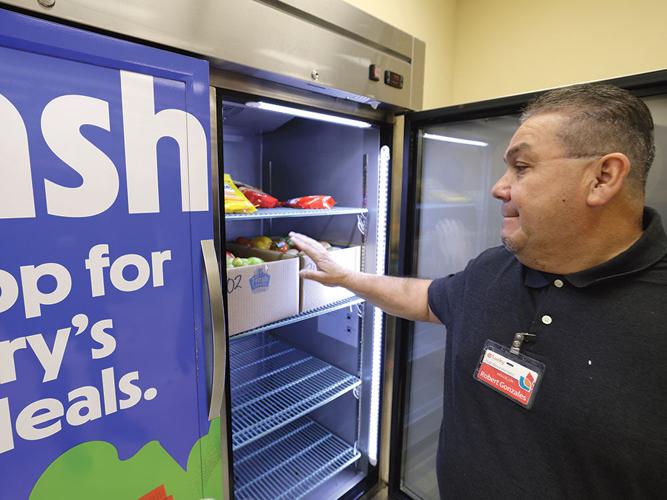
Flashfood provides a refrigerator where participating grocery stores keep items for sale on the app, ready for customers to pick up. The food sold on the app would otherwise be thrown away.

Lucky’s in Sand City offer discounted food that may go bad at discounted price through an app.
Features on a recent Thursday afternoon included pizza valued at $21 from Round Table in Marina for $6.99 or a $15 salad at Monterey’s Pizza My Heart slashed to $4.99. Whole Foods offered a bag of meat for $9.99 while the Lucky in Pacific Grove listed Columbus brand salame for half price, at $5.99.
“Our biggest competition is how easy it is to throw something away,” Cohn says.
“EDIBLE FOOD” IS A SEEMINGLY REDUNDANT PHRASE that perhaps needs some explanation. The phrase is part of a new vocabulary developed around the problem of food waste. Edible food refers to items that are still good for consumption, but instead end up in landfills – at a cost to Americans of an estimated $800 per person, each year.
The phrase applies to prepared foods, like dishes from restaurants or deli sandwiches, packaged items, such as meats or ready-to-heat meals and produce unsold for various reasons, including freshness dating and appearance.
“It’s a weird term, but we’re used to dealing with trash,” explains Zoë Shoats, director of communications for ReGen Monterey, a regional waste management district headquartered in Marina.
In this language, food generators represent any entity that might dispose of edible food, such as grocery stores, restaurants and farms. Food recovery organizations are those capable of storing and distributing it to those in need – food banks, shelters, churches and so on.
It’s important to distinguish layers of food loss. Rotting occurs naturally, as does spoilage from mold or bacteria. Insects and animals can take their toll. When high winds caused power outages on the Peninsula lasting up to a week in 2024, some restaurants were forced to toss more than $7,000 worth of food.
But recovery efforts focus on more preventable actions, such as ordering more than is needed or the routine discarding of blemished produce or beef turning brown. Mendoza sees parallels in retail, where items that are no longer in season or have had changes in packaging are put on clearance, pointing out that the product is still as good as new.
“I go to farmers markets – if the fruit is blemished, we’re going to use it,” he says. “We’re not looking for perfect. We want usability, we want it to taste good.”
Shoats credits California Senate Bill 1383, which became law in 2020 and went into full effect two years ago, as well as an app designed to more efficiently link food generators with organizations, for motivating businesses into action on food waste reduction.
“The generators were probably just trashing a lot of it. It depended if they cared,” Shoats observes. “SB 1383 is changing the game considerably.”
California is one of the few states with donation mandates. Only 12 states have implemented organic waste restrictions. SB 1383 requires local governments to slash the amount of edible food dumped into landfills by 20 percent, redirecting the recovered food to those in need. It also calls for increased storage to extend the life of perishable items. All parties involved in the process must keep records of such efforts.
Concerned that the outreach requirements of the bill were beyond staffing limits, ReGen and Salinas Valley Recycles, the solid waste authority serving Salinas and South County, purchased an app called Careit on behalf of the food recovery organizations they serve. They then teamed with Monterey-based company Blue Strike Environmental to introduce the app – there are currently 184 organizations in Monterey County registered on Careit and some 4,500 statewide.
Careit connects food generators with food recovery organizations in real time. A store or restaurant is able to upload what they have available and an organization like a food bank or homeless shelter can claim what they need.
“What we’ve heard is that Careit has been very helpful in tracking [data],” Shoats says. “It’s making a complex law easy for them to administer.”
Unlike consumer-facing apps, SB 1383 mandates that food recovery organizations and services maintain detailed records of donations. The scale varies greatly. Gathering for Women in Monterey has the capacity to store 2,000 pounds of food each month. CSU Monterey Bay’s Basic Needs program, which operates a free store on campus called The Hub, can handle 40,000 pounds per month.
Since ReGen and Salinas Valley Recycles launched the Careit app in 2022, 923,009 pounds of edible food has been recovered from the landfill pipeline in Monterey County. According to calculations from the app, that amounts to an equivalent of close to 1,440 tons of greenhouse gas emissions that did not seep into the atmosphere.
“We just signed another term with Careit,” Shoats reports. “We’ve realized the long-term benefits of this.”
THERE ARE OTHER APPS JOINING IN THE FIGHT TO REDUCE FOOD WASTE. Olio is a gateway for people to share items that are sitting unopened or unused in their pantries or refrigerators. Cookbrite suggests recipes to use what you have. But many are useful only if others in the area have downloaded the app.
“I came across Too Good To Go and thought it was perfect for bread,” Mendoza says. He has been listing loaves for two years and reports that the app accounts for about 10-15 loaves left over at the end of the previous day. “Our bread is good for five or six days,” he adds.
Apps are just one aspect of food recovery, of course. The requirement in SB 1383 that organizations increase storage capacity is forcing some nonprofits to purchase more equipment or expand their facilities. ReGen has given more than $475,000 in grants toward that end.
Another state measure, Assembly Bill 660, will go into effect in July. It makes California the first state to address confusion over food labels.
According to a 2025 Harris Poll, 43 percent of Americans toss items when they reach or pass dates stamped on labels, whether it reads “sell by” or “use by.” About the same number believe – incorrectly – that the federal government regulates expiration dates.
The new measure, which passed in 2024, will require two labels. “Best if used by” is an indication of quality. “Use by” will be a safety feature.
As Cohn says, “Food is still going to waste.” ReFed reports that produce accounts for almost 44 percent of what ends up in landfills. Prepared foods – which includes restaurant meals – make up just over 20 percent. In all, Americans discard 73.9 million tons of food, or 442 pounds, per capita.
For Mendoza, apps like Too Good To Go do well at making a dent.
“Hopefully it opens thinking, not to be wasteful,” he says. “It doesn’t have to be perfect.”
(0) comments
Welcome to the discussion.
Log In
Keep it Clean. Please avoid obscene, vulgar, lewd, racist or sexually-oriented language.
PLEASE TURN OFF YOUR CAPS LOCK.
Don't Threaten. Threats of harming another person will not be tolerated.
Be Truthful. Don't knowingly lie about anyone or anything.
Be Nice. No racism, sexism or any sort of -ism that is degrading to another person.
Be Proactive. Use the 'Report' link on each comment to let us know of abusive posts.
Share with Us. We'd love to hear eyewitness accounts, the history behind an article.