In a remote canyon in the Big Sur backcountry, Sayre Flannagan stared at the face of a 300-foot cliff a third of a mile away. As her handheld radio-tracker blipped like a radar detector, Flannagan, a Ventana Wildlife Society (VWS) biologist, had finally located a 10-year-old male condor that she and her colleagues refer to as Number 168.
The VWS’s monitoring equipment had not been picking up a signal from Number 168, which is tagged with a GPS tracking device, for five days. There was a chance that the bird had died, but it could mean that the bird was in a hole somewhere, undetectable to their high-tech tracking equipment. The scientists had started to hope that Number 168 and his female companion, Number 208, might be nesting. That would be a huge milestone—one that VWS has been working towards for years.
Until quite recently, wild California condors were on the brink of extinction. Indiscriminate shooting and lead poisoning had decimated the population by the early 1900s. In 1987, the last wild condor was captured and placed in a captive breeding program with 26 other birds. VWS, a locally based nonprofit organization, has played a big role in that recovery program since 1987.
The program has allowed the population to surge back up to over 270 birds, including 136 that have been released back into the wild. Twenty-eight currently reside in the Big Sur backcountry.
The biologists and volunteers of VWS have been focusing their efforts on creating a self-sustaining wild population. They have looked forward to the day when a pair of their birds would take a crucial step toward this goal by mating and producing an egg.
The VWS program involves lots of backcountry fieldwork. A couple of days before Flannagan spotted the cave, two other VWS biologists had headed into the scrubby, steep terrain of the Ventana Wilderness searching for Number 168. They climbed to the top of the highest peak in the area with their equipment, hoping to pick up a signal, to no avail. When they returned to civilization, Joe Burnett, VWS’s Senior Wildlife Biologist, decided to send Flannagan into the wilderness.
Two days later, Flannagan hiked directly to the location that the last GPS coordinates placed the bird. Though she knew that the condor was near, the chances that she would spot it were slim—condors leave their nests for just a few minutes every three or four days to swap off incubation duties. Still, as she searched the sky Flannagan held out hope.
After an hour and a half, she spotted a condor dive-bombing a sharp-shinned hawk in front of the cliff. It was Number 168.
Later, Flannagan told me that the condor’s unusual behavior indicated that the male might be nesting. “Condors aren’t aggressive like that,” she recalled thinking. “There’s something going on. He’s really protective of that rock face.”
After a minute, the huge vulture landed on a ledge and disappeared into a hole that looked like little more than a chink in the rock wall. At that point, Flannagan grew more hopeful. “A male adult would not be hiding in a hole on a beautiful day unless there was a nest,” she thought.
Flannagan left the area elated. This nest would be proof that the condors are on their way to maintaining their species in the wild. She related the incident to Burnett, who has worked with condors for 11 years. He agreed that the behavior she witnessed indicated that the birds were nesting. Burnett knew he would need to get a biologist into the cave to confirm the presence of an egg.
He also realized that if there was in fact an egg there, VWS biologists would have to get it. The condor that laid the egg, Number 208, was known to have DDE (metabolized DDT poison) in its bloodstream. That can cause the shell to become fragile. He did not want to risk the possibility that the fragile egg would be crushed. VWS would have to remove the live egg and replace it with an epoxy fake. The live egg would then have to be transported to a captive breeding program where the egg would be monitored until it hatched.
The following day, Flannagan led Burnett to the remote location. As soon as he spotted the cliff, Burnett realized that reaching the nest was not going to be easy. The tiny cave sits 100 feet off the ground, with the cliff’s base surrounded by a dense moat of chaparral.
Over the next few weeks, Burnett scrambled to develop a plan to reach the cave. He found a local pilot, Jim Cheatham, to fly a crew to the top of the cliff via helicopter. He also contacted two biologists with years of climbing experience, Joseph Brandt and Scott Scherbinsky, who agreed to join Burnett on the complex mission.
With vertiginous cliffs, a helicopter and a climbing team, the undertaking started to look more like an extreme sporting event than a typical scientific assignment.
~•~
On March 9, the crew struck out for the site. Under the roar of the helicopter’s blades, Burnett, Brandt and Scherbinsky hopped out of the hovering aircraft onto the top of the cliff face. As Cheatham and his helicopter folded into the massive blue sky, Burnett realized that he had underestimated the size of the rock formation from the ground.
“The condors couldn’t have picked a more inhospitable spot,” he said later. “It definitely was not meant for people to scramble around on.”
Wanting to spend as little time as possible disturbing the condors, the trio of biologists moved quickly. Though Burnett was hopeful that they would find a condor egg and a nest, he had been disappointed before. Last year, VWS found a nest in a redwood cavity near the Big Sur coast. The biologists discovered only a fragment of an egg.
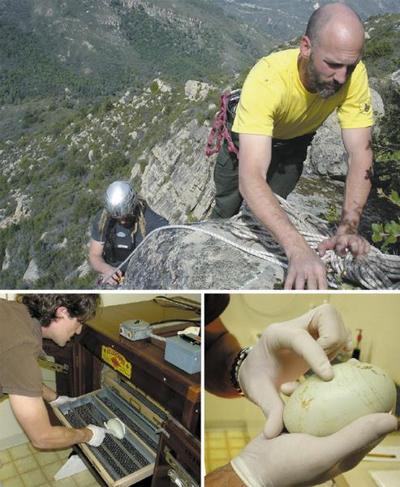
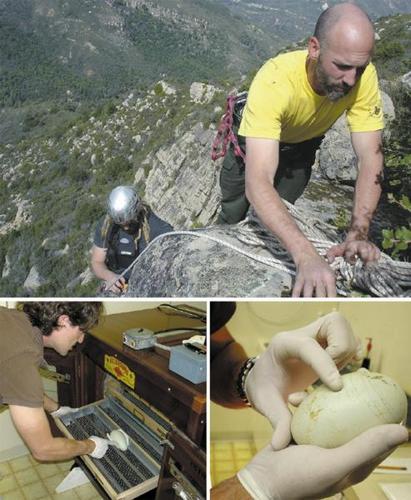
With Burnett and Scherbinsky acting as support, Brandt threw himself off of the precipice, connected to the top of the rock by his rappelling gear. The first section of the descent was particularly disconcerting: Since the cliff edge sticks out over the first steep section, Brandt hung in midair until he finally made contact with the rock-face 75 feet down the cliff.
Strapped to Brandt’s back was a padded haul bag containing a portable incubator. The biologist also carried the replica egg, which would stay in the nest until VWS could find a healthy live egg—from the captive breeding program at the Los Angeles Zoo, San Diego Wild Animal Park, Oregon Zoo or the World Center for Birds of Prey, in Boise, Idaho—to swap out.
As Brandt lowered himself onto the small ledge near the crack in the rock, the mother condor came off of the egg and exited the cave. She stood nearby on the narrow overhang and emitted a guttural grunt.
After catching his breath, Brandt carefully squeezed himself through the cramped entrance. Inside, the small cave was about four feet high and six feet deep. To its left was the white orb resting right on the rock floor. (Condors don’t build nests made of twigs and grass.)
Brandt carefully took the egg and placed it in the incubator. Then, he placed the epoxy egg in its place.
Before the biologist started his ascent, he connected the pack containing the live egg to the ropes, which Burnett and Scherbinsky slowly pulled up. Brandt then climbed up the cliff as the mother returned to the nesting area.
~•~
Under the smog-smudged Los Angeles skyline, in a gated compound deep within the Los Angeles Zoo just over a mile from the pretzel-like overpasses of Highway 5, animal keepers monitored the progress of six breeding pairs of California condors, a rotating group of juvenile condors, and—at this moment—seven condor eggs.
Inside a trailer, keepers Mike Clark and Chandra David watched a trio of monitors. Clark used a joystick to direct a camera in the nearby breeding pen. He spotted a pair of condors neck wrestling. He switched to another camera that captured a condor raising its wings like a vampire.
Clark then took me and Burnett into a quarantined trailer where the eggs were being incubated. Before entering, we submerged the soles of our shoes into a pan filled with disinfectant. Once inside, Clark informed us not to touch anything and then sprayed an antiseptic on a counter in the small room, which resembles a hospital’s examination room. After wiping down the counter and tossing the dirtied paper towels near the door for disposal, Clark rinsed his hands with iodine and pulled some disposable plastic gloves over his hands. “An egg’s biggest enemy is bacteria,” he said.
He walked over to a large wooden incubator about the size of a washing machine. Stuck to a glass window on the front of the contraption was a pink Post-It note identifying the egg inside as the one from Big Sur. The incubator was set to 98 degrees and the room felt as humid as a streamroom.
Clark said that controlling the humidity in the room and the incubator allowed scientists to control the water loss inside the egg. He told me that when an egg is laid, it weighs roughly half a pound, and is the size and shape of an avocado. Over the next 54 days, it is normal for condor eggs to lose 14 to 14.5 percent of their weight as water evaporates through the porous shell. If much more weight is lost, the embryo might be too dehydrated and weak to hatch. If less water is lost, the embryo could become too big to place itself in the correct hatching position. “Better hatchability is achieved through better weight loss,” Clark said.
When the egg laid in Big Sur arrived at the Los Angeles Zoo, there was one thing about it that caused Clark to be concerned: “It looked like it had lost a lot of weight for how old it was,” he said.
The Big Sur egg also had a few small craters on its surface. Clark said the scientists filled in the indentations using Elmer’s glue—a common procedure.
Clark became passionate when explaining that the scientists at the facility will do anything within their means to ensure that a chick is born. “It’s not important that they hatch their own egg,” he said. “It’s important they reproduce.”
Both Clark and Burnett would like to meddle with the condor’s natural processes as little as possible. But at this time in the recovery program, they must be hands-on with the captive and wild condor populations. Later, Burnett told me that since mankind drove the birds to near extinction, he feels it is mankind’s duty to get the species back up and running again.
Another egg sat a few feet away inside another incubator, scheduled to go to Big Sur. That egg had been laid by a condor in the LA Zoo’s breeding facility on Feb. 10, and the VWS biologists believed it had a strong chance of surviving. Burnett hoped to be able to deliver the egg to the remote backcountry nest in two days.
Clark opened the incubator and pulled out a drawer with the captive-bred egg in it. He carefully placed the drawer on the counter and delicately put the egg, which had “Big Sur” written on its shell in pencil, on a scale. “Seems like it’s on target,” Burnett said. “Yep, it’s 14.5.” Clark confirmed the measurement.
The parents of this egg are a female named Malibu and a 41 year-old male named Topatopa, the oldest known living condor. (Both entered the program before the practice of naming the birds was discontinued, in the late ‘90s.) The mating pair also produced the egg that Number 208 hatched from.
“To ensure the best success for this nest,” Burnett said, “we chose an egg from a very proven successful pair in captivity. We want to give them the best opportunity that we can.”
Clark took the egg over to a device called a candler, a slide projector-like piece of equipment that allows scientists to peer into the embryo without having to puncture the shell. Burnett flipped on the light switch as Clark pointed the top portion of the egg toward the piercing light. While the top of the egg seemed to glow like a light bulb, the base appeared darker, crisscrossed with red lines that looked like veins.
Clark confirmed that the red lines are in fact veins. The top of the egg appeared white due to an air pocket that had formed there.
This air cell is crucial because 53 days after the egg is laid, the chick should stick its beak into the air inside the egg to start breathing for the first time with its own lungs—a process called “internal pipping.” Just 24 hours later, the chick will have used up all the air at the top of the egg. Becoming desperate, the chick will start “external pipping,” poking a hole through the shell to access the air on the outside. This hatching process usually unfolds over three days.
As Clark held the egg near the candler, a portion of the darkened section pulsed rhythmically, like a beating heart. “It’s showing respiration,” he said. “It’s not showing typical beak movement. It could be good. It could be bad.”
~•~
This was an unexpected development. It could mean that this egg would not be able to be transferred to the Big Sur backcountry in two days. If there was no sign of pipping within the next 20 hours, the scientists might have had to find a new egg for Big Sur.
The next egg from the Los Angeles facility wouldn’t be ready until early May. That would have meant Burnett had spent hours preparing the return nest entry for nothing.
The scientists realized that they were captive to the whims of the natural processes inside the egg. “There’s always a chance that pipping won’t happen,” Clark said. “You have to go on an egg’s schedule.”
The following day, Clark X-rayed the egg and determined the chick was in the correct hatching position. Later that afternoon, he created a tiny breathing hole for the bird using a 16-gauge needle.
By the time evening came, the condor still had not pipped. The next day, it was supposed to be transferred to the Big Sur backcountry.
Clark decided to sleep at the zoo that night. At 3am, he checked the egg. It still hadn’t pipped.
He woke up again at 5:30am. Bleary eyed, he checked the egg and discovered that it had finally pipped.
He immediately placed the egg in a portable incubator, carried it out to his truck, and took off for Santa Barbara, where he would meet Brandt. Clark checked on the egg a few times during the drive and heard the chick grunting from inside the shell.
In Santa Barbara, Clark handed the incubator to Brandt, who drove it to the Salinas airport. There, after little more than a handshake with Burnett, the two checked the chick. Through a hole in the shell that was quickly increasing, the biologists could make out the chick’s eyes.
Not wanting to traumatize the baby condor, the biologists realized they would have to be particularly smooth on their return mission to the cliff face.
~•~
As a plane scratched a white line across the blue sky above, we waited for the helicopter to arrive, transporting the egg from Salinas. I stood with Flanngan, her mother, Cindy Meeker, and VWS biologist Mike Tyner, on a rise across from the cliff face containing the condor nest.
At 12:40pm, just over seven hours after the chick had left Los Angeles, the helicopter landed on the backcountry precipice above the cave. Looking through a scope, Flannagan saw Burnett and Brandt exit the aircraft with the egg. Burnett and Flannagan communicated via handheld radios.
“Copy on two,” Burnett said. “I can hear a peregrine falcon up here. Same routine as last time.”
While Burnett and Brandt hiked towards the edge and got their climbing gear ready, Flannagan noticed that the female condor was outside the cave, apparently trying to figure out where the sound of the helicopter came from. Tyner was getting a signal from the male bird on the radio tracking equipment. The biologists surmised that he had been out getting food and decided to return to the area to investigate the noise.
While waiting for Brandt to begin his descent, Flannagan described a couple of things that could go wrong with this operation. The female condor could try to scare Brandt away while he was rappelling down the precarious cliff face. She said the egg could break on the journey down.
Burnett later said that these concerns were unfounded. The only thing he could see going wrong with the operation would occur if the rope broke, which would be unfortunate for both Brandt and the egg.
“She’s outside the nest,” Flannagan radioed to Burnett. “She’s getting pissed.”
As Brandt continued to rappel down with the egg inside a portable incubator tucked in his backpack, the female took off and swooped over a dark gulley to the left of the cliff. Brandt got to the ledge and started to squeeze into the narrow fissure. When the female returned to observe, her behavior was less aggravated.
“She’s preening,” Flannagan said to Tyner. “See that Mike, she’s chill.”
From inside the cavern, Brandt radioed his progress to Burnett and Flannagan. “This egg is definitely ready to go,” he said. “There’s a dime-sized hole in it and I can see the chick.”
“That’s good news,” Burnett said.
As Brandt started to climb back up the rock, looking like a spider from where we stood, Flannagan quipped: “I have to smoke a cigar after this, right?”
~•~
Down in Los Angeles Zoo, the egg from Big Sur hatched four days before it was expected to. Clark says it was not a problem; scientists were just a little off when approximating when the egg was laid.
The chick will be brought up in the Los Angeles Zoo by its grandparents, Malibu and Topatopa, for about nine months. Then the bird will be put in a pen with a group of condors that are also scheduled to be released into the wild. The young condor is expected to be given back to VWS to be released into the Big Sur backcountry by early 2008.
Late last week, Burnett flew by the Big Sur nesting spot in a helicopter and noticed that Number 168 was being protective of the area. The biologist concluded that the father condor was safeguarding the young chick inside.
Despite the success of the complicated mission, the chick is far from being in the clear. In one month, the biologists will have to return and give the young condor a vaccination to protect it from West Nile virus, which can be lethal to birds.
Another obstacle to the condor’s safety is the presence of manmade debris in the environment. The condors have always used bone fragments and small stones to aid in the digestion of food that they regurgitate for the baby birds; recently, biologists have noticed that the parent-birds, mistaking trash such as glass and metal for digestive aides, feed it to their chicks.
VWS’s biggest worry is the presence of lead in the environment. When condors, which are scavengers, feed on game that was felled by lead shot, they can get lead poisoning, which is oftentimes fatal.
Burnett is especially concerned about this young chick because the baby bird’s mother has already had a brush with death from lead poisoning.
Despite the success of the complicated egg switch, the biologists and volunteers at VWS know that the struggle for this chick’s survival in the wild is far from over. It isn’t predators or other perils of the wild that concern Burnett, but the toxic trash that might find its way into the food the parent condors dutifully gather. The chick, he says, is “Still one feeding away from potential disaster.”
TO FOLLOW THE EFFORTS OF VWS’S CONDOR REINTRODUCTION PROGRAM, go to ventanaws.org.
(0) comments
Welcome to the discussion.
Log In
Keep it Clean. Please avoid obscene, vulgar, lewd, racist or sexually-oriented language.
PLEASE TURN OFF YOUR CAPS LOCK.
Don't Threaten. Threats of harming another person will not be tolerated.
Be Truthful. Don't knowingly lie about anyone or anything.
Be Nice. No racism, sexism or any sort of -ism that is degrading to another person.
Be Proactive. Use the 'Report' link on each comment to let us know of abusive posts.
Share with Us. We'd love to hear eyewitness accounts, the history behind an article.