
At first glance, the scene looks like any ordinary governmental committee meeting. It’s 9am on a Thursday, and about 15 people are gathered in the community room of the Castroville branch of Monterey County Free Libraries, dressed smartly and ready to conduct business. This group, however, is unique. There’s no official mandate to be there, save a moral one, and each is acutely aware they are preparing for a looming crisis.
The group of volunteers from Monterey, San Benito and Santa Cruz counties formed last fall. The coalition includes public officials, nonprofit leaders and representatives of private senior housing communities. They’re still without a name, but they have a focus: ending senior homelessness.
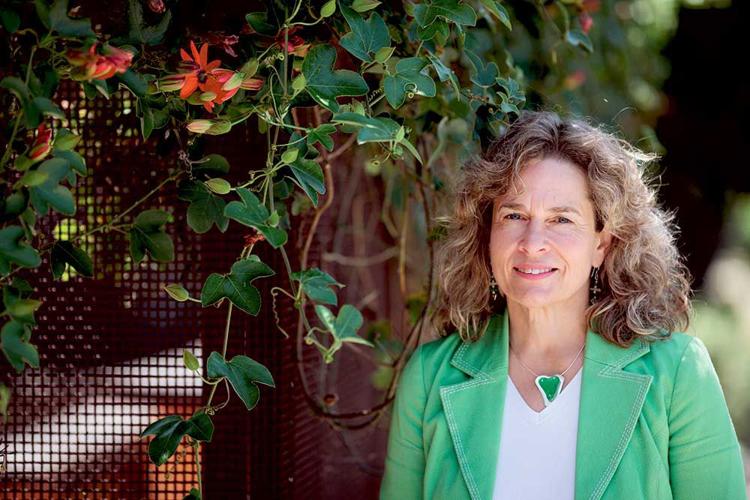
Cindy Klaniecki, a licensed counselor who works with seniors, and two other volunteer senior advocates, launched the group with an extreme sense of urgency.
“I’m amazed that more people aren’t talking about this,” she says. “We are headed into a crisis point, and they’re aren’t enough resources.”
Klaniecki has seen too many seniors who are “one hip fracture away from being homeless,” as the common saying in the senior care business goes. They just don’t have the resources or support to survive a major setback.
These monthly coalition gatherings are one way to figure out how experts can share information and work together. One their goals is to get elected officials to wake up. On this day in the Castroville library, they’re planning a fall summit to bring service providers and policymakers together to create change together and spark a plan of action.
The agencies in the meeting room are all coming at the issue from different directions, but one thing is clear: Keeping seniors in their homes, or helping them transition into senior housing – the earlier the better – is the best way to prevent them from winding up in their cars, on couches or in the streets. Once homeless, the challenges of helping seniors get into housing are even bigger. And the numbers of senior homeless are increasing, and the experts gathered in the Castroville Library say it’s only going to get worse. That trend has advocates racing to make more housing available, or to find other creative solutions to keep seniors housed and off the street.
“I’m amazed that more people aren’t talking about this. We are headed into a crisis point, and they’re aren’t enough resources.”
An exact number of seniors experiencing homelessness in Monterey County is not readily available. A 2016 study was commissioned by the Community Foundation for Monterey County, on behalf of the County Department of Social Services and the Health Department, on homeless women. Of 120 homeless women in Monterey County surveyed, 12 percent in the Salinas Valley were ages 61 and over, as were 14 percent on the Monterey Peninsula.
The 2015 Monterey County Homeless Census counted 2,308 total homeless men and women. (Those are the most recent figures available; the 2017 census data is expected to be released later this month.)Census volunteers surveyed 444 homeless people and reported that 8 percent were age 61 and over.
“And that’s only the people they counted,” says Linda Byrne, development director of the nonprofit Housing Resource Center of Monterey County. The survey is conducted every two years when volunteers fan out throughout the county to count homeless people they encounter in the field. And senior women are less likely to be seen, and therefore less likely to be counted, Byrne says; they’re more likely to be sleeping in cars or couches than in tents, and sometimes even dress as men for security.

Margaret Huffman, director of the Monterey County Area Agency on Aging, says housing costs are going up at the same time as safety net services are decreasing, creating a precarious situation for seniors with limited resources.
Anecdotally, service providers are seeing more seniors needing help, says Margaret Huffman, director of the Area Agency on Aging, responsible for implementing the federal Older Americans Act and the state’s Older Californians Act in Monterey County. Huffman wants to see a community effort to conduct a study focused specifically on seniors, replicating last year’s women’s study.
“We have a growing aging population in our county, state and nation, and we’ve got to start preparing,” Huffman says. “Currently over one in six in Monterey County is age 60 or over, and in 2020 it’ll be one in five. By 2030 it’s estimated to be one in every four.”
One of the crunches: housing. There’s concern that seniors who have homes will become homeless because they can’t afford to stay where they are. But advocates say it’s important to also remember that the chronically homeless – people who have been on the streets for most of their lives – are aging too, just like their housed counterparts.
And for people already living on the margins, aging is a reminder of the kinds of challenges they face when it comes to accessing public resources. There’s no universal definition of what constitutes a “senior.” Some groups include people over age 50. But people under 65 are too young to access Social Security benefits or other benefits specifically for seniors, and can fall through the cracks. And yet many are suffering from ailments of their older counterparts, and are unable to work to make enough money to afford even subsidized housing. The tri-county coalition includes anyone over the age of 55 with an “age-impaired related” illness.
While some of the reasons seniors fall into homelessness are the same as they are for any age – high cost of housing, lack of avilable affordable housing, mental health issues or substance abuse – advocates say seniors may also struggle with additional challenges. Those include health issues, hoarding, financial abuse or being targeted by scammers, little or no family, the loss of a significant other. The biggest issue is usually financial, since many seniors are on fixed incomes.
“There’s no expectation that these senior homeless people are going to go out and get a job,” Byrne says. “We have served women in their mid-70s and mid-80s, and they’re not going to get a job.”
“I’m too old for this. I can’t do this anymore.”
Jill Allen remembers walking down a sidewalk in Salinas’ Chinatown about one year ago, when she noticed a woman inside a tent near the corner of Soledad and Lake streets carefully folding her clothes. Allen stopped and commented to the woman how neat and tidy her tent was.
“I’m too old for this. I can’t do this anymore,” the woman told Allen, executive director of Dorothy’s Place, a nonprofit that serves the homeless. The woman, in her early 60s, was living in the tent with her boyfriend, in his late 50s. She told Allen they had both been on the streets since age 13, both were heroin addicts, had other health issues, and had both been incarcerated. He worked odd jobs, and she worked in the sex trade for most of her life.
Allen invited the couple to Dorothy’s Place. At the time, the organization was trying out a pilot program for the Coordinated Assessment and Referral System (CARS), a now-mandated program by the U.S. Department of Housing and Urban Development. In the past, homeless people seeking emergency shelter and housing were helped on a first-come, first-serve basis at individual agencies. Under CARS, clients are assessed using a vulnerability scale and inputted into a regional database of participating service providers. The most fragile clients move to the top of the list.
For the couple Allen was helping, that meant they were able to get rapid placement in transitional housing and receive support services like drug and medical treatment. There were hurdles and adjustments for the two along the way, but Allen says 10 months later, the couple signed their first lease on an apartment, with the help of a HUD Housing Choice Voucher Subsidy, popularly known as Section 8.
Allen reports that Dorothy’s Place is focused on getting homeless people into transitional housing where clients are closely shepherded by case managers. Case managers spend hours, often daily, with clients, helping them learn or relearn living and cooking inside, how to manage money and other skills. Each manager is allowed up to 15 clients, to avoid burnout. Currently Allen has four case managers for the agency’s walk-in program, and three specifically working with clients in transitional housing, which includes following clients for a full year once they’re in permanent housing.
Like Dorothy’s Place, the Housing Resource Center that Byrne works for also helps all ages, but since last year created a program specific to senior women called Save Our Seniors. It’s funded through a grant from the Fund for Homeless Women through the Community Foundation for Monterey County. The nonprofit received a two-year $140,000 grant to find housing for up to 17 women, plus assistance to 85 additional women in the form of referrals or some case management.
In the first year SOS helped five women find permanent housing, either in subsidized apartments, or in one case, arranging a shared living situation. “Through those innovative ways we were able to house five women for $41,707 for one year,” Byrne says. That’s an average of just $8,341 per person: “That’s a bargain in Monterey County.”
Like Dorothy’s Place, HRC also uses caseworkers to guide clients successfully into permanent housing and to work one on one with landlords who are sometimes skittish about tenants receiving aid.
“We need more landlords that are willing to take a chance on homeless people,” Byrne says, “because at the end of the day, it’s the landlords that are solving homelessness in our county.”
“There’s no expectation that these senior homeless people are going to go out and get a job.”
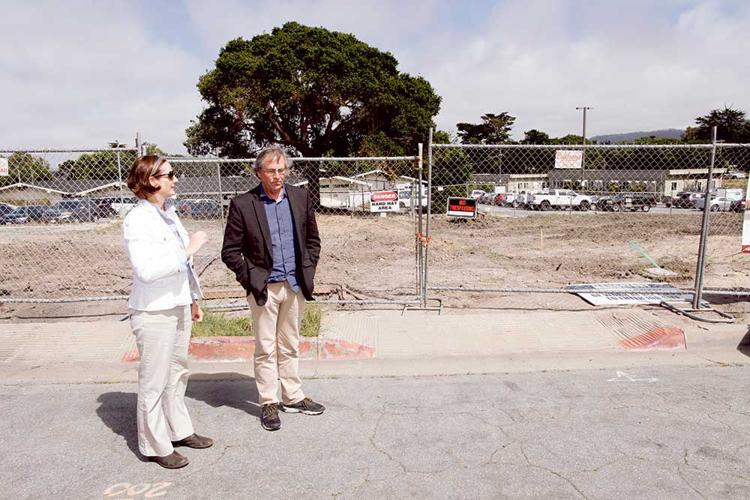
A vacant dirt lot behind the Monterey Police Station is marked by a couple of craters and a lone mature oak tree. Right now it’s hard to see how this is more than an early-stage construction project, but officials are hopeful this is one potential solution: future senior housing.
While agencies like HRC and Dorothy’s Place are working to find housing for the homeless – or in some cases those on the cusp of homelessness – others are working on creating more affordable housing communities for seniors. As Byrne notes, waits can be up to three years for apartments, so there’s a need for more units.

Betsy Nahas Wilson, director of housing development for MidPen Housing, and Rick Marvin, Monterey’s housing programs manager, survey the construction site on Van Buren Avenue for a new 19-unit housing complex for seniors making less than $25,650 a year. It’s expected to open in April 2018.
MidPen Housing, a nonprofit developer and owner of affordable housing projects in the San Francisco and Monterey Bay areas, is currently building 19 units specifically for very-low-income seniors age 62 and above in Monterey on Van Buren Avenue, on the property behind the police station. The project is expected to be completed by April of 2018.
There are two MidPen housing developments in Monterey County already, in Castroville and near East Garrison. They take all ages, not just seniors, and they both have long waiting lists, says, Jan Lindenthal, MidPen’s vice president.
The developer targets locations where municipalities are already looking to build affordable housing. In the case of Monterey, the city was actively looking to provide housing for extremely low-income seniors, defined as those who make less than $26,650 a year, which is 50 percent of the county’s median income. MidPen will own and operate the building on city-owned land.
Rent is determined by the tenant’s income, and each senior resident will pay 30 percent of their monthly income. Housing there also comes with support services, medical checks and activities to keep seniors social. Tenants do have to be able to live independently.
For many seniors, Lindenthal says, “There’s no way they can afford to stay in Monterey.” Very low-income seniors find themselves pushed out of the communities they’ve lived in, some for a lifetime.
This complex is only 19 units, but it’s a start.
“There’s no way they can afford to stay in Monterey.”
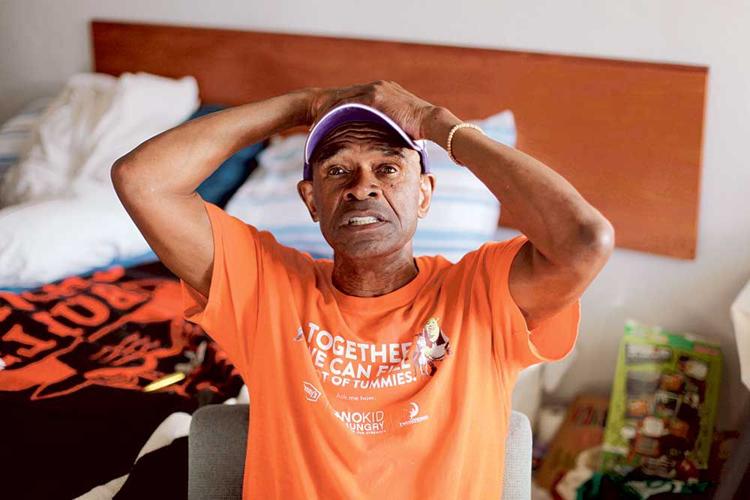
Miguel Chappotti, 66, lives in a Salinas motel. Originally from Mexico, Chappotti has lived in the U.S. for more than 35 years and worked as a court translator, among other professions, over that time. Now he’s legally blind and can’t drive, making work hard to find.
Part of what’s helping him stay in his motel room is Meals on Wheels of the Salinas Valley, which delivers pre-made food, which Chappotti heats in the microwave, on Tuesdays and Thursdays. “I’m happy receiving the meals,” Chappotti says. “It’s pre-cooked already, so it’s very convenient.
“Food is food,” he adds.
With the lack of affordable senior housing as the current reality, advocates say they are doing all they can to prevent homelessness in the first place by helping housed seniors stay where they are. Fawn Mackey, a social worker for Adult Protective Services, says she’s been able to help seniors lower costs by asking for lower cost prescriptions from their doctors, or through drug companies. She’s also been able to guide them toward receiving financial assistance, as well as food from food banks and pantries, and other sources of assistance like Meals on Wheels.
Chappotti’s current motel room is paid for with a rental subsidy that runs out in December: “Then,” he says, “I’ll probably be homeless.”
Back in Castroville, the members of the coalition are aware of seniors like Chappotti who are a breath away from the streets. Their hope is that they can sway enough decision makers to put the planning and money into the issue to create change.
“Seniors are not a major focus of funders,” Byrne says. As a nonprofit development director, she aggressively goes after grant funding, but often that money is restricted to helping other populations, like families or veterans: “The money for seniors is very slim.”
And government efforts are also spread out: “The question I have is, who will lead this effort?” Byrne says. “Where is the political will to lead this effort? Unfortunately, that’s a rhetorical question.”
RESOURCES AND HOW TO GET INVOLVED
Monterey County Homeless Services Resource Guide
mcdss.co.monterey.ca.us/cap/download/CAP_HG_2016.pdf
Aging and Adult Services/Department of Social Services
(800) 510-2020, mcdss.co.monterey.ca.us/aging
Alliance on Aging
(831) 655-1334, allianceonaging.org
Dorothy’s Place
30 Soledad St., Salinas. (831) 757-3838, dorothysplace.org
Housing Resource Center of Monterey County
(831) 424-9186, hrcmontereycounty.org
Legal Services for Seniors
(831) 442-7700 (Salinas), (831) 899-0492 (Seaside), legalservicesforseniors.org
Meals on Wheels of the Monterey Peninsula
(831) 375-4454, mowmp.org
Meals on Wheels of the Salinas Valley
(831) 758-6325, mowsalinas.org
MidPen Housing, Coastal Office
(831) 707-2130, midpen-housing.org
Veterans Transition Center
(831) 883-8387, vtcmonterey.org
Van Buren Senior Housing
Information available starting May 15, property.midpen-housing.org
Join professionals and concerned community members in addressing the prevention of senior homelessness. The soon-to-be named coalition focused on preventing senior homelessness meets the last Thursday of each month, 9-10:30am. The next meeting is May 25 at the Castroville Public Library, 11160 Speegle St. For more information, email Cindy Klaniecki at klanieckilcsw@gmail.com.
(1) comment
Thanks for sharing the great read. Due to the constant increase in the population day by day, there is a possibility that people can face the shortage of their needs in future. It has been found that the number of aging population is on the increase which demands the healthy lifestyle, thereby increasing the pressure on senior housing. At their golden years of time, seniors just want proper care and love and want to live their life in their own term. This can be settled down if all the seniors housing provides the required amenities to the seniors as provided by Kosher assisted living community and fulfill all the desired needs of the seniors.
Welcome to the discussion.
Log In
Keep it Clean. Please avoid obscene, vulgar, lewd, racist or sexually-oriented language.
PLEASE TURN OFF YOUR CAPS LOCK.
Don't Threaten. Threats of harming another person will not be tolerated.
Be Truthful. Don't knowingly lie about anyone or anything.
Be Nice. No racism, sexism or any sort of -ism that is degrading to another person.
Be Proactive. Use the 'Report' link on each comment to let us know of abusive posts.
Share with Us. We'd love to hear eyewitness accounts, the history behind an article.